Tag Archive for: senior skier

This Week In SeniorsSkiing.com (March 12)

End Or Interim, Snow West, Cooler East, Vail Run, Jan’s Saga, Demo Tips, Ski Japan?, NW XC, Happy At Appi, Sharp Porcupine.

Alta closed on March 17, 2020. Abruptly.

We’ve been through quite a year.

Last year at this time, we were hearing about and experiencing the abrupt closures of ski resorts all over the globe. Races, vacations, bookings cancelled. People just arrived to start vacations had to turn around and go home. Super-spreader events were reported at slow-to-shutter Ischgl, in Austria, Sun Valley and in Colorado. The ski industry shut down, in stutters and starts perhaps, but down tight.

Tough to relax at Ishgl after the superspreader.

A year ago, we began as skeptical, then, as the numbers grew, we became apprehensive. We had to “flatten the curve”, “social distance”, refrain from travel, and frequently and thoroughly wash our hands. We stocked up on toilet paper. Some of us knew people who had gotten sick from the virus, others thought of it as a remote and distant “hoax” impinging on their freedom. Wearing a mask became a statement of the extent you trusted in government directives or not.

Regardless, we learned to adapt, change our plans, and our lifestyles, recreational activities, and expectations. So many of our readers stayed local, skied mid-week, brought bag lunches, and made do. Others took up alternative winter sports; we’ve noted the phenomenal increase in cross-country skiing, thanks in part to regular, staying snow in urban/suburban parks and open areas. Others gave this entire season a pass, opting to wait it out. Others took trips to destination resorts, or, if they lived nearby, went on with the season skiing between the scant numbers of tourists.

This week, one year on, we are either at the end of the beginning or the beginning of the end.

On this anniversary week when the closings started in earnest and almost everything in our lives changed, we remember the 500,000-plus citizens who succumbed.

We also celebrate the vaccines now being injected in earnest. The New York Times reports that 40 percent of Americans are, in one way or another, protected from the virus, either through vaccination or by recovering from infection.

As on a ship coming nearer and nearer the coast, we can begin to see details of what will be appearing soon on the horizon. There is pressure to return to normal.  Spring Break may be a festival of youth and sunshine, or it may be yet another super spreader event. Beyond the spring, there are expectations that the summer will begin to look like it always has, and that by the fall, schools will return to classes, restaurants will return to capacity, concerts and theaters will return to performances.

Perhaps. If the virus doesn’t spike again, that is. It’s still out there, looking for people to infect. Variants may play mischief with recovering economics and public health. So, although the trends are in the right direction, this year of virus isn’t over. Far from it.
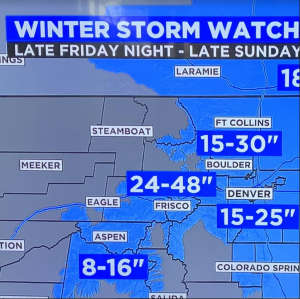
Will snow this weekend impact closing-dates in the Rockies? Credit: Joe Durzo

Which leaves resort owners with an interesting management challenge.  Given the relaxing of CDC guidelines for gatherings of people who have been vaccinated and the potential for yet more snow (Colorado and the Northwest are expecting big dumps this weekend), do resorts extend the season as practicable? Open up capacity to all comers? Try to recoup a small amount of revenue lost this season? Or, because many staff are probably not in priority groups for vaccinations and won’t be for a while, and because it may be expensive to undo the physical changes installed to protect customers and staff, just decide to end the season under COVID rules?

Vail announced this week it is extending its closing date one week to April 11.  With the current snow forecast, who knows if that might be extended? Bretton Woods, NH, is closing April 15, Killington, VT, will go to May 2. Is it worth it to change virus policy for a few weeks? If you were the manager of a ski area or resort, what would you do?

Like it began, the year of COVID continues with uncertainty.

This Week
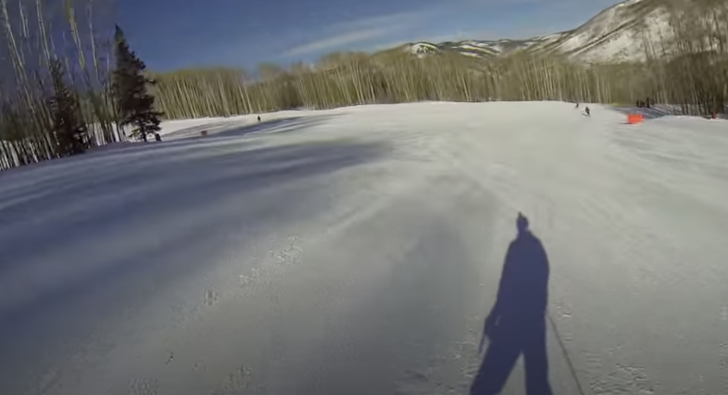
Free run for our readers down the front side of Vail all the way to the bottom. Credit: Glenn Robbins

Herb Stevens, the Skiing Weatherman, sees continuing snow events in the West and a cool down in the East following this unusually warm weekend. There’s potential for more snow out there, check the maps. Click here.

Ever skied Vail? No? Well, take a vicarious run on the front side of Vail on a sunny day. We found the run very different from our mental model of what Vail would be like.  Click here.

Jan Brunvand continues his ski life saga, this time describing his lucky move from the Midwest to Utah. Click here.

Take your pic. The lads at Epic Mountain Sports at Winter Park will help you out. Credit: Epic

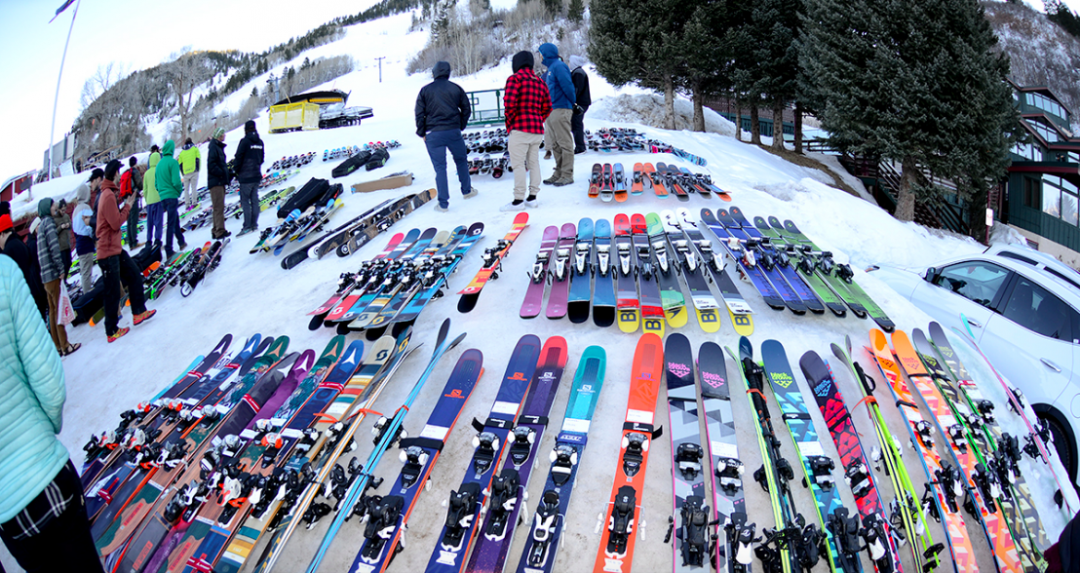
Marc Liebman gives advice on how to get the most from demo skis. His tips make your demo assessment more objective. We also learned Marc always rented skis on trips, leaving his own sticks at home.  That gave him the opportunity to try lots of skis and think about how to evaluate demos. Click here.

Dave Chambers, the Traveling Australian, tells us about his trip to Appi Kogen, a big resort in Northern Honshu, Japan.  He revels in telling us about finding a back side of the resort where he skied for a week in untracked powder. Click here.

Our Question For You this week follows up the Appi Kogen story, asking you if you skied Japan and what your experience was like. Click here.
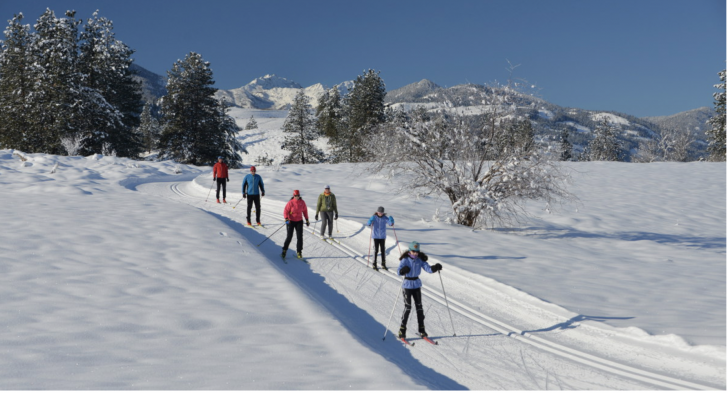
As the next in our Make More Tracks series, Pete Wilson writes in the Nordic Approach about really cool cross-country resorts in Cascadia in the Pacific Northwest. Click here.

Finally, Harriet Wallis tells us a very punny tale of the nameless porcupine who stopped traffic on the trails at Alta.  Clearly, he made a point.  Click here.

Thank you for reading SeniorsSkiing.com. And thank you for supporting us in our recent fundraiser.  We are very grateful. Remember, there are more of us every day, and we aren’t going away.
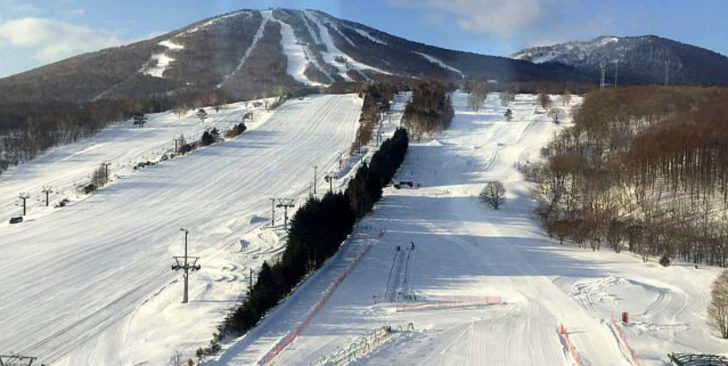
Appi Kogen is one of Japan’s best ski resorts. The resort’s tagline: “Be Happy in Appi”, of course.

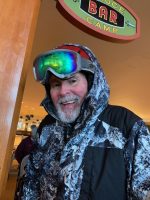
Skiing Weatherman: Action West, Cool Down East

Not Quite Spring Yet. More Snow In The Forecast.

While the resorts in the Midwest and East got a solid taste of spring this week as temperatures soared well above normal for a few days, the winter weather action picked up in the West.  A cold trough spun its way down the coast from B.C. to SoCal, depositing wonderful low density snow along the way.  The highest totals came from the Sierra, thanks to the left hand turn of the trough, which brought the core of the circulation closer to the coast than it was when it passed by further north.  The trough will spin across the southern Rockies this weekend and as it does, moderate snow will fall across the western half of Colorado into Wyoming while a major dump will unfold on the Front Range, including metro Denver, so access to the fresh snow is likely to be disrupted.

Over the Midwest and East, the warmth of this week has taken at least a modest toll on trail counts at most areas, but colder air will return this weekend and potentially set the stage for fresh snow next week.  With the return of the cold air, this weekend you should seek out sunny trails in the Northeast, where the surfaces have a chance of softening up.

Next week, another low will move from the Gulf of Alaska toward Oregon and California, and snows will return to the Cascades (Monday) and Sierra (Tuesday).  That low will track eastward and blanket the Wasatch and central and southern Rockies by midweek, so the prospects for skiing and riding in the West next week are outstanding.

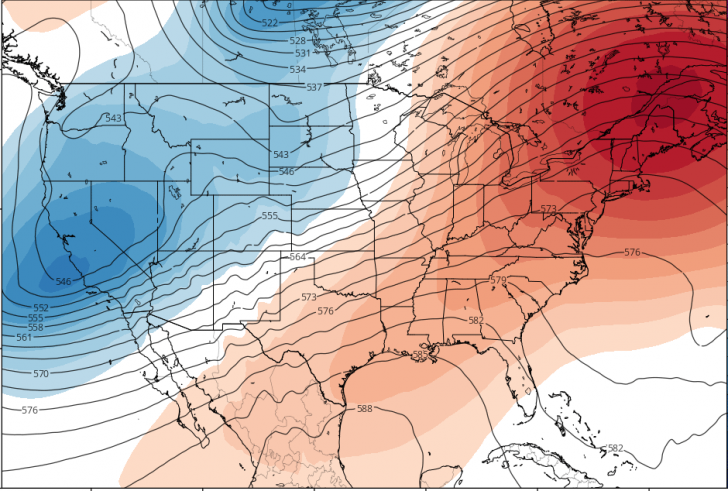
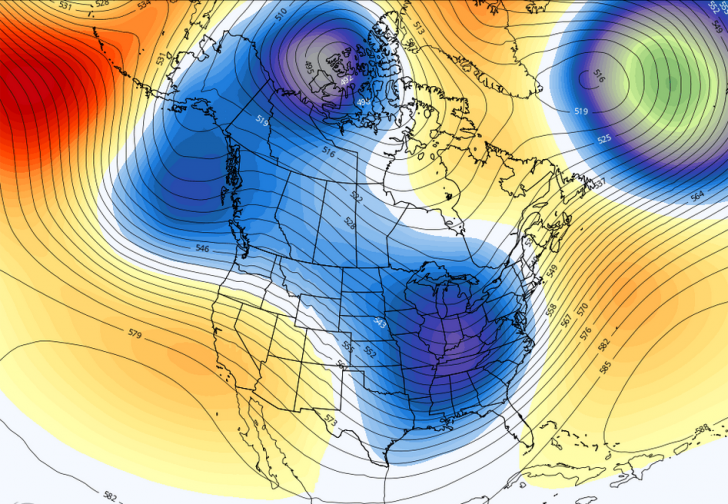
The pattern is going to be very active going forward, as illustrated by this jet stream map for Monday.

The blue areas are upper level storms (cold) and the orange peaks are ridges (milder).  The storm over Kansas is the one that will hit the Front Range this weekend and as it works east, we could see a surface low get pushed through the Mid-Atlantic States with high elevation snow during midweek.  You can see the storm on its heels along the west coast. That system will arrive in the eastern half of the country by Friday morning as you can see on this map.

The surface map at the same time looks like this…

From a position over the central Appalachians, the low center will head northeastward.  With the clockwise flow around the high over Minnesota helping to push cold air into the path of the storm, there is the potential for significant snow, at least at the higher elevations, over the northern Mid-Atlantic and Northeast at the end of the week.  Beyond that opportunity, the pattern will remain favorable for late season snow events right through the end of the month.  This week’s warmup was just a spring mirage.

REGIONAL HIGHLIGHTS:

Pac NW/B.C.:

Coastal ranges in B.C. get moderate snow this weekend.  Oregon snowy early next week.  Larger storm late next week extends further inland in B.C. and throughout the WA and OR Cascades.

Central and southern Sierra:

Great weekend after fresh snow…another moderate to heavy event early next week. Rest of next week looks quiet.

Rockies:

Jackpot is Front Range in Colorado this weekend.  Another moderate to heavy event unfolds central and southern Rockies Tuesday/Wednesday next week.

Midwest:

Northern MN resorts close this week with fresh snow…rain elsewhere.  Colder air arrives this weekend will firm/preserve snow.  Snow threat across this region later next week.

Northeast:

“Spring Break” ends Friday.  Cold weekend firms up the snow.  Pattern looks promising for meaningful snow late next week.  Season far from over.

Mid-Atlantic/Southeast:

Colder air comes back this weekend.  Higher elevation snow potential early next week…again late in the week.

Top To Bottom: Vail

Take A Vicarious Vacation On A Beautiful Blue Run.

A ticket-free run for our readers down the front side of Vail all the way to the bottom. Credit: Glenn Robbins

Here’s a long (15 minute) run down the front side of Vail on a really nice blue. For those who haven’t been there, seeing wide, groomed slopes at Vail may be different from the mental model you’ve had of what it’s like at the fabled resort.  This is not the Back Bowls, but still very nice and, for those of us on the lesser side of the risk scale, most do-able.

Curious, we notice the skier Glenn Robbins, isn’t using his ski straps. (See 1:44 and following.) Is this a thing?

Return To The Rockies

Part Five: Jan and Judy Move To Utah

Our residence in Illinois proved to be similar to grad school in Indiana. I progressed in my academic career, we had another baby, and (sigh) there was no skiing. But a phone call changed everything.

At SIU-Edwardsville, we were renting from a colleague on sabbatical, and we had just started looking for a house to accommodate our growing family. Karen, our last child, was born in February, 1966.  Then a call came from folklorist Barre Toelken in Salt Lake City. He was leaving, and he sought someone to apply for his position at the University of  Utah.

I responded, “Barre, you don’t ski do you?” My interview trip was an eye-opener. I assumed that the season had wound down by late March, but the department chairman assured me. “We’ll have skiing through April.” So it was an easy decision to leave the Midwest again after just one year.

We arrived in Utah at the cusp of the development of major skiing there. Alta and Brighton had been in business since the late 1930’s; Snowbasin opened in 1940, and Timp Haven (later Sundance) started in the mid 1940’s. Park City’s ski resort, then called Treasure Mountains, was in its third season and had its trademark gondola pictured on a patch. You could still buy little houses used by former silver miners for a pittance, and skiers could park within a few yards of the gondola base.
None of the local resorts had much in the way of base facilities or housing at that time. Solitude opened in 1957, then underwent a couple of name changes and at least one closed season before prospering. Park City West opened in 1968, then had several name changes before eventually being acquired by Vail and merging with Park City. Snowbird opened in 1971.

This photo of Judy and me at Alta was taken in 1967. The old Snow Pine Lodge is seen just off Judy’s right shoulder. A luxury hotel replaced it last season.

This was the year we finally got modern skis. I know the exact date (October 31—Halloween—1967). Stein was in the shop representing Head skis, and he signed and dated a poster for us.

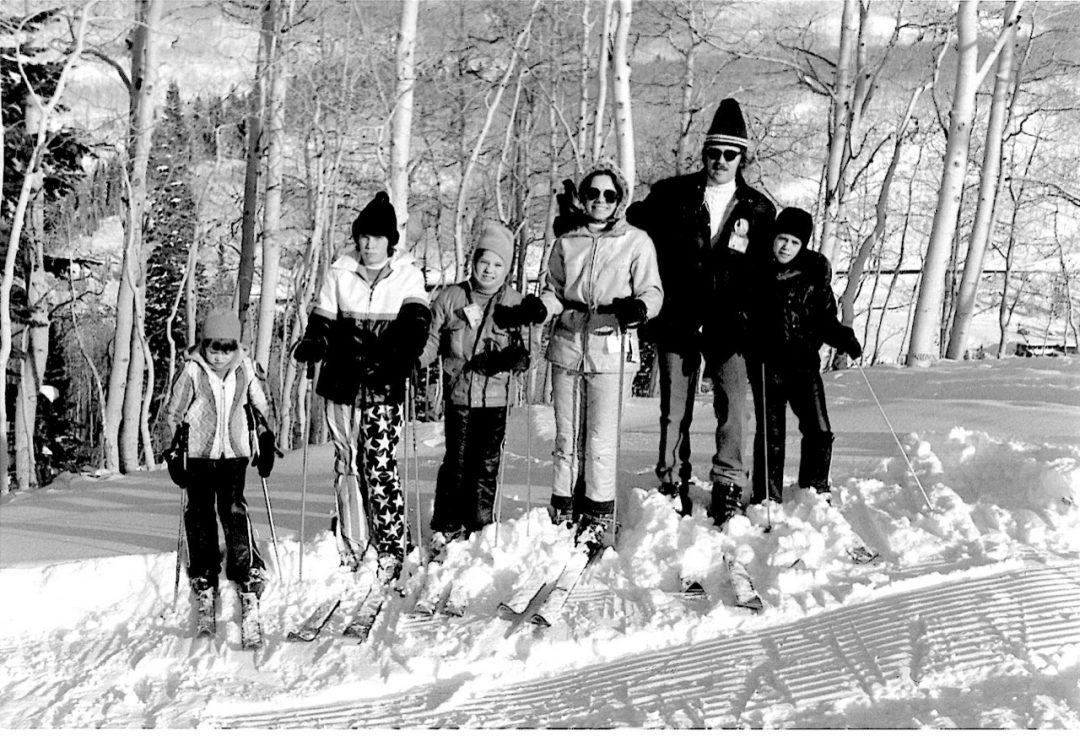
As the kids grew up, we shopped for the best family season pass deals. Here’s a photo of us at Solitude in 1972. Left to right: Karen, Erik, Amy, Judy, Jan, and Dana. After the photo was taken I stepped forward to retrieve my camera, leaving Dana without support. She slipped backwards into the trees and had to be rescued.

In 1981 we skied in Austria with two of our daughters. I had developed an interest in the folklore of Romania, and we had all been there twice in the ‘70s. In 1981 I received a grant to return from January through the summer. We brought Amy and Karen with us.

Erik was in college then and stayed in our house. Dana was on an exchange in New Zealand. Both were able to ski, so why not the rest of us? We each packed one ski outfit and hoped for the best.
As we drove south from Salzburg into the mountains in our Renault Le Car, I parked in front of a sports shop in the town of Wagrain. I asked a clerk in my best college German whether there was any skiing nearby. He grinned and pointed to a map on the wall, explaining that we were right in the middle of  “The Three Valleys,” a major ski center. There were 45 lifts linking Wagrain with the towns of St. Johann and Flachau.

We rented gear, found a B&B, and had a delightful weekend skiing the Alps. Here are Judy and the girls waiting for the ski bus. Wherever you ended up at the end of the day there was a free bus to take you back “home.” I almost gave up on Romania and switched to Austrian folklore.

Although we never managed to ski in Romania, the weekend in Wagrain made up for it. When we returned to Utah in the fall we learned that Deer Valley was opening that season. Modern skiing had arrived in the Beehive State, and we kept on enjoying it through our middle age and into senior status.

To be concluded . . .

Make More Tracks: Favorite Nordic Centers In The Northwest

Cascadia Contains Cross-Country Resorts Close To Metro Areas.

[Editor Note: This article by Pete Wilson first appeared in The Nordic Approach.] 

The Pacific Northwest of the contiguous US is a wonderfully strange bit of geography. The Western edge is home to the fjord-filled Pacific Coast, where long beaches and towering seaside rock formations make for otherworldly getaways. Go the other direction, East and inland, and the mountains await. The Coast, Cascade, Olympic and Columbia mountain ranges boast massive snowcapped peaks and thick, lush temperate rainforests at the lower elevations. All this is to say that the landscapes of Oregon and Washington are utterly unique, with highland regions that turn quite alpine in the winter months. A smattering of excellent Cross Country ski venues dots this snowy swath of Cascadia, which all offer a Nordic experience unlike any others. At these awesome centers, you can cross glaciers, gaze upon craggy horns of ice, bob beneath the snow-laden branches of ancient redwoods—all within driving distance of the bustling metropolises of Portland and Seattle, and the thriving maritime world of the coastline.

Methow Trails
METHOW TRAILS

With a staggering 200km of well-maintained terrain sprawled along the majestic Methow Valley, the Methow Nordic Ski Trail System is at the pinnacle of Pacific Northwest adventure. Not only do the near-endless trails (which are designed for fat biking and snowshoeing as well as skiing) wind their way to some breathtaking vistas and natural features, they incorporate plenty of climbs, drops and flats fit for skiers, bikers and shoers of every stripe and skill level. Bookended by the twin towns of Winthrop and Twisp—and yes, the town of Twisp exists, and is an awesomely artsy destination in its own right—visitors to the Methow valley will find plenty in the way of libations, delicious meals, and warm hospitality.

LEAVENWORTH WINTER SPORTS CLUB

Cradled in the heart of the Cascade mountains, this one-of-a-kind winter sports club offers everything from Nordic skiing, sledding and tubing to alpine skiing and fat biking. This wintery wonderland as all the infrastructure needed for such a slew of activities: two groomed ski hills serviced by rope tows, 26 kilometers of pristinely groomed Nordic terrain, dedicated Nordic trails, and even a 27-meter ski jump are all available to make lasting memories for Leavenworth visitors. With trail passes starting at $14, be sure to check out this Washington gem whenever you’re in the area.

Leavenworth Winter Sports Club
49 DEGREES NORTH NORDIC CENTER

Tucked away in the far Northeastern corner of Washington (as the name suggests), 49 Degrees’ gorgeous Nordic network expands out from the Cross Country Center, a large yurt with a spacious deck that overlooks the trails and ski school area. From there, 25km of wide, well-groomed trails roll along into hundred-year-old forests, crisscrossed by narrow snowshoe paths. A full rental lineup and certified ski instructors stand ready to make ski days special for skiers of every ability.

MT. BACHELOR NORDIC CENTER

Considered one of the premier Nordic centers in Oregon, Mt. Bachelor is a fully decked out Cross Country Ski Shop, with the ski terrain to match. Almost 60 km of widely varied terrain wind around the base of the big peak, offering stunning views of the snowcapped, glacial peaks, leg-burning climbs and heart-pumping drops. For those looking to get some off-season training or free skiing in, it is worth noting that Mt. Bachelor has the longest groomed Nordic season in North America.

Tea Cup Nordic
MT. HOOD MEADOWS NORDIC CENTER

Perched at the base of Mt. Hood, the Meadows Nordic Center takes full advantage of the excellent snow conditions it inherits from the glacier looming above it. 15 km of groomed and set track wind through woods and across meadows with Hood poised as a picturesque backdrop behind it. For a perfect blend of big mountain views with small ski center accommodations and attention to detail, be sure to swing by Meadows if you are in the Bend, OR area.


Trailside Porcupine Becomes A Celebrity


That’s one sharp porcupine. Credit: Laurie O’Connor

Skiers nimbly dodged a porcupine as he wallowed through deep snow to cross Alta’s ski slope. Some stopped to watch the prickly fellow tumble into a tree well and then start to climb. That’s all there was to see. The show was over. He was as prickly as the evergreen so his camouflage was perfect. He virtually disappeared.

But porcupine puns spiked when someone asked: “Why did the porcupine cross the trail?”

“He was looking for love,” said one.

“There was no point to staying where he was,” said another.

And the jokes continued …

“Something was needling him.”

“Because he didn’t want anybody to get stuck waiting for him.”

“He pined for a different tree.”

Needle-less to say, to get to the other side.”

“His friends kept calling him slow-poke.”

“Where there’s a quill there’s a way.”

Most rodents don’t get such laughable attention. Do you have a porcupine pun to add?

Looking down from a chairlift, porcupine tracks are easy to identify. Tracks look like they were made by a tiny snowboard. Porcupines can weigh 12–35 pounds, and their quills detach easily if touched. They’re the third largest rodent in the world after the beaver and South America’s capybara. Porcupines crave salt, and when we lived in New England they were known to eat outhouse toilet seats for traces of salt left by human bottoms. And to get road salt they’d chew the tires off hikers’ cars parked overnight at remote trailheads.


This Week In SeniorsSkiing.com (March 5)

Looking Ahead, First Timers Tips For Europe, Personal Risk Test, Midwest Nordic Centers, DV/PCR Visits, Brunvand’s Journey, L2A Top-Bottom, Tune Up Kit, Okemo Founders, Harriet’s First Time, Emily And March.

Outdoor author Patrick McManus said: “God invented March in case eternity proved to be too brief.”

March, the elongated month, stretching from the cold of February to the sunshine of April.  March, do you know what you are doing to us?  You are driving us crazy. First, snow, then, nothing, then warm rain, then snow. March is the transition month, the signal that the year is changing, moving from one state of being to the next.

Behind is the COVID year with all its unusualness.  Ahead is the change. It appears the virus and all the aberrations it brings MAY be receding, and, like the month of March, may be transitioning, too. One can certainly hope.

And if the virus morphs to a more benign level of threat, be prepared for a really big change, an explosion of demand for all things forbidden in the last year. People are rabid to get back to whatever degree of normalcy makes sense.

Example: In Ipswich, the picturesque little town down the road, a new bakery shop announced it would be opening in an historic building near the town green. The “soft opening” would be on Friday last week, testing their equipment, procedures, recipes, etc.  The local news carried the announcement. People were lined up for coffee, bread, pastries well before the doors would open for the first time, standing out in the chilly morning, lined up way up the hill for something different. Lots and lots of people who wanted a taste not only of pain au chocolat, but “normalcy”. Call it by the familiar cliche: Pent Up Demand.

We believe that if normalcy or a facsimile comes in the fall, then now is the time to think about your plans for next season. What have you always wanted to do that you feel you must do in the upcoming year? Time is marching on, dear readers. Think big and broadly about next season’s adventures.

Season pass, sure, but no big deal.  Trip out West, yes, definitely. But, if you want to put a real exclamation point on your COVID year, consider a ski trip to Europe.

Kirchburg: €€ and just down the road from Kitzbuehel

If you’ve always wanted to ski in Europe, now is the time to think about where and how. You can go on a group trip with our advertisers—the 70+ Ski Club, AlpSkiTour, or Inspired Italy—or  or you can venture forth yourself. If you’ve never been, you are presented with a dizzying array of questions: How do all those interconnected areas work? Will I need a guide? What’s crowded and when? What resorts are expensive? Touristy? Weather?

You can start your research with Bob Trueman’s article this week.  A long time ski coach, Bob is UK-based and knows the resorts in Continental Europe quite well. He offers some tips for first timers as well as sharing some of his favorite spots.

Time to spin some plans.  Or fantasies. Regardless, March is the time to shift out of our status quo.  Let’s hope.

________________________________________

Thank you, dear readers, for your generous support of SeniorsSkiing.com.  We are humbled and gratified by your response. We plan to start mailing out premiums at the end of March or beginning of April. Please be patient.

________________________________________

This Week

Jan, Judy, Erk, 1962.

Our Question For You asks what side of the risk spectrum you would place yourself? Are you a fast-and-furious hucker? A sedate blue carver? It will be interesting to see where are readers are along the continuum between those poles. Click here.

Finally, we focus on the Midwest.  Reader have rightly criticized us for not promoting Midwestern skiing.  Here’s an attempt to correct that: a compilation of the top Nordic resorts in the Midwest, part of our ongoing Make More Tracks series. Click here.

Contributor Pat McCloskey reports on a recent trip to Deer Valley and Park City. He tells us the true skinny of what it’s like to ski at big destination resorts this crazy winter. Click here.

Jan Brunvand continues his narrative of his ski life, this time, describing what happened when he returned from his Fulbright in Norway in the mid-50s. Click here.

How are your quads? Do you think you can make a non-stop run from the top of Les Deux Alpes down to the village (about one mile vertical)? Here is a video of someone who did.  Click here.

Or is this you?

Correspondent Karen Lorentz offers another profile of entrepreneurial ski resort founders, this time, the Mueller family, who bought Okemo in the early 80s and built it up, expanded, and attracted many new visitors. Click here.

The ever practical Marc Liebman shows us what is in his ski tune up kit.  He takes ski tuning very seriously. Do you? Should you? Click here.

Long time correspondent Harriet Wallis offers a memory of how she learned skiing.  Trust us, she’s just as fiesty now. Click here.

Skiing Weatherman Herb Stevens sees a storm coming to the Northeast soon. March madness, indeed.  Find out when. Click here.

Finally, our Snow In Literature series brings you a poem from Emily Dickinson about her visiting friend, you guessed it, the month of March.  Click here.

Tell your friends about SeniorsSkiing.com. Remember, there are more of us every day, and we aren’t going away.

Sunburst Six as it approaches the summit. Credit: Okemo Resort


First Timers Tips For Skiing Europe

The Straight Story On The Continental Skiing Scene For Seniors.

I have coached in pretty well all of the European skiing countries. SeniorsSkiing asked me could I recommend resorts to suit mature American skiers, especially first time visitors to the Continent. Here goes.

The range of possibilities is vast. France plasters its slopes with lifts, Italy takes a more environmental view and installs fewer but longer lifts up valleys, offering equally long descents. Gressoney St Jean in the Aosta region (about an hour from Turin) is a classic example, it also links to Champoluc and Alagna.

Other Examples

Waidring: 10 lifts, 16 trails, intermediate-beginner, gemutlichkeit.

A friend went to Waidring in Austria every year for ten years. Great people, great snow, warm welcomes. They have a tradition called gemutlichkeit – geniality or friendliness. It is tiny – 10 lifts,16 trails all told, half of them intermediate, half of them beginner.
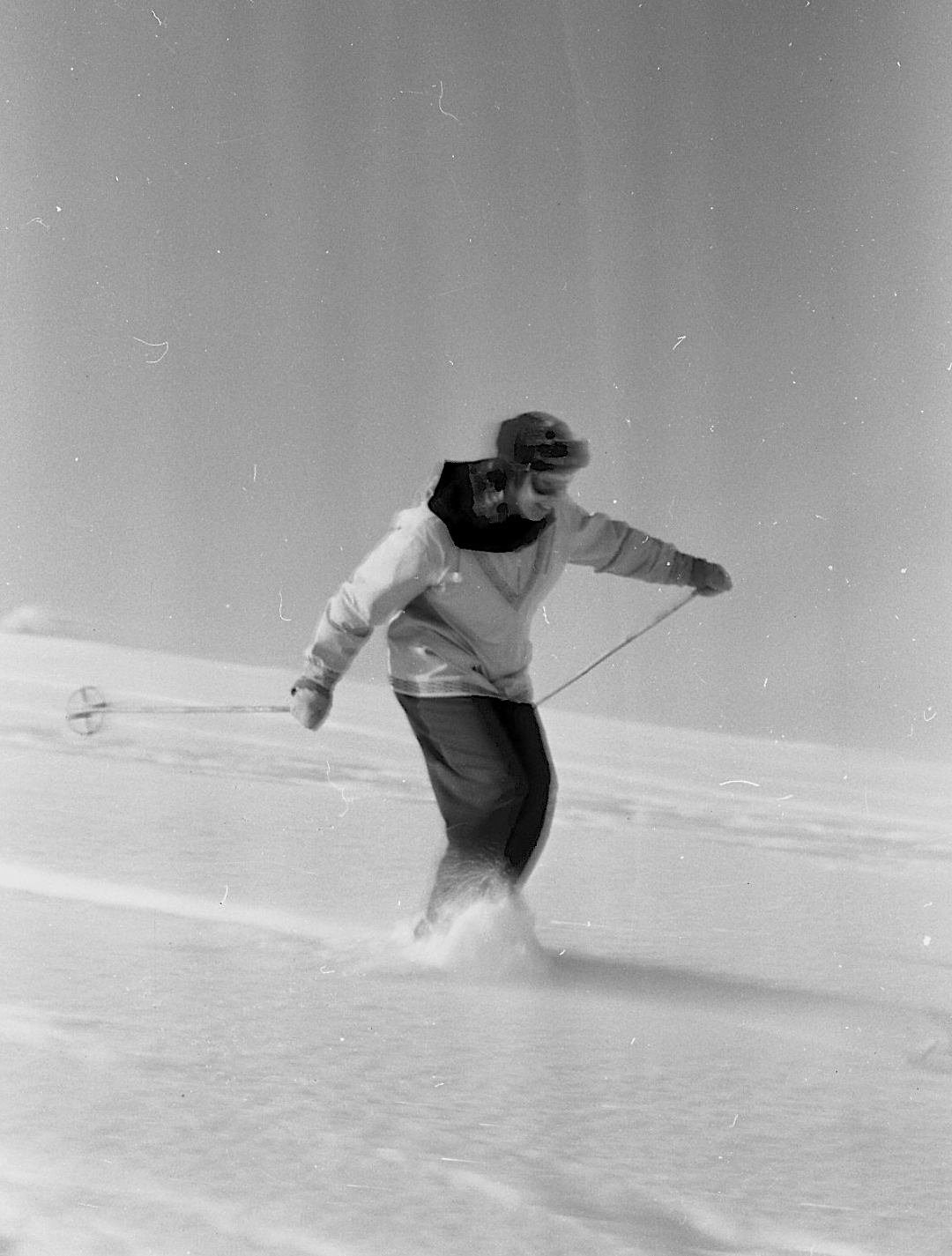
Val Thorens: 163 lifts, 373 miles of trails, ski to Courchevel

Compare that to Val Thorens-Meribel-Courchevel – 163 lifts, 373 miles of trails, 192,000 feet of vertical descent. Start in Val Thorens, ski to Courchevel, and you may not have time to get back. Hugely popular with Brits (far too popular for me, I hate lift queues)

What’s On Offer?

Different resorts in every country target different types of skiers – though they hope to get everybody.

Take the Chamonix Valley for instance, steeped in mountaineering history. Each of its resorts offers a spread of challenge but with a bias.

The lowest resort, Les Houches: charming, easier, all trails are in wooded areas, amply supplied with atmospheric mountain restaurants.

Almost an hour’s ski bus ride from Les Houches – is Le Tour. Almost treeless, big sweeping terrain, as well as plenty of intermediate trails it offers some easily accessible off-piste.

In between you have Le Brevent – high, steep, not easy; or Argentiere, home of the “hard men”, some of the blues would classify red (black) in other places.

When conditions permit, from Chamonix centre a telecabine takes you to the 22 km Vallee Blanche in the high mountains, and you only need to be intermediate, but you’ll need a professional guide: don’t try it on your own.

So How To Choose?

The internet is full of “the three best French ski resorts”; or “the ten best Austrian ones”; it’s endless.

What we need is a selection process. How does this seem:

Kitzbuehel: €€€€€

  • How pricey is it? There are big differences. If you select Kitzbuhel (fashionable) everything is more expensive than Kirchberg which is just a few miles up the road and accesses the same trails. Some resorts are designed around high net worth folk seeking luxury.
  • What duration is the connection time between your airport and the resort. It can be up to four hours or as little as only one. Does it matter to you?
  • Many European resorts are inter-connected, ask them what standard of skiing do they mostly offer. They’ll tell you they have everything, but insist on knowing what they mostly offer.
  • Within the connected areas ask them the approximate skiing times to get from one resort to another, and back: it can seriously affect your day – and how tiring it might be.
  • Ask them if skiing guides available who can show you early in your visit the general shape of the place. Many of the chalet owners and hotels offer this service – not teaching, just showing you around.
  • When are the school holidays? In France they go on for weeks. Lift queues can be horrendous. Outside of them, you can often just walk on. And remember, in some European countries lift queue etiquette and politeness is conspicuous by its absence; France is one of them.
  • Consider less popular countries that don’t have inter-connected valleys – Slovenia (home of Elan skis) has some nice small resorts; Bulgaria has more than you might think and inexpensive.

Kirchburg: €€ and just down the road from Kitzbuehel

My personal favorite? Baqueira in the Spanish Pyrenees. Two hour connection from Toulouse airport. Nicest folk you’ll ever meet (I go to the Hotel Tuc Blanc, and I’m not paid to say so). Watch out for school holidays though, it’s just across the border from France, but the Catalans queue politely.

Baqueira, the author’s favorite.

One Last Tip.

Never do “the last run down”! Everyone wants to get one more “last run” in. They do it on the return to the valley.

Don’t. They’re all tired; they’re skiing at their worst; there are crowds of them; the trails down lower are worn out or slushy. If you want “one last run” stay higher (the areas they’ve just left!) have better snow, fewer people, quieter mountains, and go down to the valley on the lift.

Hotel Tuc Blanc, author’s fav hotel in Baqueria.


seniorski5

Skiing Weatherman: Pattern Is Relatively Quiet

Fresh Snow in Cali. Mild Temps Next Week.

Last week’s installment touched upon the fight we usually see in March between lingering cold to the north and advancing spring warmth from the south.  The fight usually takes the form of storminess, where it only a matter of whether there is enough cold air in the mix to produce snow instead of that other stuff.  And yet here we are in the first week of March with something resembling a mini snow drought over the eastern half of the country.  There hasn’t been a significant widespread snowfall in a couple of weeks and aside from northern New York and northern New England, where there have been one or two light snowfalls across in recent days, surfaces have morphed into “machine groomed” or, when temps rise above freezing, “loose granular.”  Fear not, though.  I hoped that a storm late this week would turn the corner and hit the Northeast, but a cold northwesterly flow has suppressed that idea well to the south.  By no means has the East seen its last snowfall, but the next sizable one will come after a turn to milder weather during the week of the 8th.  Here is a forecast for the jet stream level on the 11th that illustrates the cause of the warm-up.

If you follow the lines around the burnt orange center in a clockwise fashion, you can see that the air mass that flows into locations east of the Mississippi originates over the Southwest, where temperatures are running above normal.  At the same time stamp, the following surface map shows a high pressure center off the coast of New England.

Following the lines clockwise around the blue “H” indicates a broad, low level mild southwesterly flow reaching the Great Lakes to New England.  So, look for a shift to softer, spring-like surfaces in these areas next week.

The flip side of these ridges at the surface and aloft are the upper troughs and surface low centers that will be moving through the West next week.  The air flow is around troughs is counter clockwise, and if you look at the first map and picture the western trough sliding down the coast from Washington to southern California, you can see that a broad onshore flow of moisture will immediately precede the arrival of the center of circulation, which is a great recipe for fresh snow in the Cascades and Sierra ranges.  The highest totals will come from central and southern Sierra resorts, where the core of the trough will pass overhead midweek. Farther north it will be offshore.  Later next week, the weakening trough will swing through the southern Rockies, where lighter snow will fall but refresh surfaces.

Back to the East.  The pattern is progressive, so the warming will be transient.  Here is a jet stream forecast for the 15th that shows a cold trough returning to the Midwest and East.

That setup will help preserve snow and produce fresh snow at times and there are signs that the colder pattern will dominate the second half of the month.  More on that next week.

REGIONAL HIGHLIGHTS:

Pac NW/B.C.:

After a heavy late week dump in B.C., lighter snows fall this weekend in the Cascades.  Periodic light snows during the week of the 8th.

Central and southern Sierra:

Fresh snow as well as wind this weekend for Tahoe.  Snowy much of the week of the 8th for all Cali resorts.

Rockies:

Turning colder next week with light to moderate snows across the north.  Weakening upper trough brings light midweek snows in southern Rockies.

Midwest:

Seasonably cold weekend and milder next week.  Best shot at snow later next week across far northern Minnesota and Michigan.

Northeast:

Cold weekend with temps moderating by midweek.  Transition back to colder pattern gets underway next weekend with potential messy storm.

Mid-Atlantic/Southeast:

Midwinter temps this weekend; spring skiing develops next week.  Colder air returns week of the 15th.


Question For You: Risk Rating

Are You A Hucker, Ripper, Park Rat, Or Just A “Sick” Planker?

This you?

Sorry for the jargon.  This week, we’d like to explore on which end of the risk spectrum our readers reside. We have a sense that some readers have slowed down, taken down the speed a notch or two, search for corduroy on on sunny days, and switched to Blues and Greens. On the other hand, we know for a fact that some readers regularly race, seek double Blacks, huck off jumps, go outside the ropes, and generally find fire in their skis.

Question For You: So which are you?  Use this scale to rate yourself:

       1 is risk lover, jumper, fast, ski whatever, go-go-go, chute flyer.

       5 is graceful carver of the wide, groomed Blues and Greens, nice, rhythmical arcs, slow-ish, and in control.

Since this is an unscientific and statistically insignificant survey, make up your own criteria for 2-3-4 on the rating scale.

It will be interesting to see how our readership sees itself.

Or is this you?


GiantsRidge_OldSawMedia-9369

Make More Tracks: Top Nordic Centers In The Midwest

Here Are Five At The Top Of The List.

[Editor Note: This article by Pete Wilson first appeared in The Nordic Approach, the site of the Cross Country Ski Area Association.]

Midwest terrain is ideal for cross-country skiing.

Generally speaking, the midwestern states make up an overlooked bit of the country—literally, the fly-over states. And sadly, this wild misjudgment often extends to the world of outdoor activities. It’s easy to think of the old woods of the East and the vast mountains of the West as focal points for things like Nordic skiing; in truth, the Midwest is chock full of world-class country ski terrain and culture. Between the region’s breathtaking plains and dense rolling woods, working fields and forgotten valleys, it offers ample opportunity for amazing winter exploration. Below are some of our favorite Nordic centers in the Midwest, all of which combine a warm plains-state hospitality with unique and visit-worthy trails into your next ski destination.

ABR TRAILS

Tucked on the Western edge of Michigan’s Upper peninsula, almost in Wisconsin, the family owned and operated ABR Trails (Active Backwoods Retreat) takes full advantage of the Lake Superior Snowbelt in which it sits. Over 60 km of expertly groomed trails climb, drop and meander along the nearby Montreal river, reaching the heights of Blueberry Bluffs and the Hautanen Highlands and the lows of Coyote Canyon. In order for every skier to easily find the perfect route, trails are divided into loops that each offer a different level of difficulty. ABR’s professional staff (whose grooming skills are so honed they host clinics on Nordic trail building and grooming) stand ready to set you up with gear, advice, warm beverages, and whatever else you may need to keep exploring their nearly endless terrain.

ABR
GIANTS RIDGE

Originally designed as a training facility for Olympic skiers, it is no surprise that Giants Ridge towers today as a pillar of world class skiing. With over sixty kilometers of meticulously maintained trails expanding in broad loops over the hills that stretch out westward from Lakes Wynne and Sabin, memorable skis are guaranteed. Combine their epic terrain with the reliably snowy Northwoods winters, and it is quickly clear why Giant’s Ridge remains such a prized destination. Backed by the indulgent amenities of a large resort, Giant’s has a near endless array of activities, lodgings, and meal options ready to make create a unique ski getaway for every guest.

MAPLELAG RESORT

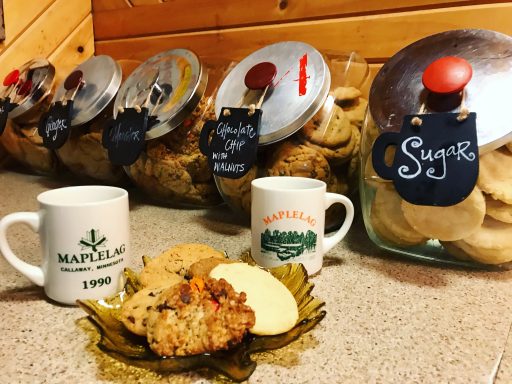
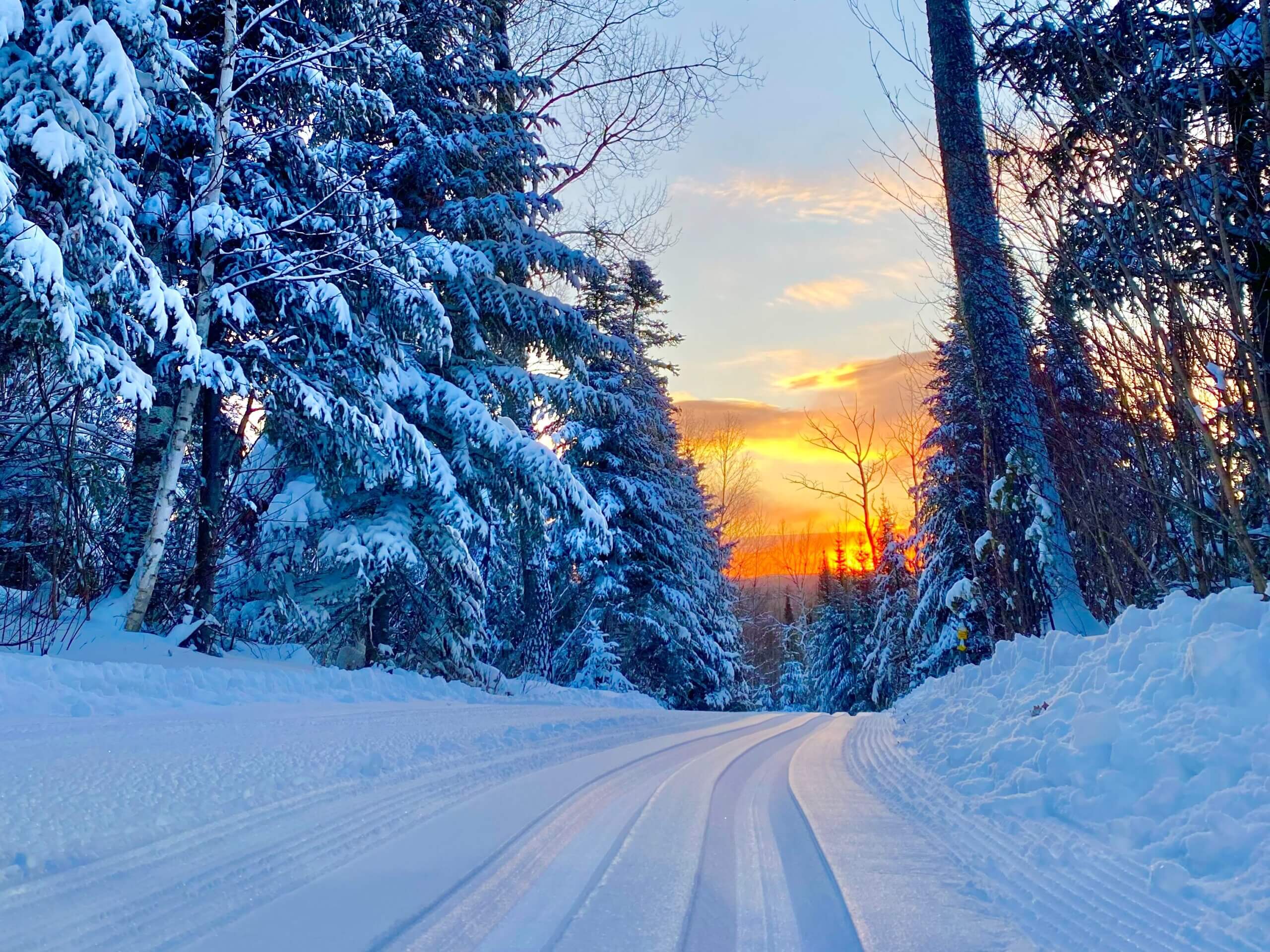
It is not often you strike upon a resort that places cross country skiing at the heart of its guest experience. Originally a maple sugaring operation, Maplelag has converted their 600 acres to pristine ski terrain, while the various buildings on the property now accommodate upwards of 200 guests. Boasting 64 km of trails flanking the frostily picturesque Little Sugarbush Lake, two onsite saunas, and a half a dozen uniquely comfortable lodging options, this erstwhile outpost updates the best Nordic traditions with Minnesotan hospitality and North American grandeur. The last chunk of forest before the Rockies, Maplelag is well worth a stop on your next trip to the Northern Midwest.

 
SOLBAKKEN RESORT

Nestled along the north shore of Lake Superior, midway between the winter sport hot spots of Lutsen and Grand Marais, Solbakken Resort’s sprawling, snowy playground awaits skiers, snowmobilers, and fat bikers alike. Consisting of 58 km of their own excellent trails, plus several hundred miles of connected trails this northerly play area promises endless adventure and a bottomless supply of what the Norwegians call Hygge—“well being.” With lodgings that run the gamut from motels to luxurious lakeside cabins, there are comfortable accommodations fit for individual skiers, fun-loving families, and couples looking for a romantic retreat alike.

GOLDEN EAGLE RESORT

Sitting both smack dab on the stunning Flour Lake and alongside the famous Gunflint Trail, Golden Eagle Resort is a well-situated gem buried deep in the wilds of Superior National Forest. The Resort’s real claim to fame, though,is its part ownership of the Central Gunflint Ski Trail System. This behemoth network of over 70 km of excellently groomed trails offers climbs to some of Minnesota’s loftiest peaks, and the spectacular views to match. Golden Eagle also maintains a small lighted loop for skiing after dark—on which, if you’re lucky, you might see the northern lights dancing in the night sky.

Moving To Indiana Then Idaho

Part Four: Jan and Judy Find Lots Of Places To Ski.

We returned from Norway in 1957 and headed to Indiana University. We skied Caberfae near Cadillac, MI, a couple of times, but otherwise, our four years at IU were devoted to my studies and having Bloomington’s New Year’s Baby in January 1960. Where and when would we ever start little Erik on skis?

When I graduated in June 1961 we had a second child on the way, and I had a job offer from the University of Florida. Then came a call from Moscow, Idaho. The chair of the Humanities Department wanted to expand offerings in American Studies, and he had contacted the well-known IU program to see whether any newly-minted folklorist was interested.

This was the only job I ever took without a site visit and a personal interview. Everything was done by telephone and letters. The offer came as a telegram. It worked out perfectly: Moscow was a pleasant small town, the university was solid, my colleagues were smart and friendly, and—best of all—there was a nice little ski area just north of town.

The North-South Ski Bowl had a couple of rope tows and a log warming house. Here is a photo of Judy and me with toddler Erik ready to ski. His baby sister Amy, was with a sitter. Yes, I’m still wearing that old Norwegian sweater.

Jan, Judy, Erk, 1962.

Besides our local area, we visited other ski resorts in our region. We skied Mt. Spokane a couple of times, and returning from a meeting in Seattle I skied Snoqualmie Pass. When I gave a lecture for an extension course in Boise I brought my skis and had a day at Brundage Mountain near McCall, a place Judy and I also skied together. By then we had replaced the front clip on our Norwegian skis with first-generation “safety bindings.”

In early 1962 I was surprised by orders to join the US Army and fulfill my ROTC obligation. Even this led to some  skiing.

On my way to join my class at Ft. Gordon, Georgia, I visited my parents in Lansing. My dad suggested that we go skiing. But was there time to drive up north? Not a problem. A new little area called Mt. Brighton was on I-96 down towards Detroit. In my dad’s garage I found some gear that fit, and thus I had what turned out to be my last ski day in my home state. Hard to believe that little old Mt. Brighton is now part of the Vail empire.

I was assigned to Fort Monmouth, New Jersey, for a year. Judy and the two kids joined me, and we found a local ski club that met in a neighborhood bar. Their meetings were the last time either of us were carded to buy drinks. We never took a ski trip with the club, but we did get to some eastern ski areas on our own.

Judy’s aunt lived in upstate New York, so we could leave the kids with her and go skiing. Here’s Judy in 1963 at the now-defunct Petersburg Pass. It’s not clear whether she was planning to ski an expert or a novice trail.

Judy checks trail map at Petersburg Pass, 1963

Back in Idaho a major new area opened in the mountains above Sandpoint: Schweitzer Basin, now Schweitzer Mountain. We skied it in January 1964 when Judy was pregnant with our second daughter, Dana, born in Moscow in June. The views from the mountain looking past the frosted trees to Lake Pend Oreille were stunning.

Lake Pend Oreille from Schweitzer.

In spring 1965 opportunity knocked in the form of an offer from the Edwardsville campus of  Southern Illinois University. I felt I should not pass up a chance for a promotion to Associate Professor and time off for folklore fieldwork. So back we went to the Midwest with our three little kids, hoping that eventually we would be able to teach them skiing.

To be continued . . .

The Skiing Tune Up Pack

DIY: Prepare And Repair  Ski Bottoms. Here’s What It Takes.

Crowded ski tool box: There must be a pony in there somewhere. Credit: Marc Liebman

Way back when I used to drive to ski resorts, I used to slide a toolbox into the back of the car with everything needed to tune a pair of skis, fix a gouge in the P-Tex and wax the bottoms. The biggest and most important item was my Toko hot waxer.

Between ski trips, each pair of skis received a coat of paraffin dripped onto the bottom, spread, scraped off and buffed. This was done three times and made the P-Tex rock hard as well as providing a base for any additional wax for the conditions or none at all. The treatment also made the bottoms much more scratch resistant.

As a back-up, or to allow someone called children to do their own skis, I had a simple travel iron. Another vital item was a 12-foot extension cord.

Also in the box was a brick of paraffin used in canning. Back before the turn of the century, each box had four, ¼ pound slabs.

In the box there were a collection of P-Tex “sticks” of varying colors to drip them into gouges. They sat in the same tray in the toolbox with a scraper and butane cigarette lighters I’d use to melt the P-Tex sticks and a soldering iron used to help clean out some of the gouges.

Several flat files were in the bottom for sharpening the bottom part of the ski’s edges. To take burrs off and to sharpen the edges to a perfect right angle, over the years, I’d acquired several different “planes” or edge sharping tools. Then once I was finished with the filing I had small whetstones to take off any microscopic burrs.

Most shops have belt sanders to grind off the bottoms and that just grates on my nerves. For one thing, the sander takes way too much bottom off. And two, the sander leaves burrs that need to be carefully filed off. Too much pressure during a careless pass down the belt sander could ruin a ski.

When finished, the edges could slice paper, which if you ski or race in New England a lot, is very helpful.

Every night after dinner, the family’s skis were waxed. My kids started helping around age eight and by the time they were teenagers, they could wax their own skis (!) And, yes, they could feel the difference between a tuned ski and one that wasn’t. The ritual also gave me a chance to check my family’s skis and bindings.

Also in the box was a box of helicoils which can be inserted in holes to enable a screw to be tightened. Having started skiing way back when metal plates were not built into the ski, they were handy to have around.

Ski tuning, or even de-tuning is an art as well as a science. Today, I can’t tell you how often a shop has given me a pair of high-performance rental skis that was desperately in need of a tune-up.

Don’t Tell Me To Stay Home

How I Was Reinvented As An Athlete.

Riding the rope. Harriet’s daughter Alison, 5, in leather boots and wooden skis on Jiminy Peak’s rope tow. Credit: Harriet Wallis

I learned to ski on a dare. Actually, it was a threat.

When my husband announced he was going to learn to ski, I gulped. I thought skiing was something crazy people in the other side of the world did, but not here in Connecticut.

“You’re going to do what?” I asked. “How are you going to learn to ski?”

“I read a learn-to-ski book, and I’m going to do it,” he said.

I was still processing that concept when he added, “And you can babysit the kids.”

I was being told to stay home and take care of the kids while he was going off to learn some stupid sport. That was the last straw.

“Whatever this ski-thing is, we’re all going to learn to ski,” I insisted. “You, me, and the kids.”

It was the early 70s and equipment was changing rapidly. Plastic boots were making a hit, and leather boots were cheap at ski swaps. We outfitted all four of us – boots, boot carriers, wooden skis, poles, and a few jackets – for under $100. Lessons got us started, and we spent many Saturdays practicing wedge turns from Jiminy Peak’s free rope tow. The sport was beginning to stick.

As for me, I didn’t know I was athletic until I learned to ski. I was in my 30s with two children. Back in high school gym class, I was always the last one picked when they chose teams. I wasn’t even chosen. I was the last one standing there and the gym teacher would say: “Harriet, go over to that team.”  I just wasn’t very good at team sports: volleyball, basketball, or softball. But when I learned to ski, I was reinvented as an athlete.

And that has stuck too.

This Week In SeniorsSkiing.com (Feb. 26)

Cross Country Bubble, Skiing Styles History, Aspen Top-Bottom Run, Gelati Apres-Ski, Norway Skiing, Yellowstone Yurt Resort, Goggle Fog, Weather Ahead.

Dawn, Appleton Farms, Ipswich, MA. Credit: NSNA

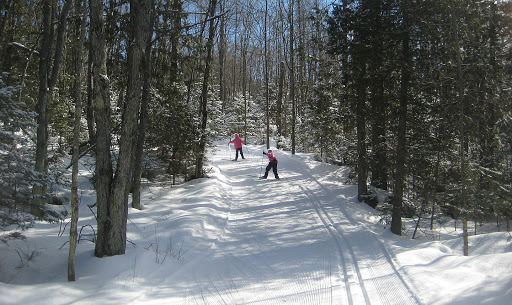
Across the street in Appleton Farms, we notice many disparate groups of xc skiers, snowshoers, dog walkers, and hikers have been descending in growing numbers whenever there is a decent covering of snow, a frequent occurrence this February.  The stalwart North Shore Nordic Association, a non-profit group of volunteers, grooms miles of trails at night and reports snow conditions in their daily online update.  Cars overflow the parking lots provided by the Trustees of Reservations, spilling over to the tiny country roads around the farm. When the snow falls, snow lovers come out to the country.

The numbers are many, many more than we’ve ever seen at Appleton’s, a sprawling 900-acre tract of conservation land on Boston’s North Shore. The good news is that cross-country skiing and snowshoeing have arrived. You can tell from the technique of many of the skiers, the heavyweight parkas and snow pants, and the way they hold their poles that some of the many are truly neophytes. A good thing! New people into the sport!

It took a pandemic, months of being shut-in with limited activity, Alpine ski resort restrictions, and some decent snowfall all over the country to bring cross-country and snowshoeing into the spotlight.

According to the Cross Country Ski Areas Association, sales of cross country skis, boots, and bindings are up more than 30 percent compared to sales through mid-February last season. Snowshoe sales are also up 30 percent. Some retailers noted that sales have doubled or more. And some retailers are sold out and report they can’t get additional products from suppliers. Fat bikes didn’t see a jump in sales, though. That’s probably because of a lack of inventory after last summer’s biking boom.

We view this as a very positive development for winter sports. We know our readers want to get out in the snow, the cold is not an obstacle, and that the exercise and fresh air make all the difference after being cooped up and distanced.  If you have been reluctant to discover or re-discover these other snow sports, now’s a good time to give it a go. Take those old skinny skis down to the ski shop and have them checked out. Look at the articles in SeniorsSkiing.com’s Make More Tracks Resource Guide. Find a place near you. Golf course, cross country resort or ski area, (see XCSkiResorts.com), city park, baseball field. Take it slow and flat at first, bring your lunch in a backpack with a couple of cans of Heineken. Sit down in the sun and enjoy the feeling. Get some instruction. And tell your friends you’ve just had a terrific day outside on the snow.

________________________________________

Thank you to you, dear readers, for your amazing support during our February Fundraiser.  The response has been overwhelming, and we are sincerely touched.  The premiums and stickers will be going out by the end of March. If you want to make a donation, please click here.

________________________________________

This Week

Judy in powder on her new skis and outfit.

Correspondent Jan Brunvand continues the saga of his skiing life with a look back at his Fulbright year in Norway in the mid-50s.  Newly married, Jan and Judy seem to have immersed themselves in all kinds of Nordic adventures in and around the Oslo area. Click here for Part Three of his ongoing story.

Dining room and kitchen yurts glow at sunset.

When this virus finally clears out, you might be interested in a real outdoor adventure in a beautiful setting.  Correspondent Jonathan Wiesel describes his magical stay at Yellowstone Expeditions, a rustic, remote, yet comfortable camp-resort tucked away in the National Park. Sleep in a yurt, ski among the wild life, dine in a tent. Yellowstone Expeditions is definitely a Make More Tracks resort to check out.  Click here.

Our Question For You this week comes from a reader who believes that COVID has brought new problems to keeping goggles clear. Offer your advice and solutions to his question: “What do I do about face mask-induced foggy goggles?” Click here.

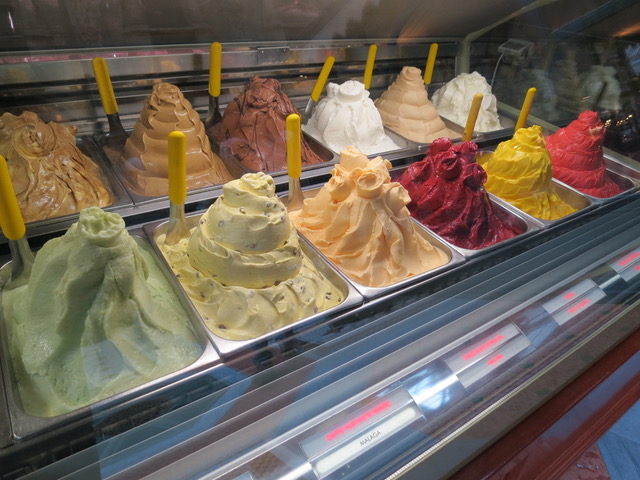
The Traveling Australian, Dave Chambers, reflects back on the tail end of a three-week ski trip to the French, Swiss, and Italian Alps.  His story isn’t so much about skiing, but rather the joy of decompressing in the beautiful city of Milano, and being obsessed by the abundance of Gelati, the elixir of the weary alpine skier. Catch the flavor here.

Gelati in the presence of Il Duomo di Milano. Perfect. Credit: Dave Chambers.

Ski coach and frequent contributor Bob Trueman explains the history of ski styles and the role international competition between France and Austria played in creating, and, in his opinion, branding defined ways of skiing and teaching skiing. Where did that counter-rotation idea come from? Those ankles welded together? The French turn? You’d be surprised how some mistaken observations and assumptions created a rigid orthodoxy around technique. Click here.

We found another “top-to-bottom” video taken by a skier, this time taking us from the tippy top of Aspen Mountain all way down to the Silver Queen gondola. Since you probably aren’t heading to Aspen this season, (if you are, lucky you), this will serve as a nano-vacation. Enjoy the non-stop run, and, since it’s vicarious, your quads will love you for it. Click here.

Finally, The Skiing Weatherman Herb Stevens pipes in with a view of next week’s weather. As you will see, like the stock market, conditions will be going up and down. Click here.

Thanks again for supporting SeniorsSkiing.com. Please tell your friends and remember, there are more of us every day, and we aren’t going away.

Groomed trails ready for the day. Appleton Farms, Ipswich, MA. Credit: NSNA


Make More Tracks: Yellowstone Expeditions

A Rustic Retreat In Remoteness.

Yurts and heated tent cabins accommodations in remote corner of Yellowstone.

When skiers talk about great backcountry, they often cite the Tenth Mountain and Braun systems in Colorado; Sierra Club huts in California; Skoki Lodge, Assiniboine and Shadow Lake in the Canadian Rockies. I’d like to add a new destination, near Canyon in Yellowstone National Park. (Check an atlas, find Yellowstone in the northwest corner of Wyoming; Canyon is in the north central part of the Park.)

Actually, Yellowstone Expeditions is in its 38th season. And to be honest, they use yurts and tent cabins, not log huts or lodges. But “great” is perfectly appropriate, whether it’s skiing or snowshoeing, staff, dining, or the amazing landscape of the world’s first national park (1872).

Yellowstone isn’t exactly a winter secret, but skiers visit the Canyon area only when they’re passing by in enclosed heated snowcoaches or on snowmobiles, mainly because there’s no lodging within 35 miles except Yellowstone Expeditions.

The company was founded by Arden Bailey, who in summer works as a geologist who once specialized in radioactive waste disposal. (There’s a theory Arden is such a bright guy that no one in his vicinity needs a headlamp.)

The high point of my winter used to be running winter trips in the U.S. and Canadian Rockies, so it was a joyous thing to be a guidee around Canyon. Most of the time I skied with Erica Hutchings, a Renaissance woman who’s been office manager, snowcoach driver, PSIA-certified instructor, and super-guide. Come summer, she’s been a river ranger in Grand Teton National Park.

Who Are Those Guys?

Dining room and kitchen yurts glow at sunset.

All the guides are a hoot. They’re also naturalists, dishwashers, and talented cooks, working crazy hours with all kinds of clients, and carrying it off with humor and panache and quick wits. What a work ethic!

Arden’s talents include amazing stories and still more unbelievable jokes. This sense of humor seems to inspire guests, who tend to be crazy-diverse in their professions and interests anyway. Our group on one visit included a doctor from New Mexico, a writer from New York, and the owner of a trucking firm in Texas. I learned something about publishing fiction, summer weather around Houston, anatomy, movies, Superfund sites, national politics, and succession tree species after the Yellowstone fires of 1988.

A typical four-, five- or eight-day trip begins with a snow van ride from West Yellowstone to Canyon with skiing near the rim of the Yellowstone toward the end of the day. We enjoyed a novel experience along the Gibbon River—a herd of maybe 200 slow-moving bison. We couldn’t pass them for almost two hours. It was a photographer’s dream, including the chance to take pictures of fuming snowmobilers who revved engines but still didn’t intimidate the beasties.

And There’s Skiing

Here’s why people come to Yellowstone.

You can visit the park for its beauty, for wildlife, for geysers. I did it that time for long tours, powder, and downhills. It’d been a long time since I’d really skied hard in the backcountry. It’s easy to forget how few miles a small group can REALLY go in eight hours when you’re breaking trail through two feet of fresh snow.

The Yurt Camp is based at 8,000 feet, so it gets and holds 200-250 inches of snow, usually the light stuff Montanans call “cold smoke.” It’s in a spectacular area, minutes from the deep canyon of the Yellowstone. Terrain runs from long-open-steep to wooded-gentle.

I’ve always been a so-so unenthusiastic telemarker, never quite found that ideal combination of grace, strength, and technique. After that trip, I’m a certified Wannabe.

It stood to reason that 205 cm light touring gear would do the trick for touring, even for low-angle telemarking. This might have worked if the heels of my boots hadn’t kept jamming with snow. It’s demoralizing to start a turn, come round just far enough that skis are pointed down the fall line, and find the only part of the boot/binding system meeting its obligations is the toe.

Humility is a great teacher.

Yeah yeah, I know, “It’s the equipment.” But the next day I used mid-length general touring gear with a 3/4 metal edge with backcountry boots and bindings. Spectacular improvement! Even carrying a full pack, those skied floated and came around on request.

Actually, we could have skipped hills almost entirely. There’s a huge variety of trails—groomed, ski-set, or just marked—taking off right from camp, including gentle tours to places like Inspiration Point and Cascade Lake.

Wilderness luxury

Guests stay in warm, comfortable hut tents, a moments walk from the kitchen and new dining yurts. Here’s the thing you sweat for and dream of on skis or snowshoes: getting home at twilight and trying the new cedar sauna before dinner. Or better yet, a backwoods (indoor) shower—rapture!

Among my favorite moments were the intermittent thunder of the Yellowstone’s Lower Falls (much higher than Niagara); walking around Washburn Hot Springs (it’s a map-and-compass trip in); watching a park ranger skate at dusk beside the Grand Canyon of the Yellowstone, just after a grooming machine came through; learning the differences between fisher and coyote tracks; digging a snow pit for evaluating avalanche potential; and the pleasure of a heated outhouse.

Now, that’s livin’!

More Detail

Packages include delish meals, lodging, snowcoach, sleeping bags and sheets, and guiding. The season runs December 17-March 7th. Four-day/three night visits run $1,260 per person, double occupancy. The camp holds 10-12 guests. Check out the dynamite web site by clicking here or call 800-728-9333.

Late afternoon along the thermal waters of Alum Creek


Obsessing Over Gelati In Milano

After Your Ski Trip, Do This, Especially When In Italy.

Duomo di Milano where we indulged in our initial Gelati. Credit: Medium.com

It is the 8th March 2013, the day is cool but sunny. It is still winter here in Milano, Italy. Food and Italians go together like toast and marmalade on Isle of Wight. The clever people that they are they gathered the recipe from Marco Polo and created ice cream. Gelati to the Italians, and not simply ice cream as we know it.

We have skied some legendary powder. Morzine, Avoriaz, Courmayeur, and the slopes of high Switzerland. Now all behind us. The mishap that was Marg’s on the slopes of Morzine Ski Resort where her hip parted company with her femur. It’s done and sorted. She by now languishing in a hospital back in Australia. Ahead of her months and months of exercises by physical therapists. Our remaining group of skiing tourists head to downtown Milano for some creature comforts and good European hot chocolate and to search for that legendary Gelati.

Forget your bucket list, it’s so yesterday; just visit Italy. Don’t dally, this place is cool. Built by people that know a thing or two about how to construct a medieval village. It has everything you never realized you needed. But now know where your life experiences can be fulfilled.

In Italy, they have Gelati; it’s everywhere. In Italy, it helps to be passionate and quite obsessive about food. You fit the culture better. The medieval diet is a thing. The food here makes your heart sing. I am a man of simple taste, I like a Lou Reed riff, Italian Gelati, fresh snow, Uva di Troia, blue sky, powder snow, porcini mushrooms, wasabi pear paste, Nutella Pizza, Italian hot chocolate, and cats. Italy has nine out of the above, that’s plenty to make a trip of a lifetime.

Tack it on to the end or start of your next skiing trip.

Anyhow, Gelati is our focus. We decided, as you do in Italy, to search for that Zen moment. Or nirvana when food passes your lips and mere seconds later you are taken to another place.

Gelati in the presence of Il Duomo di Milano. Perfect. Credit: Dave Chambers.

Day One Milano. We sit in the hugely dominating presence of the massive cathedral that almost blankets the whole square. The Duomo di Milano, 600 years and still standing, all 135 gargoyles of it. Seated at an open-air restaurant, we eat yet another excellent pasta. Porcini mushrooms grow wild in the forest here. Collected from the forest and scattered with a slip of black truffle across a fresh house made pasta. Simple yet sublime. Accompanied by a very good Montepulciano.

The conversation turns to Gelati, and, I kid you not, within twenty quick paces we find a purveyor of fine Gelati . We ordered enough scoops to satisfy a platoon.  All your typical flavors. Our excitement was rewarded with explosions of flavor.

Could it get better than this. We didn’t think so.

Day Two. Now down to just two of us, the other tourists having skipped and flown home. We are just getting a feel for Italian lifestyle. Our concentration heightened now we are tuned in to the local food scene. Feeling switched on. We trawl through the piazzas. We circle and wander the streets looking for shops that mysteriously stay hidden for almost two hours looking for snow wear retail stuff. My mate has a tired ski jacket in need of replacement. Suddenly we blunder upon the old bohemian quarter, exclusive and designer expensive. The luxury within these narrowed walkways is revealed. By chance or divine intervention, our next serve of designer Gelati is nigh. Imagine Mango, so smooth, the deepest orange in color and very glossy with smooth mouthfeel. This mango Gelati has the most intense sweet flavor and equal first place to yesterday’s I decide. Sacrilegious, I know, but folded within a wispy thin, crepe.

Simply the best: cioccolata italiana milano.

Last day. We lunch under the brooding gargoyles of the Duomo di Milano, now grey with mist and rain.  Within our shallow bowl, pasta. The waitress recommends a very fine local red wine. I ask her about Gelati. “Oh yes,” she says encouragingly, “You should visit Cioccolata Italiana,” further adding, “It is the best in Milano.” We are excited. I demand four flavors.  It’s a bucket but a small one. Of flavors chosen, I can’t remember because my tastebuds had hard wired to my brain. Endorphins now in overdrive. The Cioccolata Italiana Chocolate conjured angels. Those angels started dancing on my tongue, the intensity of chocolate, the smoothness as it melted around your taste buds, all balanced with a not too sweet finish, a deep dark chocolate that lingered long after the first taste. The heavens had opened just then for a tiny glimpse of ice cream nirvana. This is not just any Gelati, this is alchemy for the tastebuds and simple the best Gelati I have ever experienced. The ancient Romans may have brought you the amphitheatre, sewers, and concrete, but I am thanking them for their wonderful Gelati and the Medicis for Marco Polo.

Chocolate, please. Credit: Dave Chambers


This Week In SeniorsSkiing.com (Feb.19)

Why Support SeniorsSkiing.com, Ski Test Process, Flat Light Nemesis, Women Behind Pico, Sustainable XC Resorts, Snow In Literature, Skiing Weatherman.

Fresh snow. Credit: AA Maginn

If you are of a certain age, you’ve probably figured out by now that people in business, sports, and marketing, who design, sell and market products and services, who have hiring responsibilities, and, generally, who are under 40, view aging as a liability. You get that attitude from ads which extol youth, age-ism in the workplace, and people who view us a draw on the economy.

And yet, the AARP says Americans 50 and older represent 35 percent of the population but control 83 percent of all household wealth (2018). And we are responsible for 56 cents for every dollar of consumer spending. So, we’re not nothing.

We get it. The old view of aging is that people get old, look like dried apples, consume medical care, juggle doctor appointments, and go away to rocking chairs on porches watching birds at the bird feeder and occasionally babysit.  That’s the old view, and, unfortunately, the view that many, many un-old people have of aging.

Of course, we know that’s totally misguided. Readers of SeniorsSkiing are those who recognize what’s possible later in life. We are out there, actively living, doing what’s meaningful, and chasing goals and dreams. That’s the view we have; the demographics below our senior level haven’t figured that out yet.  But they will when they mature.

Our surveys have shown that even though our reader’s average age is about 69 years old, our self-image age is in the 40s. That’s the point. We don’t feel or act old. No stereotyping here. We just keep going.

That is what makes SeniorsSkiing unique. We are the only publication we know of that focuses on seniors who love the winter outdoors and all the sports and activities that includes.

And, we’ve found a wonderful audience that resonates with the idea of being active, engaged, and connected.

Consider supporting SeniorsSkiing. We are on your side. Click here.

[Editor Note: Co-Publisher Jon Weisberg is facing a medical challenge this week. You can wish him well by taking a run for him. Short Swings will be on hiatus for a while.]

________________________________

This Week

Nipika is totally off the grid.

Correspondent Marc Liebman recalls how he and John Perryman created a more objective set of procedures for ski testing back in the 70s. Controlling ski tester bias is the big variable. Click here.

Co-Publisher Jon Weisberg found an unusual accessory for the original Model T Ford. Various parts could turn the car into a snow mobile. It was marketed as a way to save money on horses. Click here.

Our Question For You this week shifts to a practical question: How do you manage flat light? It’s been our personal nemesis when we encounter it. We’ve had several articles about flat light, but this time, we want to hear what you do. Do you goggle up with special lenses? Do you head for the lodge? Is it a big deal for you, as it is for us, or is it just one of those things? Click here.

Karl and June Acker took over from Janet and continued to expand the Pico resort.

Correspondent Karen Lorentz sends a report on the women who shaped the history of Pico Mountain Resort, VT. Several determined women owners actually led the development of the resort—one of America’s oldest—with their partners. An impressive story about impressive people. Click here.

XCSkiResorts.com publisher Roger Lohr has an interesting Make More Tracks story about how xc ski resorts are saving money and protecting the environment by adopting a variety of clean-energy sources. Click here.

The Skiing Weatherman brings us a view of the next week in Snow Land. What’s ahead? Click here.

And here’s the next in our next Snow In Literature series, Robert Frost’s On A Tree Fallen Across The Road. There’s a message here about how to deal with obstacles. “Seize the earth by the pole” is a start. Click here.

Thanks for reading SeniorsSkiing.com. Tell your friends, and remember there are more of us every day, and we aren’t going away.


FreeSkier

Why I Don’t Read Ski Test Reports

[Please consider supporting SeniorsSkiing.com with a donation. We appreciate your help. Click here.]

Unlike this ski test, the author masks the ski’s identity. Credit: FreeSkier

Seven Ways To Make Ski Tests More Objective.

Way back in the late 20th Century, while running the SKIpp Testing program for SKI Magazine, John Perryman and I learned the most difficult problem to solve and the biggest variable was the ski tester. In conversations with almost every manufacturer, they said the same thing. So the goal of SKIpp (way back in the 1970s before engineering modeling software was available), was objectivity and processes that minimized tester bias. John created a bench test and then tested the ski on the snow so we could compare the results.

Amazingly, we were successful. We were invited as “consultants” by several manufacturers, to compare SKIpp’s results with theirs. Again, SKIpp was very accurate, more so than some manufacturers would admit.

Most ski testers are really good skiers and as such, they unconsciously adapt their technique to the ski, terrain and conditions and the brand’s design philosophy. This makes objective comparisons very difficult. In the SKipp program on-snow methodology, seven steps were incorporated to reduce the human variable.

One, we did blind testing. The tops and tip logos of each ski were covered with shelf paper before numbering each pair. The tester was not allowed to pick up the ski until he/she “tested” the ski to minimize identification.

Two, we skied the same trail every day that gave us about 1,000 feet of vertical and a chair lift that made yo-yoing possible. The ski area spread fertilizer on a long marked off segment to simulate frozen granular and give us a consistent snow surface to reduce the “snow condition variable.”

Three, each skier filled out a test card which graded a list of mandatory maneuvers/turns. At the beginning of the year’s session, we conducted a clinic on the required maneuvers and how the ski should react.

Four, each tester was allowed only two runs on the ski before grading. We wanted first impressions and found that after two runs, most testers adapted to the ski’s idiosyncrasies.

Ski tester range from racers to intermediates. Controlling tester bias is key.

Five, the testers’ skills ranged from certified ski instructors who either had been racers or coaches to intermediate skiers. Our youngest testers were in their mid-20s (we did have a few teenagers one year) to older skiers in their 50s.

Six, the “racing” models were skied down a 20 gate GS course that had been “fertilized” so the surface was rock hard.

Seven, only 10 skis were tested each day. After 10, the testers had a hard time determining the differences.

We let the testers pick which skis they wanted to ski in the afternoon. Again, the choice and why was recorded. Only then did we allow the ski to be identified. Results were tabulated each evening by hand because Excel, laptops, etc. didn’t exist in the 1970s.

Even with all these precautions, most of us could, after a few weeks of on the snow testing, tell one brand from another. To this day, I can tell a Rossignol from a Dynastar from an Atomic from a Head or K2.

So, when I read the current ski reports filled with jargon such as “edge gripping power” or “discover the amazing effect of (name of manufacturer) new Energy Management Circuit,” my reaction is %$^@*&, and I stop reading. Whatever credibility just evaporated. I’ve been there and writing facts about the ski’s performance instead of hype is, well, boring. But, experience tells me that the reports are more believable. So now you know why I don’t read ski test reports and prefer to “on snow test” them myself.


Question For You: Flat Light Tactics

[Please consider supporting SeniorsSkiing.com with a donation. We appreciate your help. Click here.]

Is Flat Light The Bane Of Your Skiing Experience? Or Just One Of Those Things?

Head for the lodge after this one? Think so. Credit: Jan Brunvand

No contrast, lack of depth perception, no tell-tale marks on the snow, flat light adds another dimension to deal with. Not welcome to many. Tolerable to some.

We’ve had a couple of our more spectacular falls in flat light conditions. Too fast, unexpected terrain. And boom. The lasting result is that whenever we see that gray-white shroud, we tighten up, and more likely than not, head for the bottom and home.

There’s an excellent article by correspondent Marc Liebman on Coping With Flat light in our archives. Check it out here.  But what is your way of approaching flat light conditions? Do you have a specific brand of goggles you swear by? What about technique? Changes in how you approach the trail? Let us know.  Perhaps you can help up break through our reluctance to head out on flat light.

Question For You: How Do You Manage Flat Light? Tell us how you do it. Or if you just avoid it.

Write a comment in Leave A Reply below.

Women Played Integral Role at One of Nation’s Oldest Ski Areas

[Please consider supporting SeniorsSkiing.com with a donation. We appreciate your help. Click here.]

Janet Davis Mead, June Aker, Verlene Belden All Kept Pico Going And Growing, Despite Obstacles and Challenges.

Janet and Brad Mead started Pico in 1937.

Vermont’s Pico Mountain survived a war, two owners’ deaths, and a neighbor called Killington to become one of the 30 oldest continually operating ski areas in the country.

It’s a feat that was largely driven by women in its first 30 years, a time when the ski industry was known to be “a man’s world.”

Women also played major roles in Pico operations since that time, continuing the strong family influence that began with co-founder Janet Davis Mead.

A feisty woman given to exaggeration, Janet Davis told Brad Mead she had skied at the Lake Placid Club, so he invited her to go skiing.

“I had to follow him down what looked to me then like Mount Everest. I made it, but without poles,” she would write years later, explaining she had thrown them in the bushes, not knowing what they were for.

Her bravado paid off; they married and researched building a ski area.

Envisioning a year-round resort with mountainside homes, aerial tram, swimming pools, ice rinks, and tennis courts, the Meads leased Pico Mountain and opened Thanksgiving Day 1937 on Little Pico with a 1,200-foot rope tow and a rough-cut, 2.5-mile Sunset Schuss skiers could ‘skin up’ to the summit.

The Meads hired Swiss racer Karl Acker to run the ski school, added two tows, widened Sunset Schuss — renowned for downhill racing and the Pico Derby — and installed the first U.S. Constam T-Bar to the top of Little Pico.

After Brad died in a boating accident in 1942, Janet carried on with support from skiers, the Otter Ski Club, and Otter Patrol. When workers including Acker left for World War II, she kept Pico open despite hardships of rationing and shortages that caused many areas to close. Using her marketing skills, charisma, and tenacity, she gave special rates to schoolchildren and servicemen who visited on furlough weekends.

Karl and June Acker took over from Janet and continued to expand the resort.

Having survived wartime, Janet bought the mountain (1947) as Acker returned to teach and help operate Pico. (He coached daughter Andrea Mead, first American to win two Golds in the 1952 Olympics, bringing acclaim to Pico’s strong racing tradition.) As the first woman to own and run a U.S. ski area still operating, Janet survived four lean snow years, weak finances, and growing competition by lowering ticket rates and offering summer rides on chairs hung on the T- Bar (1950). With the ski boom on and her children not interested in running Pico, she sold to Karl and June Acker in 1954.

Karl added trails, a T-Bar, and a J-Bar. “The lack of access to funding caused him to do too much of the work himself; the long hours and the stress of the new J-Bar which he couldn’t get to work quite right contributed to his fatal heart attack” in May 1958, June told me in 2007.

“The three banks that had lent us money to purchase Pico had insisted on a life insurance policy on Karl. Because I was a woman they needed to know I could repay the loan if he died,” June said of becoming Pico’s owner at age 30.

She added trails, replaced a lift, and obtained financing for Pico’s first chairlift, a Stadeli double that went halfway to the top ($110,000 in 1962).

“Pico needed lift service to the summit to compete and survive.  Being a woman contributed to the banks’ reluctance to provide more loans,” June said, of her decision to sell to Bruce and Verlene Belden (1964) in hopes they would carry on a family-oriented mountain.

Bruce had helped build Mount Snow (1955-1964), while Verlene ran their 30-guest ski lodge and raised four children. With former guests investing, they became majority owners with Verlene as office manager. Her business acumen coupled with their strong family orientation and expansion of the mountain enabled Pico to survive the trying 1970s when all but five major Vermont ski areas changed owners, and most surface lift areas closed. Vermont had 81 areas in 1966 but just 39 by 1988.

When they retired in 1987, Pico had a reputation as the “friendly mountain” with strong racing and instruction programs and new base village engendering a loyal following.

Women played significant roles in achieving that reputation. “They taught youngsters to ski and race and were instrumental in the Pico Ski Club. They also ran various departments from ski shop to ski school, tickets to childcare. They contributed to the skier loyalty that saw kids who grew up at Pico return as instructors or coaches and bring their own families to the mountain,” noted former GM Frank Heald.

Current Pico Director of Operations Rich McCoy added, “Pico staff make people feel at home and welcome. That’s a legacy that women through their leadership roles have contributed to throughout Pico’s long history and still do today.”

Sunset Schuss: Had to skin up in the old days.

Make More Tracks: Sustainable XC Ski Resorts

[Please consider supporting SeniorsSkiing.com with a donation. We appreciate your help. Click here.]

[Editor Note: This article first appeared in XCSkiResorts.com.]

Craftsbury has a solar array, one element in a system that provides heat.

Many cross country (XC) ski areas operate in an environmentally-friendly manner, and some of these operators, who are exemplars using the most sustainable practices, are models of sustainability in the effort to combat climate change. The operators at these resorts practice what they preach such as: using renewable energy, protecting scenic values and wildlife habitats, practicing water/energy conservation, reducing waste and reusing products, designing and building facilities in an environmentally-sensitive manner, managing forest and vegetation properly, handling potentially hazardous waste properly, and educating clientele and staff about environmental awareness.

These sustainable practices are not typically million dollar investments, but they are meaningful accomplishments, and the information about many of their practices can be shared with hundreds of other XC ski areas across the US and Canada.

Devil’s Thumb has geo-thermal heating.

At Devil’s Thumb Ranch Resort & Spa in Tabernash, Colorado, a geothermal heating system is used throughout the resort. The system consists of glycol-filled pipes that have been installed in the Ranch’s on-site lake. Heat is transferred to the glycol from the water, and then heated to 105 degrees by compressors in each building. The resort has also installed EPA-approved specially designed chimneys that minimize emissions from wood burning fireplaces and used recycled asphalt for paving. “We continue to make a concerted effort to work with local suppliers and businesses and reduce our carbon footprint at every level,” said General Manager Sean Damery.

The White Grass Ski Touring Center in Canaan, WV has been awarded the WV Environmental Council’s Green Entrepreneurs Award. The facility is heated with wood and uses about $6.66 worth of electricity a day. Environmental education is a key element at White Grass as there are regular outings in the WV Highlands Conservancy and the Canaan Valley National Wildlife Refuge, which they helped to establish.

In the northeast US, the Great Glen Trails Outdoor Center in Gorham, NH upgraded an old micro-hydro 10 kw system, which now supplies 80 percent of electric needs. They’ve also got a wood pellet heating system in the lodge and have converted more vans that tour up to the top of Mt. Washington to propane gas and installed an electric vehicle charging station, too. The new Glen House Hotel has a geothermal closed loop system and high insulation for high building efficiency. The LED lighting is throughout the hotel indoors and the outside lighting is “Dark Sky Compliant” at night. One of the coolest things at the Glen House is the regenerative elevator system that feeds energy back to the building’s electric grid.

Craftsbury Outdoor Center in VT has incorporated sustainability in its mission statement to be carbon neutral. At Craftsbury Outdoor Center everything is net metered with 32kW on the solar trackers and 3,000 square feet of panels on the roof, supplying the Activity Center with close to 70kW. Between the two, that provides 63 percent of operation’s electricity and there is also solar thermal to provide  summertime domestic hot water, which is supplemented with heat pumps.

Craftsbury has incorporated massive amounts of insulation into all of the new buildings, and locally sourced many of the wood products used in the building construction. The roof of the Activity Center is at R72 and the walls are R46. It also has composting toilets, a heat pump, and locally-sourced wood for paneling and recycled steel beams for support were incorporated in the construction. High efficiency wood gasifying boilers provides all of the heating and domestic hot water demands during the cooler months. They’re tied into the 10 million BTUs of thermal storage in the form of 20,000 gallons of water. This storage system allows them to cogenerate with the snowmaking generator, providing electricity for the pumps and guns, and catching waste heat off the engine.

Sleepy Hollow owners Dan and Sandy pose in front of one of 10 solar arrays at the resort.

Sleepy Hollow Inn Ski & Bike Center in Huntington, VT added 10 kwH of solar this summer and now has 50 kwH of solar net metering from its solar panel arrays to provide for electric needs that include power for a snowmaking system used to guarantee snow early in the season. A solar hot water system heats 50 percent of the hot water use at the inn, and the lights on the ski trail have been converted to LED lights. Sleepy Hollow Proprietor Eli Enman commented, “By April, we’re expecting to see that close to 100 percent of our total electricity would’ve been powered by solar energy and that includes our all-electric snowmaking system water and air pumps.”


Nipika is totally off the grid.

A sustainable Canadian resort that practices what it preaches is Nipika Mountain Resort in BC, which is off the public power grid. It uses solar panels to supply energy needs. The resort’s furniture was built on site with wood from trees that were killed by the Mountain Pine Beetle.

Boundary Country Trekking on the Gunflint Trail in MN offsets the carbon produced on the Banadad Trail (such as snowmobile grooming) by investing in reforestation in the area. This is a planting estimated at 75,000 trees. Boundary Country Trekking is one of the few XC ski operations that have a sustainability statement and a comprehensive implementation plan. Another Minnesota XC ski area, Maplelag Resort in Callaway, is an active tree farm where it has planted thousands of trees and has created more than 20 ponds to benefit wildlife there.

For people who seek beautiful destinations to cross country ski and want to patronize businesses that fight climate change, the resorts in this select group are the places to visit.

Snow In Literature: On A Tree Fallen Across The Road

[Please consider supporting SeniorsSkiing.com with a donation. We appreciate your help. Click here.]

(To hear us talk)

By Robert Frost

The tree the tempest with a crash of wood
Throws down in front of us is not bar
Our passage to our journey’s end for good,
But just to ask us who we think we are

Insisting always on our own way so.
She likes to halt us in our runner tracks,
And make us get down in a foot of snow
Debating what to do without an ax.

And yet she knows obstruction is in vain:
We will not be put off the final goal
We have it hidden in us to attain,
Not though we have to seize earth by the pole

And, tired of aimless circling in one place,
Steer straight off after something into space.


This Week In SeniorsSkiing.com (Feb.12)

Valentine To Our Readers, Loon Visit, Resort Liability-Less, Vicarious Swiss Ski Run, Marg’s Moment, Personal Ski, XC Ski Injuries, Skiing In College In The 50s, Take A Lesson, Herb’s Weather For The Week.

[Please consider supporting SeniorsSkiing.com with a donation. We appreciate your help. Click here.]

Here in SeniorsSkiing.com’s New England headquarters, we are feeling very gratified. We’ve been receiving donations from both online donors and through the mail. The notes on little pieces of paper mailed in with checks have been supportive and encouraging. “We love reading your e-magazine,” says one. “Keep it up,” says another.

Thank you very much. Here’s a Valentine picture for you taken on a beautiful blue bird day at Appleton Farms just after Sunday’s snow fall.

If you haven’t made a donation yet, please consider it. All donations go to help defray expenses which are growing as we grow. Click here.

__________________________________

This Week

Correspondent Tamsin Venn visits Loon Mountain and reports on her ski experience in times of COVID.  It’s like a throw-back to the old days, simple, economical, and ski-focused. Click here.

We found an interesting video on YouTube where someone took a run at Nax resort, a small-ish area in the Swiss Alps. It’s an eight and a half minutes from the top of the lift to the bottom.  You judge if you would have been comfortable doing what the videographer did. Or whether you think it’s safe. Click here.

The traveling Australian Dave Chambers recounts a 30-day ski journey in France.  On day one, a member of his safari has a bad accident. His tale of Marg’s foreshortened vacation and the wonder of travel insurance are a lesson in being prepared for evacuation far from home. Click here.

Correspondent Marc Liebman has done some research on the potential of a “personal ski”, that is, one made just for you.  Hey, if Dell can customize computers to your specs, why not a ski? Click here.

XCSkiResorts.com publisher Roger Lohr describes the typical injuries you can get in XC and how to avoid them. Click here.

Jan Brunvand, a frequent contributor from Utah, sent us a reminiscence about skiing in college in the 50s and how his first date with his current wife worked out. Click here.

Ski instructor John Gelb advises readers to take a lesson and reports on the three common flaws he sees in seniors that can be improved with instruction. Click here.

Finally, the Skiing Weatherman Herb Stevens brings us next week’s weather prediction. Coming up to four weeks to spring. Click here.

Thanks for reading SeniorsSkiing.com. Please tell your friends and remember, there are more of us every day and we aren’t going away.


Skiing Weatherman: The Hits Just Keep On Coming

Busy Storms. Slopes in Good Shape.

As I write this piece at the start of President’s Day weekend, the slopes from coast to coast are in fine to extraordinarily good shape, thanks to a very busy coast to coast pattern of storms that has played out in recent weeks.  A push of arctic air delivered by the stratwarm episode that was discussed in last week’s column is providing cold air over the eastern two-thirds of the country.  At the same time, upper level energy that supports the stormy pattern continues to be ejected from an upper level trough over the Aleutians.  After the holiday weekend those disturbances will continue to favor resorts north of I-70 and I-80 in the West, but as the energy tracks eastward and interacts with the cold air flowing into the center of the country from Canada, storms will bring fresh snow to the Midwest and the East.  Here is a jet stream for Friday the 19th that illustrates the snowy “handoff” pattern that is in place now and should stay in place for the next couple of weeks.

With one trough over the Gulf of Alaska and another over the eastern half of the country, combined with a blocking ridge still hanging around Greenland, storm after storm will cross the country, some small, some more significant.  Initially, the snow will fall in British Columbia and the resorts of the Pac NW and northern Rockies.  The northern Great Lakes will pick up a round of powder as the disturbance heads toward the high amplitude trough that stretches from the Great Lakes to the Gulf of Mexico.  As the disturbance in the northern branch of the jet stream interacts with the larger system, the result could be a storm that could run up the length of the Appalachians late in the week and into next weekend.  As I suggested earlier, there will be ample cold air around, as shown by this map of 5,000 foot temperatures for next Friday.

The green and gray colors show where temps will be below 32 degrees aloft, a proxy for snow vs. rain at the surface.  You can see that a long-track snow event up the eastern seaboard could indeed be in the cards.  Now if you look at the jet stream map above, you will see an extended trough reaching from the waters west of Washington northward to the Arctic region.  The counter clockwise flow around that feature suggests that after 10-12 days of domination by arctic air, Pacific air masses will get involved, leading to somewhat milder weather (less cold) by the end of the month or so.  In the meantime, enjoy the frequency of flakes and preponderance of powder!

REGIONAL HIGHLIGHTS:

Pac NW/B.C.:

Big storm late this week followed by more storms from the Gulf of Alaska rolling into the mountains of B.C., Washington, and Oregon.

Central and southern Sierra:

One storm this weekend and another early next week.  Glancing blows from storms to the north bring light snow later next week.  Heavy snow next weekend.

Rockies:

Weekend snow followed by a moderate to heavy accumulation a couple of days later central and south.  Potential for another round next weekend.  Moderate amounts of snow next week in northern resorts

Midwest:

Arctic air dominates.  Light snow from Clipper systems and some lake effect snow in northern Lakes.

Northeast:

Parade of storms continues to add snow every couple of days.  Shot at significant snow middle of next week and again late in the week.

Mid-Atlantic/Southeast:

Two shots at moderate to heavy snow in next week…first one around Tuesday and again a couple of days later.