Tag Archive for: senior skiing

Indoor Skiing? Bode Miller?

Ski In A T-Shirt. In July. In Colorado.

Bode Miller endorses the indoor, endless carpet as a way to practice and learn. Credit: Snobahn

Bode Miller endorses the indoor, endless carpet as a way to practice and learn.
Credit: Snobahn


There is a way to keep skiing year round.  As we have seen, the urge to keep skiing has been explored in many different ways.  This time, Snobahn, a “state of the art” indoor ski facility is coming to the US with its first facility in Centennial Colorado.

Hey, if you are learning or yearning, it’s a place to get some vertical done.  Snobahn says 30-minutes on the continuously moving carpet gives you the equivalent of 20,000 vertical feet.  That’s a work out.

Plus, there’s a lounge, and the price is right: $40 per rental and instruction. And Bode Miller is an enthusiast.  Pretty interesting.  Check out the video. And thanks Teton Gravity Research for the story idea.


Cycling Series: Join A Charity Ride This Summer

Cycling With A Champion On A Charity Ride: Priceless.

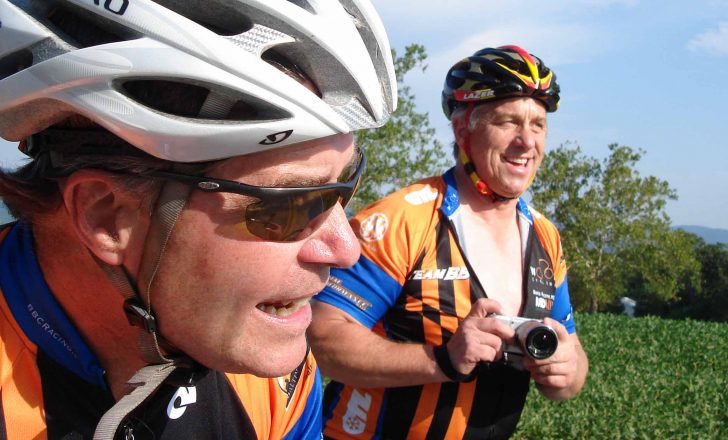
SeniorsSkiing.com correspondent Pat McCloskey with cycling great Greg LeMond. Credit: Pat McCloskey

SeniorsSkiing.com correspondent Pat McCloskey with cycling great Greg LeMond.
Credit: Pat McCloskey

One of the more enjoyable events in cycling are those which support a charitable cause.  Throughout the country there are road rides where participants receive donations per mile or flat donations to support different organizations.  These are usually marked with support from the local motorcycle club escorts, food vendors and volunteers at the rest stops, and colleges or other venues that provide camping or room facilities with showers and dining hall options.  Sometimes these are one-day rides of 25- to 50-miles.  Others are multi-day events culminating with a large sponsored finish line party.   The events are well organized and many of the event organizers are well known non-profits like the Juvenile Diabetes Research Foundation , the Leukemia and Lymphoma Society , and the National Multiple Sclerosis Society .  All of these organizations have local and national events.  America’s Most Beautiful Bike Ride around Lake Tahoe is a MS sponsored event and I had the privilege of riding in that one a few years back, and it definitely deserves the moniker.  Gorgeous views of the lake and the surrounding mountains.

One of the more interesting rides that I have participated in recently was an event put on by an organization called 1in6.  This organization provides support to men who were abused as children.  The honorary chair person for the ride was none other than our three-time Tour De France Champion Greg LeMond.  The event is called the Catoctin Challenge held annually in Maryland.  The compelling thing about riding with a Tour de France Champion like LeMond is how affable and easily approachable he is.  Surrounded by people all the time, LeMond tirelessly signed autographs late into the evening and was willing to answer any question that anybody had at the event.  With his wife Kathy at his side, he is surely the poster child of any charitable bicycle ride and I was fortunate enough to be with him for two years running.

The amazing thing to me was the fact that most people on the ride preferred to ride by themselves or ride with their friends.  There were only 6 of us who rode both days of the weekend with LeMond including our host Scott Weiner of MHW Corporation.  Being a former road racer, I was kind of in awe about this opportunity because I have been a big fan of LeMond for decades.  He is a little slower now, thankfully, which allowed me to ask him many questions.  What was Sean Kelly like?  How did you get on with Fignon?  How about the psychological battles with Hinault?  I peppered the guy and he was gracious in all of his responses including some of the issues with the recently defrocked seven time TDF Champion.  In all, it was a true pleasure to ride with him in two events in recent years and I can’t say enough about the guy with his entrepreneurial spirit ( He developed the aero bar, Giro Helmets, and many other cycling accessories along with his own bicycle brand.)  Truly a gracious champion and all around good guy.  Great sense of humor, too, in that one guy in our group kept trying to hammer him, and LeMond got ahead of us and hid in the bushes until the guy rode by.  We all laughed at our buddy trying to kill himself looking for LeMond in the distance.

If you ever get the chance to participate in a charity bicycle event, do it.  As the saying goes ”a great cause and riding the miles for smiles.”

Tour de France winner Greg LeMond snapping pics on charity ride with Pat McCloskey.

Tour de France winner Greg LeMond snapping pics on charity ride with Pat McCloskey.

Ski Portillo Gets 9 Feet!!!!!

Road to Resort Blocked.

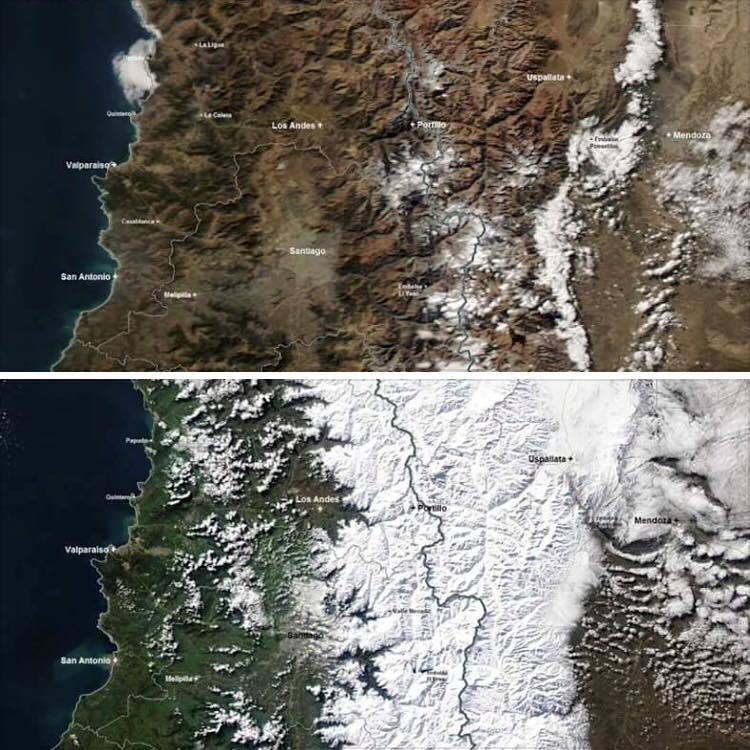
Before and After satellite images of Portillo region in Chile captures the magnitude of the storm

Before and After satellite images of Portillo region in Chile captures the magnitude of the storm

Winter shifted hemispheres quickly this week and delivered a 9-foot monster dump of snow on Ski Portillio. Resort operators there are ecstatic with the early season delivery.

Dramatic satellite images show the day-before/day-after difference in coverage.

If any readers are on their way or have plans to go this season, take some pictures and send a report.

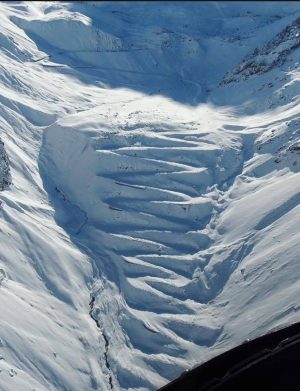
This is the mountain road to Portillo. Switchbacks are completely inundated.

This is the mountain road to Portillo. Switchbacks are completely inundated.

This Week In SeniorsSkiing.com (June 3)

Survey Headlines, Still Skiing At Stowe, Cycling Series.

This is definitely the last run, right? Credit: Robby Kelley

This is definitely the last run, right?
Credit: Robby Kelley

This week, we welcome a new advertiser to SeniorsSkiing.com. Vail Realty has joined our crew. Note their ad in the right column, and also note that they are providing a 20 percent discount for subscribers of SeniorsSkiing.com. Click the ad and get in touch.

You wanted discounts, we’re doing our best to make that happen.

Working the results takes time!

Working the results takes time!

We’re also publishing top level findings from our recent Spring Subscribers Survey 2016. The response rate has been outstanding , and we are very happy to heard from so many engaged readers.

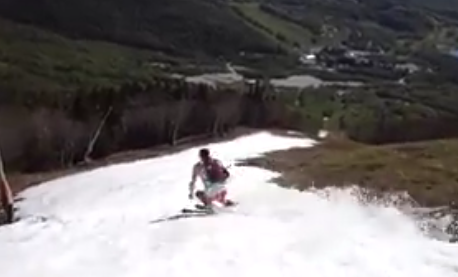
Believe it our not, there was a guy who took a run down a trail at Stowe, VT, on May 26 in 80 degree weather. We have the video proof. Check it out.

Finally, Pat McCloskey does what a lot of senior snow enthusiasts do in the non-snow months: He cycles. Here’s his snapshot of riding around a cool town in Western New York State.

Thanks for all your great ideas submitted in the survey. Please keep them coming.

Tell your friends about SeniorSkiing.com, and remember, there are more of us every day and we’re not going away.


Survey Highlights: Surprises And Advice

Here Are Top Level Findings: Discounts, Meet Ups, Instruction.

Analyzing the data from the survey. We're still working the numbers!

Analyzing the data from the survey. We’re still working the numbers!

We are so grateful to the many readers who responded to our Spring Subscriber Survey 2016. We had a 28 percent response rate. Anyone who knows surveys and response rates can appreciate how phenomenal that is. And a huge surprise to us. Most surveys get response rates in the single digits!

What that immediately says to us is that our readers are very engaged and, in fact, are rooting for seniorsskiing.com. We received many comments like “Keep going”, “Good job”, and “Like what I see”. When people said, “We appreciate what you are doing,” well, we got a little teary. Thank you for your encouragement.

As for immediate findings, the following were mentioned frequently in the comments:

Many of our readers said they wanted discounts, and we understand.  Those of you who have opted-in withSeniorsSkiing.com (provided your email address for weekly updates) have access to Promotive, the web service providing discounts on outdoor gear and clothing from hundreds of manufacturers. These are the same “PRO FORM” discounts enjoyed by PSIA members. If you haven’t already done so, sign up for this free SeniorsSkiing.com benefit .

We also are developing a relationship with a major online lift ticket reseller. Watch for these lift ticket discounts.

Finally, look for our updated list of US areas that provide free skiing for seniors. We are updating it for next season.

Meeting up with other seniors. The next most frequent comment was “How can I meet other seniors to ski with?” We were surprised how important this was to our readers and here’s what we can suggest right now. More ideas will be forthcoming.

First, use The Forum for posting where and when you want to meet others. The Forum is a bullet board application that is accessed from SeniorsSkiing.com home page. There is a category for Meet Up/Get Together.

Second, “like” SeniorsSkiing.com’s Facebook page and use that to post when and where information. That message will go to other people who “like” the page.

Third, you will soon see an ad for the 70-plus Ski Club on SeniorsSkiing.com. This club is a perfect match for our readers. The club goes on many trips to many different areas in the US and abroad. You can find one that fits your needs and, voila, you’ve made a bunch of new skiing pals.

Technique, Instruction, Gear for seniors. Here was another pleasant surprise. Many of our readers are interested in skiing technique and instruction that meets seniors’ needs. These include people who are returning from a long hiatus, those adjusting to the new skis and boots, and others who want to ski safer.

We’ve noticed a trend for ski areas to have “Senior Days”, or “Master’s Clinics” on a regular basis through the ski season. It makes enormous sense for ski resorts to do this for their most loyal customer. We’ve been publicizing these through the last couple of seasons.

We will be working on how to publish more technique stories from instructors who have developed curricula for seniors. If you know of anyone who teaches seniors how to re-start their skiing experience, or who has some special ideas for seniors who want to sharpen their technique, please let us know.

More findings will be coming along as we continue to analyze the data.

Working the results takes time!

Analysis and divining results requires concentration…


May 26: Spring Skiing At Stowe

Now This Is Hard Core.

Saw this on Facebook and had to show you.  This is from Robby Kelley at Stowe Mountain Resort.  His pal Ryan Siegle hiked and skied in 80 degree weather. Comments?

This is definitely the last run, right? Credit: Robby Kelley

This is definitely the last run, right?
Credit: Robby Kelley

Cycling Series: Small Ski Town Turns To Bikes In Non-Snow Season

Western New York Ski Town Has Lots Of Cycling Opportunities.

Western New York State has some awesome cycling terrain. Ellicottville is at the center. Credit: Pat McCloskey

Western New York State has some awesome cycling terrain. Ellicottville is at the center.
Credit: Pat McCloskey

One of the more interesting things that happens to a ski town is the metamorphosis that occurs after mud season.  Mud season is traditionally when spring rolls along and the snow melts and the locals in ski town head for vacation.  Soon after, the festivities that define the area in the “off season” begin.  Large ski areas are great with this transition but so are the smaller ski towns like Ellicottville, NY.  When summer comes to this region, the mountain bike and hiking trails come alive in the Allegheny National Forest and the riding/hiking  can compete with anywhere in the country.

Personally, my favorite loop is to ride from the Inn at Holiday Valley to the Race Loop at the ski area.  Then proceed to Big Merlin Trail, the Dead Dog Loop, to Sidewinder and back to Big Merlin and the Race Course Loop.  All these trails are available on www.mtbproject.com or also in a regular map provided by the Western New York Mountain Bike Association.  These trails are not too technical in nature, but there is some climbing.  Also, this loop can lead to miles of maintained trails in the Allegheny

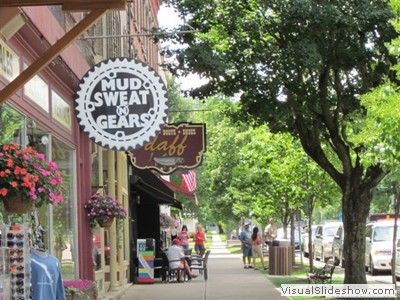
Ellicottville is a cool place the just hang-out. Non-cycling spouses can browse in many boutiques. Credit: Pat McCloskey

Ellicottville is a cool place the just hang-out. Non-cycling spouses can browse in many boutiques.
Credit: Pat McCloskey

National Forest.  Check with Mud, Sweat and Gears , a very cool ski/board/cycle shop in the center of Ellicottville, for rental information as well as great choices of cycling clothing, accessories, and of course a wide selection of road and mountain bikes.

For those who have noniriding spouses, the town of Ellicottville has many shopping options including boutiques, ski shops turned to cycling and outdoors shops, and a myriad of restaurants including the John Harvard Brew Pub in the Tamarack Club at Holiday Valley Ski Resort.  The pot pie there is not to be missed.  Also, the Ellicottville Brewing Company (EBC)  has a weekly menu board of craft  beers produced on site for your post ride and post shopping enjoyment.  Their food is also great.

Lot to Trails

All of the trails leaving Ellicottville can be accessed from the parking lots at Holimont Ski Area or Holiday Valley Ski area via the Race Course Loop which is clearly marked.

Terrain

Typical Eastern Singletrack with some steep climbs but not terribly technical in nature.  Not hybrid friendly but mountain bike accessible.

Whether it is EVL or any other ski town, don’t miss the summer activities that are available in the “off season”.

This Week In SeniorsSkiing.com (May 27)

Indoor Skiing, Inspiration From A Senior Swimmer, Update On Free Senior Skiing In NH, College Course On Mountains And Art.

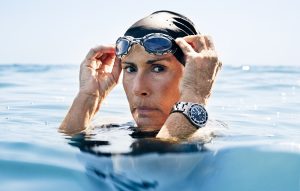
In 2013, Diana Nyad swam the Florida Straits, 110 miles, without a shark cage in 53 hours. She was 64 years old. Credit: Steven Lippman

In 2013, Diana Nyad swam the Florida Straits, 110 miles, without a shark cage in 53 hours. She was 64 years old.
Credit: Steven Lippman

The response rate to SeniorsSkiing.com’s Spring Subscriber Survey 2016 is, frankly, astonishing.  We’re at 29%, a number that reflects how engaged our readers are.  Thank you so very much.  Next week, we’ll start reporting the results, at least the big insights we see in the data.  These fascinating and surprising results will help us steer how we manage our content and our relationships with our readers.

This week, we look at yet another indoor skiing facility, this one in the Toronto, ONT, area.  There are many indoor ski areas around the globe, but most have man-made snow.  This new one has “dryslope”, that is, faux snow.  Very interesting development.

We report an update about the threat to free skiing for senior NH residents.  There have been some developments on the positive side, but the final outcome is still up in the air.

Diana Nyad is a senior marathon swimmer who swam from Cuba to Key West at 64 years old.  We discovered some words of advice and inspiration for all seniors.  Let us know what you think.

Finally, what promises to be an ongoing feature on SeniorsSkiing.com is an account of a Wesleyan University course on Mountains and Art by professor Peter Mark.  Professor Mark is an inspired teacher and outdoor enthusiast who combined his expertise to produce a unique view of mountains and their place in the history of art.  His students have written essays on various topics that may become articles of interest for our readers.  Stay tuned.

Meanwhile, to our very engaged readers, remember: “There are more of us every day, and we aren’t going away.

Indoor Skiing Tries Again: Toronto Next

Experts And Beginners Can Ski All Year On Faux Snow.

Many years ago, we remember when the town of Etobicoke, ONT, a suburb of Toronto, used its municipal trash collection to build a ski hill. That’s a clue to how geographically feature-less the terrain around Toronto is.  While the greater Toronto area has at least 10 ski areas in driving range of the city and reasonable ski ticket prices, the dimensions are modest.

Shredding is possible on "dryslope" faux snow.

Shredding is possible on
“dryslope” faux snow.

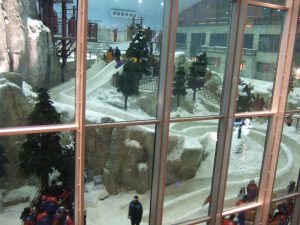
Into this mileau comes a bold idea: Indoor Skiing.  We’ve seen how indoor skiing has been tried in other parts of the world, most notably at Tokyo’s Lalaporte Skidome SSWAS.   There’s also one in the Middle East called Ski Dubai which features real snow and penguins.

Now, a company is building a 20,000 square foot indoor facility in Vaughan, ONT, just north of Toronto.  Axis Freestyle Academy is billed as “Canada’s Indoor Ski and Snowboard Progression Park”, a year-round dry snow, aka, dryslope, training facility.  There is also a 4,000 square-foot trampoline area for fitness and fun.  The ski hill is divided between open slope for beginners and terrain filled with rails and jumps for experts or wannabes.

SkiDubai's indoor ski area has real snow, interesting features, and cold temps.

SkiDubai’s indoor ski area has real snow, interesting features, and cold temps.

In any case, Torontonians—especially young ones—will have another option to practice and prepare for winter.  On second thought, we’re curious if some folks find the faux snow appealing enough to stick with the indoor facility all year round.  Oh, no lifts, by the way.  It’s a walk-up; that won’t be too bad because the elevation is 17 feet.

The facility is scheduled for opening in June 2016.

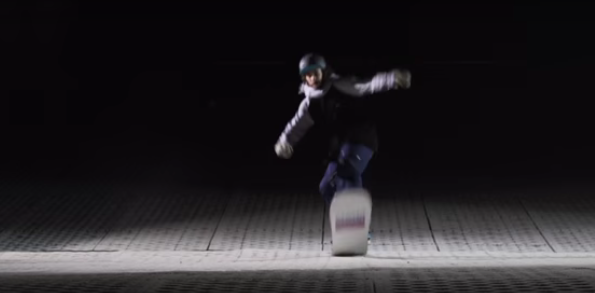
Here’s an artsy two-minute view of what snowboarding can be like on a “dryslope”.


This Week In SeniorsSkiing.com (May 20)

Spring Survey Responses A Wow, Fling Golf, La Nina Coming Soon, More Cycling Series.

La Nina is next year's weather maker. Here's what happens in a typical La Nina year. Credit: NOAA

La Nina is next year’s weather maker. Here’s what happens in a typical La Nina year.
Credit: NOAA

We are truly awed and grateful for the incredible, enthusiastic responses we’ve been getting to our Spring Subscriber Survey 2016. If you’re familiar at all with surveys, you know that response rates are often in the single digits. So far, we’ve received fantastic 27.5% response rate. To us, that means our readers (you) are engaged and interested in what we are trying to accomplish. Thank you so very much. We will report results after we dig into the data.

Our stories this week venture into the world of golf, well, sort of. Fling Golf is a new take on the old game. Check out the video in the story. Flinging is really different. Will golfers like it?

We’ve been watching the weather lately as the spring and summer months are when winter patterns start to emerge. Right now, the El Nino we’ve seen create unusual snow amounts both east and west is fading away. In its place comes La Nina, cooler sea surface temperatures in the Eastern Pacific. This change will definitely play a role in next season’s snow predictions. Check out the story and resources for further study.

Our Northwest correspondent John Nelson has sent a really neat article for the Cycling Series about Arches National Park in Utah. We have learned from our survey that many of you cycle in the non-snow season and Moab, UT, home base for Arches, is a center of activity. Some amazing pictures, too, from John.

Next Week

We will be updating you on the attempt to eliminate free skiing for seniors at Cannon Mountain, NH. We’ve heard that there has been resistance to making that change. We’ll see.

We will also continue our Cycling Series as well as the usual fun stuff.

Finally, we plan to give you a first peek from the highlights of the survey. A quick glance shows there are so many wonderful ideas we can use. Once again thank you so very much for your terrific response.

And remember, there are more of us every day, and we aren’t going away.

Tower of Babel watches over Arches National Park, UT. Credit: John Nelson

Tower of Babel watches over Arches National Park, UT.
Credit: John Nelson

New Golf: Ready For A Fling?

Snowboarding:Skiing as Fling Golf:Golf.

https://www.youtube.com/watch?v=zVDUq1Rqd10

We love sport entrepreneurs.  These folks are creative and have bold ideas about bringing new sport ideas to the public.  The guy who invented Fling Golf is certainly bold.

Into the hallowed traditions of the golf world comes a very different way to get around the links.  The idea is to fling a golf ball from a device that has a close resemblance to a lacrosse stick.  Instead of hitting the ball with a golf club, you flip it down the fairway.  Same basic game, different equipment.

The premise is that it is an easier game to play than “real” golf, and more people can be attracted to golf courses. More people would be a good thing because golf participation has fallen and leveled off since a high in 2003.

How this will go over with 1) other golfers and 2) golf course management is yet to be determined.  Do flingers share the course with clubbers? Do clubbers let flingers into the sanctum sanctorum golf clubs (think Augusta, The Country Club in Brookline, MA, Pebble Beach, St. Andrews)? Do we have the Alta version of golf courses? (Alta doesn’t permit snowboarders). Is that good or bad?

It is interesting how a new way of playing an old sport causes one to reflect on the nature of change.

What do you think, golfers? Are you ready for a fling?

Same game, different gear. Are you ready to share the links? Credit: Fling Golf

Same game, different gear. Are you ready to share the links?
Credit: Fling Golf

This Week In SeniorsSkiing.com (May 13)

Survey Launch, Hiking Boots, Basics Of Fly Fishing, John Christie Passing.

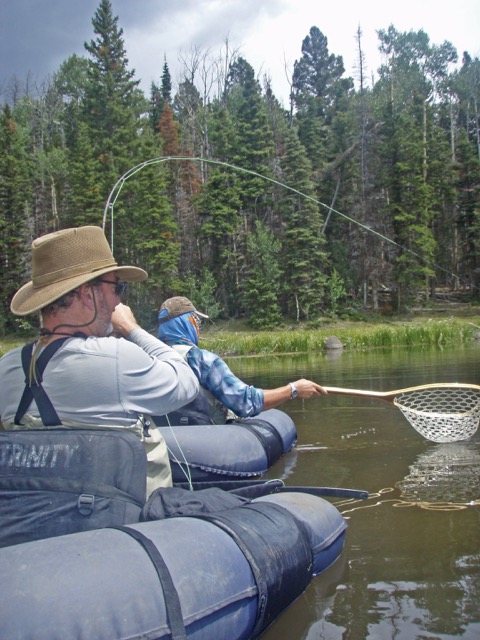
Skiers are attracted to fly-fishing because of the skills, the outdoors, and the lore. Credit: Jan Brunvand

Credit: Jan Brunvand

As we write this, our SeniorsSkiing.com Spring Survey 2016 was sent out just over three hours ago, and we are already approaching a 10 percent response rate.  Three Hours!  Thank you all so much.  We really, really appreciate your support.  If you haven’t responded yet, please join the crowd.

This week features Steve Hine’s story on the highlights of picking hiking boots.  We went to Steve’s REI store for boots before we hiked the Routeburn Track in New Zealand.  Steve’s advice was spot on, and the boots he recommended were fantastic choices for that rugged walk.

We also hear from Jan Brunvand who is switching from one favorite pastime—skiing—to another.  His article on fly-fishing contains some truly wise suggestions for getting involved in this very attractive sport. Anyone can learn the simple basics of casting and fly selection in a few days.  However, the intrigue and delight of fly-fishing is learning the sophisticated intricacies and arcana.  That’s a long range journey. Careful, you can get hooked very easily.

Finally, the ski world lost John Christie whose presence in the business of running resorts and associations goes back at least five decades.  John was a legend in Northeast skiing, founding, owning and managing some of New England’s biggest and well known resorts. We are extremely proud to have published an article in March that John submitted to us about his re-discovery of Nordic Skiing. We are saddened greatly to lose a friend and writer.

Next Week

On we go into mid-Spring.  More Cycling Series, more product information, interesting historical glimpses and perhaps an oddity or two about seniors and sports.

Remember to please respond to our SeniorsSkiing’s Spring Survey 2016.  And don’t forget, there are more of us every day and we aren’t going away.

HikingBoot

The Right Hiking Boot For The Senior You

Balancing The Scales: Hiking Footwear—Comfort vs. Support.

HikingBoot

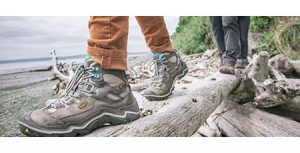
Picking the right kind of hiking boot can make a big difference. It pays to learn the trade-offs between types. Credit: REI

At the shop where I work, questions customers often ask include:

  • “I’ve been wearing the same boots for over twenty-five years, is there anything new?”
  • “How comfortable should my hiking shoes/boots be?”
  • “What’s the boot that gives me the most support?”
  • “Which type of hiking footwear protects my ankles best?”

While hiking footwear is no longer restricted to the heavy leather boots we all wore in our younger days, the variety of hiking boots on the market today and the technology in them can help get you back out on the trails quickly and safely.

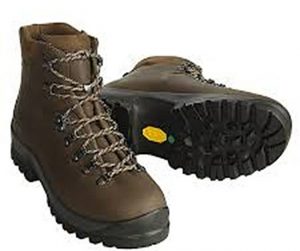
A leather hiking boot is the most supportive, but potentially has some comfort issues. Credit: Steve Hines

A leather hiking boot is the most supportive, but potentially has some comfort issues.
Credit: Steve Hines

I usually suggest either a lightweight and supportive boot or one of the new “mids”. A mid is a lower boot that instead of lacing above the ankle, laces at the ankle. For those who haven’t hiked in a while or are new to hiking and want to “gear up” a balance of features is best.

In a one sense, the choice between Comfort versus Support isn’t binary. Just because a boot is supportive (rigid across the sole from toe to heel) doesn’t necessarily mean the boot must be uncomfortable. Cushioned mid-soles, improved in-soles, softer grippy outsoles and proper break-in all help a boot balance the scale.

SUPPORT

A supportive boot usually needs more break-in time to become that boot you can wear all day. The best supportive boots are usually made of all leather.

Leather boots come in one of three types or “grades” of leather:

  1. Top grain – The lightest and most durable, but they must be cared for.
  2. Suede (split grain) – Resists scratches. However, thicker than top grain can make the boots heavier.
  3. Nubuck (split grain) –Ages nicely. Again, thicker than top grain can make the boots heavier.

COMFORT

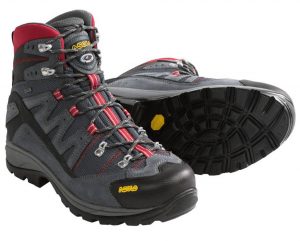
Fabric and leather boots are tipped to comfort. Credit: Steve Hines

Fabric and leather boots are tipped to comfort.
Credit: Steve Hines

Common belief is that boots which combine fabric with leather pieces are more comfortable right away. It is true that combination boots break in quicker. It’s also true that a poor fitting fabric and leather boot can hurt your feet as easily as a non-broken in leather boot.

When people ask me how comfortable a boot should be I use this scenario: Imagine you are involved in some emergency situation in which you are required to have your boots on for 24 hours. Your boots should be comfortable enough that at the end of the 24 hour emergency you would not be dying to get those boots off your feet.

Seems like the hiking world is leaving heavy leather boots behind, instead opting for light weight, low boots and shoes. When I’m asked which is best I usually try to determine the kind of hiking being done and the level of hiking experience. For instance:

  • Terrain – mountain trails, dense woods, higher altitudes
  • Climate, season, weather
  • Duration of the hike or trip
  • Pack weight

In summary, find the right boot for you that will combine the right amount of support and is as comfortable as possible. Remember, a lighter weight boot can have good support and an all-leather boot can be comfortable.


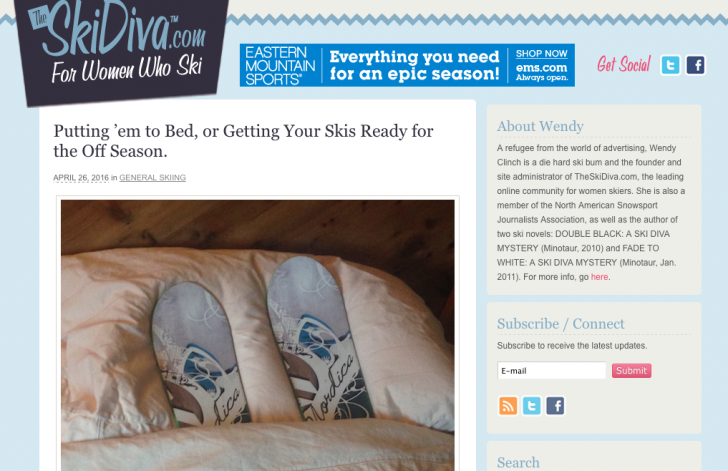
The Ski Diva: How To Put Your Skis To Bed

If You Take Care Now, You Save Time And Hassles Next Season.  Here’s How.

TheSkiDiva


It’s that time.  Despite the teasing snow in Vermont and New Hampshire this week, the season is fini, over, done.  And our friend and colleague, The Ski Diva, is offering advice about how to put your gear to rest for the summer.  If you heed her advice, you can get going a lot easier next time the snowflakes fly.  Thanks, Ski Diva, for letting us use your story.

Cannon

Free Senior Skiing Under Threat In NH

State Legislature Considers Ending Decades Of Free Senior Skiing At Cannon Mountain.

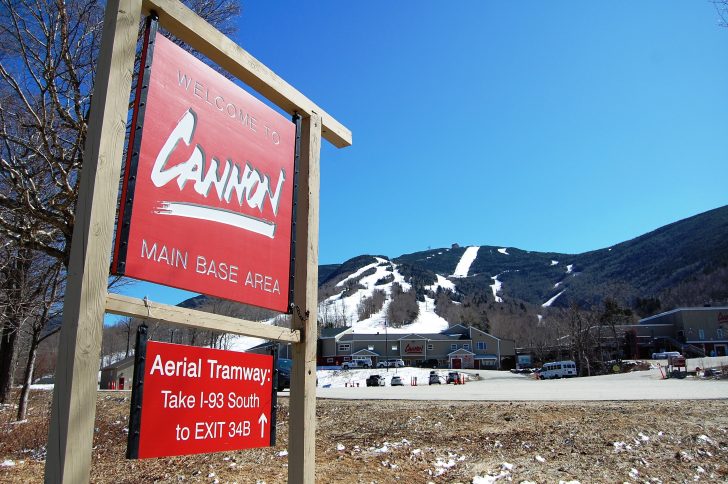
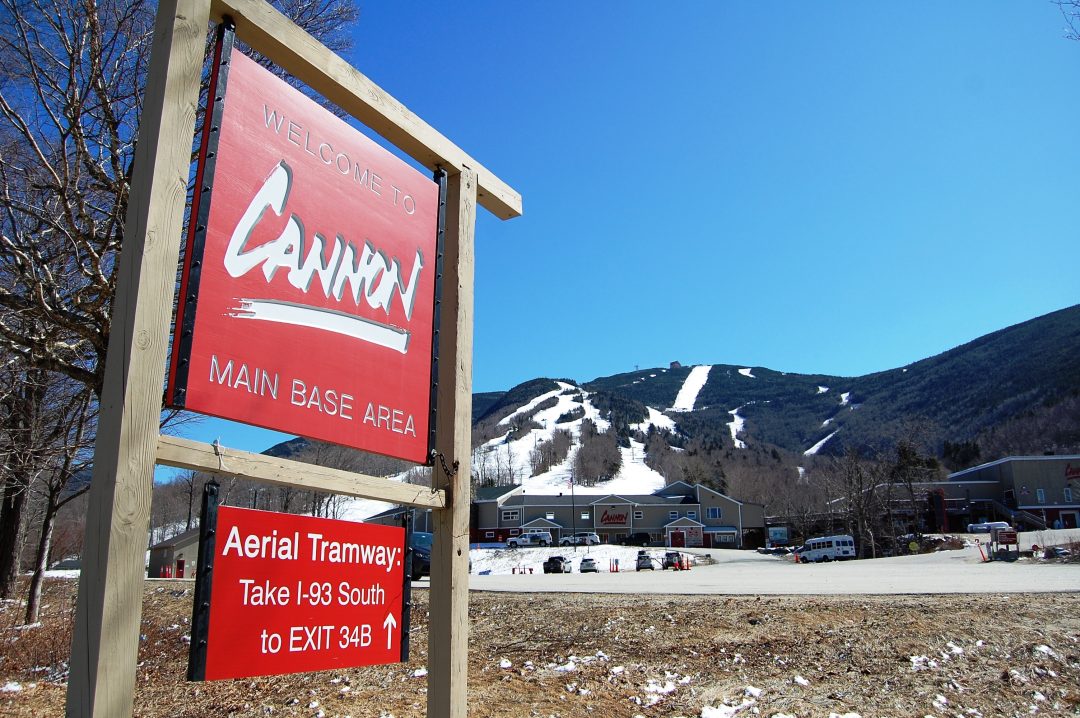
Cannon Mountain is a state-owned area, famous for its aerial tram and free skiing for 65+ seniors. Credit: Cannon Mountain

Cannon Mountain is a state-owned area, famous for its aerial tram and free skiing for 65+ seniors.
Credit: Cannon Mountain

Since 1973, state-owned Cannon Mountain has been the only ski area in New Hampshire to offer free skiing to seniors 65-plus.  This year, a second attempt to end free skiing for seniors was introduced to the legislature.  The change would mean seniors would pay a discount of two-thirds ticket price on weekends and one-third on weekdays.  Free skiing is currently only available during the week.

Supporters of the repeal of free skiing say that the additional revenue is needed to help the NH Division of Parks and Recreation become self-sufficent, a requirement of 1991 legislation.  Opponents say that many seniors in the region are far from wealthy and view the change as a “tax” on seniors who usually ski during the week when the slopes are nearly empty.

In a close vote, the bill, SB 411, was passed by the House and now goes to the House Ways and Means Committee for review before coming back to the House for a final vote.

There are currently about 97 ski areas that offer free skiing in North America, according to the National Ski Area Association.  A handful of small resorts start free skiing at 65, while the majority offer the privilege to 70+ skiers.  An adult ticket currently cost $75 at Cannon; the senior discount would mean a $50 weekend ticket and $25 for weekday.

SeniorsSkiing.com has recommended that the free skiing benchmark should be raised from 65 to 70, still providing access to skiing for the many skiers in the region while creating a reasonable discount for 65-70.  A season pass reflecting a deep discount for 65-70 is also recommended.  We hope the State Legislature of New Hampshire acts with a sense of compromise and fairness in this matter.

What are your thoughts?

Winter In The East: Performance Review

We’ve Been Watching Your Performance, And We Have To Talk.

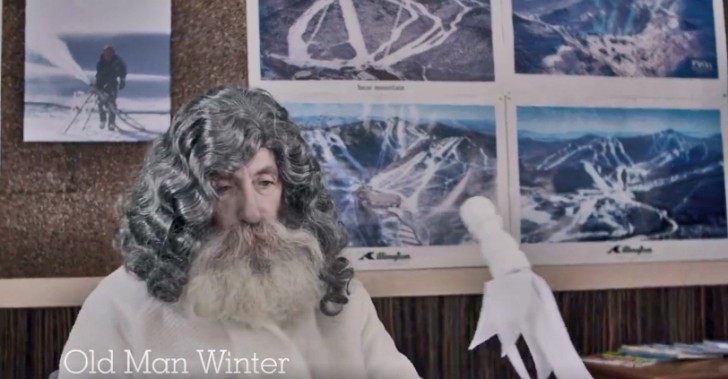
Thanks to Killington Ski Resort for this hilarious take down of Winter.  You guys in the West have no idea…

Killington gives Old Man Winter a little feedback. Credit: Killington Resort

Killington gives Old Man Winter a little feedback.
Credit: Killington Resort


This Week In SeniorsSkiing.com (Mar. 18)

A Senior Boarder Tells All, Crazy Matterhorn Run, Products and Senior Day at Jack Frost.

We received a post card in the mail from a reader who explained that the weekly delivery of SeniorsSkiing.com to her electronic doorstep was lessened by hard-to-read, too-light blue lettering. Notice the new look. There are also some other subtle graphic changes that make it easier to read. Hope you like.

Heading down to Powder Mountain lodge, Dave Hayes took a couple of years to make the transition from skier to board.

David Hayes, former skier, now snowboarder descends to Powder Mountain (UT) lodge.

David Hayes, reader and senior snowboarder, sent in a comment complaining (in jest, he says) that we don’t have any snowboarder stories. So we asked him to write one. Here’s his journey from an avid skier to a pretty good boarder. There’s a video clip in there of him descending to the Powder Mountain (UT) lodge. David is going to write some more about the life of the senior boarder. We also refer you to our friend at graysontrays.com for some interesting posts.

Nick

We also ran across a really scary video clip of Nicolas Falquet, Swiss athlete, skiing from the pointy end of the Matterhorn. Makes you wonder, ahhh, why?

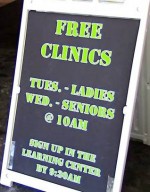
All season long, seniors can take a free, one-hour clinic on Wednesdays. Credit: Bill Runner

Jack Frost senior clinics
Credit: Bill Runner

Jack Frost Ski Area (PA) has a really great senior program that we wish other ski resorts would consider. There’s a free, hour-long clinic every week, terrific, right? Also in the middle of February, JF had a Senior Day featuring demonstrations and presentations. All low-cost, no-cost enhancements to the senior skiing experience. NSAA, are you listening?

Seattle-based correspondent John Nelson shows us Stevens Pass, the venerable Cascades resort. Find out how much they charge seniors. Amazing. Co-publisher Jon Weisberg tries out a ski parka that uses pumped air for inflation. See what he thinks about this novel idea. We always knew he was a bit flatulent.

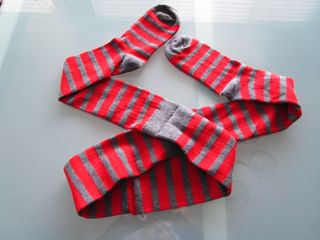
Finally, what to do with your tattered ski socks at season’s end? Why, turn them into a gift scarf, of course. Find out how here. Sure, wash them first.

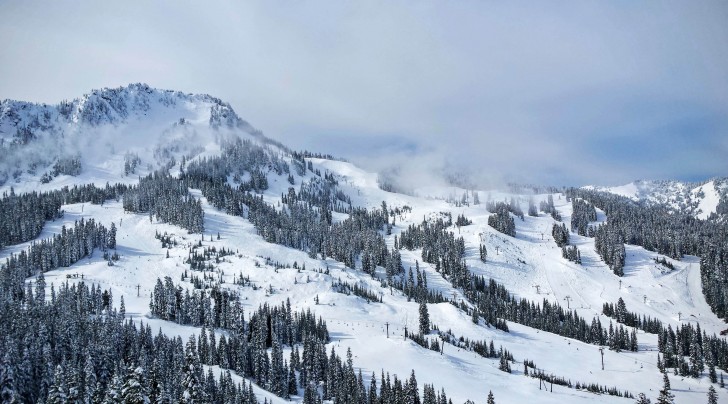
Clearing skies over Cowboy Mountain at Stevens Pass. Credit: John Nelson

Cowboy Mountain at Stevens Pass.
Credit: John Nelson

Preview

The season in the East has ended or will end soon. One industry member said of this year, “It certainly didn’t make the top ten.” Despite that, the weatherman is predicting a late spring snow storm for Boston. We’ll give you our observations of this season from this side of the continent.

There’s more going on out West. We’ll have some more Resort Reviews and ideas for products.

If you have story ideas or comments, please let us know.

Remember: There are more of us every day and we aren’t going away.

socks 8


SeniorsSkiing Guide: Stevens Pass—Low, Low Prices For Seniors

It Is Hard To Beat These Lift Ticket Prices For 70+.

Clearing skies over Cowboy Mountain at Stevens Pass. Credit: John Nelson

Clearing skies over Cowboy Mountain at Stevens Pass.
Credit: John Nelson

I learned how to ski at Stevens Pass, so whenever I return, it feels a little like a trip back in time.

The lifts are updated, of course, but I can’t help reminiscing about those days more than a half-century ago as I learned how to make a parallel turn on the rugged slopes. For many skiers of a certain age who grew up in Seattle, Stevens Pass served the same purpose.

Skiers enjoy the soft snow on Hog Heaven, an intermediate run on the frontside of Stevens Pass. Credit: John Nelson

Skiers enjoy the soft snow on Hog Heaven, an intermediate run on the frontside of Stevens Pass.
Credit: John Nelson

On this trip, I arrived to a classic late-winter storm that brought 10 inches overnight. Instead of the narrow wooden skis of my youth, it was a day for rockered powder planks. As the morning progressed, the skies cleared, revealing Stevens’ dramatic scenery.

If I can hang on for a few more years, Stevens will offer another reason to return: exceptionally low pricing for 70-and-older skiers.

Snow, Terrain and More

  • Location: The ski area is 75 miles east of Seattle on U.S. Highway 2, a major east-west route through Washington state. It takes about 1½ hours to drive to the ski area on good roads.
  • Snowfall: More than 450 inches fall annually on Stevens’ 1,200 acres. The pass is often in the stormtrack for Pacific systems that hit Washington, with major dumps a common occurrence.
  • Terrain: The “frontside” is dominated by two peaks rising from a base of 4,061 feet: Cowboy Mountain (5,845’) and Big Chief Mountain (5,600’). The “backside” is called Mill Valley and drops from the top of Big Chief Mountain into a south-facing basin that bottoms out at 3,821 feet. About 35 percent is rated advanced, with 65 percent rated beginner and intermediate. A large and popular terrain park is located on the Brooks Chair, keeping the boarding tricksters in one location.
  • Lifts, lights: Stevens is designed to handle large crowds. Three high-speed quads ferry passengers, along with four triple chairs and and three doubles. Much of the frontside terrain is lighted for Stevens’ popular night-skiing.

Lot to lift access

  • Parking is a problem on busy weekends and holidays. Arrive early. On weekdays, it’s much better, but you still may need to park some distance from the base area. A passenger and gear unloading zone is available near the lodges.
  • Bus and shuttle services bring passengers from Seattle to the sometimes-busy area.
  • Accommodations: Stevens is an easy day trip from Seattle. The best option for overnight lodging is Leavenworth, Wash., a tourist hub 37 miles to the east.

Culture

  • The vibe: Stevens is a big resort, but it’s much less tony than rival Crystal Mountain. A fun-loving party scene occurs during night-skiing.
  • Dining: The base area has three lodges with busy bars and restaurants and the best coffee (T-Bar Market) of any ski area in the Northwest.

Bottom line

  • If you’re 70 and older, your ski day is a bargain: Just $15. Regular adult passes (ages 16-69) are $69 during peak days and $64 for off-peak days.
  • Grooming is exceptional on the area’s lower slopes. Upper-elevation lifts take skiers into a challenging world of powder and steeps.
  • The south-facing Mill Valley side offers sunny-day exposure in an open bowl.

Trail Map Click Here

Stevens Pass Webcam Click Here

Sunny side of the mountain: South-facing Mill Valley. Credit: John Nelson

Sunny side of the mountain: South-facing Mill Valley.
Credit: John Nelson


SeniorsSkiing Guide: Waterville Valley Resort Is Super Senior-Friendly

The Silver Streaks Make Senior Skiing Unique: What A Great Idea.

Magnificent views provide a backdrop for senior friendly skiing at Waterville Valley Resort. Credit: Waterville Valley Resort

Magnificent views provide a backdrop for senior friendly skiing at Waterville Valley Resort.
Credit: Waterville Valley Resort

When it comes to picking a spot to ski, seniors are after two things: Other seniors to ski with and a price that’s less than a bundle. That is why my husband and I have come to enjoy skiing at Waterville Valley Resort in New Hampshire.

Skiing began here in the 1930s with the building of Civilian Conservation Corps trails on Mount Tecumseh and Snow’s Mountain. Fast forward to 1966 when Olympic skier Tom Corcoran, fresh from Aspen, opened this self contained family resort in a scenic cul-de-sac along the Mad River circled by the White Mountain’s 4,000-foot peaks.

Waterville Valley has great intermediate and challenging terrain, designed by a world champion skier, Corcoran. You’ll find humdingers like True Grit and Lower Bobby’s Run mixed with fun intermediate cruisers with stunning views of the Tripyramids and Osceola. I like Upper Bobby’s to Old T (Tecumseh), or Periphery to Lower Tippy; and the popular Oblivion. High Country puts you up top with more intermediate runs and a peek at Mt. Washington to the northeast. Stop for lunch at the cozy Schwendi Hutte. All trails lead to the base area; you can always find the person you got separated from.

Lot to Lift Access

  • The parking areas can be a schlep, so best to drop off gear, then park. A shuttle picks you up from farther lots.  But, members of Silver Streaks, the Waterville Valley Resort community of senior skiers, get to park close in Lot 1.
  • Visitors staying in the valley can park the car and relax. The valley is very walkable, and a free shuttle connects you to the mountain. The village is really a small town complete with lodging, dining, shops, condos, schools and services of all kinds.
  • Freedom pass (includes White Mountain Athletic Club) comes with your hotel stay at any of five lodges. For seniors, it means more folks to meet and chat with.

Snow and Terrain

  • Waterville Valley Resort has 220 skiable acres with snowmaking ability on every trail. The ski area peaks at 4,004 feet, with a vertical drop of 2,020 feet, 50 trails, and 11 lifts.
  • Novice: 14%, Intermediate: 64%, Advanced: 22%

Senior Program Is Fantastic

Silver Streaks is the longest running senior skiing program in the country. Because of its super senior-friendliness, Waterville Valley Resort has been awarded SeniorsSkiing.com’s Super Friendly Award for two years in a row.  Silver Streaks is open to skiers 50 years and over. It meets Monday-Thursday mornings in the base lodge on non-holiday days for for coffee and pastries and a warm-up run with resort staff.  Other benefits of belonging to Silver Streaks include:

  • Reserved parking area in Lot 1
  • Complimentary Snowsports clinics for seniors only
  • Aprés ski party every Wednesday
  • Banquets and other special events
  • Reduced price NASTAR every Wednesday

Nordic Streaks meets Wednesdays, non-holiday, 10 a.m. at the Adventure Center in Town Square for two hours of Nordic skiing with professional guides. Waterville has a 70+ km trail system groomed for both skate and classic. Streakers then enjoy lunch at the Center, with complimentary coffee and pastries.   Membership rates for Silver Streaks (2016-17): Alpine , $80; Nordic Streaks, $50 (Lift passes not included)

Bottom Line

Senior Rates: Daily Lift Ticket: (65 plus) $57; (80 plus) free. Season Pass: (65-79) $499; Super Senior (80 plus): $25. You can get a season “Value Pass” for $399 (65-79), if you don’t mind a few blackout dates during school vacations. If you buy online, you can get a mid-week lift ticket for as little as $26 midweek. And, if you buy your season pass now, you get free skiing for the rest of the season. Click here for more.

Trail Map Click Here

Web Cam Click Here

Can't beat some of these blue beauties at Waterville Valley Resort. Credit: Waterville Valley Resort

Can’t beat some of these blue beauties at Waterville Valley Resort.
Credit: Waterville Valley Resort

Inspiring “Powder Philosophy”: George Jedenoff, 98

George Says Make The Most Of What You’ve Got.

SeniorsSkiing.com salutes George Jedenoff on his 98th birthday. Credit: Ski Utah

SeniorsSkiing.com salutes George Jedenoff on his 98th birthday.
Credit: Ski Utah

“It’s a pleasure by itself to be in the great, fresh cold air that seems to uncloud your brain…It’s a chance to reflect on your own life…[Skiing] is an opportunity to reflect on the wonderful things you can do…The plusses far outweigh the minuses…Take time to appreciate the positives.”

Thanks to Ski Utah for sending along this message from a ski legend, George Jedenoff, who has been skiing in the Wasatch for the past 56 years.

This Week In SeniorsSkiing.com (Feb.19)

Big News For Our Subscribers, Resort Reviews, Stretching Advice, Boots and a Ski-From-Home Apartment in Borat-Land.

PromotiveWe are extremely excited this week to announce a fantastic and exclusive discount deal for SeniorsSkiing.com’s subscribers.  Now you guys can sign up with Promotive.com (using a special access code you will receive shortly in a separate email), and get discounts on top brands in ski equipment, clothing and lots of stuff.  We know this is important to you because our reader surveys have revealed that discounts are critical, really.  So, there you go, have at it.  Free.  No charge for subscribing to SeniorSkiing and no charge for signing up with Promotive.com. Look for the subscribers-only email with access instructions very soon.

Stories this week include reviews of Mt. Baker, snow catcher of the Northwest, by our newest contributor John Nelson.  Great ticket deals there, seniors. There’s also a guide to skiing easy ways down Mt. Mansfield, Stowe’s magic mountain, by correspondent Tamsin Venn. We remember beautiful, long runs down the Perry Merrill, many, many years ago. Stowe is a special place in the pantheon of skiing., and Tamsin does a great job of introducing seniors to its charming, blue runs. Paul Foy also shows us some lightweight gear that might encourage you to visit the backcountry, a segment of snow sports that is really growing.

We asked Salt Lake City correspondent Harriet Wallis to investigate the stretching challenge we discovered in our recent poll.  We found that 60 percent of you do some level of stretching and 40 percent don’t.  What she found when she consulted with her physical fitness advisor and others surprised her, us and it will you, too.

Co-Publisher Jon Weisberg has a report on Muck Boots, hearty footwear for snow country. Curious how a boot originally designed for cleaning horse stalls has made its way into snow country fashion.

Finally, we have a bit of fun with a most amazing architectural design: An apartment building with a built-in ski slope. Yes, this is legit; it even won an architectural award. Think of the implications for Saturday night parties.

Preview

Because this week was so busy with our Promotive announcement, we weren’t quite able to get the Washington Birthday race story in press.  It is interesting that our queries around the ski industry into that race’s history resulted in little information.  The Washington Birthday race was a “people’s race”, like the Vassalopett in Sweden.  Everyone lines up in a giant, snow-covered field, and off you go.  Was great fun back in the 60s and 70s.  Anyone out there have memories or pictures to share?

That's what Borat says.

That’s what Borat says.

More Resort Reviews, product ideas, and ideas for making snow sports rewarding.  Remember, if you want to communicate with other readers, find people to pal up with or ask questions, use the FORUM.  Click the menu in the upper right, blue bar.

Thanks again for subscribing to SeniorsSkiing.com.  There are more of us every day, and we are not going away.

SeniorsSkiing Guide: Mt. Baker, Snow Catcher

Hey Seniors, Low Ticket Prices In The Northwest!

With Mount Shuksan looming behind, a snowboarder shreds soft snow at Mt. Baker Ski Area. Credit: John Nelson

With Mount Shuksan looming behind, a snowboarder shreds soft snow at Mt. Baker Ski Area.

Mt. Baker is a storm factory.

This North Cascades ski area holds the world record for snowfall in a season—an incredible 95 feet dumped here in 1998-99!

I arrived in mid-January to a modest three inches new, but that was on top of a foot that had fallen the previous day. The snow was soft; the scenery stunning.

The Canyon, one of Mt. Baker's signature runs, takes skiers and boarders into a narrow drop between mountain walls. Credit: John Nelson

The Canyon, one of Mt. Baker’s signature runs, takes skiers and boarders into a narrow drop between mountain walls.

I immediately took a few runs down The Canyon, one of Baker’s signature drops. Skiing between these towering mountain walls is a rush.

But best of all was Pan Face, a wide-open powder shot into a lovely mountain basin. Empty slopes meant fresh lines all day.

To top it all off, Mt. Baker is an incredible bargain for senior skiers, with some of the lowest ticket prices in the Northwest.

Snow, terrain, and more

  • Location: Baker is 52 miles from Bellingham, Wash., on State Route 542. It is the northernmost ski area in Washington and is closer to the Vancouver, British Columbia, metropolitan area (about a two-hour drive) than it is to Seattle (two and a half hours).
  • Snowfall: Pacific winter storms seem converge on Mt. Baker; it averages 640 inches annually, far more than any ski area in the state.
  • Terrain: About 1,000 acres are lift-served with 31 percent rated as advanced and 69 percent rated as beginner and intermediate. The Mt. Baker backcountry is enormous with huge, avalanche-prone big-mountain drops. You’ll need a partner, transceiver, shovel and probe to go out of bounds.
  • Vertical: 1,589 feet (the base is 3,500 feet; chairlift access to 5,089 feet).
  • Lifts: Eight chairlifts (none high-speed) operate out of two base areas: White Salmon (open every day) and Heather Meadows (open weekends and holidays only).
  • Views: If you’re lucky enough to visit between storms, you’ll have a commanding view of 9,131-foot Mount Shuksan to the north, a stunning, glaciated wall of rock and ice. Mount Baker (the volcano) stands at 10,781 feet to the south and is visible from certain locations of the ski area.

Lot to lift access

  • Parking on a weekday at Mt. Baker is a breeze; I arrived 10 minutes before opening and parked in the front row next to the ticket window at White Salmon Lodge. Weekend parking is busier and skiers might find closer lift access at the Heather Meadows base.
  • Bus service operates daily out of Bellingham.
  • Closest lodging options (motels and condominiums) are in Glacier, Wash., a foothills town about a half-hour from Mt. Baker. Bellingham (population 82,000 and counting) is a lovely port city about 75 minutes away with top-notch dining and accommodation options.

Culture

  • The Vibe: Old-school friendly. Everywhere I went, I was talked up by locals who were happy to share their knowledge and pride in Mt. Baker.
  • Dining: Lodges operate out of the two base areas, but the best option is the cozy Raven Hut, a mid-mountain lodge at the base of Chairs 4, 5 and 6.

Bottom line

  • Baker is a true bargain. Weekend and holiday tickets are $58 for adults; seniors 60-69 pay $50, and those 70 and older pay $39. Weekdays are even cheaper: $53 for adults; seniors 60-69 pay $41.
  • Big powder dumps are common, and locals are happy to share their advice.
  • Snowboarders love Mt. Baker for its rough features and natural half-pipe; out-of-bounds, big-mountain terrain attracts hard-cores.

Trail Map Click Here

The open, powdery slopes of Pan Face drop into the Heather Meadows side of Mt. Baker Ski Area. Credit: John Nelson

The open, powdery slopes of Pan Face drop into the Heather Meadows side of Mt. Baker Ski Area.
Credit: John Nelson

Poll Results: Seniors Are Serious Skiers

Our first major poll reveals a compelling factoid about our readers.

Last spring, we did our first Subscriber Survey to learn, among other things, just who our readers were.  We learned that you guys like discounts first and foremost.  We also learned you that 55 percent of our respondents skied more than 30 days a year!  Now that is impressive considering that the average number of skier days for all demographics was 7.6 in 2013-14, according to Snowsports Industries America.

That our readers are passionate about skiing continues to be validated by a new sliver of data.  SeniorsSkiing.com’s first major poll revealed that in late August and early September,  66.3 percent of respondents had ALREADY bought their season passes and another 6.3% were about to.  Clearly, you were taking advantage of early-bird discounts. And you definitely planned to ski at a favorite ski area.  A lot. Here are the results.


PollGraph copy

Women-Only Snowshoes: Vive La Difference!

Special Thanks to Roger Lohr, Editor and Publisher of XCSkiResorts.com for allowing us to post this article which first appeared on that site.

About half of all snowshoers are women, who snowshoe to experience nature, to exercise with friends and family, for backcountry access, and to have outdoor fun throughout the winter. The various snowshoe companies have been catering to this market by offering a broad selection of women’s-specific snowshoe technologies recreation and fitness, but do the women’s snowshoes go beyond just a change in cosmetics?

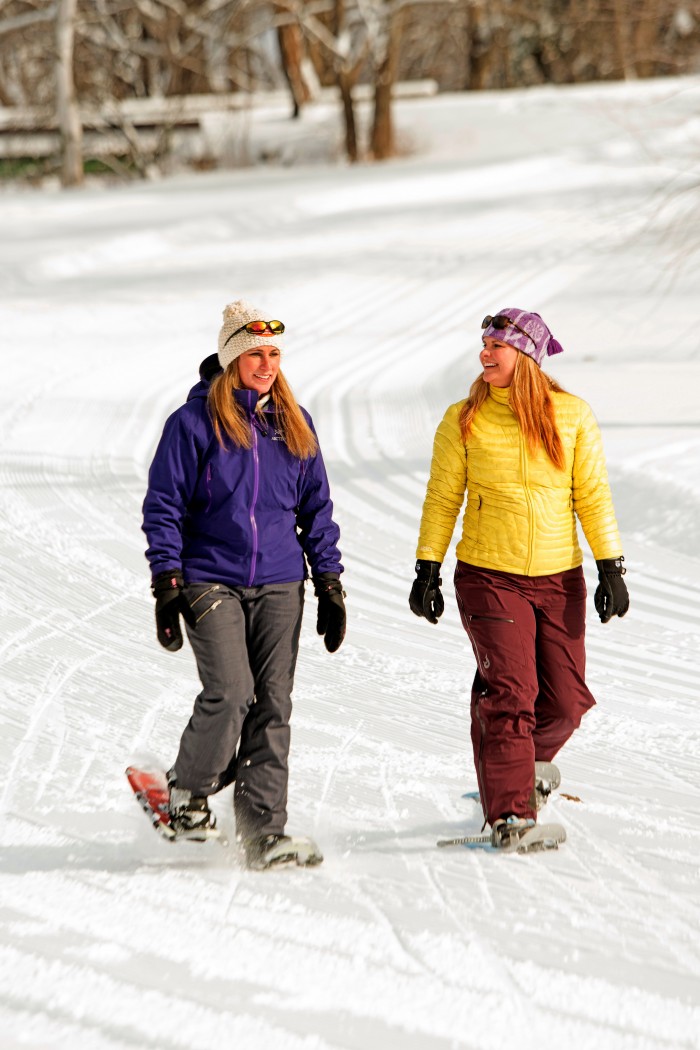
Woodstock Inn attracts women snowshoers who can step along in women-only gear. Credit: Woodstock Inn

Woodstock Inn attracts women snowshoers who can step along in women-only gear.
Credit: Woodstock Inn

Tubbs Snowshoes pioneered the development of women’s-specific snowshoes by offering patented binding technologies that custom fit women’s boot sizes and by ergonomically engineering frames that are tapered at the tip and tail to accommodate women’s shorter strides. The result was lightweight, comfortable, high-performance snowshoes and many of the other brands have followed suit.

There are a few differences between Tubbs’ men’s and women’s snowshoes. On average, women have a narrower stance and shorter gait, so women’s snowshoes are narrower in width. Women’s average weight range is both more light weight and a smaller range than men’s, so they provide snowshoes in a shorter size for women, longer for men. The Tubbs men’s and women’s bindings differ, providing the optimal fit for the average women’s boot size and volume range, versus a larger average men’s boot size and volume range. Foot size also affects the optimal position for the heel lift, so the placement of the heel lift on men’s snowshoes varies from the placement on women’s snowshoes.

The Atlas Snowshoes Company conducted gait studies and biomechanics research to create snowshoes that enable women to hike and run with the most natural stride possible, while making the snowshoes both comfortable and lightweight. The research revealed that women have a greater Q-angle (at the knee where the thigh bone angles in from a woman’s wider hips) and abducted gait that create specific issues when snowshoeing. Women also tend to pronate (collapsing arches) pointing to the need for bindings to support the arch of the foot.

MSR snowshoes for women balance a naturally narrower gait and the need to “float” on the snow. Credit: MSR

According to the people at MSR, the studies conducted by Tubbs clearly showed male/female anatomical differences. However, when these differences are translated into physical products the design changes are not as noticeable. For example, women generally walk with a narrower gait than men. Therefore, a very narrow snowshoe would suit women better, but the snowshoe width has a direct impact on flotation so the final design can’t be too narrow. The ideal width snowshoe for women is a balance between very narrow to accommodate gait and wider for adequate flotation.

MSR believes that it is important to look beyond the measurements and understand how the snowshoes feel. Thousands of hours of field testing showed that subtle differences are noticeable. The major male/female differences with men’s and women’s versions of MSR are with decks and bindings. The women’s deck shape is optimized for snowshoe performance (traction & flotation) and a female gait. The bindings are sized to meet the proportions of a women’s footwear. There is also specific MSR technology such as Axis™ Gait Technology (Women’s Lightning Ascent Snowshoes), which allows women to compensate for varying degrees of toe-out or toe-in. This technology provides laterally adjusting the bindings independently of the frame, ensuring efficient, parallel-tracking snowshoes regardless of a women’s natural toe-out or toe-in stance. This means that the binding itself can swivel on the snowshoe to adjust for varying degrees of natural toe direction allowing binding alignment with your natural stance rather than forcing you to point your feet directly ahead.

Yukon Charlies Snowshoes has the YC Pro II Series women’s snowshoes, which are designed with features specific to the needs of the female snowshoe enthusiast. The rockered V shape tail enhances performance and allows for a more natural stride. These snowshoes are lighter, stronger and more reactive than any of the company’s other women’s snowshoes.

Yukon Charlies’s Advanced Series for women is a feature-packed “go anywhere” snowshoe is designed by women, for women. The rocker V tail allows for a natural stride from a walk to an aerobic sprint, while the integrated heel lift and the axle system makes Yukon Charlie tout them as their best women’s snowshoe ever.

Redfeather Snowshoes has three styles of Hike snowshoes with the SV2 pull handle binding. There’s also a choice to get the snowshoes in a kit with poles and a bag. The Redfeather Hike has sizes of 22, 25, 30 (inches) for women up to 150, 175, and 200 lbs.

Tubbs Snowshoes and Atlas Snowshoes have shown the greatest commitment to women’s snowshoe products and they are probably the largest snowshoeing product brands. Tubbs Snowshoes has 11 models for women (in seemingly every snowshoe category) including Flex ESC, Flex TRK, Flex ALP, Flex RDG, Flex Vrt, Wilderness, Mountaineer, Frontier, XPlore, and Xpedition.

Atlas Snowshoes has six options for women including the Electra 8 and 9, Endeavor, Fitness, Race, and Run.

Few of the snowshoe companies invest in marketing directly to women but the Tubbs Snowshoe event “Romp to Stomp Out Breast Cancer” Series, is very popular focused on women. This year’s event at Frisco Nordic Center in Colorado was attended by more than a thousand people! The series, which has been hosted at sites across North America has raised funds and awareness since 2003 bringing in more than $2.8 million for the fight for a cancer cure.

Whether the trail conditions are light fresh snow, crust, slush or ice, women want to trust their snowshoes for all-condition durability, excellent traction, flex for control, and comfort. Women are coming to expect that their snowshoes are specific to their needs and built to withstand frequent use offering many seasons of recreation, fitness and adventure.


My Fitness Journey Continues: Part Six

The Battle Of The Bulge Rages On! (Thankfully, Reserve Forces Are On Their Way.)

Getting back into shape is a combination of courage, knowledge and just doing. SeniorsSkiing.com Correspondent has all three working for her.

Getting back into shape is a combination of courage, knowledge and just doing it.

As I enter the sixth month of my personal (and public!) journey to fitness, I continue to make slow, steady progress toward my goal of being in great shape for the slopes come the first snowfall (and it IS supposed to snow in the Sierra this winter). Faithfully attending my four weekly exercise classes? Check. Doing weights three times a week? Check. Continuing to lose up to an inch in my measurements each month? Check. Drinking more water? Check. Getting more sleep? Check. Getting on the scale once a week? Check. Losing weight? Not so much. Since I started this journey, I’ve lost a total of 14 pounds, but I still have 26 pounds to go. So three pounds a month instead of two pounds a week is a bit disappointing. But the good news is that I haven’t gained anything back, and I have established a few good eating habits, such as snacking on edamame instead of salami and crackers. But I need to crank it up!

So it was quite fortuitous for me when a special issue of the highly respected University of California, Berkeley, Wellness Letter arrived in my mailbox a few weeks ago. The entire Special Fall Issue 2015 is devoted to body weight and all its attendant issues. It includes an overview article that looks at our nation’s battle with obesity, and sidebars on BMI (body mass index), why it’s so hard to keep the weight off that one’s lost, and a brief analysis of recent diet studies.

Watching what you eat is the key to weight loss. Ix-nay on the donuts.

Watching what you eat is the key to weight loss. Ix-nay on the donuts.

But the article that really caught my eye was “18 Keys to Healthy Weight Loss: Tried-and-true advice that can help tip the scales in your favor.” I did a quick check and found that I was adhering to nine of them, which was encouraging, but I plan to add a few more to accelerate my weight loss. Some of the pointers are well-known, such as eating a healthy diet that’s tilted toward vegetables, fruits, whole grains, fish, and lean meats and away from sugary foods and saturated and trans fats, and being a conscious eater (eating smaller portions, eating more slowly, and keeping a food diary). But there were several less-intuitive but scientifically proven pieces of advice that I’m going to add to my arsenal of weapons to help me win my battle of the bulge. For instance, “Key #7: Go for volume (low-energy-dense foods)” recommends

Exercise is only part of the picture. Diet plays the most important role in weight loss.
Exercise is only part of the picture. Diet plays the most important role in weight loss.
eating foods with lower calories relative to their weight and volume, in other words, foods that have high water and high fiber content such as fruits and vegetables and broth-based soups rather than low-moisture, denser, high-fat foods such as crackers, cheese, cookies, etc. Case in point: a cup of grapes is the equivalent of 1/4-cup of raisins. In short, think “watery” foods! “Key #10: Limit variety at meals” points out that “you’re likely to eat less if you have less variety, since foods similar in taste and texture dull the palate (a phenomenon called sensation-specific satiety).” It offers a good suggestion for buffets and parties, just in time for the upcoming holiday season: when facing a whole array of appetizers, choose just the two or three that most appeal to you and limit yourself to one trip to the table. It will keep your appetite from accelerating.

Accompanying the article are several useful sidebars that help you calculate your daily calorie count, outline which kind of diet will work best for you (surprisingly, genetics and individual proclivities play a major part in what will actually result in the best outcome for you), offer a critical look at diet supplements, and discuss the part exercise plays in losing weight.

The editors of the newsletter had just posted this particular article on their website, so you can read it in its fascinating entirety! Just click here.
To calculate your BMI, go to to this NIH site.
Editor Note:  SeniorsSkiing.com salutes Correspondent Rose Marie Cleese for chronicling her journey back to fitness.  She continues to be an inspiration to those of us who wonder about our conditioning as we age.  Keep going, RMC.  We’re all rooting for you!