Tag Archive for: senior skiing

The Late, Late Show: Killington Still Killin’ It

Skiing In New England In May?

Yes, it has been a curious winter and curiouser spring.  We had a snow drought in the West, a middling winter in the Rockies, and bitter cold in the East.  Now, it’s mid-spring, and we’ve heard of quite unexpected, new powder skiing in the Rockies and the Dakotas.  Did people actually go skiing out there after the lifts closed down?  Someone please tell us; we thought most areas in the region closed early to less-than-ideal snow conditions this spring.

Superstar Trail is open for business at Killington on May 22. Credit:  Paul Remillard

Superstar Trail is open for business at Killington on May 22.
Credit: Paul Remillard

Now we hear from SeniorsSkiing.com Subscriber Paul Remillard who reports he and his pal Joe spent May 22 at Killington, VT., on the bumps and has pictures to prove it.  He reports conditions were still top to bottom on Superstar with corn snow and a hard base between moguls.  “Sweet,” says Paul.

This unusual ski season refuses to end.

Pal Joe dismounts the lift at the top of Superstar. Note trees. Credit: Paul Remillard

Pal Joe dismounts the lift at the top of Superstar. Note trees.
Credit: Paul Remillard

Try Nordic Walking: Many Benefits By Adding Poles To Hike

Poling While Hiking Is An Exercise Multiplier

Roger Lohr is co-founder and editor of XCSkiResorts.com and a noted writer on all the varieties of Nordic skiing.

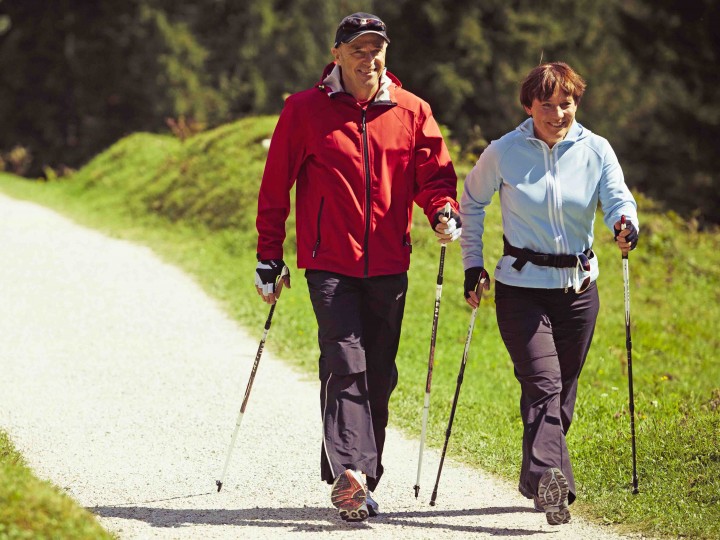
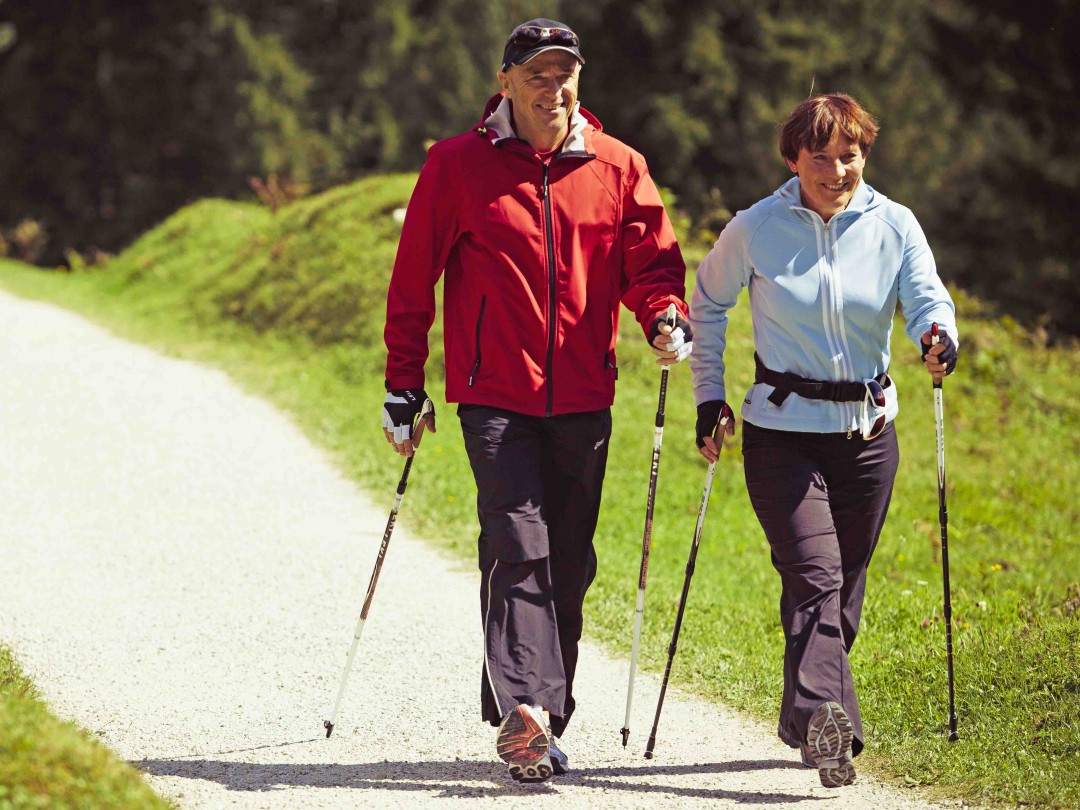
Walking a la Nordic raises efficiency of exercise by 40 percent. Credit: Leki

Walking a la Nordic raises efficiency of exercise by 40 percent.
Credit: Leki

More than 10 million Europeans of all ages and fitness levels are Nordic Walking (also known as Ski Walking) with special Nordic Walking Poles. This new fitness activity turbo-charges the normal walking regimen burning as much as 40 percent more calories compared to regular walking.

For those who are unfamiliar, Nordic walking is a fitness activity that combines walking with specially designed poles to engage the upper body muscles.

Nordic Walking poles help individuals with balance issues, knee issues or new knees, hip issues or new hips, back issues (including those with rods in their back), weight issues, multiple sclerosis (MS), Parkinson’s Disease, neuropathy, arthritis, bursitis, scoliosis, lumbar stenosis, fibromyalgia, post polio, osteoporosis, stroke recovery, cancer recovery, and other limitations to walking. Nordic Walking is helping thousands of people get off the couch, get outside, start walking safely, and effectively launching much needed walking campaigns.

The Human Kinetics book entitled Nordic Walking for Total Fitness by Suzanne Nottingham and Alexandra Jurasin covers the topic. Trekking (hiking with poles) and Nordic walking are two different activities that use very different poles and techniques. It may sound silly, but perhaps “walking is not just walking.” The pole angle, weight, grip, and straps are different between the aforementioned modes of walking. The Nordic walking pole is designed to allow your hands to relax in order to target the larger wrapping muscles of the back. But using poles of any kind automatically stimulates your spine and all of the muscles around it, even with inefficient technique. When walking, the key postural muscles of the core and upper body are engaged.

The book also includes fitness assessments, sample workouts for varying levels of interests from first timer to cross training triathletes. There are also suggestions about customizing your program. Training program recommendations are offered for building distance, fluctuating daily intensity, and rest days.

I’ve been a Nordic Walker for a few years and found many of the claimed attributes in the book regarding posture and exercise to be true. I’ve always been in search of a way to decrease the amount of time spent exercising, so I was sold when I heard that using the poles increases caloric burning by 40 percent. Being a cross-country skier, it is easy to quickly master Nordic walking. After a summer of Nordic walking, I noticed a marked improvement in my cross-country ski poling in terms of strength and timing. It seemed that I increased the amount of forward momentum that was attributable to poling and I was able to pole stronger and longer when skiing.

Nordic Walking for Total Fitness provides a foundation for anyone, ranging from those just looking for an activity to lose weight to health aficionados interested in taking it to higher levels of fitness.

Nordic Walking for Total Fitness is available for $19.95 plus shipping from Human Kinetics at www.humankinetics.com or call 217-351-5076. 

Product Update: ThinOptics Now has Bold Colors, New Magnification

You’ll Always Have These Readers With You.

Finally, you can read your cell phone, trail maps and restaurant menus with ease because you can always have these very cool reading glasses with you. And the case snaps onto your Smartphone for ready access. Now isn’t that novel!

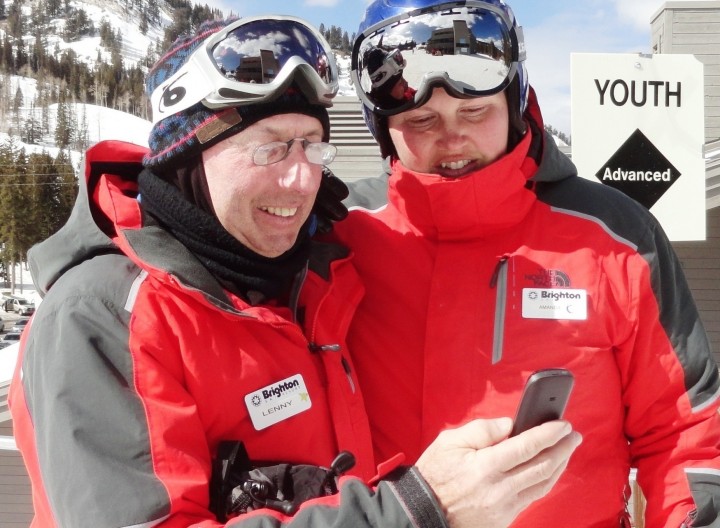
Brighton Resort ski instructors Lenny Bernstein and Amanda Cimini check the phone. Lenny is wearing ThinOptics. Credit: Harriet Wallis

Brighton Resort ski instructors Lenny Bernstein and Amanda Cimini check the phone. Lenny is wearing ThinOptics.
Credit: Harriet Wallis

ThinOptics readers solve the problem that has plagued seniors since Smartphones were invented. The phones are smart, but the info is too small to read. ThinOptics to the rescue. These tiny glasses perch comfortably on your nose then store away on your cell phone. No more fumbling for bulky reading glasses or passing glasses around.

After millions of dollars of research, these virtually indestructible readers were introduced last year, and they rocketed to popularity with seniors. Now they come in vivid frame colors as well as traditional black and clear. In addition. a new magnification level has been added.

Check our original review from October, 2014 here.

Silver Streaks: A Model For How Ski Areas Can Serve Seniors

You Always Have Someone to Ski With at the Waterville Valley Program.
Gold_Waterville_Valley_Resort[Editor Note:  Waterville Valley’s Silver Streak Program was a Gold Senior Friendly Award Winner, based on SeniorsSkiing.com’s First Ski Area and Resort Survey.  Silver Streaks is the oldest senior ski program in the US.  We hope that other ski areas can start “Thinking Seniors” like Waterville.]

“I’m so excited, I just turned 65,” says Anne Pelletier, booster for the Silver Streaks, a program for the 50-plus set at Waterville Valley, N.H.
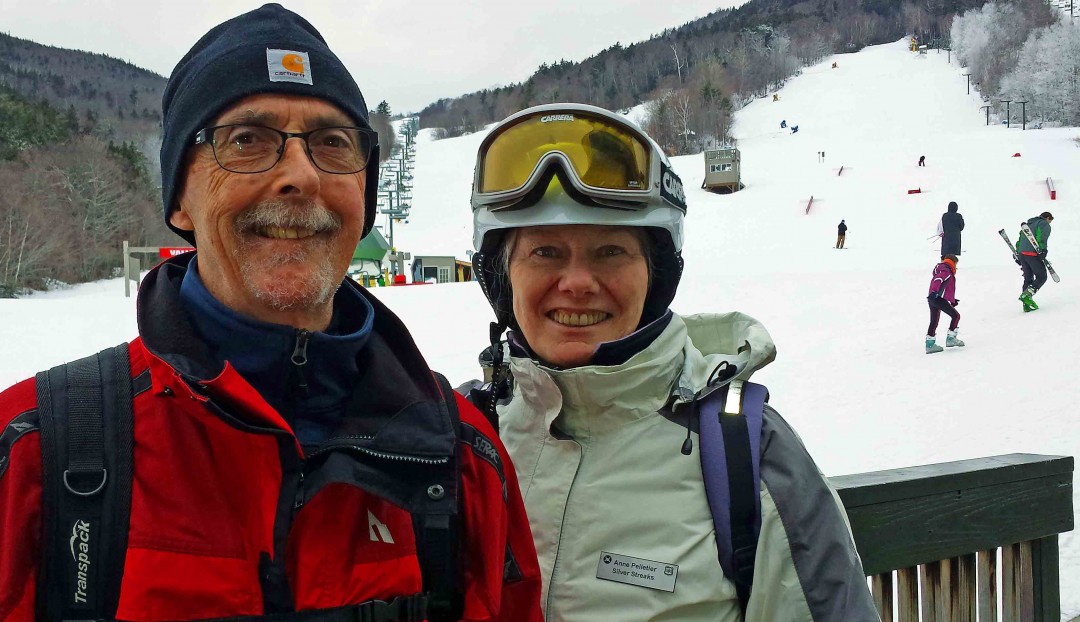
Silver Streakers Mike and Anne Pelletier totally enjoy the benefits of the Waterville Valley program. Credit: Tamsin Vinn

Silver Streakers Mike and Anne Pelletier totally enjoy the benefits of the Waterville Valley program.
Credit: Tamsin Venn

Nearly 30 years old, it was one of the first senior ski programs in the country to cater those 50 and over, a demographic astutely valued by Waterville’s founder ex-Olympian Tom Corcoran.

Pelletier, a lively woman in fire-red ski pants and state-of-the-art heated jacket, has reason to be happy. At age 65, the Waterville season pass benefits kick in: $379 for non-holiday midweek skiing.

For much longer, though, she has been with the Silver Streaks.

For the $95 joining fee, senior skiers get:

  • Reserved area in Parking Lot # 1 (one 90-year-old joined for that reason alone).
  • Complimentary coffee and pastries in the Base Lodge from 8:30-10 a.m. in special meeting area.
  • Complimentary Snowsports clinics for seniors only.
  • Après-ski party every Wednesday at rotating venues.
  • Banquets and other special events throughout the season.
  • Reduced price NASTAR every Wednesday.
  • Nordic program every Wednesday for two hours of Nordic skiing with professional guides, followed by lunch at the Nordic Center.

The program runs Monday-Thursday, non-holiday, early December to mid-March.

Also every Monday night the Coyote Grill at the White Mountain Athletic Center offers a $12 dinner; après-ski two times a month. (unfortunately $5 martini night was retired for reasons easy to imagine).

Other events: a Memorial ski run from the top in single file to remember those who have died in the past year.

The Pelletiers like the friendships, but they have an ulterior motive.

Says Anne, a platinum (top) NASTAR racer, “We have a need for speed.” Husband Michael, 72, is a top-ranked marathon runner in New England.

Silver Streakers Randy and Reggie Breeckner moved full time to Waterville 15 years ago from their home in the Litchfield Hills in northwestern Connecticut where they raised seven children.

Reggie notes, “I’m going to try snowshoeing when I get old.”

“You develop strategies not to get hurt,” adds Randy, a six-decades-long New England skier. Those include not skiing when it’s icy, foggy, or on busy weekends.

What about snowboarding?

“We know only one person in the group who snowboards,” he says.

Albert and Kristina Ruehli from southern New Hampshire are also on board. Albert learned to ski at age six in his native Switzerland.

Says Albert, “the mountains, the view, it’s a beautiful sport, plus you’re expressing yourself on the hill.”

“I went to a meeting and one of members said, ‘You’re too young to join,’ so of course I joined immediately,” says Kristina, 71.

 “We figure when we can’t ski anymore, we should just let an avalanche take us,” adds Kristina philosophically

Julius Feinleib from Thornton, N.H, has grandchildren ages seven and nine who now whiz by him on the trail. His reasons for joining are simple. “Just being with people I recognize.” He also likes the cup of coffee and doughnuts.

For more on Silver Streaks, click here.

 

Knee Replacement—What Do I Do Now? Part 5

If you want to get back to skiing, learn to love your physical therapy.

It took my expert knee replacement surgeon one hour to cut, saw, hammer and install each new knee. It took me a year to rehab them. I was astounded by how long it took.

Correspondent Harriet Wallis works it. The key to recovery is following through with your  physical therapy regimen. Credit: Harriet Wallis

Laurie O’Connor, friend of correspondent Harriet Wallis, works it. The key to recovery is following through with your physical therapy regimen.
Credit: Harriet Wallis

I was in good physical condition before surgery, and I had the mind set that I would bounce right back. I’m strong. I’m tough. I thought that a set of new knees would be something like taking my car in for an oil change. Drive in with old oil. Drive out with new oil and keep on rolling. I was incredibly wrong. The analogy didn’t work. Healing and rehab take time

The good news is: The body is a healing machine.

The bad news is: Lots of people slack off their physical therapy exercises as soon as they can get into the car and do their grocery shopping. They lose their motivation and unfortunately they don’t get full benefit of their new knees. They probably aren’t skiers. We skiers are motivated to get back to the sport we love.

Eight months after surgery I was back on the slopes – starting on the opening day of the season. I skied 93 days that year. EEEhaw! (During the winter before knee replacement, all I could do was skid down a bunny slope.)

Friends asked: “How long did it take to get used to artificial knees?

My response: “About six turns.” My new knees worked wonderfully.

Skiing is good exercise, but it’s not focused physical therapy. Continuing the prescribed exercises was vital. Now, two years later, I still do certain exercises. I believe that maintaining artificial knees is an ongoing process.

My new knees do have some minor disadvantages. I cannot squat with my butt down to my heels. Artificial knees aren’t designed to bend that far. Therefore I sit on a low stool while weeding the garden. And swimming laps confounded me because it took more strokes to get across the pool. I think that’s because metal is heavier than bone, so my legs are lower in the water. I had to find a new balance point for swimming.

The bottom line is this: When the surgeon is done, your work is just beginning. Do your rehab exercises with gusto – and I’ll see you on the slopes.

Note: This is a five-part series in which SeniorsSkiing.com’s correspondent Harriet Wallis describes her knee replacement journey with tips to guide you if you’re anticipating knee replacement. Part 1: Inspired by a ski patroller with artificial knees. Part 2: Research 101 – why and how to do it. Part 3: Interviewing surgeons and questions to ask. Part 4: How I found the right doctor for me. This is Part 5, the final segment of the series.


Special Edition: First SeniorsSkiing Ski Area Survey Results

Free Skiing, Deep Discounts For Senior Skiers Plus “Senior Friendly” Awards

oldfashionedskierWhich areas are truly trying to accommodate 50-plus skiers? To find out, we surveyed 85 North American resorts. Several resorts stand out for giving senior skiers special attention and deals. They received the new SeniorsSkiing Skier Friendly Award. Those with the deepest discounts and best amenities received Gold awards. Those with better than average discounts received Silver Awards.

The survey had a 34 percent response and will be conducted annually. We hope that by asking the right questions for our readers, SeniorsSkiing.com will help drive greater recognition, discounts and amenities for senior snow sports enthusiasts.

SeniorsSkiing “Senior Friendly” Gold AwardsGold_Waterville_Valley_Resort

Of all respondents, six stand out with the best discounts and amenities.

  • Whitefish Mountain Resort, MT — Free skiing for 70-plus skiers
  • Hood Ski Bowl, OR — Free skiing for 71-plus skiers
  • Ski Whitewater, BC — Free skiing for 75-plus skiers
  • Alta, UT — Free skiing for 80-plus skiers
  • Lake Louise, AB — $20 season pass for 80-plus skiers
  • Waterville Valley, NH — Hosts Silver Streaks, the country’s longest running senior ski program. “We provide the structure and facilities; the members organize their own events,” explains Peter Sununu, Waterville spokesman. Members gather daily for coffee and pastries in a designated meeting area; enjoy mid-week NASTAR races, complimentary clinics, preferred parking, après-ski parties, awards banquets, other amenities.

Free skiing as a strategy to introduce the next generation

The percentage of all midweek senior skiers at resorts which offer free lift tickets for seniors is estimated to be about 50 percent. Mt. Hood Ski Bowl’s Hans Wipper explains the value of providing free skiing to the older customer, “We want to reward loyal skiers, and we want them to bring their extended families.”

SeniorsSkiing “Senior Friendly” Silver Award

Silver_Copper_MountainThese respondents had great discounts for seniors:

  • Sutton, QUE — 55 percent off tickets Tuesdays, January – mid February.
  • Okemo, VT — pre-December season pass purchase (includes Mt. Sunapee, Pico Peak, Killington, Crested Butte): 45 percent off for 65-plus; 70 percent off for 70-plus.
  • Ski Butternut, MA — pre-December season pass purchase: $125 for 65-plus
  • Sugarbush, VT — $199 for Mid-Week Boomer Pass for 65+ (was $99 before Sept 9).

Other Silver Awards went to:

  • Alpine Meadows, CA
  • Copper Mountain, CO
  • Vail, CO
  • Hunter Mountain, NY
  • Windham Mountain, NY
  • Deer Valley, UT
  • Snow Basin, UT
  • Snowbird, UT
  • Red Mountain Resort, BC
  • Whistler Blackcomb, BC
  • Mont Tremblant, QUE

Takeaways: Lift ticket deals are out there, especially for the early-bird, pre-season buyer. So are discounts in restaurants, rentals and other amenities. Look and ask.

We also encourage ski area management to consider the business benefits of catering to the interests of the senior skier: increased mid-week traffic, younger “tag along” full paying clients, and a loyal and vocal clientele.

Winter 2015 Forecast: Maybe Snow, Maybe Not

Handicapping 2014-2015 winter can lead to confident-sounding but wrong predictions.

By now, you’ve noticed that the weather in the past few years has become a series of conversation-starting, concern-causing, head-scratching, question-asking phenomena.  Last winter was—as they say down east— a “hoser”.  In the Northeast, we had the most persistent, bitterly cold winter in memory.  According to the National Weather Service, New England temperatures frequently and persistently ranged at or below normal low ranges from January to the end of March.  Even the Mid-Atlantic States had a cold and snowy season.  Early snow and a lot of it created deep powder conditions in the Alps, especially Italy.  Meanwhile, the Polar Vortex brought a cold and snowy season to the Northern Rockies and Midwest while California was unseasonably dry and warm.

What’s in store for 2014-15?  Joel Gratz of OpenSnow, an interesting online forecasting site we recommend to our readers, is

OpenSnow Compared US and International Models Credit: OpenSnow

OpenSnow Compared US and International Models
Credit: OpenSnow

not enthusiastic about long-range forecasts in general.  Nevertheless, he compared a number of US and European forecasts for the upcoming 2014-15 season and found some consensus:  Dry in the Northwest, Snowy in the Far West and uncertain from the Rockies eastward to New England.  Just to test the reliability of long-range predictions like this, he compared the accuracy of several forecast models from the prior 2013-14 season with actual results.  Those predictions were “far from perfect”.

So, he concludes, “Can we trust seasonal forecasts from these models? Based on last year (predictions), definitely not.”  He suggests we treat all of this as entertainment.  On the other hand, this year’s El Nino might actually “force the weather to behave in more predictable ways.” At the end of the day, who knows?

Besides, the Boston Globe reported this June that long-range climate is warming fastest in the Northeastern states, led by Maine and Vermont and in the South West.  Conclusion:  Ski when and where you can.

When Skiing Was New: Early Scenes From 30s To 50s

Skiing was once considered a fad like Mah-Jong.  That was a long time ago.

Here’s a seven-minute series of clips from John Jay’s “Ski Down The Years”, a visual history of skiing from the early days of rope tows in the mid-30s in New England to the FIS championships at Aspen in 1950.  From our current perspective, those initial attempts appear at once hardy and comical.

A flop on the Inferno, Mt. Washington, circa late 1930s.  Credit: John Jay.

A flop on the Inferno, Mt. Washington, circa late 1930s. Credit: John Jay.

Ski Mobile in North Conway, mid-1930s.  Credit: John Jay

Ski Mobile in North Conway, mid-1930s. Credit: John Jay

Oh, the technique! Downhill shoulders leading through a turn.  Bending forward at the waist.  Oh, the savior-faire.  Lowell Thomas, the celeb journalist, has a knowing air about him as he adjusts his skis.  And Gary Cooper puffing away at Sun Valley.  Oh, the early glory of powder skiing.  There’s a series of shots of Dick “Straight Down” Durrance skiing powder at Alta.  Amazing.  Most interesting is the formation skiing of the Tenth Mountain Division training on Mt. Rainier.

We’re lucky we have this kind of footage to reflect upon.  We remember the legacy of those early days in our own first skiing gear and experiences in the mid-1960s.  Leather lace-up boots, bear trap bindings, army surplus goggles, rope tows.  What equipment from your first days can you track back to that glorious time?


Powder Skiing Fantasy in Swiss Alps

 GoPro Channel hosts unbelievable footage from little camera.

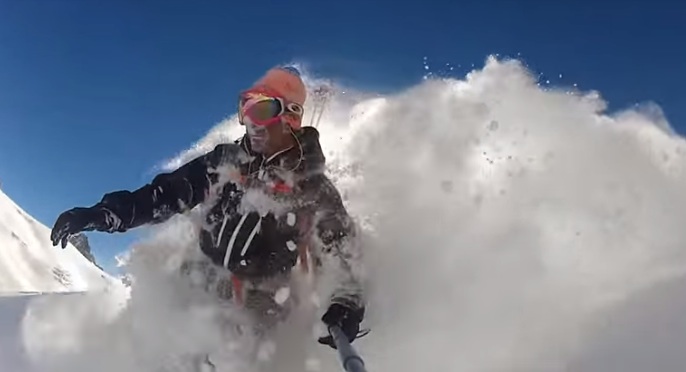
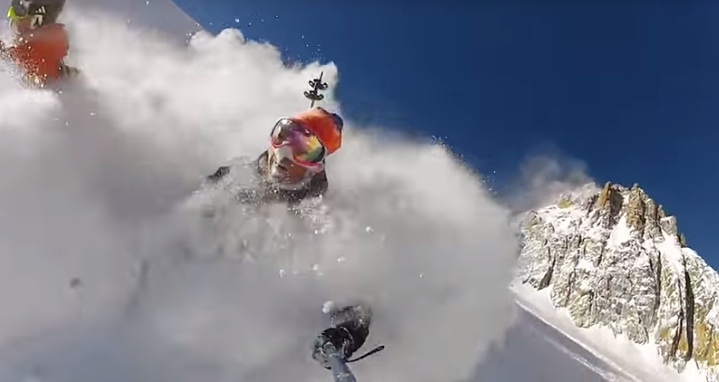
Can you see how Nate Wallace is doing this?  He’s holding a little GoPro camera on the end of an aluminum pole.  The effect shows that this kind of powder skiing is nothing short of exhilarating.  If you’ve never tried deep powder, this is what it’s like.  Click here to be transported.

Truly like a dream.

Excellent Credit: Nate Wallace/GoPro

Excellent
Credit: Nate Wallace/GoPro

Exhilarating. Credit: Nate Wallace/GoPro

Exhilarating.
Credit: Nate Wallace/GoPro

Incredible. Credit: Nate Wallace/GoPro

Incredible.
Credit: Nate Wallace/GoPro

CADS: How to Add Years to Your Skiing

An ingenious invention extends your ability to ski well on not-so-great knees

On the high side of usefulness for seniors, we find CADS, a remarkable body weight suspension system for skiers and riders that reportedly helps relieve knee pressure by acting as a spring between your butt and your knees.  Instead of

Strut from butt to boot Credit: Dan Leeth

Strut from butt to boot
Credit: Dan Leeth

gravity relentlessly pressing down—using your knees as a fulcrum—CADS is said to relieve the pressure.  Less pressure, less muscle tension, less fatigue and more skiing.

CADS stands for Constant-force Articulated Dynamic Struts—think of your car’s shock absorbers, and you have an analogous idea.  The skier wears a harness around the waist and under ski pants. Thin pole-like struts attach to the waist belt and to a fitting in the back of the ski boot.  The struts are detached on the lift and remounted at the top of the hill.

CADS inventor Walter Dandy said in a January, 2013 Dallas Morning News article, “It’s like sitting on a bedspring.  It pushes down on the ski.  It pushes up on the skier.”  He claims, “You don’t get tired, and your knees don’t hurt.”

“CADs does a novel thing,” said Walter in a SeniorsSkiing phone interview.  “In addition to weight bypass, CADs replicates what the thigh muscles do, so you’re reducing the strength requirements of your own muscles.”  CADS also puts downward pressure on your ski, allowing the ski to be in more continuous contact with the snow.  “That reduces muscle tension and fatigue,” said Walter.  “One senior skier held a tuck position from the top of one Vail ski run to the bottom without burning his thighs.  He said he couldn’t even do that when he was 25!”

Walter said that people whose knees hurt when they are skiing are prime prospects for the CADs system.  “Our customers are typically life-long skiers—engineers, physicists, surgeons, dentists and the like.  These people are self-reliant, knowledgeable, but they have a knee issue that is threatening their skiing experience.  So, instead of quitting, they try CADs.  These are not fashion-sensitive people, and they want to keep skiing.”

Struts and Bands Supply the Force Credit: CADs.com

Struts and Bands Supply the Force
Credit: CADs.com

The CADS website has lots of videos of regular folks skiing with the device.  The hard-data medical research and testimonials collected over the past twenty-four years are impressive.

If you happen to be in Vail, you can get a free on-slope demo from Walter using trial equipment.  If Vail isn’t in your plans, you can order by mail.  Walter will ask you to send your boots and ski pants so he can fit them out before sending you back your new CADS.  Or, you can install the devices yourself.  Walter is also happy to advise prospective buyers curious about the technology and whether it could be potentially helpful for them.

Yes, it looks very different, but according to the testimonials on the CADS website, this really works.  And if you can keep skiing and skiing well, who cares about stares?  “The change in attitude in people from before trying CADs to after is remarkable,” said Walter.

We like the idea of CADs because it gives senior skiers a choice where there wasn’t any before.  We plan to try CADS this season and post a review.

Have you seen or used CADs?  Tell us your story.


We haven’t yet tried CADs and can’t officially endorse it until we do.  But it certainly is worth a look if you are thinking of quitting because of bad knees.  Here’s the official promotional video.

First Ski Area and Resort Survey Results Coming Soon!

We were curious about what ski areas and resorts were doing to accommodate the rapidly growing number of senior snow enthusiasts who were coming to play.  So, we launched our First Ski Area and Resort Survey, polling a number of key areas in the US and Canada about lift discounts, amenities and special deals for seniors.  The Good News:  There are great deals out there including FREE SKIINGat some very special senior-friendly ski areas.  The Opportunity: There is a lot of room for improvement for expanding many ski areas’ programs that will attract seniors. We are still muddling through the survey data, but we’ve already identified a number of ski areas that will be named Super-Friendly for Senior Snow Enthusiasts.  Stay tuned to find out!

SurveyGraphPost2

One of our excellent questions.

Senior Skier’s Skin Game: Five Protective Tips

SkinCareElephant_FAIL

While a great mid-winter day on the slopes may nourish the soul, it can do the opposite for aging skin. It’s common knowledge that our skin changes with age. It becomes thinner, loses fat, loses sweat and oil glands, and generally takes longer to heal than it did in younger days. Fortunately, with a little extra effort, skin can be kept healthy skiing into your golden years. Here are five keys to maintaining healthy, aging skin:VanillaMint

1. First and foremost, prevent skin cancer. Even on cloudy days, skiing at high altitude on sun-reflective snow can expose the skin to harmful ultraviolet rays. Skin cancers like basal cell and squamous cell carcinomas can take residence on areas of the face exposed to sun. That’s why choosing the proper sunscreen is key. Since both UVB and UVA rays are linked to skin cancer, it’s important to use a “broad spectrum” sunblock of at least SPF 30. Click here for natural products-based sun screen.

2. Be mindful of your meds. Antibiotics like tetracycline and sulfonamides make the skin more photosensitive, as do thiazide diuretics used for hypertension. If you take these meds, think of reapplying your sunblock more frequently or aim for an even higher SPF.

KissMyFace3. Don’t forget your lips! Not only is the skin on the lips thinner than on the rest of the body, your kissers contain very little melanin, a pigment that helps protect against the sun. People use lip balm to combat dryness, but if it doesn’t contain SPF , its glossiness can attract the sun’s rays even more! Choose a lip balm with a high SPF. Here’s a natural product-based balm to check out. It’s called Kiss Your Face Lip Balm.

4. Stay well hydrated. Seniors tend to have dry skin in general and spending most of the day outdoors in the cold, dry air can make this problem worse. One way to combat dryness is to stay well hydrated. Aim for drinking half your body weight in ounces of water, and replenish an additional 8 ounces for every “vice” drink (caffeine or alcohol) consumed. Not sure you’re drinking enough water throughout the day? Check your pee! Unless you’re on certain medications or supplements that would change the hue of your urine, aim for a light yellow to beige color. Anything darker than that is a cue to reach for the water bottle.YesToCarrots_edited-1

5. Cool it during apres ski. After a day on the hill, nothing feels better than a hot shower, jacuzzi or bath. While great for sore muscles and relaxation, it may not be so good for dry skin. Hot water strips the skin of moisture. Keep your time in the bath to a minimum or lower the water temperature. And be mindful of soaps and body washes; chemicals like sodium lauryl sulfate can strip the skin of its natural protective oils and trigger irritation. Aim for sulfate-free cream cleansers that contain skin-nourishing ingredients, like oatmeal or shea butter. After your bath or shower, moisturize with an alcohol-free lotion. Like sulfates, alcohol can strip away the protective barrier on the skin and cause flakiness and irritation. Two ideas for moisturizers: Yes To Carrots Body Butter and Vanilla Mint Body Wash. Sounds yummy.

Skincare is probably the last thing on your mind when exploring the hill. By incorporating these healthy habits into ski days, common skin issues are less likely to arise, and your focus can stay where it belongs: Down the mountain!

Why Seniors Still Ski

A celebration of senior skiers, including American deep powder legend, Junior Bounous describing his descent of Snowbird’s Pipeline when he was 80 years young (he’s about to turn 89). Why does he still do it?

Snowbird’s Pipeline Conquered By Junior Bounous at 80 (Taken March 8, 2014)

DSC04514

Snowbird’s Pipeline (the top to bottom ravine in center of picture) : One of North America’s toughest ski routes, descends from Twin peaks above Snowbird. First skied by Junior Bounous in the early 70s. He skied it again during his 80th year. Junior is an inspiration to senior skiers everywhere.
&nbsp

Skiing Super Heroes!!

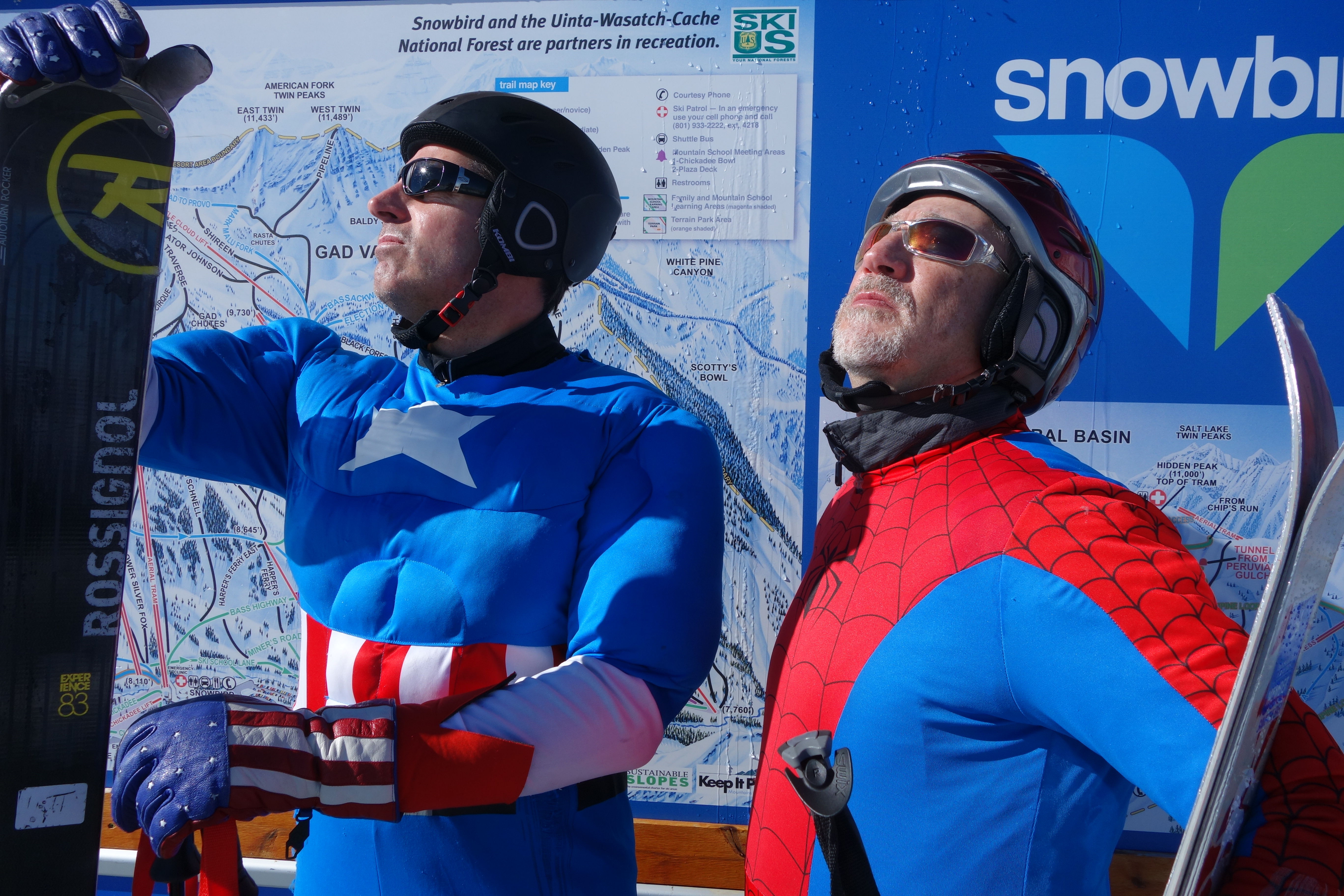
Why not ski in costume? Credit: Jon Weisberg

Why not ski in costume?
Credit: Jon Weisberg

Spidey and Cap’n America, Skiing’s Super Heroes, about to save the day at the top of Snowbird tram. Senior Skiers, do you ski in costume? If you could choose one, what would it be?

Long Time Between Runs

SeniorSkiing

It is a sunny and cold Thursday morning in early February.  There are a handful of other skiers on the mid-New Hampshire ski area lift.  I decide to go right at the top.  Trail is untouched, the corduroy grooming marks fresh and waiting.  I turn, effortless.  Ahhh.  I turn again, making a big, wide arc.  The feeling is like floating, my new skis carving and then, almost without a conscious notion, shifting to the other edge.

Hard to believe this is my first real run in thirty-five years.  Okay, there was an expensive, uncomfortable holiday weekend on rental skis and boots in the 90s with cranky children, cheesy condo and unrelenting cold.  It was an exception.  I had left my real skiing behind long time ago.

I started in college, in the mid-60s.  Back then, it was blue jeans and rice-paddy parkas with Moriarity hats, wooden skis, leather boots and Cubco bindings.  In the early 70s, I lucked out and worked as an assistant editor at Skiing Magazine working and rubbing elbows with some of the greats.  Now, that was fun.

I was Associate Editor in the early 70s

I was Associate Editor in the early 70s

The next few decades had me running a business, flying here and there, finding and keeping clients.  No time, no interest in skiing.  Too cold, too time consuming.  The closest I made it to the slopes was working on my laptop while watching my wife kids from the day lodge window.

Then I came back.  With retirement came time.  I looked at boots and skis in a ski shop one day and said to myself, “I can do this now.”

I find almost everything about skiing has changed for the better during my long hiatus.  The skis are magical instruments, boots are comfortable, clothes are warmer, the lifts are faster, the trails well groomed and, because of my senior status, the lift tickets are relatively cheaper.  And, there is no more need for speed.  Instead, I relax into the slow turn, pressing down to feel the slice of the edge.

Parabolic skis rule! Turning has never been more easy or more fun.

Parabolic skis rule! Turning has never been more easy or more fun.

Apparently, I’m not the only veteran coming back to skiing.  Although we are still a small percent of the total, the number of skiers over 65 has doubled since the 1997-98 season, according to a National Ski Areas Association demographic study published in 2013.  And we ski more often than younger skiers, too.  We get in 9.5 skiing days per season compared to a national average of five days.  We are using the gift of time that retirement has bestowed.

What does it take to get back?  Fitness for starters. That’s a good idea, regardless. A good ski shop to fit you out with the proper equipment, maybe starting with decent rentals.  A lesson might be helpful, too.  A couple of friends to go with.  A nice winter day in the middle of the week.  More and more runs.

What’s your return-to-skiing advice?

Tag Archive for: senior skiing

Nothing Found

Sorry, no posts matched your criteria