


The Value of Guided Skiing
Try It, You’ll Like It OR Let Me Toot My Horn.

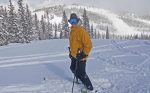
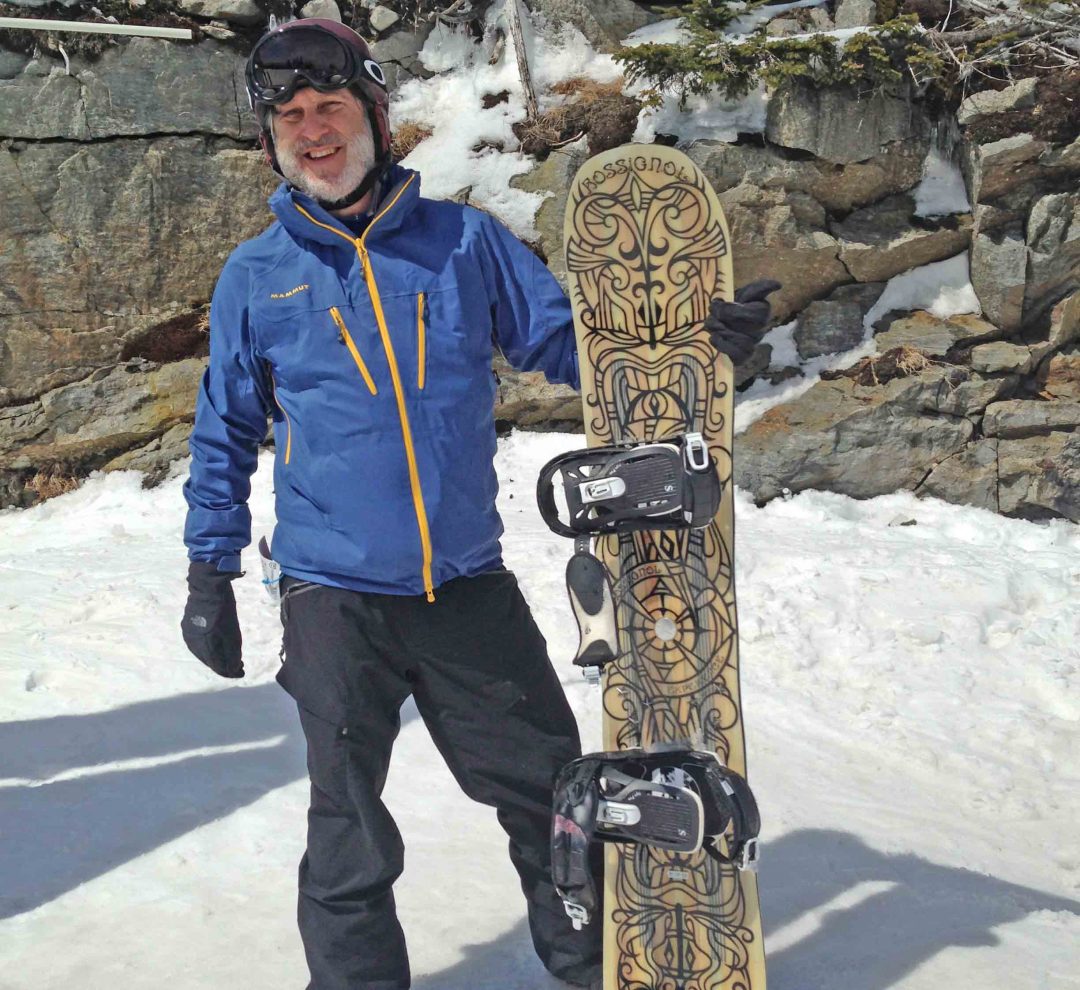
Ski Guide Peter McCarville, who lives in western Colorado, assumes a pose at Snowmass.
Credit: Peter McCarville
When I tell people that I am a guide for skiing and hiking I, basically, receive two different responses. The first response goes something like “cool, I want your job, ….”. The second response goes something like “why does someone need a guide for skiing, that sounds silly….?”. I definitely like the second question because it is an opportunity to make my case for hiring a guide when skiing anywhere in the world. I know it is popular and common to hire a guide for heli-skiing or for skiing off-piste in Europe, but I want to make the case for hiring a guide or going with a guided group when on a domestic (US) ski trip.
In March 2016, I met some friends in Summit County, Colorado, to ski at Copper and Breckenridge. I have not skied at these places in years but considered them my home mountains when in my 20s. I generally am a very good route finder and have good orientation skills. Hell, I am a geologist by profession and a guide in these kinds of terrains with guests! On this trip, however, I found that I was having lots of trouble finding the best terrain and snow for my interests. I just could not remember the mountains well enough to maximize my fun. In addition to the snowstorm we were skiing in, there were some new high peaks at Breckenridge that I had never skied. Combine that with thin cover (although we just had 36” of snow in three days) and flat light, and I found myself tentative on some of the slopes. My buddy, with whom I was skiing, considered Breck his home mountain. However, he is my stockbroker, not a guide. At numerous times, we were lost and not in the bowl he thought we were in. Once he lacked the information to tell me about the thin cover on a line I was skiing, and I had a nice chat with some shallowly buried rocks at about 30 mph. Also, the lines at the lifts! Why are we at this lift, I said to myself. OK, I should have known; weekend in March, Breck, Spring break, and he is a broker, not a guide.
As a guide, I show my guests the best line to ski on a hill. I describe the fall line, the band of rocks to avoid, and where the lift lines aren’t. I also look out for their safety as well as many other small helps.
Although ski guiding in Europe is quite common, in the US we have very few listings of guides for skiing. Backcountry guides are available via companies that provide Mountain Guiding Services. The best ways to engage a ski guide at a ski area for the day or longer are: 1) word of mouth, 2) a search service like toursbylocals.com, or 3) a mountains’ concierge service. The free on-mountain guiding services, offered by larger ski mountains, may be short in duration, but just may suit your needs. On the other hand, a personal, paid, guiding service is a completely different experience. Remember, a guide is worth his or her weight if they place YOU on the right terrain and snow conditions, in an unfamiliar area, to meet your skiing ability. And, keep you safe doing it.







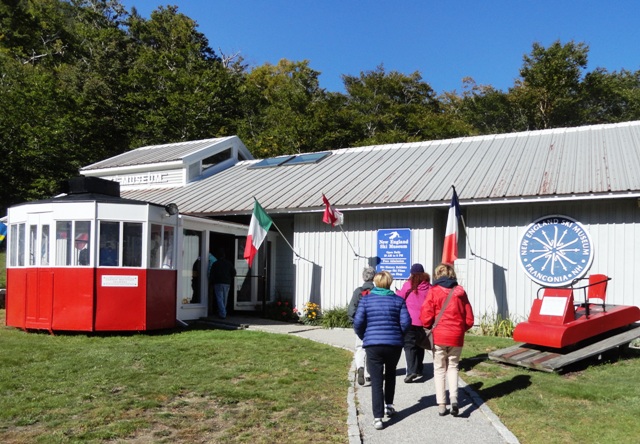
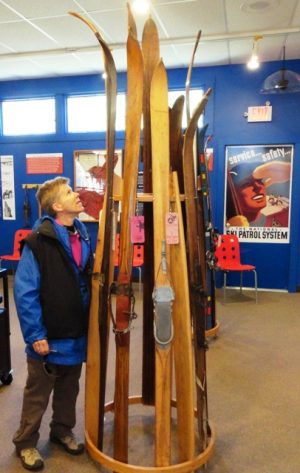 The sled-looking thing was Cranmore Mountain’s idea of an uphill lift. Skiers sat in the sleigh, and it was hauled uphill on a trestle.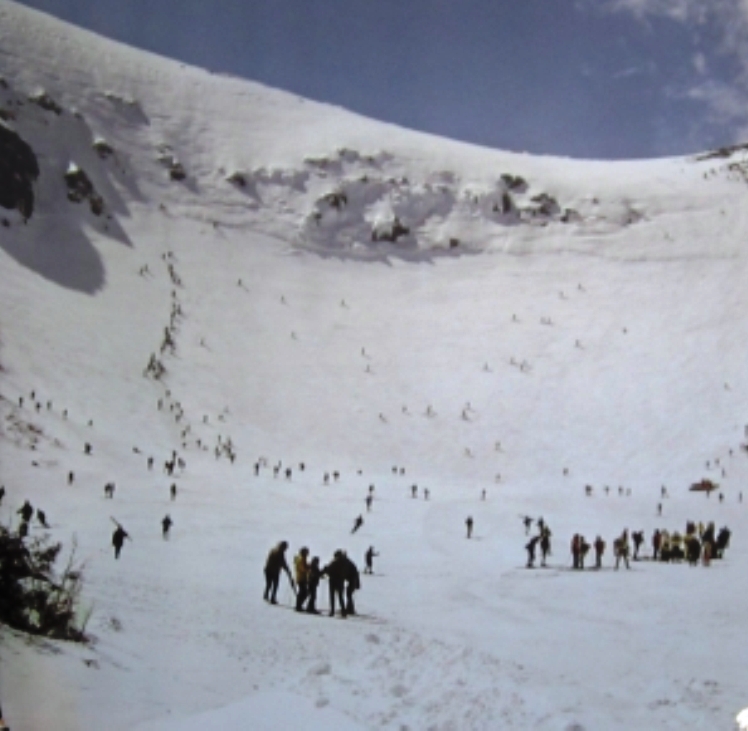
















 Consider the size of the foot in Figure 1. This illustration shows two feet which are the same length, but each require different size boots. There are different fittings for short-arched and long-arched feet. Proper boot fitting incorporates not only overall length (heel-to-toe measurement) but also arch length (heel-to-ball measurement). Boots are designed to flex at the ball of the foot. Correct fitting properly positions the ball joint in the boot and provides room for the toes so they are not confined.
 Once you’ve chosen a boot, check the length by untying the boot, shove or kick your toe into the toe of the boot and slide your finger down behind your heel as shown in Fig.2. You need a finger’s width between the heel of the boot and the heel of your foot for the boot to be long enough.
 Volume – The measure of the boot around the forefoot has no alpha-numeric indicator (and neither does your foot). Fig. 4 shows the location of the volume and it is important because too much volume could cause your heel to be continually lifting up causing a heel blister. Too little volume and you’d have problems with your toes.
 Shape – Some boots have a slight curve inward from the heel to the toe and some are very straight. Like volume, there is no alpha-numeric indicator of shape. Shape is important to prevent pinching or sliding. If the boot pinches in any area as shown in Fig. 5, then the boot may be the wrong shape for you.