Last issue, a handful of readers had difficulty accessing articles. If you find yourself in that situation, please see the guidance at the end of this document.
Several weeks back, we introduced LUV2SKI, the photo gallery of of skiing-oriented license plates.
So far, we’ve collected about 100 of these clever combinations of letters and numbers gracing vehicles around the country. Many of the images will be included in the Licensed To Ski poster we’re producing as a gift for the upcoming SeniorsSkiing.com fund-raiser.
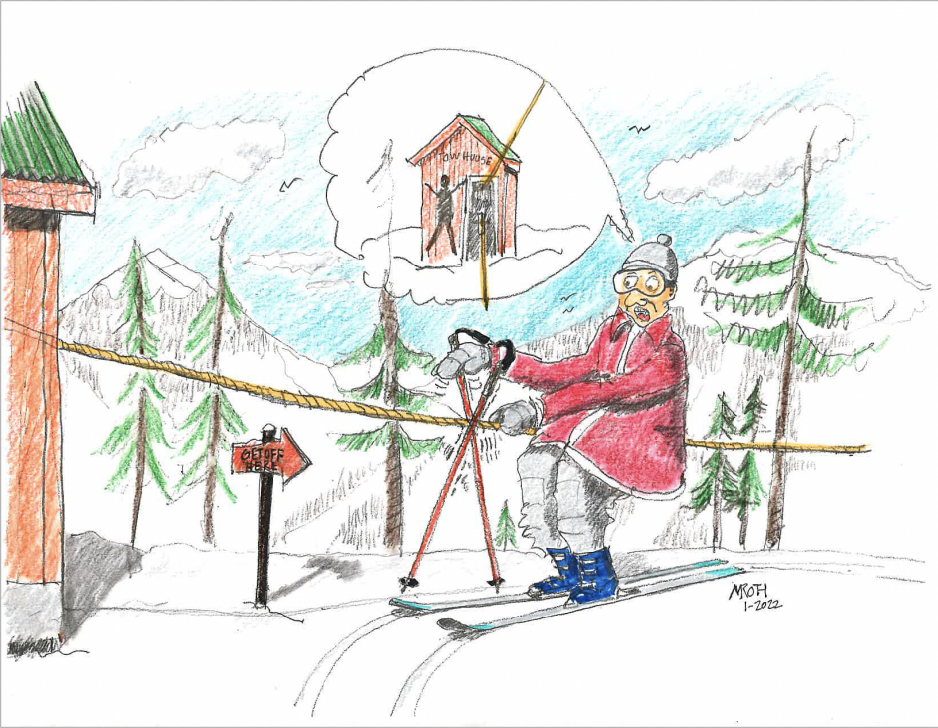
This week, we’re introducing a new, yet-to-be named feature. Fellow ski journalist, Mike Roth, is a talented cartoonist, whose work has appeared on this site and elsewhere. Mike will be illustrating personal stories submitted by SeniorsSkiing readers. Take a look at Hanging On for Life and (Almost) Getting Eaten by the Rope Tow to see his clever take on two reader tales. Send in any story from your skiing experience. We’ll publish the most interesting along with a Mike Roth illustration.
In this week’s Short Swings! column, Jon contemplates what to do when the sky is falling. He also reports on current industry developments and a variety of timely skiing curiosities.
Snow seems to be selective where it chooses to fall. Skiing Weatherman, Herb Stevens, explains the dynamics of the weather and gives an accurate forecast of what that means for ski areas across North America. Paying attention to Herb’s reports provides a good education in meteorology.
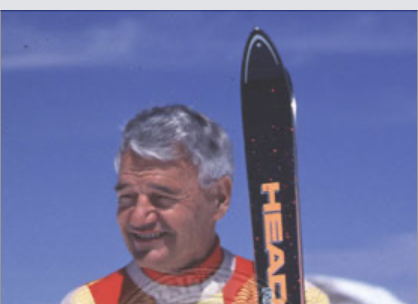
At 96, Junior Bounous is an American deep powder icon. Frequent contributor Harriet Wallis, temporarily sidelined with a ski-induced fracture, wrote this terrific profile.
Don Burch shares his love of skiing by producing short artistic videos. His most recent, Fun Times at Mount Snow, Okemo & Stratton, has me longing for those sweet New England ski days of my youth.
Frequent contributor, Pat McCloskey, reports on a day of skiing with Kathy Brennan, new CEO, PSIA- Eastern Division and her interesting take on lifelong learning. Jonathan Weisel reviews Celebrate Winter, the third book from Nordic Olympian, John Morton. And don’t miss the opportunity to win a prize in the Test Your Skiing Knowledge feature.
Having problems linking to SeniorsSkiing.com? Any of these steps will get you there: 1) Access full article content from this email by clicking on the headline in the synopsis, the [Read More…] link, or the “Read in Browser” link. 2) Go directly to www.seniorsskiing.com for full access. 3) Wait a few minutes and try again. 4) Still not working? Email saucutt@seniorsskiing.com with brief description of problem including your operating system, web browser, and if you received an error message.
https://seniorsskiing.com/wp-content/uploads/2022/01/margery-martin-1-1-e1642627707492.png548728seniorsskiing/wp-content/uploads/2014/04/Seniors-Skiing-since2013-Logo@2x-300x68.pngseniorsskiing2022-01-20 12:45:162022-01-20 22:49:36This Week: January 21, 2022
I don’t mean to be a bummer, but I really need to get this off my chest. Does anyone else out there get the feeling that things, in general, are falling apart?
You call a company “help” line and wait for 15-20-30 minutes to speak with someone…that is, if you’re not disconnected. All that while being told “your call is important to us.”
Yes, it’s hard to find and hire people. But does that justify the Target cashier rudely refusing to verify the price of an item when politely asked?
What about reserving and purchasing a Powder Mountain lift ticket online? Several of the resort’s owners are from tech. Wouldn’t you think the online process they set up would work? It didn’t for me, and based on comments from people who work there, it doesn’t work for others. Fortunately, real people answer the phone and are helpful.
The other day, at Park City Mountain Resort, I tried downloading a free App to request a ride from the shuttle service. Completing the process required clicking twice on the button on the right side of my phone; the same process that shuts the phone down.
Compared to what’s going on the world, these are minor irritants; incremental reminders that things are not as promised; that, perhaps, the sky is falling, but not right away.
If you haven’t seen “Don’t Look Up,” Netflix’ star-studded comedy about the end of the world, you may want to. I fall in the camp of those who enjoyed it. Others find it more irritating than entertaining. At first glance, it’s about a large comet on a direct collision course with Earth. Metaphorically, it’s about the long-term perils of climate change or, more immediately, the effects of Covid.
I know from past comments that some of you prefer not to pay too much attention to the pandemic. From a skier’s perspective, ski areas, from Sun Valley to Ischgl have served as super-spreaders: places where people from afar have transported the virus, infecting others who carried it back to their home communities. By now that’s old news. But the ongoing resistance to wearing masks and/or getting vaccinated – also old news – is giving the virus more opportunity to keep spreading, killing, and interrupting our lives.
What’s the point of this venting? I’m reaching a point that, knowing I have just so many years ahead of me, I’m reducing exposure to the aggravatingly repetitive drumbeat of news, pundits, etc.
Maybe it’s time to reduce the volume and focus more on things that bring me happiness and joy. It will be a narrower vision but, possibly, a happier one.
Stevens Pass Petition Update
As previously reported, about 20,000 Epic Pass holders at Washington’s Steven’s Pass petitioned Vail Resorts (VR) to refund 60% of the cost of their passes. That, because VR sold passes, knowing that only 60% of terrain and lifts would be open this season. Now, the signatories are being urged to email VR cancelling the “auto renew” feature for their 2022-23 season passes.
Park City Patrol Averts Strike With New Contract
Park City Professional Ski Patrol Association voted to approve a new contract with Vail Resorts. The agreement gives the ski patrollers a $19/hr average wage and tenure recognition. It also provides wage parity with Colorado residents, meaning that a rise in Colorado’s minimum wage will be matched for patrollers at Park City.
Duck, Duck, Moose
Two moose crossed a heavily used trail at Steamboat recently. A skier captured the scene. A few weeks ago, on The Canyons side of Park City Mountain Resort, moose (without skis) on two trails, prompted those trails to be closed. Moose-sightings at The Canyons is not unusual.
Be Happy You Weren’t on THAT Chair
https://www.youtube.com/watch?v=DKyk1iWrX6I
Skiers on a chair at Beech Mountain (NC) had the unpleasant experience of riding through a cold geyser resulting from a ruptured water line. A few unfortunate souls were stuck in the powerful spray for extended periods when the lift stopped. Why management did not stop the lift to prevent people from being sprayed is a question that may be asked by their attorneys. Yet another example of things, in general, breaking down.
IDAHO DOG SLED RACES
Photo by Melissa Shelby
If you’re in or around Cascade, Idaho Jan 30 – Feb 3, try to take in the Idaho Sled Dog Challenge. World-class mushers will compete on the 300-mile qualifier for Alaska’s Iditarod. The Idaho event is considered one of the world’s toughest. For more details visit idahosleddogchallenge.com.
Getting Back to Basics
The winter sports market in China is touted to be more than $126 billion, growing to $160 billion by 2025. Among the drivers, hundreds of new ski areas and the Beijing Winter Olympics. Tmall Winter Festival is the country’s major annual Winter shopping event. Click on the image (above) to screen the curious video promoting snow sports. At least, that’s my interpretation of the piece.
Children of Patrol
This video is much easier to understand. It’s about the children of members of the Jackson Hole Ski Patrol. Several of the kids have become patrollers. It is six-minutes, family-oriented, and delightful!!
Calgary’s Ghost Area
Fortress Mountain reached its peak sometime in the 1980s. This 10-minute video sponsored by Black Crows Skis tells the area’s story and that of the crew determined to bring it back to life.
As we approach the approximate halfway point in the skiing/riding season, the slopes in all regions of the U.S. and adjacent to Canada are in good condition, with the western half of the continent still benefitting from the astounding amounts of snow that fell in late December. This season got off to a roaring start in the West and a sluggish one in the East, but the jet stream pattern that delivers cold and storms has favored the Midwest and East for a couple of weeks now. A western ridge/eastern trough couplet has dominated, and that setup will remain in place much of the time for the rest of this month. In early February, a subtle change will lead to a turn to milder weather in the East. If we look at the jet stream map as this forecast gets underway, we see strong ridging that stretches up to Alaska where the clockwise flow around that ridge can tap deep cold air over northern Canada.
In that position, the ridge is far enough west to allow small packages of jet energy to slide down its eastern flank and bring some snow to the inland ranges of West. Not major snow, due to the lack of a direct tap into Pacific moisture, but after lots of bluebird days of late any new snow is very welcome. The coastal ranges from B.C. down through California will be kept rather dry by the eastern flank of the large upper ridge sitting offshore. The jet level flow along the coast is nearly northerly right now, so the disturbances will be able to dive all the way to the Mexican border, which would bring the resorts south of I-70 some light snow this weekend…the fast movement will limit the input of Pacific moisture, but the “freshies” will do a nice job of softening the surfaces a bit.
As has been the case for the past couple of weeks, the real forecast challenges will come over the eastern half of the country, where the interaction of the northern and southern branches of the jet stream determine the track and intensity of surface storms. In the Rockies, the track of the storm determines who get heavy snow and who gets light snow. In the Midwest and East, it determines much more, with sleet, freezing rain, and plain rain often part of the landscape. If we look at the Monday morning 1/24 jet stream, we can see a good example of the forecast challenge.
The systems that swings through the Southwest is headed out to the southern Plains, where it could join forces with northern stream energy moving into Minnesota. If they phase into one larger trough, another substantial winter storm would impact the Midwest and East. Just where the two branches of the jet combine will determine whether the surface low goes up west of the Appalachians, just east of the mountains and along the coast, or it stays off to the south. All three have vastly different outcomes in terms of “who gets what”. Right now, I favor the two streams staying separate with light snow in the Lakes and Northeast. This busy pattern will persist until the trough eases west at the end of the month, perhaps supporting a “cutter” low into the Lakes at that time.
Ski industry icon Junior Bounous, 96, is a mover and shaker whose passion is to keep people skiing throughout their lives. In a nutshell, he tells seniors: Just “keep moving.”
Junior’s career spans nearly eight decades with a list of accomplishments and awards longer than both my arms: Intermountain cross country and national gelande jumping champion, national race course setter, ski patroller, founding member of Professional Ski Instructors of America, father of today’s American Ski Teaching System, an advisor to ski manufacturers, a ski trail designer for resorts, and the director of skiing in California and Utah including Sundance and Snowbird. In 1996, he was inducted into the National Ski Hall of Fame.
And he keeps on moving. On a bright spring day in 2021, he heli-skied from the 11,489’ Twin Peak summit, the highest point in the Little Cottonwood Canyon range, making him — at 95 years and 244 days — the Guinness World Records’ oldest heli-skier. Getting out of the helicopter was difficult because his knees don’t bend as well as they used to. “The skiing was the easy part,” he said.
Follow the legend
A role model for seniors, Junior continues to ski for the joy of it.
A few days ago my senior ski friend Beth Tait was skiing at Alta when she saw a yellow helmet. Junior always wears a yellow helmet. As she got closer, she saw it really was Junior. He was talking with skiers around him, and she joined in. Later, Beth followed him, trying to ski as smoothly and fluidly as the 96-year-old. “Junior is an incredibly athletic skier not to mention his heartwarming personality,” she said.
From barrel staves and manure piles to Alta and Snowbird
Junior was the youngest of six children in an Italian farming family in Provo, Utah. His first ski experience was on the farm at age 8 when he attached barrel staves to his feet and skied down a slope trying to miss the manure piles at the bottom.
Alf Engen (l) and Junior Bounous Source: J.Willard Marriott Digital Library
Fast forward to 1948, when, at age 22, he became one of the first certified instructors in Utah, and he began a long-lasting relationship with his cherished mentor, Alf Engen. For the next 10 years, Bounous was Engen’s primary assistant in Alta’s Alf Engen Ski School known worldwide for teaching students how to ski powder. His skiing and teaching careers kept accelerating.
When Snowbird was on the drawing board, founder Dick Bass recruited Junior to lay out the trails, and when it opened in 1971, he became its Ski School Director inspiring generations of skiers.
Junior’s top tips for Seniors
It’s a bird, it’s a plane, it’s Junior in the air in 1957. Photo credit: Harriet Wallis
Balance and coordination are major factors for senior skiers. “Older people have trouble with their eyes and ears, but you can extend the life of both senses if you practice,” he said.
He advises cross training. “Stay active. Do not confine yourself to just skiing. Play golf, ride a bike, take a walk. Do whatever you enjoy – but do it. It will help you get out of the bathtub, get out of the car, and go up the stairs.”
He also recommends improving balance by skiing slightly different terrain and snow conditions. Don’t get stuck skiing only on bluebird days or just on your favorite trails. “It boils down to just doing it. Stay active in as many ways as possible,” he said.
Take Junior’s advice: Just do it.
However, “Many older people drop out because they no longer have anyone to ski with. They’re physically capable, but they’ve lost the social fun of skiing. Find somebody to ski with,” he said.
Help Us Compile SeniorSkiing.com’s list of senior ski groups
To help seniors find someone to ski with, SeniorsSkiing is starting a list of senior ski groups around the country. If you know of a senior ski group, please use Leave a Reply at the end of this story. Include as much information as possible about the group.
Kathy Brennan, new CEO, PSIA-East, at Seven Springs, PA
I recently skied with Kathy Brennan, the new CEO of PSIA -E (Professional Ski Instructors of America- Eastern Division). Kathy has an impressive background in the snow sports industry and is currently on staff at Waterville Valley, New Hampshire. She has been touring areas in her division which extends from Maine to North Carolina.
An accomplished skier and excellent teacher, Kathy did something at the beginning of our session suggesting how she‘ll function in her new role: She asked everyone for feedback on how to make PSIA better, any suggestions or comments on the organization and, in short, what she could do to improve the organization’s mission of being an education platform.
She received numerous comments and suggestions. I asked what PSIA was doing to retain older instructors. She said we never stop learning even after seniors are long past their certification exams.
She also explained that she’s dedicated to assuring that PSIA partners effectively with areas, suppliers, patrol, race programs, and the industry, in general. Educational programs can be utilized by any member, especially seniors who want to stay in the game and improve their skiing and teaching abilities. In her words, PSIA has changed from a “pin chasing” entity to an organization dedicated to providing programs for skiers and boarders of all ages. She’s meeting with area management to educate them on the value of the organization and how its current direction will lead to better instructor education, better lesson quality, and greater customer satisfaction. This approach also will help areas retain good quality certified instructors.
Our conversations were held on chairlifts. On the snow, she gave us – skiers, tele-skiers, and snowboarders – a clinic. Her emphasis, common to the three approaches: balance,rotary movement, edging, and pressure control.
I’m retired from ski teaching but maintain my membership in PSIA with the goal of learning something new every year.
Kathy’s goal is to unite the entities in the ski industry and to make them aware of the value of what PSIA brings to the table. From my time with her at Seven Springs, I’m confident she’ll have great success.
https://seniorsskiing.com/wp-content/uploads/2022/01/Screen-Shot-2022-01-17-at-10.10.30-AM-e1642439498761.png707728Pat McCloskey/wp-content/uploads/2014/04/Seniors-Skiing-since2013-Logo@2x-300x68.pngPat McCloskey2022-01-20 12:25:002022-01-21 12:13:30A Day With Kathy Brennan, New CEO, PSIA-East
It has been decades since I’ve skied the East. Once I discovered Western skiing, I traded the long flight for the long drive, eventually moving to Utah to shorten the time to the slopes. But Don Burch is giving me second thoughts. He’s developed an appealing alternative ski video genre (shot largely at Eastern areas). His most recent, “Fun Times at Mount Snow, Okemo & Stratton,” makes me long for those long-gone New England ski days.
Click on the image to screen this 60-second gem.
https://seniorsskiing.com/wp-content/uploads/2022/01/fun-times-thumb.jpg11001960Don Burch/wp-content/uploads/2014/04/Seniors-Skiing-since2013-Logo@2x-300x68.pngDon Burch2022-01-20 12:20:282022-01-20 22:27:07Don Burch’s Fun Times (at Mount Snow, Okemo & Stratton)
Over the past 50+ years, John “Morty” Morton has cross-country skied around the world, been an international-caliber racer and coach, and, as far as I’m concerned (this is homage from a friendly competitor), is the premier Nordic ski trail designer in North America.
Morty has seen dramatic evolutions in the sport – from wood skis to synthetic, wool to spandex, the introduction of skate technique, grooming snowmobiles replaced by snowcats, narrow trails sometimes giving way to highways, etc. Over these years, he served in Vietnam, taught high school English, and has served as broadcast journalist and newspaper columnist.
Now he’s written Celebrate Winter, a book filled with anecdotes and insights based on his intriguing life. It’s his third book, preceded by Don’t Look Back(1992), where he shared his story and training program, and A Medal of Honor: An Insider Unveils the Agony and the Ecstasy of the Olympic Dream (1998), a novel about biathlon.
John Morton, age 76.
Celebrate Winter is a compilation of memories, from John’s days as a kid in New Hampshire to skiing for Middlebury College in Vermont; competing and coaching internationally in biathlon; coaching at Dartmouth College in New Hampshire; designing multi-use trails for the past 30+ years; to (most recently) skiing with his young granddaughter in a backpack while she calls out for more downhills!
Biathlon is a theme tying many of the roughly 70 stories together, as are observations on the human condition (ego, anger, generosity, laughter, inspiration). He covers the role TV plays in popularizing biathalon; Coca Cola at feeding stations; weather and altitude as they can affect racing; Olympic politics; doping; saunas; holding the Olympic torch for a moment at the Calgary Winter Olympics; and a constant sense of the magnetism of cross-country skiing, its beauty, diversity, and comraderie.
As trail designer, Morty has worked with schools and colleges, lodges and real estate projects, alpine resorts and pure cross-country areas, communities and private land owners, ski clubs and non-profits. Unlike some other designers, he’s well aware of the fact that really tough trails are only suited for elite athletes, whereas the great majority of us are recreational skiers (and the bread-and-butter for most Nordic ski areas).
If having your own professionally planned and built trail system sounds intriguing (cross country skiing, hiking, running, biking, snowshoeing, equestrian…), John Morton (https://www.mortontrails.com/) is still going strong in his mid-70s.
I recently purchased several copies of Celebrate Winter to give as gifts. Many of the anecdotes are just a few pages long, making for a delightful – no, mesmerizing – read.
https://seniorsskiing.com/wp-content/uploads/2022/01/Screen-Shot-2022-01-17-at-9.48.28-AM.png684464Jonathan Wiesel/wp-content/uploads/2014/04/Seniors-Skiing-since2013-Logo@2x-300x68.pngJonathan Wiesel2022-01-20 12:15:072022-01-20 15:10:05Celebrate Winter: Anecdotes and Insights from a Cross-Country Skier’s Experience
Editor’s note: Spend enough seasons skiing and most of us will get into some form of trouble. Last issue, I explained how I got into hot water by inadvertently becoming end-of-day Pied Piper to a bunch of kids who followed me on a long winding trail, while their parents anxiously waited their return. A few readers emailed their tales of on-slope woe.
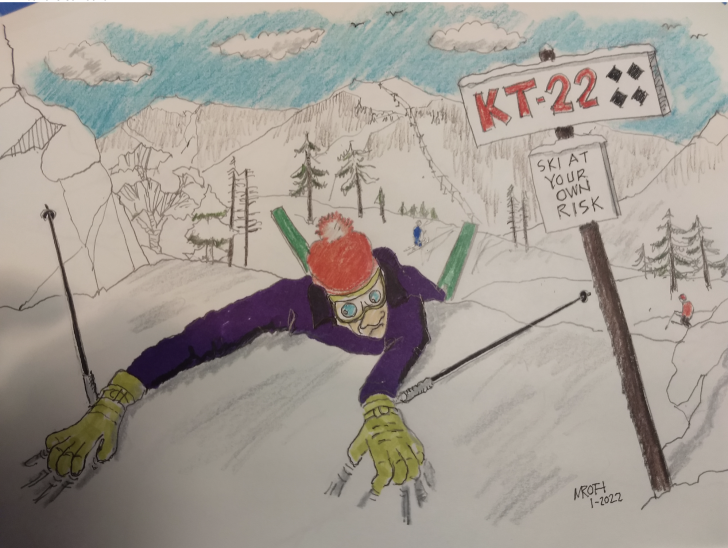
Mike Roth is a ski journalist who writes a regular ski blog for the Albany Time Union. He is also a talented cartoonist and and architect. When asked, last minute, if he had time in his busy schedule to illustrate these reader stories, he responded, “When do you need them?” A few hours later, Mike emailed his drawings.
This cliff-hanger happened to Jeffrey M. Fine when he was 40, but he still remembers the day. Jeffery is now based in Dillon, CO.
Sometime in the 1980’s while living in Indiana, I took a trip out to Squaw Valley. I thought I could ski KT-22, and it almost cost me my life. While skiing down the right side of the run, I caught an edge and almost went off a cliff with a 50’ drop. I managed to fall just before going over the edge and held on with my fingers in the snow (I was highly motivated to grab anything) while my skis hung over the edge in space. The ski patrol was able to throw me a rope and pull me to safety. I feel very lucky to have survived!
And here’s a rope tow tale from Ed Schultz, Penn Yan, NY. It happened when he was 30.
Back in the early 70’s skiing a small area in Massachusetts near Wooster, (can’t remember the name), I got on the rope tow. I had one arm behind with my pole straps around my wrist. What I didn’t realize was that the poles were bouncing in the snow behind and my pole straps somehow got twisted so when I went to get off I was caught on the rope. The rope tow rose up at the end toward a building housing some of the tow’s mechanism. I had visions of being carried up and going splat on the building. There were no safety stops in those days. Fortunately, I wriggled and twisted, freeing the straps and exiting the tow just in time.
Have a personal ski story you’d like to share? It can be about almost anything.Send it to info@seniorsskiing.com. We’ll share the most interesting with SeniorsSkiing’s 17,000 subscribers, along with an original Mike Roth illustration.
https://seniorsskiing.com/wp-content/uploads/2022/01/Screen-Shot-2022-01-17-at-7.54.30-PM-e1642474837357.png548728Mike Roth/wp-content/uploads/2014/04/Seniors-Skiing-since2013-Logo@2x-300x68.pngMike Roth2022-01-20 12:10:062022-01-20 15:09:18Hanging On for Life and (Almost) Getting Eaten by the Rope Tow
Each issue of SeniorsSkiing.com has a picture to help test your skiing knowledge. The pictures are from collections in a variety of participating ski museums, which we encourage readers to visit.
The object pictured here was made in the kitchen, but its nothing you’d want to eat. It was available throughout New England in the 1960s and 70s. One more clue: The image comes from the Maine Ski and Snowboard Museum‘s exhibit, “Made in Maine.” What was the brand name for this useful little object? The first reader to send the correct answer to info@seniorsskiing.com wins a soon to be determined but useful prize.
The Maine Ski and Snowboard Museum shares many stories from Maine and the state’s role in the development of skiing and snowboarding. Last summer, the museum moved from Kingfield to a new home on the Access Road to Sugarloaf. The current “Made in Maine” exhibit explores the development of skiing and snowboarding through equipment made in the Pine Tree State. If you’re in the area, be sure to visit.
Michael Bannon, Bartlett, NH, was the first reader to correctly identify the picture in the last Test Your Skiing Knowledge. It’s the upper chairlift at Thorn Mountain, Jackson, NH. Thorn Mountain opened in 1949 with two single chairlifts stacked one above the other to give a vertical rise of more than 1,000 vertical feet. Thorn closed about 1956. Michael has been a Level 3 PSIA instructor since 1966. He’s been a SeniorsSkiing.com subscriber for 5 years. Congratulations, Michael! You’ll soon be receiving a container of Slide On, the dry lubricant spray that helps your feet slip in and out of ski boots. One application lasts for a month of frequent boot use. One 2 oz. can is good for the entire season. The picture was submitted by The New England Ski Museum, located in Franconia Notch State Park, New Hampshire. Admission to the museum is always free.
https://seniorsskiing.com/wp-content/uploads/2022/01/Screen-Shot-2022-01-17-at-7.23.12-PM.png206296seniorsskiing/wp-content/uploads/2014/04/Seniors-Skiing-since2013-Logo@2x-300x68.pngseniorsskiing2022-01-20 12:05:582022-01-20 15:08:15Test Your Skiing Knowledge
Just added a few new plates to the gallery. A terrific original poster of these and other skiing license plates will be the premium for the annual SeniorsSkiing.com fundraiser starting next issue. Enjoy the gallery (and please continue to send in pictures).
Unfortunately, Covid continues to impact our lives…even on the hill. Jon’s Short Swings! column explores the different ways two neighboring Utah ski areas – Park City Mountain Resort and Alta – are handling Covid. He also describes the time he was banned from a ski area in the 1970s. Don’t miss the link to an informative critique of the trails constructed specifically for the upcoming Beijing Winter Olympics.
Skiing Weatherman, Herb Stevens, has another clear-headed report on what’s happening, weatherwise, throughout ski country.
In her debut piece for SeniorsSkiing, Cynthia F. Jones explains the joys of skiing after a 30-year absence and her contentment with staying on the greens. It’s a fun read.
Veteran ski writer, Karen Lorentz reports on new lifts and other infrastructure improvements at Okemo. You’ll find her in the photo of the first people to ride one of the new chairs.
A piece by Jon on managing flat light while skiing has been updated from when it first appeared several years ago in Huffington Post .
Don Burch’s newest video production, December Skiing, is a gentle and beautiful visual summary of the month. His soft touch is a welcome contrast at this time of the fast-paced ski video.
Taking a cross-country ski vacation? Roger Lohr, SeniorsSkiing.com’s X-C ski editor, recommends four locations for the classic New England experience.
Seth Masia, editor of Skiing History Magazine, summarizes that publication’s most recent issue. Skiing History, produced by the International Skiing History Association (ISHA), is a consistently good read and well worth the modest cost of ISHA membership. Free digital copies are available by clicking on the adjacent ISHA advertisement.
Finally, try guessing the name of the short-lived New England ski area pictured in Test Your Skiing Knowledge. No one correctly identified the ski instructor pictured in the last issue. Read about his interesting background. And the latest reader-submitted crop of ski-oriented license plates is shown in LUV2SKI.
Please tell others about SeniorsSkiing.com. It’s an important way to grow our community of older snowsports enthusiasts. Do you have ideas for articles? Please send a note to info@seniorsskiing.com. Problems with accessing the site (yes, there are occasional problems)? Please email the same address. Thanks for reading and look for the next full issue on Friday, January 21.
This is the first issue of SeniorsSkiing.com of 2022. I wish all readers good health, happiness, and peace for the New Year. But Covid’s omicron variant is challenging that wish for good health. It’s spreading fast, even among those who have been triple vaxxed. For most of the infected, it appears to be less taxing than Delta or earlier iterations. One side effect reported by several people I know, is hearing loss.
Ultimately, omicron’s virulence may cause such widespread infection that we’ll achieve herd or crowd immunity. That remains to be seen.
We’re older skiers and, by definition, more vulnerable to serious illness from the virus. For simplicity’s sake, I’ll divide our cohort into two categories: those who stay at lodges when they go skiing and those who ski and return home. Each is subjected to infection on lifts and in day lodges. Those overnighting in lodges have the additional risk of exposure from employees and other guests.
I don’t know if Utah is typical, but in terms of looking at the intersection of skiing and Covid, it is relevant.
Alta has no mask or vaccination-proof requirements. That, according to several friends who have skied there multiple times this season. The area recently closed its Watson Shelter because some staff tested positive. Alf’s remains open but with no mask or vaccination-proof requirements. The midmountain day lodge does keep windows open, according to a source working there.
Alta’s Smiling Rock Photo: Harriet Wallis
By comparison, day lodges at Park City Mountain Resort (indeed, all Vail Resorts ski properties) require proof of vaccination and masks to access food-service and tables.
On the day I’m writing this, a front-page article in The Salt Lake Tribune reports that Covid swept through several of Alta’s overnight lodges, causing some guests to leave early, rather than risk getting ill. Of the five lodges, the only one requiring proof of vaccination is The Rustler. Snowpine, totally rebuilt a few years ago, follows Utah’s libertarian spirit and requires neither vaccination nor masks. The lodge’s website is devoid of any reference to Covid.
The Tribune quoted a 74-year-old guest who beat it back to her California home: “I’m not going back to Utah. It’s a COVID [nightmare]. Nowhere has better powder than Alta. Too bad it’s in Utah.”
The Christmas feast at our friends’ home was a lot of fun. Three guest couples, all contemporaries; all skiers; all known to the host and hostess but not to each other. Following festive fare, our ever-creative hostess, asked each of us to talk about the first time we skied and about a time we got into trouble while skiing.
The answers to Question #1 revealed surprising similarities among the men: none had been particularly “athletic” in youth. But then they were introduced to skiing. Each of the wives became interested through their husbands.
Getting into trouble on skis produced stories of literal, cliff-hangers; skis lost in deep powder, etc. Listening to these tales of woe, reminded me of the time I inadvertently became the end-of-the-day Pied Piper to a bunch of kids whose anxious parents awaited their return.
It was in the mid 70s and Pam and I were skiing Plattekill, an 1100’ ski hill with a variety of interesting terrain in the Northwestern Catskills, a few hours north of New York City.
Pam returned to the day lodge as I took one last run. At the top, I entered a trail I hadn’t noticed before. It was more of a road than an actual trail, one of those endless runs looping back and forth through the forest. A few minutes in I heard laughter behind me. I looked back and counted 12 little ones following.
Back to Pam waiting in the lodge; wondering, Where’s Jon? Around her, clutches of agitated parents wondering, Where are our children? Several minutes later, I walk in, followed by the kids. Emotional parents embraced their missing ones.
The angry area owner yelled at me from across the large room, accusing me of taking the kids on a closed trail. I called back: “The trail wasn’t roped off, and I didn’t know the kids were following.” His response: “Do you know how much it costs for rope?”
I was banned from returning to Plattekill; a punishment promptly ignored. Those kids must now be in their 50s!
Have you gotten into trouble while skiing? Send in your stories. We’ll publish the most interesting.
Stevens Pass Petition: 20k Signatures
In a mere five days, more than 20,000 Epic Pass holders at Stevens Pass ski area in Washington, signed a petition demanding that Vail Resorts refund 60% of the cost of their passes. Why 60%? They claim that VR sold passes while knowingly planning to keep 60% of Stevens Pass terrain and a majority of lifts closed for the season. The petition gives VR a deadline to act by January 15 before filing a complaint with the Consumer Protection Division and the Attorney General of Washington State. Click here to read the petition.
Incivility at Beaver Creek
According to a posting by the victim’s wife, her husband was struck by someone skiing in a group. When he confronted the person, another man in the group removed his skis and gave her husband a severe beating, leaving him with a broken rib and other injuries. The group, thought to be in their 30s, skied off and were not found. The incident was reported to patrol and the Sherriff’s office. It occurred December 31 at Beaver Creek.
Park City Patrollers Seek Raise
The Park City Professional Ski Patrol Association (PCPSPA) rejected Vail Resorts’s offer of a starting wage of $15 per hour. The patrollers want $17. Current wage is $13.25. More than 200 patrollers are working without a contract. Other Park City Mountain Resort employees receive $15 per hour minimum. Patrolling requires extensive training and patrollers generally are responsible for supplying their own equipment. If VR blinks, minimum wages for patrol throughout its many holdings will climb.
Timberline and Ski Bowl Discontinue Free Skiing for Seniors
Subscriber, Thomas Levak, informs us that Timberline and Ski Bowl (OR) have discontinued free skiing for super seniors (73+). Lift tickets for 65+ skiers are $65 (days) and $45 (nights), and skiers are required to make advance reservations for the days and times they want to ski (perhaps not a bad idea given that limited numbers of skiers are allowed for different time slots). Thanks for the info, Thomas!
New Advertisers: Booster and Slide On
The Booster Dynamic Power Strap is an elastic power strap that replaces the power straps found on most boots and helps you ski better, regardless of skill level. It is used by 80% of all Olympic skiers. Slide On is a dry lubricant spray that helps your feet slip in and out of your ski boots. One application lasts for a month of frequent boot use. One 2 oz. can is good for the entire season. Click on the Booster/Slide On ad for more information.
Snowbird’s Golden Anniversary
Believe it or not, The Bird opened 50 years ago. Those of you who have been there, know its magic. If it’s still on your “to do” list, take steps to get it done. Its 2500 skiable acres are accessed by tram and 10 chairs. It connects to Alta, for a combined 5000+ acres terrain. I have many memorable days skiing thigh-deep (sometimes waist-deep) Snowbird powder with friends. The resort produced a 3-minute video telling its history. Click on the image, above.
Patagonia Walks the Talk
Patagonia makes superb, durable outerwear and redirects a portion of its profits to support environmental and other worthy causes. Another example of the company’s progressive policies is its closing all its stores from Christmas through New Year’s while paying employees.
Austria Tightens Covid Rules for Brits
Austria has classified the UK as a “virus variant” region. Effective December 25, visitors from the UK are required to quarantine 10 days upon arrival, even if fully vaccinated. Given that Austria is a major destination for UK skiers, this is a big deal. Exceptions: Those fully vaccinated and boosted who have a negative PCR test. Children under 12 are exempt. Teens meeting certain conditions also may enter the country.
Record Snow Records
More than 200″ (almost 17′) fell in the Sierra’s in December. Utah is getting hammered with one pulse after another. Revelstoke (BC) has received 21’+ so far this season. All that snow prompted me to look into snow accumulation records. An amazing 1,140″ (95′) was recorded at Mount Baker Ski Area (WA) (4,200 feet elevation) during the July 1, 1998 to June 30, 1999 snow season. Mt. Ibuki (Japan’s Honshu Island) measured 465.4″ (38.8′) February 14, 1927. The most snowfall in 24 hours (6.3′) was measured in Silver Lake, CO, April 14-15, 1921. Mount Shasta Ski Bowl (CA) recorded the most snow from a single storm: 189″ (15.75′), February 13-19, 1959.
Brrrrrrr: New Ice Hotel on Italian Glacier
A bedroom is the ice hotel next to Capanna Presena Refugio
A new ice hotel is now booking reservations. The luxury facility is on Italy’s Presena Glacier at Passo Tonale in Trentino and features intricate ice carving on both interior and exterior surfaces. The three-igloo-room facility is next to the Capanna Presena Refugio.
Vintage Cars in Snow
Here, from Weather.com, are 53 photos of cars in snow…most of them stuck in the snow. They’re from both sides of the pond and fun to see. Click here to view.
Another Weather.com entry: 91 vintage images of people playing in the snow. Notice that virtually every person pictured is smiling. Of course, they are! They’re in the snow. Click here to view.
Do you have information you want to share with other members of the growing SeniorsSkiing.com community? Send it to jon@seniorsskiing.com. Use the same address if interested in contributing articles. Please forward SeniorsSkiing.com to other older skiers who may enjoy receiving it. Or simply tell them about the site.
The 2021 holiday period provided epic snow conditions across most of the West with trails counts and surface conditions rather sketchy over the eastern half of the country. While storm after storm nailed the West, a typical La Nina upper level ridge over the southeastern states was enhanced by a sudden spike in the output of the sun, as detailed last week. The solar flux increase has reversed course in dramatic fashion as the red line on the following graph shows…
With the change in the solar flux, that pesky southeastern ridge has been crushed and replaced by a skier friendly upper trough as illustrated on this map…
That trough has delivered two snowfalls to the Mid-Atlantic and parts of the Northeast this week and troughs will be the dominant jet stream feature over the eastern half of the U.S. for the next several weeks. The northwesterly flow across the Great Lakes will deliver cold air masses that will support major snowmaking efforts, as well as natural snow at times. One source of natural snow will be “Alberta Clippers”…smaller scale troughs that originate in west-central Canada before tracking through the Great Lakes and into the larger jet stream feature further east. Mid-winter Clippers produce fluffy snow north of their centers and usually bring along a reinforcing shot of cold air with them. After a mild autumn and early winter, the waters of the Great Lakes are still warmer than normal, so meaningful lake effect snow can still fall although we are approaching midwinter. Lake effect has helped boost trail counts and soften surface conditions in the Midwest during the past week and that trend will continue. Clippers can turn into something more formidable as they approach the east coast if a smaller scale trough also comes rolling along in the southern branch of the jet stream. If the two streams phase, which strengthens the trough, very often the result is a bonafide Nor’easter.
I don’t want to forget the West, but the parade of storms that pounded that half of the country for the final three weeks of December has slowed down considerably, and with an upper ridge axis just off the west coast for much of the time in the next 2-3 weeks, the amount of moisture that reaches the Cascades, Sierra, and Rockies will be much more limited. Systems will crest the top of the ridge and spin down through B.C., the Northwest, and the northern Rockies at times, but they will be weaker than their December cousins. The southern branch of the jet looks to be more active later next week, so the southern Sierra and Southwest resorts could be in line for a refresher event at that time. As long as the trough dominates in the East, though, there will be more bluebird days than powder days out west.
Looking further down the road, here is a jet stream forecast for the 21st that looks good to me…
The clockwise flow around the ridge over the northeast Pacific will deliver arctic air to the trough covering the eastern two thirds of the country, sustaining the winter weather that is now locking in. By this time, conditions coast to coast should be outstanding.
Here are regional highlights…
Northwest U.S./Western Canada: This week ends with one more heavy snowfall. Weaker systems move through with light snow next week.
Sierra: Development of upper ridge stops the storm parade for the next week and likely beyond. Southernmost resorts could pick up new snow late next week.
Rockies: Upper ridge dominates going forward. Bluebird skies common…snowfall harder to come by.
Midwest: Winter has locked in. Lake effect, clipper snows and virtually unlimited snowmaking windows continue.
Mid Atlantic/Southeast: Two snowfalls in the past week have helped. Favorable pattern continues in place much of this month.
Northeast/QB: Cold dominates this month. Presence of upper trough will pick up the pace of natural snow.
SeniorsSkiing.com encourages readers to submit accounts of personal experiences on the hill. The following, sent in by Cynthia F. Jones, expresses her joy of returning to skiing following a 35-year absence.
Vanity Fair 1919
I ski only green runs. At 73, coming back to skiing 35 years after the briefest taste of its magic and delight many years ago, I’m having so much fun it should be illegal.
So…why am I writing this? First I LOVE that I found the SeniorsSkiing website – it’s been inspirational. The articles and information have opened doors to let me know I CAN re-embrace skiing as a senior. However, when it comes to connecting with senior ski groups – I realize I’ll probably never ski at the level of those members (acing the blue runs, tackling the single and double black diamonds), so there probably isn’t a peer group for those like me who just enjoy cruising the greens. Or maybe we are just the silent elder skiers.
Truth Magazine 1896
My goal is simply to have fun and continue to embrace the joy, the stoke and absolute zen I find on the mountain. Experiencing that perfect glide downhill (if the body is willing to cooperate on any given day) is worth all the effort.
Ok – I’m saying this in full view of senior skiers – I may never tackle a blue run. I do sometimes cast a glance over at them, on my fun runs, but they don’t beckon yet and the call to go blue may never be strong enough. The one thing I don’t want to do is take the fun out of skiing with “should’s.” And right now I’m having tons of fun.
My reintroduction to skiing was via a student in my yoga class. Forever will I be grateful to Sue for encouraging me to take that plunge back into something I had not been able to continue in my 30’s due to life circumstances. And yet – while eternal gratitude will always be there – Sue is a highly skilled skier (she’s been skiing for decades) and she quickly tired of skiing with me since my goals and skills on the mountain are quite different from hers.
Woman’s Home Companion
But hey – it’s all good. I take the occasional group or private lesson, as I explore different mountains, to keep my confidence growing. I’m exploring the “Senior Friendly” ski resorts…it’s one of the most enjoyable travel adventure projects I’ve had in a long time. I have no goal or personal need to graduate from the green slopes because I’m HAPPY!
And mostly I’m delighted, that now, in retirement, I can make following the powder a priority in life (I’ve put everyone on notice that a snow alert has priority over EVERYTHING!).
So here’s to the greenies if there are others out there – life is good!
https://seniorsskiing.com/wp-content/uploads/2022/01/Screen-Shot-2022-01-01-at-1.59.34-PM-e1641070810196.png976728Cynthia Jones/wp-content/uploads/2014/04/Seniors-Skiing-since2013-Logo@2x-300x68.pngCynthia Jones2022-01-06 19:30:492022-01-06 22:37:30Musings of a Greenie
Now in its 66th winter season, Okemo is one of the most technologically advanced ski areas in the East.
The first -chair passengers of the new Quantum Six at the top terminal: (l to r) Resort Guest James Kraft, Okemo GM Bruce Schmidt, Journalist and Ski Historian Karen Lorentz, Okemo Director of Resort Operations John Neal and Director Of Skier Services Steve Clark. Photo:Bonnie MacPherson
This year’s installation of two express lifts maintains that tradition with the debut of an express replacement for the Green Ridge Triple and the new Quantum Six Express lift at Jackson Gore, providing greater and quicker access to upper Jackson Gore, home of several expert trails and Tuckered Out, a classic winding New England run.
This is great news for seniors like me who enjoy skiing from Jackson Gore to South Face and getting lots of runs in less time. It has the added bonus of comfort of quick rides on really cold days. Fifty years ago, I might have gotten eight runs all day. Now, thanks to these new, fast lifts, I can get 12 to 20 runs in four hours. The Evergreen lift will put the frosting on my exercise cake by making possible upper mountain laps on blue favorites.
Quantum Six will disperse people more quickly from Jackson Gore to Okemo’s main summit when they’re skiing to the Evergreen Summit Express. Okemo recycled its Quantum Four Express bubble lift to replace the fixed-grip Green Ridge Triple and named it Evergreen Summit Express. The renamed lift increases rider capacity, cuts ride-time in half, and adds a bubble, providing greater comfort on cold, windy days.
A new, short connector trail with snowmaking re-routes skiers from the Mountain Road trail to the Evergreen’s loading station. For those coming from Jackson Gore, the new trail and lifts not only reduce the time it takes to access the main Summit, it cuts the time to access the summit of South Face from Jackson Gore’s base from approximately 40 to 25 minutes.
Senior Director of Mountain Operations Eb Kinney noted the Evergreen lift offers a good alternative to the Sunburst Six for skiing a host of upper mountain trails — like Timberline, Sapphire, Tomahawk, and Jolly Green Giant, several tree runs, and some easy greens. Greater usage of this underutilized lift/skiing area will reduce lift waits at the popular Sunburst Six, he said.
Installations of the new lifts followed existing lift footprints and skier loading areas.
Part of Vail Resorts’ multimillion-dollar capital improvements plan for Okemo this year are upgraded snowmaking infrastructure, addition of a new grooming machine, improvements to the Clock Tower base area, and new shuttle service between Okemo’s main parking lot to the Clock Tower base.
https://seniorsskiing.com/wp-content/uploads/2022/01/Screen-Shot-2022-01-05-at-2.26.42-PM-e1641418063312.png562728Karen Lorentz/wp-content/uploads/2014/04/Seniors-Skiing-since2013-Logo@2x-300x68.pngKaren Lorentz2022-01-06 19:15:362024-08-20 15:13:48Okemo Debuts New Express Lifts
A version of this article first appeared in 2015 in Huffington Post.
I was hardly able to move; disoriented on terrain I’d skied for years. Other skiers seemed to be managing fine. But the light was flat, and my eyes could no longer pick up contours in the white on white.
Flat light sucks. Credit: Jan Brunvand
“Flat light,” a version of whiteout, greatly reduces the contrast that helps anyone on snow see where the dips and moguls are.
In extreme conditions, every skier of every age is affected, and the best way to get to where you’re going is to ski near trees, where their dark forms create visual contrast against featureless snow.
But these were not extreme conditions. Skiers and boarders were easily moving around, while I was in a featureless and confusing snowscape.
Credit: Jan Brunvand
Older skiers have older eyes. According to Dr. Jeff Pettey, Assistant Clinical Professor at the University of Utah’sJohn A. Moran Eye Center, all skiers eventually experience decrease in on snow contrast sensitivity. The most common culprit is cataracts, the cloudiness that forms on the eye’s lenses, causing loss of clarity and decreasing the quality of light focused on the retina. Cataracts can start forming when we’re in our 40s and 50s, though they’re more commonplace in our 60s and 70s.
Less common are processing issues related to diseases such as glaucoma and macular degeneration. They decrease the quality of the signal transmitted to the brain.
For me the eye opener was the other skiers who hardly slowed down while I was straining just to find the trail. I had been treated for age-related macular degeneration. But cataracts? A few weeks earlier, the ophthalmologist told me they were early stage. Those baby cataracts compromised what I could see in the snow!
After a minute or so of discomfort, I donned my goggles and headed down.
Getting Goggles Right
Choice of goggles and goggle lenses can make a big difference helping senior skiers with compromised vision navigate flat light conditions.
Most goggle manufacturers agree that the more light entering the lens the greater the definition and contrast. The trick is to select a lens whose color helps enhance depth perception. Amber, yelloe, rose, green and gold lenses tend to transmit more light. Photochromatic lenses, which change color under varying light conditions, can be effective.
While some industry experts recommend polarized lenses, the glare-reducing technology used in many sunglasses, others advise that in extremely flat light a little glare helps distinguish between ice and snow, making the trail more readable.
No More Fog
Regardless of light quality, fogged lenses get in the way of good vision. Having lived through many seasons of foggy goggles, I’ve explored many approaches to reducing the curse. Wipes, saliva, goggles with built in fans, products and technologies that claim to keep lenses clear under all conditions. Some work better than others, but none do a really good job.
SnowVision Rx goggles integrate prescription with inner lens
The unique SnowVision prescription goggle, virtually eliminates foggy goggles by positioning the presciption lens at a distance from the face where it remains cool, while providing a full range of vision using bi-focal or progressive lens technology.
Gee Whiz!
Some inventors have gone beyond goggle and lens with ideas that would remove the “flat” from flat light. Among them, twin laser beams projecting a contoured grid of the surface in front of the skier. The idea is to navigate, videogame-like, through the contours. Lower tech, but equally out there, is a built in spray gun system that skiers would activate to send a fine blue color onto the snow, forming the contrast needed for better visibility. Similar sprays are used to make race courses easier to read in flat light.
Artist’s concept of Earth and Sun. Credit: NASA
While lasers and sprays remain in the planning stages, Michael Barry, past-president of the National Ski Areas Association has this advice for those of us with aging eyes: Get to the mountain early and ski until early afternoon. This strategy works best for the first half of winter when light tends to flatten as the day progresses.
As the Earth’s axis shifts and daylight lengthens, pop on those rose-colored goggles and enjoy every last run.
https://seniorsskiing.com/wp-content/uploads/2018/10/Flat-Light2-e1539089365912.jpg502728Jon Weisberg/wp-content/uploads/2014/04/Seniors-Skiing-since2013-Logo@2x-300x68.pngJon Weisberg2022-01-06 19:00:542022-01-06 22:32:22BLINDED BY THE (FLAT) LIGHT: SENIOR SKIERS CAN SEE CLEARLY IN SNOW
Don Burch sent in a video treat: “December Skiing.” It’s one of his signature short productions that makes you want to be back on the mountain. Click on the image to screen. I’ll also include it in the next issue, which will be distributed Friday, January 7.
Many thanks to readers who sent notes of appreciation for SeniorsSkiing.com.
Best wishes for a Healthy, Happy 2022 with many great turns! Jon
https://seniorsskiing.com/wp-content/uploads/2021/12/december-skiing-video-thumb.jpg7401303Don Burch/wp-content/uploads/2014/04/Seniors-Skiing-since2013-Logo@2x-300x68.pngDon Burch2022-01-06 18:45:002022-01-06 22:30:55December Skiing Video
XCSkiResorts.com recommends these classic New England towns and areas for a cross country ski vacation:
Stowe, VT, is quintessential New England with its white steepled church and main street lined with stores.
Source: Trapp Family Lodge
It’s also the home of the Trapp Family Lodgeof Sound of Music fame. Trapp Family Lodge has a 110 km trail network with 60 km of groomed and machine-tracked trails. Stowe has a full range of dining and shopping options. Other nearby XC resorts include Bolton Valley, Stowe Cross Country Center, and Edson Hill.
Woodstock, VT is another winter mecca with inns, restaurants, unique shops, and a national historical park.
The Woodstock Nordic Center operated by The Woodstock Inn & Resortoffers two trail systems right in town covering more than 45 km. The Mount Peg trails begin on the golf course at and climb to the summit overlooking the village below. On nearby Mt. Tom, the Center grooms more than 20 km of trails on old carriage roads in the midst of Vermont’s first tree farm and Marsh-Billings-Rockefeller National Historical Park.
The Mt. Washington Valley in the White Mountains of New Hampshire has some of the best cross-country skiing in the East.
“Enchanting” is the best word to describe Jackson, the paragon of New England towns and home to Jackson Ski Touring Foundation, a non-profit organization chartered to provide and maintain XC trails on more than 80 private properties and national forest. Country inns are scattered throughout the region. The base lodge is accessed through a scenic covered bridge.
Covered bridge at Jackson Ski Touring Center, New Hampshire Photo: Roger Lohr
Great Glen Outdoors at the base of Mount Washington is a magnificent setting with 45 kilometers of XC skiing, snowshoeing, and an ol’ fashioned tubing hill. Great Glen’s scenic trail system offers an enjoyable combination of well-protected spruce and fir-lined trails plus wide-open areas with breathtaking views of Mt. Washington and surrounding peaks. On the trails is the classic New England Glen House Hotel, with 68 rooms, a pub and restaurant. For even more adventure, enjoy a comfortable winter tour on the 9-passenger Mt. Washington SnowCoach, which transports guests to an unforgettable journey to a sub-Artic world on Mt. Washington.
Skiing at Bretton Woods, NH Photo: Roger Lohr
Bretton Woods Nordic Centeris a thriving cross country ski center on the grounds of the Omni Mt. Washington Hotel. It. The grand Bretton Woods hotel has 100 km of XC ski laced throughout 1,700 acres of spectacular scenery. The Mountain Road, accessed via a lift at the Bretton Woods alpine ski area, offers spectacular vistas of Mt. Washington from a 7 km groomed trail down to Route 302.
Bethel, Maine is home to theBethel Inn and Carter’s XC Ski Center, and Sunday River Resort’s alpine ski trails. The town settled in 1774, retains its small-town lifestyle.
Bethel Inn Resort , Bethel, ME
The XC ski trails, which meander through forest to a picturesque, covered bridge are canine friendly. Several inns along the trails are operated by the nonprofit Bethel Inland Woods and Trails organization. The Carter’s XC Ski Center has beautiful views of the Mahoosuc and Presidential mountain ranges. Alpine skiing, dogsledding trips, and snowmobile rentals are available nearby.
Many businesses in each of these New England ski towns organize special events on winter weekends and vacation weeks to encourage people to get out and enjoy the snow.
If you’re into XC skiing and keep a bucket list, Stowe and Woodstock, VT, the Mt. Washington Valley, and Bethel, Maine are classic New England destinations not to be missed.
https://seniorsskiing.com/wp-content/uploads/2022/01/Trapp-Family-Lodge-e1641075521811.png487728Roger Lohr/wp-content/uploads/2014/04/Seniors-Skiing-since2013-Logo@2x-300x68.pngRoger Lohr2022-01-06 18:30:232022-01-06 22:28:55Four Bucket List New England Cross Country Ski Towns
Covid-related delays at the printer and post office caused the November-December issue of Skiing History to mail a month late. The online version posted right after Thanksgiving, and you can read it here. Here’s what you’ll find:
Aspen’s Anniversary: 75 years ago, Aspen built its first chairlifts and opened for business. Most of us are familiar with the story of how racing champion Friedl Pfeifer returned as a wounded veteran of the 10th Mountain Division and forged a partnership with Chicago industrialist Walter Paepcke to form the Aspen Skiing Company. In this issue, Aspen-based writer and editor Cindy Hirschfeld tells the story of the locals who surveyed the ground, cut the trees, dug the footings, hauled and poured the concrete, assembled the towers, hung cables and chairs, and then ran the lifts and ski school.
100th Anniversary of Megève, the first purpose-built resort in France. When the Baroness Noemie de Rothschild took a break from running a military hospital during World War I, she went skiing at St. Moritz. There she bumped into the German arms-maker (and notorious antisemite) Gustav Krupp. She swore to build an all-French resort, and in December 1921 opened her Hotel Prima in this medieval village just off the main road from Geneva to Chamonix. Under the stewardship of four generations of Rothschilds, the resort has maintained is ultra-luxe ambience. The skiing is good, too: After all, Megeve produced Emile Allais. Article by Bob Soden.
Ron’s Last Run: We go into the New Year mourning the sudden death of our great friend and longtime contributor Ron LeMaster. His obituary is on the SkiingHistory.org website now. This issue contains the last article he wrote for us – the history of ruade, the “horse-kick” turn that evolved into down-unweighting and paved the way for avalement.
American Downhiller Marco Sullivan retired after 105 World Cup starts and went to promote Alpine speed through coaching and an award-winning film. Edie Thys Morgan reports.
Walter Kofler Invented Kofix, the first polyethylene base, in 1952. It replaced celloid bases and revolutionized ski racing, making the Austrian and Swiss teams dominant at the 1956 Olympics. By Seth Masia.
150 Years of Skiing in Yellowstone. Explorers, poachers and even the U.S. Cavalry skied into the bitterly cold, snowbound National Park beginning around 1872. By Jay Cowan.
Meet the U.S. Ski and Snowboard Hall of Fame Class of 2021, with boot designer Sven Coomer, snowmaking genius Herman Dupre, skiing stuntman John Eaves, retail pioneers Dave and Renie Gorsuch, broadcaster Peter Graves, freeskiing hero Mike Hattrup, ski mountaineer Jan Reynolds and pro freestyler Alan Schoenberger.
Farewell to Ski Pioneers Rupert Huber of Atomic Skis, inventor of the fat powder ski; racing promotors Anne and Joe Jones; adaptive ski coach Hal O’Leary; Whistler general manager Peter Alder; Burke Academy founder and ski-racer Martha Coughlin Corrock; and pro racer Paul Carson.
The January-February issue should mail around mid-January, but you can already read Edie Morgan’s brilliant report on the upcoming Olympics, Beijing Olympic Alpine courses are a mystery.
https://seniorsskiing.com/wp-content/uploads/2022/01/Screen-Shot-2022-01-05-at-2.45.24-PM.png578408Seth Masia/wp-content/uploads/2014/04/Seniors-Skiing-since2013-Logo@2x-300x68.pngSeth Masia2022-01-06 18:20:472022-01-06 23:49:03Skiing History Magazine
Each issue of SeniorsSkiing.com has a picture to help test your skiing knowledge. The pictures are from collections in a variety of participating ski museums, which we encourage readers to visit.
This picture, submitted by The New England Ski Museum, shows a chair that serviced a New England area in the 1950s. It was the upper of two lifts that, combined, providing more than 1000′ of vertical. The area closed in the mid-50s. What was the name of this short-lived ski area?
The first person to submit the correct answer to jon@seniorsskiing.comwins a yet to be determined, but skiing-related prize. Note, only answers sent to that address will qualify.The correct answer and the name of the winner will appear in the next issue of SeniorsSkiing.com.
Unfrtunately, there were no correct answers to the last Test Your Skiing Knowledge quiz. Perhaps the answer was a bit arcane. Nonetheless, it is quite interesting.
Source: New Mexico Ski Museum and Ski Hall of Fame
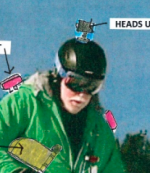
The man in the middle is Bruno Hans Geba, and he’s shown instructing two coeds from the University of New Mexico at Sandia Peak Ski Area in 1968. Several readers thought it might be Ernie Blake at Taos, probably because the image was submitted by the New Mexico Ski Museum and Ski Hall of Fame. Geba was born in 1927 in Salzburg, Austria. After World War II, he received bachelor’s, master’s and doctoral degrees in medical science, psychology and physical education from the University of Vienna. In 1955 he was invited to the US to serve as a consultant for the Aspen Institute for Humanistic Studies. At about the same time, he received his American doctorate in clinical psychology at the University of Colorado. While in Aspen, he trained the U.S. men’s and women’s Olympic ski teams and coached the International Professional Ski Racers Association. In 1966 he started a private psychotherapy practice in San Francisco; later becoming a professor at San Diego State University. He retired in 1992, moved to Hawaii. and passed away there at age 74.
Source: New Mexico Ski Museum and Sk Hall of Fame
https://seniorsskiing.com/wp-content/uploads/2022/01/Screen-Shot-2022-01-05-at-3.12.21-PM-e1641420874390.png916728seniorsskiing/wp-content/uploads/2014/04/Seniors-Skiing-since2013-Logo@2x-300x68.pngseniorsskiing2022-01-06 18:15:492024-08-20 15:14:35Test Your Skiing Knowledge
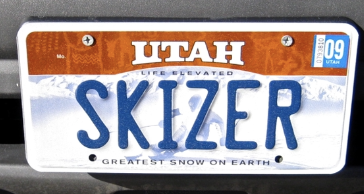
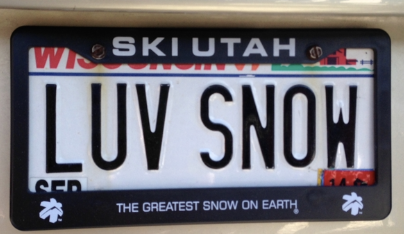
Isn’t it fantastic what a good imagination can do with six or seven characters…especially when a passion for identifying with skiing is involved?
These new additions to the license plate gallery came from Margery Martin, Minneapolis; Jack Whalberg, Cape Cod, and Hamlin “Ham” Pakradooni, Cape Cod.
If you run across a skiing license plate and want to add it to the SeniorsSkiing license plate picture gallery, take a picture (preferably close up and straight on) and send it to info@seniorsskiing.com. We’ll do our best to credit each contributor.











 The
The 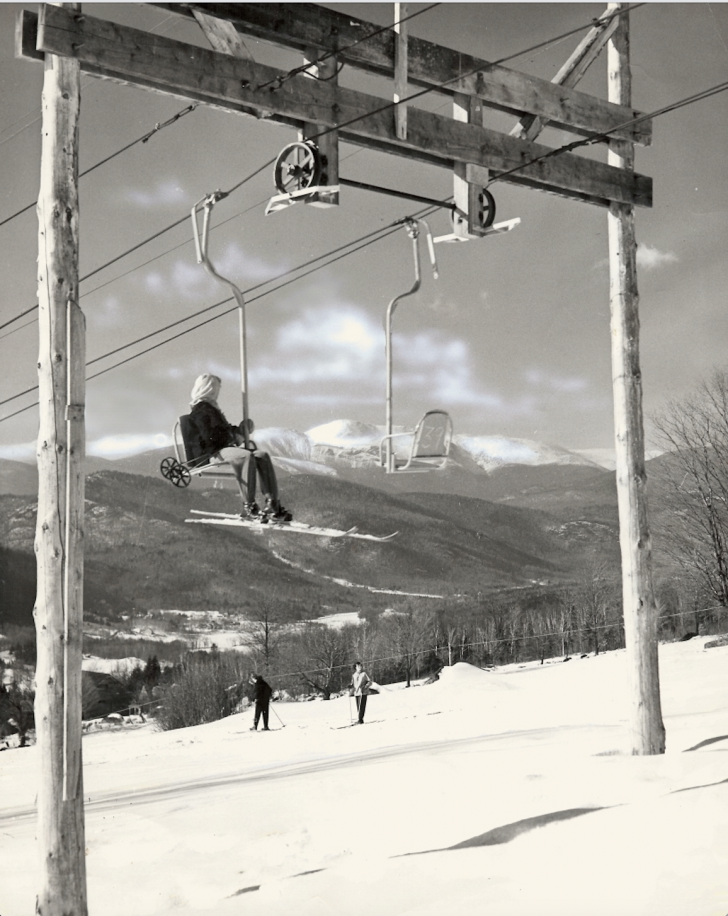 Michael Bannon, Bartlett, NH, was the first reader to correctly identify the picture in the last Test Your Skiing Knowledge. It’s the upper chairlift at Thorn Mountain, Jackson, NH. Thorn Mountain opened in 1949 with two single chairlifts stacked one above the other to give a vertical rise of more than 1,000 vertical feet. Thorn closed about 1956. Michael has been a Level 3 PSIA instructor since 1966. He’s been a SeniorsSkiing.com subscriber for 5 years. Congratulations, Michael! You’ll soon be receiving a container of Slide On, the dry lubricant spray that helps your feet slip in and out of ski boots. One application lasts for a month of frequent boot use. One 2 oz. can is good for the entire season. The picture was submitted by The New England Ski Museum, located in Franconia Notch State Park, New Hampshire. Admission to the museum is always free.












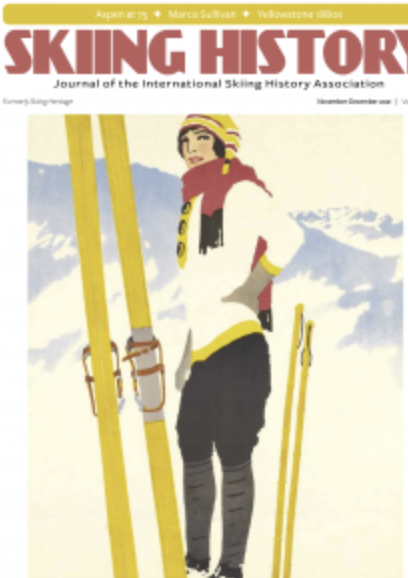
 Aspen’s Anniversary: 75 years ago, Aspen built its first chairlifts and opened for business. Most of us are familiar with the story of how racing champion Friedl Pfeifer returned as a wounded veteran of the 10th Mountain Division and forged a partnership with Chicago industrialist Walter Paepcke to form the Aspen Skiing Company. In this issue, Aspen-based writer and editor Cindy Hirschfeld tells the story of the locals who surveyed the ground, cut the trees, dug the footings, hauled and poured the concrete, assembled the towers, hung cables and chairs, and then ran the lifts and ski school.
 100th Anniversary of Megève, the first purpose-built resort in France. When the Baroness Noemie de Rothschild took a break from running a military hospital during World War I, she went skiing at St. Moritz. There she bumped into the German arms-maker (and notorious antisemite) Gustav Krupp. She swore to build an all-French resort, and in December 1921 opened her Hotel Prima in this medieval village just off the main road from Geneva to Chamonix. Under the stewardship of four generations of Rothschilds, the resort has maintained is ultra-luxe ambience. The skiing is good, too: After all, Megeve produced Emile Allais. Article by Bob Soden.
 Ron’s Last Run: We go into the New Year mourning the sudden death of our great friend and longtime contributor