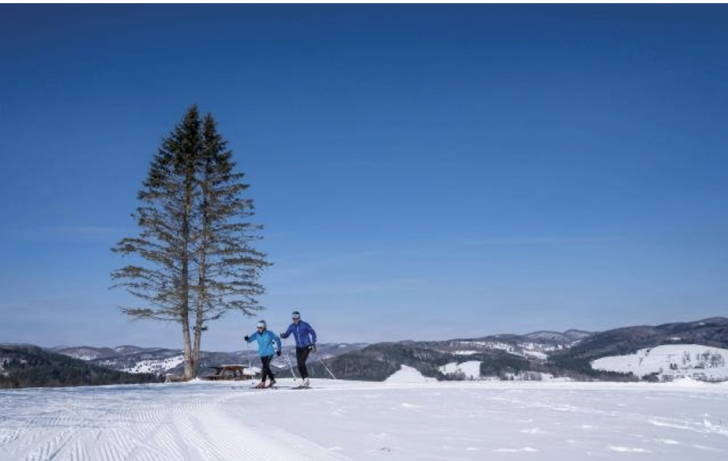
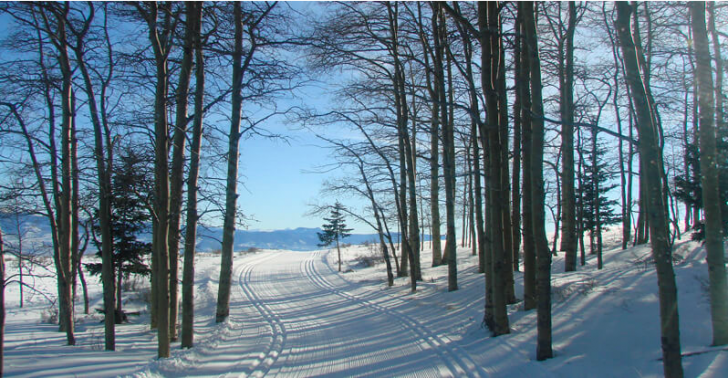
Over the past 50+ years, John “Morty” Morton has cross-country skied around the world, been an international-caliber racer and coach, and, as far as I’m concerned (this is homage from a friendly competitor), is the premier Nordic ski trail designer in North America.
Morty has seen dramatic evolutions in the sport – from wood skis to synthetic, wool to spandex, the introduction of skate technique, grooming snowmobiles replaced by snowcats, narrow trails sometimes giving way to highways, etc. Over these years, he served in Vietnam, taught high school English, and has served as broadcast journalist and newspaper columnist.
Now he’s written Celebrate Winter, a book filled with anecdotes and insights based on his intriguing life. It’s his third book, preceded by Don’t Look Back(1992), where he shared his story and training program, and A Medal of Honor: An Insider Unveils the Agony and the Ecstasy of the Olympic Dream (1998), a novel about biathlon.
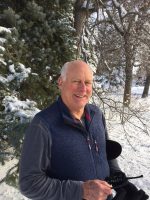
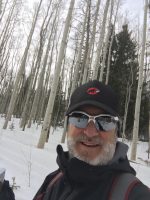
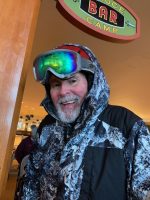
John Morton, age 76.
Celebrate Winter is a compilation of memories, from John’s days as a kid in New Hampshire to skiing for Middlebury College in Vermont; competing and coaching internationally in biathlon; coaching at Dartmouth College in New Hampshire; designing multi-use trails for the past 30+ years; to (most recently) skiing with his young granddaughter in a backpack while she calls out for more downhills!
Biathlon is a theme tying many of the roughly 70 stories together, as are observations on the human condition (ego, anger, generosity, laughter, inspiration). He covers the role TV plays in popularizing biathalon; Coca Cola at feeding stations; weather and altitude as they can affect racing; Olympic politics; doping; saunas; holding the Olympic torch for a moment at the Calgary Winter Olympics; and a constant sense of the magnetism of cross-country skiing, its beauty, diversity, and comraderie.
As trail designer, Morty has worked with schools and colleges, lodges and real estate projects, alpine resorts and pure cross-country areas, communities and private land owners, ski clubs and non-profits. Unlike some other designers, he’s well aware of the fact that really tough trails are only suited for elite athletes, whereas the great majority of us are recreational skiers (and the bread-and-butter for most Nordic ski areas).
If having your own professionally planned and built trail system sounds intriguing (cross country skiing, hiking, running, biking, snowshoeing, equestrian…), John Morton (https://www.mortontrails.com/) is still going strong in his mid-70s.
I recently purchased several copies of Celebrate Winter to give as gifts. Many of the anecdotes are just a few pages long, making for a delightful – no, mesmerizing – read.
https://seniorsskiing.com/wp-content/uploads/2022/01/Screen-Shot-2022-01-17-at-9.48.28-AM.png684464Jonathan Wiesel/wp-content/uploads/2014/04/Seniors-Skiing-since2013-Logo@2x-300x68.pngJonathan Wiesel2022-01-20 12:15:072022-01-20 15:10:05Celebrate Winter: Anecdotes and Insights from a Cross-Country Skier’s Experience
Editor’s note: Spend enough seasons skiing and most of us will get into some form of trouble. Last issue, I explained how I got into hot water by inadvertently becoming end-of-day Pied Piper to a bunch of kids who followed me on a long winding trail, while their parents anxiously waited their return. A few readers emailed their tales of on-slope woe.
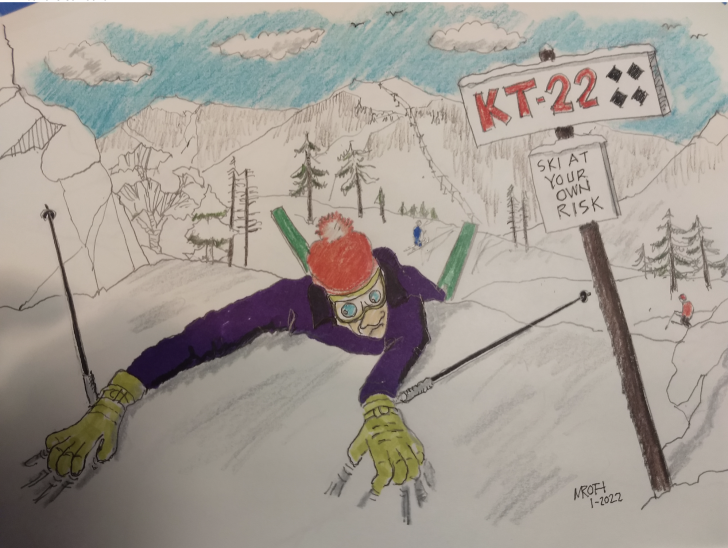
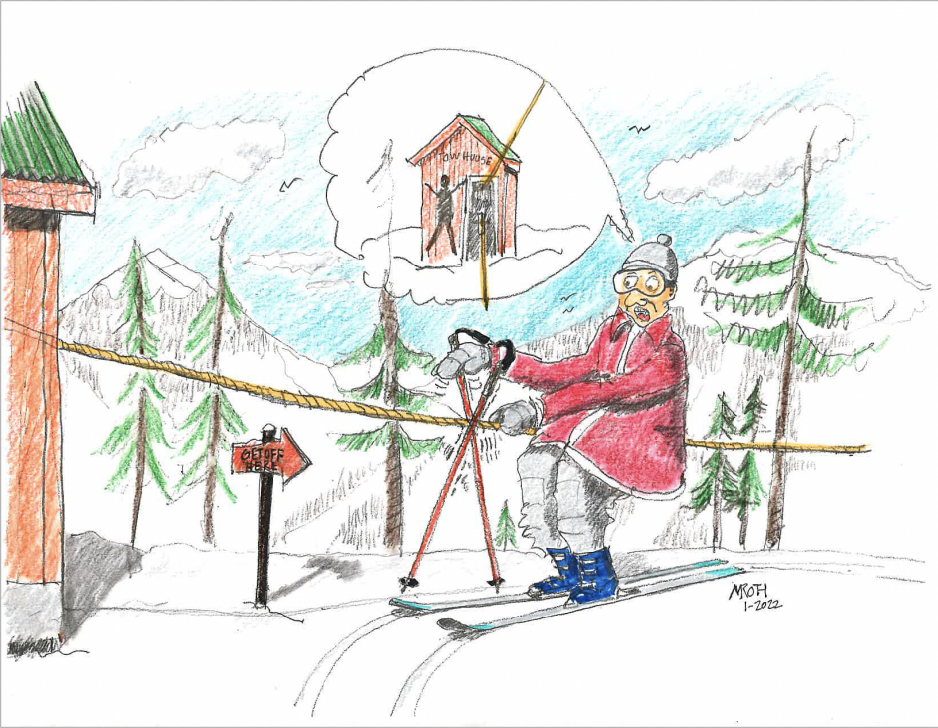
Mike Roth is a ski journalist who writes a regular ski blog for the Albany Time Union. He is also a talented cartoonist and and architect. When asked, last minute, if he had time in his busy schedule to illustrate these reader stories, he responded, “When do you need them?” A few hours later, Mike emailed his drawings.
This cliff-hanger happened to Jeffrey M. Fine when he was 40, but he still remembers the day. Jeffery is now based in Dillon, CO.
Sometime in the 1980’s while living in Indiana, I took a trip out to Squaw Valley. I thought I could ski KT-22, and it almost cost me my life. While skiing down the right side of the run, I caught an edge and almost went off a cliff with a 50’ drop. I managed to fall just before going over the edge and held on with my fingers in the snow (I was highly motivated to grab anything) while my skis hung over the edge in space. The ski patrol was able to throw me a rope and pull me to safety. I feel very lucky to have survived!
And here’s a rope tow tale from Ed Schultz, Penn Yan, NY. It happened when he was 30.
Back in the early 70’s skiing a small area in Massachusetts near Wooster, (can’t remember the name), I got on the rope tow. I had one arm behind with my pole straps around my wrist. What I didn’t realize was that the poles were bouncing in the snow behind and my pole straps somehow got twisted so when I went to get off I was caught on the rope. The rope tow rose up at the end toward a building housing some of the tow’s mechanism. I had visions of being carried up and going splat on the building. There were no safety stops in those days. Fortunately, I wriggled and twisted, freeing the straps and exiting the tow just in time.
Have a personal ski story you’d like to share? It can be about almost anything.Send it to info@seniorsskiing.com. We’ll share the most interesting with SeniorsSkiing’s 17,000 subscribers, along with an original Mike Roth illustration.
https://seniorsskiing.com/wp-content/uploads/2022/01/Screen-Shot-2022-01-17-at-7.54.30-PM-e1642474837357.png548728Mike Roth/wp-content/uploads/2014/04/Seniors-Skiing-since2013-Logo@2x-300x68.pngMike Roth2022-01-20 12:10:062022-01-20 15:09:18Hanging On for Life and (Almost) Getting Eaten by the Rope Tow
This is the first issue of SeniorsSkiing.com of 2022. I wish all readers good health, happiness, and peace for the New Year. But Covid’s omicron variant is challenging that wish for good health. It’s spreading fast, even among those who have been triple vaxxed. For most of the infected, it appears to be less taxing than Delta or earlier iterations. One side effect reported by several people I know, is hearing loss.
Ultimately, omicron’s virulence may cause such widespread infection that we’ll achieve herd or crowd immunity. That remains to be seen.
We’re older skiers and, by definition, more vulnerable to serious illness from the virus. For simplicity’s sake, I’ll divide our cohort into two categories: those who stay at lodges when they go skiing and those who ski and return home. Each is subjected to infection on lifts and in day lodges. Those overnighting in lodges have the additional risk of exposure from employees and other guests.
I don’t know if Utah is typical, but in terms of looking at the intersection of skiing and Covid, it is relevant.
Alta has no mask or vaccination-proof requirements. That, according to several friends who have skied there multiple times this season. The area recently closed its Watson Shelter because some staff tested positive. Alf’s remains open but with no mask or vaccination-proof requirements. The midmountain day lodge does keep windows open, according to a source working there.
Alta’s Smiling Rock Photo: Harriet Wallis
By comparison, day lodges at Park City Mountain Resort (indeed, all Vail Resorts ski properties) require proof of vaccination and masks to access food-service and tables.
On the day I’m writing this, a front-page article in The Salt Lake Tribune reports that Covid swept through several of Alta’s overnight lodges, causing some guests to leave early, rather than risk getting ill. Of the five lodges, the only one requiring proof of vaccination is The Rustler. Snowpine, totally rebuilt a few years ago, follows Utah’s libertarian spirit and requires neither vaccination nor masks. The lodge’s website is devoid of any reference to Covid.
The Tribune quoted a 74-year-old guest who beat it back to her California home: “I’m not going back to Utah. It’s a COVID [nightmare]. Nowhere has better powder than Alta. Too bad it’s in Utah.”
The Christmas feast at our friends’ home was a lot of fun. Three guest couples, all contemporaries; all skiers; all known to the host and hostess but not to each other. Following festive fare, our ever-creative hostess, asked each of us to talk about the first time we skied and about a time we got into trouble while skiing.
The answers to Question #1 revealed surprising similarities among the men: none had been particularly “athletic” in youth. But then they were introduced to skiing. Each of the wives became interested through their husbands.
Getting into trouble on skis produced stories of literal, cliff-hangers; skis lost in deep powder, etc. Listening to these tales of woe, reminded me of the time I inadvertently became the end-of-the-day Pied Piper to a bunch of kids whose anxious parents awaited their return.
It was in the mid 70s and Pam and I were skiing Plattekill, an 1100’ ski hill with a variety of interesting terrain in the Northwestern Catskills, a few hours north of New York City.
Pam returned to the day lodge as I took one last run. At the top, I entered a trail I hadn’t noticed before. It was more of a road than an actual trail, one of those endless runs looping back and forth through the forest. A few minutes in I heard laughter behind me. I looked back and counted 12 little ones following.
Back to Pam waiting in the lodge; wondering, Where’s Jon? Around her, clutches of agitated parents wondering, Where are our children? Several minutes later, I walk in, followed by the kids. Emotional parents embraced their missing ones.
The angry area owner yelled at me from across the large room, accusing me of taking the kids on a closed trail. I called back: “The trail wasn’t roped off, and I didn’t know the kids were following.” His response: “Do you know how much it costs for rope?”
I was banned from returning to Plattekill; a punishment promptly ignored. Those kids must now be in their 50s!
Have you gotten into trouble while skiing? Send in your stories. We’ll publish the most interesting.
Stevens Pass Petition: 20k Signatures
In a mere five days, more than 20,000 Epic Pass holders at Stevens Pass ski area in Washington, signed a petition demanding that Vail Resorts refund 60% of the cost of their passes. Why 60%? They claim that VR sold passes while knowingly planning to keep 60% of Stevens Pass terrain and a majority of lifts closed for the season. The petition gives VR a deadline to act by January 15 before filing a complaint with the Consumer Protection Division and the Attorney General of Washington State. Click here to read the petition.
Incivility at Beaver Creek
According to a posting by the victim’s wife, her husband was struck by someone skiing in a group. When he confronted the person, another man in the group removed his skis and gave her husband a severe beating, leaving him with a broken rib and other injuries. The group, thought to be in their 30s, skied off and were not found. The incident was reported to patrol and the Sherriff’s office. It occurred December 31 at Beaver Creek.
Park City Patrollers Seek Raise
The Park City Professional Ski Patrol Association (PCPSPA) rejected Vail Resorts’s offer of a starting wage of $15 per hour. The patrollers want $17. Current wage is $13.25. More than 200 patrollers are working without a contract. Other Park City Mountain Resort employees receive $15 per hour minimum. Patrolling requires extensive training and patrollers generally are responsible for supplying their own equipment. If VR blinks, minimum wages for patrol throughout its many holdings will climb.
Timberline and Ski Bowl Discontinue Free Skiing for Seniors
Subscriber, Thomas Levak, informs us that Timberline and Ski Bowl (OR) have discontinued free skiing for super seniors (73+). Lift tickets for 65+ skiers are $65 (days) and $45 (nights), and skiers are required to make advance reservations for the days and times they want to ski (perhaps not a bad idea given that limited numbers of skiers are allowed for different time slots). Thanks for the info, Thomas!
New Advertisers: Booster and Slide On
The Booster Dynamic Power Strap is an elastic power strap that replaces the power straps found on most boots and helps you ski better, regardless of skill level. It is used by 80% of all Olympic skiers. Slide On is a dry lubricant spray that helps your feet slip in and out of your ski boots. One application lasts for a month of frequent boot use. One 2 oz. can is good for the entire season. Click on the Booster/Slide On ad for more information.
Snowbird’s Golden Anniversary
Believe it or not, The Bird opened 50 years ago. Those of you who have been there, know its magic. If it’s still on your “to do” list, take steps to get it done. Its 2500 skiable acres are accessed by tram and 10 chairs. It connects to Alta, for a combined 5000+ acres terrain. I have many memorable days skiing thigh-deep (sometimes waist-deep) Snowbird powder with friends. The resort produced a 3-minute video telling its history. Click on the image, above.
Patagonia Walks the Talk
Patagonia makes superb, durable outerwear and redirects a portion of its profits to support environmental and other worthy causes. Another example of the company’s progressive policies is its closing all its stores from Christmas through New Year’s while paying employees.
Austria Tightens Covid Rules for Brits
Austria has classified the UK as a “virus variant” region. Effective December 25, visitors from the UK are required to quarantine 10 days upon arrival, even if fully vaccinated. Given that Austria is a major destination for UK skiers, this is a big deal. Exceptions: Those fully vaccinated and boosted who have a negative PCR test. Children under 12 are exempt. Teens meeting certain conditions also may enter the country.
Record Snow Records
More than 200″ (almost 17′) fell in the Sierra’s in December. Utah is getting hammered with one pulse after another. Revelstoke (BC) has received 21’+ so far this season. All that snow prompted me to look into snow accumulation records. An amazing 1,140″ (95′) was recorded at Mount Baker Ski Area (WA) (4,200 feet elevation) during the July 1, 1998 to June 30, 1999 snow season. Mt. Ibuki (Japan’s Honshu Island) measured 465.4″ (38.8′) February 14, 1927. The most snowfall in 24 hours (6.3′) was measured in Silver Lake, CO, April 14-15, 1921. Mount Shasta Ski Bowl (CA) recorded the most snow from a single storm: 189″ (15.75′), February 13-19, 1959.
Brrrrrrr: New Ice Hotel on Italian Glacier
A bedroom is the ice hotel next to Capanna Presena Refugio
A new ice hotel is now booking reservations. The luxury facility is on Italy’s Presena Glacier at Passo Tonale in Trentino and features intricate ice carving on both interior and exterior surfaces. The three-igloo-room facility is next to the Capanna Presena Refugio.
Vintage Cars in Snow
Here, from Weather.com, are 53 photos of cars in snow…most of them stuck in the snow. They’re from both sides of the pond and fun to see. Click here to view.
Another Weather.com entry: 91 vintage images of people playing in the snow. Notice that virtually every person pictured is smiling. Of course, they are! They’re in the snow. Click here to view.
Do you have information you want to share with other members of the growing SeniorsSkiing.com community? Send it to jon@seniorsskiing.com. Use the same address if interested in contributing articles. Please forward SeniorsSkiing.com to other older skiers who may enjoy receiving it. Or simply tell them about the site.
A version of this article first appeared in 2015 in Huffington Post.
I was hardly able to move; disoriented on terrain I’d skied for years. Other skiers seemed to be managing fine. But the light was flat, and my eyes could no longer pick up contours in the white on white.
Flat light sucks. Credit: Jan Brunvand
“Flat light,” a version of whiteout, greatly reduces the contrast that helps anyone on snow see where the dips and moguls are.
In extreme conditions, every skier of every age is affected, and the best way to get to where you’re going is to ski near trees, where their dark forms create visual contrast against featureless snow.
But these were not extreme conditions. Skiers and boarders were easily moving around, while I was in a featureless and confusing snowscape.
Credit: Jan Brunvand
Older skiers have older eyes. According to Dr. Jeff Pettey, Assistant Clinical Professor at the University of Utah’sJohn A. Moran Eye Center, all skiers eventually experience decrease in on snow contrast sensitivity. The most common culprit is cataracts, the cloudiness that forms on the eye’s lenses, causing loss of clarity and decreasing the quality of light focused on the retina. Cataracts can start forming when we’re in our 40s and 50s, though they’re more commonplace in our 60s and 70s.
Less common are processing issues related to diseases such as glaucoma and macular degeneration. They decrease the quality of the signal transmitted to the brain.
For me the eye opener was the other skiers who hardly slowed down while I was straining just to find the trail. I had been treated for age-related macular degeneration. But cataracts? A few weeks earlier, the ophthalmologist told me they were early stage. Those baby cataracts compromised what I could see in the snow!
After a minute or so of discomfort, I donned my goggles and headed down.
Getting Goggles Right
Choice of goggles and goggle lenses can make a big difference helping senior skiers with compromised vision navigate flat light conditions.
Most goggle manufacturers agree that the more light entering the lens the greater the definition and contrast. The trick is to select a lens whose color helps enhance depth perception. Amber, yelloe, rose, green and gold lenses tend to transmit more light. Photochromatic lenses, which change color under varying light conditions, can be effective.
While some industry experts recommend polarized lenses, the glare-reducing technology used in many sunglasses, others advise that in extremely flat light a little glare helps distinguish between ice and snow, making the trail more readable.
No More Fog
Regardless of light quality, fogged lenses get in the way of good vision. Having lived through many seasons of foggy goggles, I’ve explored many approaches to reducing the curse. Wipes, saliva, goggles with built in fans, products and technologies that claim to keep lenses clear under all conditions. Some work better than others, but none do a really good job.
SnowVision Rx goggles integrate prescription with inner lens
The unique SnowVision prescription goggle, virtually eliminates foggy goggles by positioning the presciption lens at a distance from the face where it remains cool, while providing a full range of vision using bi-focal or progressive lens technology.
Gee Whiz!
Some inventors have gone beyond goggle and lens with ideas that would remove the “flat” from flat light. Among them, twin laser beams projecting a contoured grid of the surface in front of the skier. The idea is to navigate, videogame-like, through the contours. Lower tech, but equally out there, is a built in spray gun system that skiers would activate to send a fine blue color onto the snow, forming the contrast needed for better visibility. Similar sprays are used to make race courses easier to read in flat light.
Artist’s concept of Earth and Sun. Credit: NASA
While lasers and sprays remain in the planning stages, Michael Barry, past-president of the National Ski Areas Association has this advice for those of us with aging eyes: Get to the mountain early and ski until early afternoon. This strategy works best for the first half of winter when light tends to flatten as the day progresses.
As the Earth’s axis shifts and daylight lengthens, pop on those rose-colored goggles and enjoy every last run.
https://seniorsskiing.com/wp-content/uploads/2018/10/Flat-Light2-e1539089365912.jpg502728Jon Weisberg/wp-content/uploads/2014/04/Seniors-Skiing-since2013-Logo@2x-300x68.pngJon Weisberg2022-01-06 19:00:542022-01-06 22:32:22BLINDED BY THE (FLAT) LIGHT: SENIOR SKIERS CAN SEE CLEARLY IN SNOW
XCSkiResorts.com recommends these classic New England towns and areas for a cross country ski vacation:
Stowe, VT, is quintessential New England with its white steepled church and main street lined with stores.
Source: Trapp Family Lodge
It’s also the home of the Trapp Family Lodgeof Sound of Music fame. Trapp Family Lodge has a 110 km trail network with 60 km of groomed and machine-tracked trails. Stowe has a full range of dining and shopping options. Other nearby XC resorts include Bolton Valley, Stowe Cross Country Center, and Edson Hill.
Woodstock, VT is another winter mecca with inns, restaurants, unique shops, and a national historical park.
The Woodstock Nordic Center operated by The Woodstock Inn & Resortoffers two trail systems right in town covering more than 45 km. The Mount Peg trails begin on the golf course at and climb to the summit overlooking the village below. On nearby Mt. Tom, the Center grooms more than 20 km of trails on old carriage roads in the midst of Vermont’s first tree farm and Marsh-Billings-Rockefeller National Historical Park.
The Mt. Washington Valley in the White Mountains of New Hampshire has some of the best cross-country skiing in the East.
“Enchanting” is the best word to describe Jackson, the paragon of New England towns and home to Jackson Ski Touring Foundation, a non-profit organization chartered to provide and maintain XC trails on more than 80 private properties and national forest. Country inns are scattered throughout the region. The base lodge is accessed through a scenic covered bridge.
Covered bridge at Jackson Ski Touring Center, New Hampshire Photo: Roger Lohr
Great Glen Outdoors at the base of Mount Washington is a magnificent setting with 45 kilometers of XC skiing, snowshoeing, and an ol’ fashioned tubing hill. Great Glen’s scenic trail system offers an enjoyable combination of well-protected spruce and fir-lined trails plus wide-open areas with breathtaking views of Mt. Washington and surrounding peaks. On the trails is the classic New England Glen House Hotel, with 68 rooms, a pub and restaurant. For even more adventure, enjoy a comfortable winter tour on the 9-passenger Mt. Washington SnowCoach, which transports guests to an unforgettable journey to a sub-Artic world on Mt. Washington.
Skiing at Bretton Woods, NH Photo: Roger Lohr
Bretton Woods Nordic Centeris a thriving cross country ski center on the grounds of the Omni Mt. Washington Hotel. It. The grand Bretton Woods hotel has 100 km of XC ski laced throughout 1,700 acres of spectacular scenery. The Mountain Road, accessed via a lift at the Bretton Woods alpine ski area, offers spectacular vistas of Mt. Washington from a 7 km groomed trail down to Route 302.
Bethel, Maine is home to theBethel Inn and Carter’s XC Ski Center, and Sunday River Resort’s alpine ski trails. The town settled in 1774, retains its small-town lifestyle.
Bethel Inn Resort , Bethel, ME
The XC ski trails, which meander through forest to a picturesque, covered bridge are canine friendly. Several inns along the trails are operated by the nonprofit Bethel Inland Woods and Trails organization. The Carter’s XC Ski Center has beautiful views of the Mahoosuc and Presidential mountain ranges. Alpine skiing, dogsledding trips, and snowmobile rentals are available nearby.
Many businesses in each of these New England ski towns organize special events on winter weekends and vacation weeks to encourage people to get out and enjoy the snow.
If you’re into XC skiing and keep a bucket list, Stowe and Woodstock, VT, the Mt. Washington Valley, and Bethel, Maine are classic New England destinations not to be missed.
https://seniorsskiing.com/wp-content/uploads/2022/01/Trapp-Family-Lodge-e1641075521811.png487728Roger Lohr/wp-content/uploads/2014/04/Seniors-Skiing-since2013-Logo@2x-300x68.pngRoger Lohr2022-01-06 18:30:232022-01-06 22:28:55Four Bucket List New England Cross Country Ski Towns
Yes, age does give many of us some advantages. Wisdom is often cited, but, I, for one have made enough errors in judgment to be exempted from checking that box. I’m probably not alone.
Financial well-being is another frequent citation. Fortunately, along with about two-thirds of SeniorsSkiing readers who say they’re financially independent, I’m okay in that category. But I know too many older skiers whose fortunes took them in another direction. Many have adjusted lifestyles so they can continue to pursue their favorite sport.
Outlook and attitude also are advantages for some of us. My old friend, Frank Burgmeier, is 98. A veteran of 65+ bomber flights in WWII, he continues to have a sharp mind and a great attitude. “I’m blessed,” he tells me. That, despite disappointments from some family members. “When I peel all of those things away, I’m happy and at peace.” If I make it to that age, I hope my mind and spirit are as healthy as his.
Jim Cobb is another example. Jim is 89 and the developer and manufacturer of TheBootster, the ski boot shoehorn that advertises on these pages. He skied many years with the National Brotherhood of Skiers before age caused him to retire. When I mention that we just had a 24-hour snowstorm here in Utah, he sighs with resignation and says, “I’m envious that you’ll be skiing. That part of my life is behind me.”
Some are fortunate enough to ski on and on. George Jednikoff continued past 100. At 99, Claus Obermeyer is still going. I know there are others, but I don’t know their names.
Luck also is a big factor. I recall being at a luncheon where the speaker was Mike Singletary, then coach of the San Francisco 49ers. One comment that stuck with me was the 20% luck factor. Being in top physical condition and having outstanding skills were essential for his players’ good results, he said. But luck always plays a role on the field; he thought about 20%.
Luck (good or bad) also is a factor as we age. Like many other senior skiers, I’ve had my fair share of bad luck. Much of it seems to have occurred health-wise in 2021. I’ve been climbing out of that hole for the past six months, and I’m now ready to get back to what I love: skiing. I readily admit that the goal of publishing SeniorsSkiing.com kept me motivated during some dark and difficult times.
Wisdom. Financial well-being. Outlook and attitude. Good luck. They can keep us going as we age. Whether we possess all of them or a few, we should be grateful for what we have, while we have it.
Wishing all readers good health, good skiing, and good times for the Holidays, and beyond.
[[Taking Christmas and New Year’s off. Next issue of SeniorsSkiing.com will be sent January 7. You always have access to all articles by visiting seniorsskiing.com. New articles are posted on the site during the week leading up to each publication date. Please help us grow the seniorsskiing.com audience by sharing seniorsskiing.com with other senior skiers.]]
232 Skiing Santas Raise Charity $$$s
For the past 21 years, Sunday River (ME) has kicked off the Holiday Season with Santa Sunday, a fund-raiser for a local charity. This year, 232 Santa-clad skiers each paid a $20 entry donation, raising more than $5000 for The River Fund, which invests in the education of young people in the region.
Vail Resorts Tops Season Pass Sales
Vail Resorts reported it sold more than 2.1 million season pass products for this season. That’s 700,000 more than last year, a record for the company. Also, for the second year in a row, Newsweek named VR one of America’s Most Responsible Companies.
Jackson Hole Ups Hourly Wage
Jackson Hole Mountain Resort is increasing its minimum wage for all non-tipped positions to $18 per hour, up from $15 per hour. The increase is intended to attract new and retain existing employees.
Really Smart Helmet Technology
Source: Twiceme
Twiceme, a Swedish company, has teamed up with Salomon to produce “smart” ski helmets. To be available late 2022, the helmets will utilize twICEme® technology to provide a suite of safety information ranging from personal medical records to finding a lost child. It will be readily accessible to ski patrol and search and rescue.
NE Areas Banning Boot Bags?
SeniorsSkiing subscriber, Torry Hack, writes: “As a grey-haired skier who likes to put on his boots in the lodge vs in his car, I am disappointed to find that many New England areas are still banning bags.”
New England skiers: Please email info@senioirsskiing.comto let us know if your area bans bags in the day lodge, and we’ll publish the list.
Shipping Container Ski Lodge
The Pad Hotel, Silverthorne, CO
The town of Silverthorne, in Summit County, Colorado, is home to The Pad, a hotel constructed from 18 shipping containers. Private rooms are $350. per night; bunk rooms, $50. It’s not far from Copper, Keystone, Breckenridge, and A-Basin.
Surprise Storm
Reader Donna Ohanian in New Hampshire, sent in this photo along with a note stating, “This storm was supposed to be 3-6”. Nope. 30!” Note the LUV-SNO license plate. Thanks, Donna!
Snowball Fights in Art
Detail from a fresco depicting the month of January at Buonconsiglio Castle in Trento, Italy, ca. 1400
Public Domain Review is a British-based organization that issues interesting articles and illustrations outside of copywrite restrictions. Click here to enjoy PDR’s history of snowball fights in art over the centuries and in a variety of cultures. It’s a treat.
When was the last time this happened to you on the mountain: you’re skiing down one of your regular trails, having fun, where you know every turn by heart, and then, as you approach a trail sign for a more difficult run than you’re used to, you think maybe it’s a good time to try it…but then you keep on skiing down the regular old way.
So what happened? It happens to me also: a tiny little wave of discomfort/anxiety/fear creeps into my head (I call it the “fear monkey”) and causes me to ski the easier way, meanwhile telling myself, “I’ll do this one tomorrow.” And just like that… fear becomes the boss of me! I hate that, but it happens. How can we change our patterns, so we take the turn down the more challenging terrain?
Don’t let the fear monkey get in your way.
I’ve noticed this for years in my own skiing, although I’ve gotten better at deciding when I’m going to “go for it” and challenge myself more than usual. The key for me in making positive changes, and skiing more challenging terrain on a regular basis, started when I began ski instructing twelve years ago! Huh? Let me explain…
I’d take a group of skiers, usually 3-6 people, ranging in ages from 18-50. While the group was being organized, I’d always introduce myself to each skier, and ask each person a few questions about why they were taking a lesson, what types of sports and activities they enjoyed, what they hoped to get out of the lesson; stuff like that. I’d also ask, ”What are you worried about?”
I’d hear a lot of things that would help me figure out what each person’s “takeaways” were for their lesson. It was almost like each person would give me the magic key for solving their “personal skiing puzzle.” Everyone’s got one, hidden away, just waiting to be revealed, including me: “afraid of going too fast,” “getting my skis more parallel in the turn,” “keeping my speed under control to lower my fear,” ”not be so afraid,” “looking as good skiing the tough stuff as the easier stuff!” What’s yours?
For skiers, the degree of FEAR in their heads is the ultimate limiter on both performance and improvement. Of course, we need fear to warn us away from true danger, but fear is greedy, and likes to hang around unless we send it away.
The good news is that you can send fear to the back of your mind. It’s simple. Just figure out your own magic key to your own skiing puzzle. What do YOU need to do on a tougher run to stay confident? For me it was this: take the more difficult trail, but plan to ski it in a very measured way, slower than the other runs, pausing to pick each line, just one turn at a time, and stay smooth. Once I started thinking differently about skiing the tougher stuff, it became much easier to choose those double blacks, and it felt good at the end of each day to have skied them.
https://seniorsskiing.com/wp-content/uploads/2020/12/IMG_1071-rotated.jpg640480John Gelb/wp-content/uploads/2014/04/Seniors-Skiing-since2013-Logo@2x-300x68.pngJohn Gelb2021-12-16 20:14:262024-08-20 15:16:16The Fear Monkey in Our Heads
If you’re among the many newcomers to XC skiing, I suggest that you take a lesson. XCSkiResorts.com recommends starting at one of the following locations:
Metropolitan Boston — Weston Ski Track, a county-owned golf course accessible by public transportation. Snowmaking guarantees good cover and lights allow for night skiing. A 75-minute session covers the basics (i.e. motion, turning and negotiating small hills). A package of rental gear, lesson, and trail access starts at $44 for kids and $64 for adults. There are well-priced multiple session packages, too.
New Hampshire — Great Glen Trails, Gorham, encourages booking on line because of capacity limits in its 75-minute group lessons. Coaching goes at a pace that is comfortable for the whole group to learn gliding, stopping, and getting up (just about everyone falls on the snow when they begin skiing). The views of Mt. Washington from Great Glen Trails are astounding.
Mt. Peg at Woodstock Nordic Center
Vermont — Trapp Family Lodge (the Sound of Music family), Stowe, starts newcomers by teaching basic techniques which help beginners get control (e.g. kick and glide motion, using poles, and stopping). They use soft skis, which make it easier to turn and stop. Woodstock Nordic Center, Woodstock Inn & Resort, offers a 20-minute “Mini Clinic” for first timers ona golf course behind the inn. It includes a lesson, trail pass, one hour equipment rental for $50.
New York — Lapland Lake Vacation Center in Northville customizes the introduction to XC skiing to the skier’s level of ability. There is terrain with a wide modest downhill and a run-out to make skiers feel more comfortable.
Michigan — Cross Country Ski Headquarters, Roscommon, offers free lessons on weekend mornings for beginners in classic or skate skiing. Their Winter Trails Day on January 8 provides free access and a lesson with a complimentary hot cocoa and hot dog cookout for only $9.
Minnesota — Maplelag Resort, Callaway, is a family-oriented operation that goes out of its way to make people comfortable with new adventures like XC skiing or snowshoeing so they’ll want to come back for more. Maplelag is a community-based experience and often, experienced guests provide extra attention to first time skiers.
Breckenridge Nordic Center lodge
Colorado — Breckenridge Nordic Center specializes in working with those who are first timers. The Center gives a 20% discount on group lessons booked on line. All resort staff are ambassadors who freely offer ski tips to all. As soon as the skier steps out the door, staff is available to help skiers put equipment on, review the trail map, talk about body balance, and provide other tips.
California — Tahoe Donner Cross Country has low cost opportunities to help people learn basic ski skills. The $87 member price is for a group lesson package that includes rental gear, trail pass, and a 75-minute lesson or tour with an instructor.
Washington – Located in eastern Washington, Methow Trails has one of the largest trail networks in the U.S. On January 21. It hosts Free Backyard Ski Day with free access to the trails, free rental gear, and free lessons available for beginners.
XC skiing delivers physical, mental, and spiritual well-being. Spending time in a snowy landscape can be magical. Do yourself a favor and give it a try.
https://seniorsskiing.com/wp-content/uploads/2021/12/Screen-Shot-2021-12-13-at-2.29.23-PM-e1639431029754.png461728Roger Lohr/wp-content/uploads/2014/04/Seniors-Skiing-since2013-Logo@2x-300x68.pngRoger Lohr2021-12-16 20:11:372024-08-20 15:17:27New To Cross Country? These Nordic Centers are Great Places to Start.
We live in what some call an attention economy. Those who attract attention – regardless of how they go about it – appear to be the victors in our narcissistic new world. The companies making skis and related gear are no exception. One of their primary ways of competing for attention is producing short videos of pro skiers using their gear in wild and wooly terrain.
Videos of people doing amazing things on skis are similar to porn: there are just so many tricks in the bag, and it’s not long before they get boring. That said, ski manufacturer lemmings invest in making videos that, in one way or another, try to outclass their competition.
The New Age of Reason is a new addition, from a company named WNDR (Wonder Alpine). It combines a soundtrack of barely audible British voices making quasi-intellectual statements, while pro skiers make deep powder turns and jump cliffs in some easy-to-watch and quickly forgettable scenes. Unlike most other short promotional videos which depend on big-name super skiers and/or pulsing rap music to appeal to their intended audience(s), this one relies on pretense. That said, WNDR appears to be a company with good policies and good products.
Will its video approach help the the company break through the rest of the promotional ski video clutter? Maybe for a few minutes while the ski marketing echo chamber resonates with email congratulations.
A few years ago, at the Winter Outdoor Retailer Show, I attended a presentation that discussed a variety of advertising and promotional investments. The activities were listed in order of their perceived effectiveness in contributing to product sales. As I recall, in-store salespeople and word-of-mouth were most effective. Way down on the list…I mean toward the very bottom…were promotional videos. They cost a lot to produce. They reach a relatively small audience. They make their sponsors feel good about their investments. But do they move the needle when it comes to sales? You know the answer.
As I finished drafting this, yet another video landed in my inbox. At 21 minutes, it’s a bit on the long side. But if you want to see what has become possible on skis in entirely impossible terrain, “Good Luck” will get you up to speed with a smile. Click here to screen.
Ski Journalist Dies Following Collision with Snowboarder
Ron LeMaster, 72, was killed earlier this week after colliding with a snowboarder on Eldora Mountain (CO). LeMaster, a ski writer and photographer, was a certified PSIA instructor. No charges were filed against the boarder. The tragedy is a reminder for older skiers/boarders to exercise extreme caution on the hill. R.I.P.
Realskiers.com: Ski Industry Is in Trouble
Jackson Hogen publishes realskiers.com, a long-established website featuring in-depth reviews of each year’s new skis and a host of observations about the sport. The self-proclaimed Pontiff of Powder periodically sends out thought pieces under the heading, “Revelations.” A few weeks back, he took a dystopic and disturbingly realistic view of the future of skiing. It’s titled, “Will the Next Generation of Skiers be the Last?”, covering, among other big issues, cost, accessibility, competing interests and climate change. To read the short essay, click here. SeniorsSkiing.com subscribers are eligible for a 50% discount off the annual realskiers.com rate of $19.95. Use Code SS21 at checkout.
Klaus Obermeyer is 102!
Klaus created the ski apparel line bearing his name. He is credited with making the first down-filled parka. When I interviewed him a few years ago, he said that he found it easier to ski than to walk.
Winter Park to Donate Uphill Ski Pass Revenue to Charities
Source: Winter Park Resort
The area will donate proceeds from sales of its uphill ski passes to local charities. The passes cost $25 each. It’s good policy, given that paying to climb on the slopes is a relatively new development that has been met with some criticism.
Aspen Bumps Minimum Wage
Aspen Skiing Co. will increase starting wages to $17 per hour, a significant bump from Colorado’s current $12.32 minimum. The company also increased employee housing to 1,000 beds.
High Tech Bandage Changes Color
DrySee is a long-lasting bandage that changes color when it needs to be changed. Cost depends on bandage size. Manufacturer of this interesting new product is offering SeniorsSkiing.com readers 20% off when they enter “Facebook 20” at checkout. Visit www.drysee.com to learn more.
Last Minute Gift for Senior Skiers
The Bootster ski boot shoehorn is ideal gift for older skiers
Get them The Bootster. It’s a clever, fit in your pocket ski boot shoehorn that is solidly made and will last many, many seasons. Handmade by company founder, Jim Cobb. At $25, it’s one of the best bargains around. Click on the adjacent ad and read the rave reviews.
Dep’t of Wretched Excess
The world’s most expensive “hotel” room costs $175,000 per night.Lover’s Deep is a luxuriously tricked-out submarine in St Lucia. Amenities include captain, cook and helicopter.
Diamonds Are Forever Martini
The world’s most expensive cocktail is now available at Tokyo’s Ritz Carlton hotel. The Diamonds Are ForeverMartini costs $22,880 and is garnished with a one-carat diamond. Kampai!
New 10th Mountain Division Documentary
https://youtu.be/x6BpDQ85ZN8
“Mission to Mt. Mangart” is a new documentary exploring the famed 10th Mountain Division, whose members relied on skis. Click on the trailer (above) to see the slalom they organized in June, 1945.
Update: Jackson Hole’s Skiing Wunderkind
I wrote about Kai Jones when he was 12. Kai, now 14, is the Jackson Hole ski wunderkind whose skiing is a joy to behold. This short video was shot last season, when he was a high school freshman.
Sometimes life exceeds expectation. That’s what I’ve found with winter ranches in the Rockies.
In summer, hundreds of dude ranches draw thousands of visitors. They’re crazy-diverse: homespun and elegant; private and heavily peopled; mostly self-service or with staff at your call. You’ll find Spartan working ranches as well as places with canapés and kidney-shaped swimming pools.
The few ranches open in winter are outstanding – magnificent settings and staff, excellent facilities and food, and snow so delicate it drifts through the air like cold smoke. They’re run for cross-country skiers, snowshoers, and, increasingly, fat bikers by people who love the season and their profession.
Wecome to Latigo Ranch
A prime example is Latigo Ranch, near the town of Kremmling in north-central Colorado’s Gore Range. It’s owned and managed by Lisa and Randy George and their kids.
Latigo used to run cattle, sheep, and “dudes” before it totally converted to guest ranching in 1987. Once you turn off Highway 134, you start climbing, trading sage for pine, spruce, and aspen, interspersed with vast meadows. It feels like the top of the world.
Latigo can cater to pretty much any culinary taste, be it red meat, vegetarian, kosher, low carb, or low fat. Breakfast is my favorite meal. I have fond memories of buttermilk pancakes imprinted with the ranch brand, complemented by genuine maple syrup.
Latigo comfortably handles 22 guests, but you’ll seldom find that number except during holidays. Cabins are ski-in/ski-out, nestled in pines above the lodge with wood-burning stoves. This is a ski ranch, not a resort (no phones or TVs in the rooms).
50km of groomed trails lace through Latigo
Latigo grooms 50 kilometers of trail for track, skating, and fatbiking.
This is gorgeous, rugged country, with some of the most enjoyable skiing and diverse trails I’ve ever experienced. For example, the descent on Arena Run can be like silk in fresh snow; lightning in the spring.
High up on windswept Jumper Flats, you’ll find a broad panoramic view. You can tear down The Luge at sunset, when you may be greeted with a spectacular play of colors over the Indian Peaks Wilderness – 70 miles of mountain and valley snowscape.
If you’re altitude-sensitive, book a longer stay and take it easy for at least the first day. (Latigo’s trails range from around 8,600’ to 9,400’ above sea level.)
It’s a wonderful thing to ski back to the ranch on a crisp afternoon, saunter over to the Social Center, and finish the day with a sybaritic Jacuzzi soak!
When You Go
Latigo is 150 miles from Denver International Airport. In addition to trails, you can go sledding, tubing, and snowshoeing. Skis, snowshoes, and pulks can be rented at the ranch, but you’ll need to bring your own fat bike.
Adult rate for winter 2021-’22 is $225/day and covers lodging, meals, trails, and “100 % free views.” The season begins just before Christmas and runs into early March. Interested in learning more? Call 970-724-9008; email Randy@LatigoRanch.com, or visit www.latigoranch.com.
Several responses to a recent article under the same heading suggest I left the wrong impression on some readers. That’s anathema for a coach, so this is an attempt at clarification.
Source: Bob Trueman
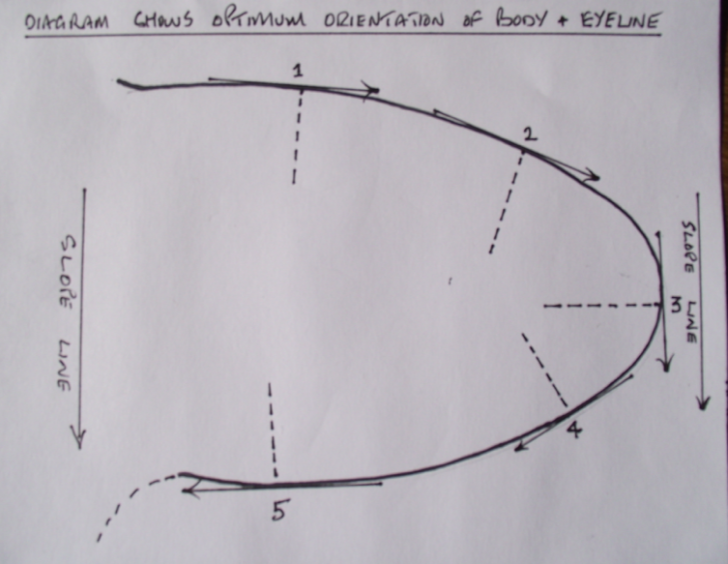
The sketch is my attempt to explain the direction in which the skier’s torso is best oriented; not the direction your skis will be taking.
In reality, every arc comprises an infinite number of “points”, not just the ones I picked out for illustrative purposes. For now, let’s consider those few identified points.
RADII AND TANGENTS
At each of the points I have drawn a dashed line at a 90º angle to the radius. Focus on the direction of the line.
That dashed line indicates the direction in which your body would travel if you suddenly became detached from your skis. (Where your skis went after such an event is anybody’s guess and of no importance to anyone other than the poor unfortunate who happened to be in the way!)
Good skiers orient their torsos in the direction of the dashed line, with the axis across their shoulders and their hands at right angles to the dashed line. That is to say, facing slightly outward of the arc. If you imagine an arrow glued smack in the centre of the skier’s chest, facing forward, it would point in the direction of the line.
The optimal degree of difference between ski direction and body orientation will vary; on this sketch it’s noticeable if you look at the point where the arc is “sharpest” – in this case just momentarily as skis and torso encounter the slope line (aka fall line).
This “outward” orientation is counter-intuitive, which is why unskilled skiers have a strong tendency not to do it, instead consistently aligning torso with ski tips or rotating into the arc; sub-optimal movements to be avoided.
LEG ROTATION
A more effective and controlled technique is to utilize the hinge-like mechanism of our bodies. While legs travel in the direction of the skis and the torso faces outward in the direction of the dashed line, the thighs rotate in the hip sockets. Importantly, this is why skiers must be flexed forward at the hip joint. When standing upright on skis, effective and efficient turning are impossible.
Lito Tejada Flores, celebrated ski instructor, author and filmmaker used to call it being “anticipated”. What it gives you is enhanced stability and improved form.
I hope this helps.
https://seniorsskiing.com/wp-content/uploads/2021/12/Screen-Shot-2021-12-02-at-10.43.36-AM-e1638467091412.png564728Bob Trueman/wp-content/uploads/2014/04/Seniors-Skiing-since2013-Logo@2x-300x68.pngBob Trueman2021-12-02 22:33:002024-08-20 15:19:41Skiing Technique: Where should you be headed?
Many in the ski resort industry harbor an image of older skiers taking up otherwise profitable space in day lodges while consuming their bag lunches and lingering over a cup of coffee. I take offense at that stereotype. I prefer a cup of hot tea to coffee and I take my own teabag from home.
Clearly, the facility makes more selling beers than charging $0.25 for a cup of hot water. And, like it one not, a few lunchtime drafts are more likely to produce on-hill crashes than coffee or tea.
On a recent trip to the skateboard park with my grandson, I realized that good pre-season safety training might involve dodging boarders while wandering through the half-pipe.
Most areas have well-known secret places where skiers and boarders go for a bowl. Some claim it gives them greater awareness and control. I can see it working that way in mature minds and bodies. But teenage boarder boys and girls? Those are accidents waiting to happen.
Which brings me back to what we quote most from that American patriot, Spiro Agnew. I don’t intend to be a nattering nabob of negativism but looking at the hypocrisy in the industry (what industry, government, institution doesn’t have its fair share of hypocrisy?), all I’m asking is that the people in charge recognize that older skiers are a good thing. We keep their lifts occupied mid-week. We ski more. We make more skiing-related purchases for ourselves, our kids and our grandkids. We tend to ski in control and show consideration for others on the lift, in the lodge, and on the hill.
Rodney Dangerfield
Most of us have supported the industry through bad and good times. Yet, they keep taking away the discounts and other privileges. The majority of those still offering discounts have upped the age threshold…most now at 80; some as high as 90. It’s not that we need the discounts, but it would be nice to have greater respect. Rodney Dangerfield was right.
Killington Now Skiing
Vermont’s Killington Resort, the largest ski and snowboard destination in Eastern North America launched its 2021-22 winter season last Friday. It was the first Eastern resort to open for skiing and boarding.
Steamboat’s $269 Lift Ticket
Steamboat Ski Resort (CO), announced that a holiday/weekend day ticket will cost $269 when purchased at the window that day. Last season, Steamboat upped its day pass to $225 from $199. Most skiers will purchase in advance at a lower rate or ski Steamboat on their Ikon pass.
What a Run!
Markus Eder is an Italian freestyle skier of great nerve and grace. This 10 minute video shows him negotiating some remarkable terrain. Enjoy the show.
Ski Maps Galore
Remember the area ski maps of your youth? Skimap.org is a site with 16779 images of ski area maps. For example, listings for Mount Snow in southern Vermont shows more than 50 maps from 1957 to 2021. The Americas shows 8849 maps; Europe, 5100; Asia, 1633. There’s even 232 maps for fantasy ski areas shown. Viewers can upload maps after registering.
Reality TV at Mount Baldy
Given the ski area labor shortage, it made sense that the CBS reality TV series, Tough As Nails, would have its two teams race to fix chairs at Southern California’s Mount Baldy ski area. It broadcasts as Episode 2 of the show’s third season. Click here to preview.
Snowbird Patrol
Safety Keepers, produced with support from Mammut, documents a day in the life of two Snowbird patrol people. It’s short and worth watching.
Ski Area Map Making Made Easy
Here’s a fun time-lapse video of ski trail map artist, Kevin Mastin, painting Tennesee Creek Basin at Ski Cooper (CO).
There are two trips around Walden Pond near Concord, MA. The first is a ski tour through a picturesque New England landscape, with sharp and steeply wooded hillsides surrounding an ice-covered, lambchop-shaped lake.
Around the same pond is a second trip, a pilgrimage that passes the cabin site of Henry David Thoreau, “self-appointed inspector of snowstorms”, conjuring the spirit of a special place and inspiring the thoughts of the pilgrim visitor.
Henry David Thoreau in 1856. Source: Wikipedia
If you choose the first trip, you‘ll find a pleasant ski tour: maples, birch, and oaks, rubbing branches in the wind, a frozen-solid pond to ski across, varying widths of trails in and out of sunlight, all free of charge, all well-tended, all convenient to the Walden Pond State Reservation parking lot on the Concord Road.
But, if you choose the second, be prepared to confront a man who discovered himself in those very woods and hills of Walden Pond, giving us a model of independence and renewal. One thing is for sure; if you take this trip around Walden, you won’t come out the way you went in.
What is it about Thoreau that initiates such pilgrimages? Why are visitors on foot and on skis so drawn to this singular place, the site of a small cabin gone long ago?
The answer is in the subtle message Thoreau left in those winter woods. To know the message, you have to know why Thoreau went to the woods to live alone by Walden Pond and what changes the woods made to his life.
Born in Concord in 1817, Thoreau went to Harvard College where he was homesick for the fields and forests where he once had played. Upon graduation, he and his brother, John, started a school in Concord. John became ill, the school closed, and Henry went to live with Ralph Waldo Emerson, serving as the philosopher’s gardener and handyman. Shortly after moving in, John Thoreau died, and Emerson’s five-year-old son passed away; their mutual grief bonding the two.
Now, Thoreau turned his attention to the community of thinkers surrounding Emerson, splitting his time between handyman and writing philosophical essays.
He was 28, an unsuccessful writer and poet living among the most dynamic American literary and philosophical giants of the time. Frustrated by the complexities of society, Thoreau returned to the woods, to think, write, learn and sort out his life.
Replica of Thoreau’s cabin. Source: The Walden Woods Project
On July 4, 1845, he moved into the cabin he had built on the northwest shore of Walden Pond on land owned by Emerson.
You can ski up to the site of Thoreau’s cabin by following the shoreline trail on the north side of the pond or by a ridge trail also to the north of the pond but in more rugged terrain. If conditions are right, you can ski right across the frozen surface.
All of these trails are short, about a quarter-mile from the parking lot. A circumnavigation of the pond is less than three miles. If you want more skiing, cross Concord Road and link into the web of well-tended trails that spread around Sandy Pond and into the town of Lincoln.
But this is a pilgrimage.
Thoreau’s house site and cairn. Source: The Walden Woods Project
The cabin site is in a clearing of pine and hickories “on a pleasant hillside.” A cairn nearby has been building since the site was discovered in 1947. Stone markers indicate a small cabin, about 11 by 15 feet, the door facing the pond.
Much has been written about Thoreau’s two-year residence in the woods as a practical experiment and a naturalist’s odyssey. However, as you stand in that clearing by the cabin site, imagine Thoreau writing on his little desk, remembering his brother and struggling to express his thoughts about life, values, and simplicity. Surely, the time spent at Walden was a time of renewal.
“I went to the woods because I wished to live deliberately, to front only the essential facts of life, and see if I could not learn with it had to teach and not, when I came to die, discover that I had not lived,” he wrote later.
In September 1847, Thoreau left Walden and moved back to his father’s house in Concord. He left knowing he could live the life he wanted. For the rest of his life until he died in 1862 at 43, Thoreau wrote, lectured, travelled, and continued to wander the woods.
Walden had been a turning point; the woods were a catalyst that helped him recognize who he was and where he was going, a man marching to a different drummer.
If you make this pilgrimage in winter, go early. You’ll find yourself alone in the woods next to Walden Pond. Stop skiing and stand quietly. The wind will crackle the branches, and you’ll hear your heart pounding.
Like Thoreau, let the woods give you respite. Recall what these woods have done, what any woods can do to vexed souls. Reflect on the simple beauty around you, read aloud from Walden, go back to the parking lot, different than when you went in.
This is my shortest ever blog, but it may have a significant impact on your next ski holiday.
Should have taken the day off.
It’s your first day back on the slopes, and you want to hit the ground running. You don’t want to miss a thing, so you‘re up early, on the first chair, and skiing like a mad thing all day. It feels so good!
The next day you’re just a wee bit sore, but not enough to stop you.
But on the third day you hit the “Day Three Slump”. Your skiing seems to have got worse. Your energy levels have slumped. You hoped you’d get better; it’s frustrating. At the end of the week you feel you’ve made no improvement; got no better than last year. This is how your week may go:
Source: Bob Trueman; Bobski.com
I have a suggestion for “slump day”: take it easy, be patient, don’t push it, do lessthan you might.
Would it be sacrilege to suggest taking a later breakfast? An even greater sacrilege to suggest starting at 11:30 and finishing at 2:30? Or, if it pleases you, consider taking a half day out and visiting a local place of interest. You could spend an amusing hour or two in a ski shop trying to guess which of this year’s new wonder skis is actually last year’s but in different livery.
Tomorrow do just a little bit more. On day three you’ll be ready to fly; stronger, your muscle memories will have kicked-in. You’ll find yourself skiing better, not worse.
At the end of the week, you’ll be skiing better than last year, and you won’t get home feeling frustrated that your skiing is in decline.
Your week will go like this and end on a high:
Source: Bob Trueman; Bobski.com
It will be a better feeling and well worth a try!
https://seniorsskiing.com/wp-content/uploads/2021/01/OutOfControl.png490368Bob Trueman/wp-content/uploads/2014/04/Seniors-Skiing-since2013-Logo@2x-300x68.pngBob Trueman2021-11-11 22:55:492021-11-11 18:20:18The Day Three Slump
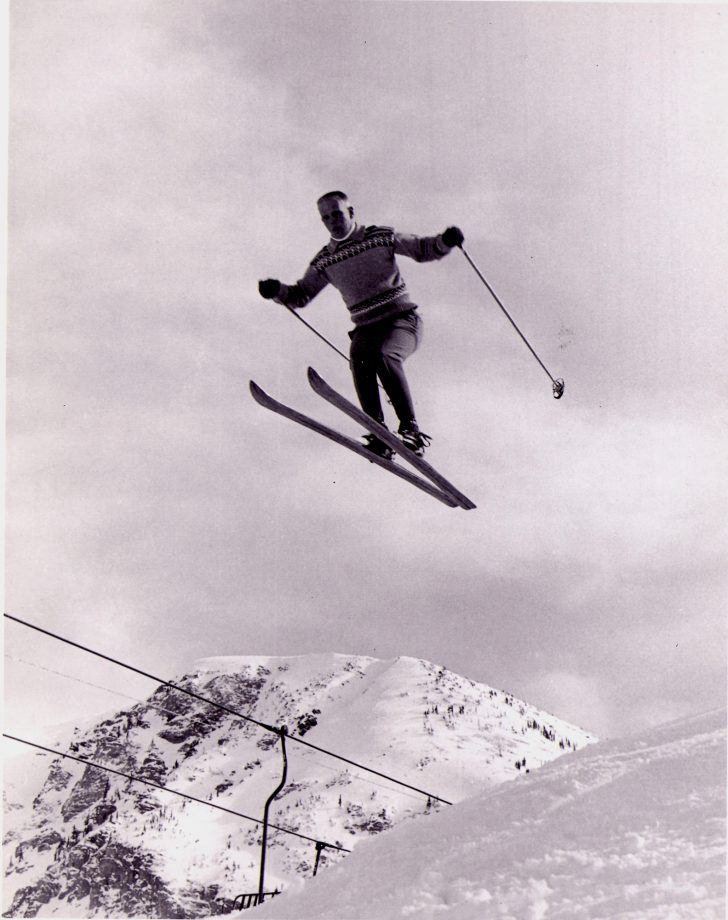
Each issue of SeniorsSkiing.com has a picture to help test your skiing knowledge. The pictures are from collections in a variety of participating ski museums, which we encourage readers to visit.
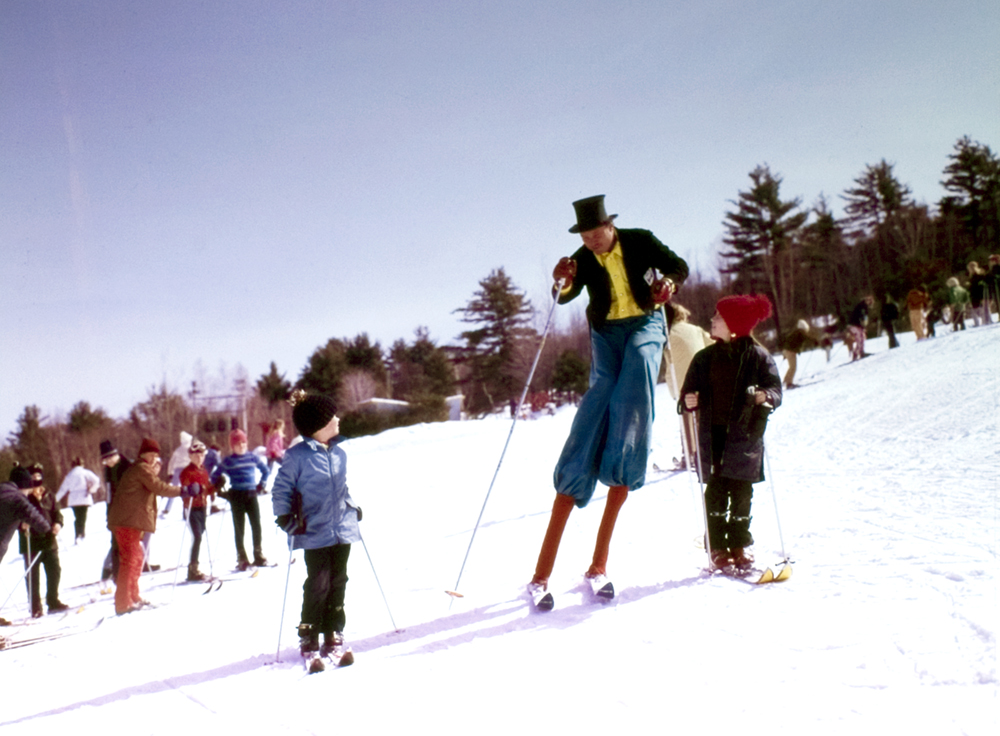
This big time skier was hardly stilted when it came to skiing or to publicity stunts. He was ski school director of the ski school of a New England area which has since changed names. The New England Ski Museum submitted the image for Test Your Skiing Knowledge.
Be the first to identify both the stilted skier AND the name of the ski area (before its name change) and receive a one-year membership to Outside+ ($79.00 value) with access to this season’s Warren Miller film, Winter Starts Now, plus two annual print subscriptions to your choice of SKI magazine, Outside, Backpacker, BETA MTB & more; access to extended gear reviews and instructional video from SKI from bumps to backcountry courses; Gaia GPS Premium access to thousands of maps and backcountry navigation recommendations; member-only content on all 18 sites in the Outside network, and full access to OutsideTV premium adventure films & series. Only answers sent to jon@seniorsskiing.com will qualify. Please do not submit your answer to Comments.
The correct answer and the name of the winner will appear in the next issue of SeniorsSkiing.com.
The winner of the last Test Your Skiing Knowledge is Kay Geitner of Centennial, Colorado. She correctly identified the ski jumper as Alan Engen, past diector of skiing at Alta and currently a member of SeniorSkiing.com’s Advisory Council. Kay taught at her home resort, Copper Mountain, for 28 years. She was the first American woman to graduate with the National Diplome from Ecole National de Ski and Alpinisme in Chamonix France. She represented the Pacific Northwest Ski Association at the US Junior Nationals and for five years represented Washington State at the Western States American Legion Championship in Sun Valley. Kay reports she’s been a SeniorsSkiing.com subscriber since we started in 2014. She wins a free pair of EZFIT Universal Insoles from Masterfit (retail value: $44.95).
https://seniorsskiing.com/wp-content/uploads/2021/11/IMG_4834.jpg7361000seniorsskiing/wp-content/uploads/2014/04/Seniors-Skiing-since2013-Logo@2x-300x68.pngseniorsskiing2021-11-11 22:30:092021-11-11 18:22:51Test Your Skiing Knowledge
Every industry benefits from a mix of offerings. The ski area industry is no exception. I find it enjoyable to ski big corporate resorts as well as independently-owned areas. Some, like Alta, Big Sky, and Jackson Hole offer both big terrain and an attractive level of smaller resort intimacy.
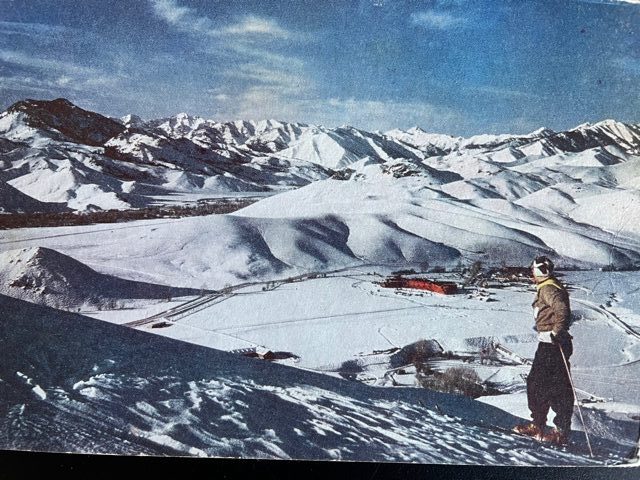
SUN VALLEY in the old days
It may surprise you that, according to the National Ski Areas Association, of the 37 states with ski areas, New York State has the most with 51…almost 11% of the country’s 470 areas. Next is Michigan with 40 areas, then Colorado and Wisconsin (31 each); California and New Hampshire (30 each), followed by Pennsylvania (26), Vermont (23) and Minnesota (20).
The majority of these are smaller and either independent or part of small group ownership.
Many smaller areas make it because they’re close enough to population centers and/or they’re the only game around. They get a large enough following to sustain them season-after-season.
Skiers in Norway: 1907
I like to mix up my skiing experience with visits to big and small. A few seasons ago I spent a delightful day exploring Pomerelle, a smallish area in southern Idaho. The terrain wasn’t challenging but it was interesting. And the base lodge was like going back in time…including the price of lunch.
Skiing big resorts is a different kind of experience. Vail is endless. Aspen, Breckenridge, Jackson Hole and others are challenging. Ditto with my home resorts Alta and Snowbird. I know them and their hidden stashes well. Alta, especially, combines great skiing with local friendliness and warmth. There’s a reason it’s a magnet for skiers from around the globe.
Teton Gravity Research recently produced “In Pursuit of Soul,” a short film celebrating smaller ski areas. To view the trailer click here. It builds the case for independently owned areas and was sponsored, in part, by Indy Pass, the reasonably priced pass that offers skiing privileges at 80 independently owned areas in North America and Japan.
Two skiers. Two skis. One turn.
If I had a few long weekends each season to ski and deep-enough pockets, I’d book at one of the big places in a region with reliable snow. For a family ski holiday with young grandkids, I’d choose a smaller resort with trails that funnel into one or two bases. That way there’s less chance for them to get separated or lost.
I like big mountains with a variety of terrain, and, frankly, it doesn’t matter much who owns them. They just need to be well-covered in snow.
Newly Found: 1300 Year-Old Ski
Archaeologists in Norway recently dislodged a 1300 year-old ski from the Digervarden Ice Patch. They believe it matches another ski found nearby in 2014. The newly found ski has an intact binding of twisted birch and leather. Click on the video (above) to witness the discovery in real time. A more detailed account appears in the Secrets of the Ice website which documents glacial archaeology.
The Superior Rx Goggle
SnowVision Rx goggles integrate prescription with inner lens
If you wear prescription goggles you owe it to yourself to learn about SnowVision‘s unique prescription lens. Unlike other Rx goggles, SnowVision integrates the prescription lens onto the inner lens of the goggle (see middle lens in picture above). Among its numerous advantages is the total lack of fogging. Another is remarkable visual clarity and full range of vision, including around the periphery of the lens. This is virtually unheard of in conventional prescription ski goggles and results from the curvature in SnowVision’s prescription and outer lenses. The lens – fully photochromic so it gets dark or light depending on conditions — is available as unifocal, progressive or bifocal. SnowVision’s components are made by high-quality vendors in Germany, Italy and Japan. Every senior skier who wears glasses should take special care when it comes to prescription goggles. There are some unsatisfactory products on the market, as I, unfortunately, have encountered. SnowVision is a breakthrough.
Please Help with This SeniorsSkiing Crowd-Sourcing Project
Numerous readers have asked about groups for older skiers. Some, like the Wild Old Bunch (Alta) and the Over The Hill Gang (multiple areas) are fairly well-known. SeniorsSkiing.com wants to compile a list of groups. If you know of any, please email name, location(s), a contact name and email and/or phone number to jon@seniorsskiing.com. The info will be posted on the site and updated as new info is received.
Special Discounts
EZ•Fit Auto Adaptable Insoles
Masterfit is offering 20% off any of its EZFit insoles (Snow and Universal models), Tongue Eliminators, Boot Horn and SkiSkootys. To learn more about these products, and/or make a purchase, visit https://masterfitinc.com. The Tongue Eliminators, Boot Horn and SkiSkootys can be found under “Fit Aids.” The 20% discount is good at any time. Simply enter the code SS21 during check out.
Use code SENIORSSKI to receive a 30% discount on online orders for any of Arcadia Publishing’s 27 ski titles. The offer is valid through November 7.
Holiday Shopping for Older Skiers
The Bootster ski boot shoehorn: ideal gift for older skiers
It’s really quite easy…and reasonably priced. The Bootster is an ingenious ski boot shoehorn so compact that it easily fits in a parka pocket. The little device unrolls to reveal a slippery surface that helps the foot slide easily into the ski boot…even when the boot is cold. Each Bootster is hand assembled and very well made. The price is $25 plus shipping. I can’t think of a better or more appropriate gift for older skiers on your list.
FeedSpot Now Delivering SeniorsSkiing.com Content
FeedSpot is an online service that consolidates and delivers news based on the user’s preferences. Happy to report that for FeedSpot subscribers seeking ski-related news, SeniorsSkiing.com articles are now part of their package.
Skiing in Taiwan?
Before global warming had taken it’s toll on so many places with snow, skiers in Taiwan frequented the island nation’s Hehuanshan ski resort. Alas, like so many other locations around the globe, there no longer is enough snow to ski there.
RIP: The Farmer
Dave Van Dame, The Farmer, was an Alta ski legend, skiing deep powder there for 48 years. He recently passed away. Those of you who were privileged to witness his technique are fortunate. Alta recently issued this short video tribute.
The Best Car Commercials
A thing of beauty: my Willys 1/2 Ton Pick Up
I recently sold my (unrestored) 1950 Willys half-ton truck. It was love at first sight several years ago when I saw it on a side street in Ouray, Colorado…a foolish purchase requiring far more skill than I had and more money than I wanted to spend. I concluded that, like many things, old cars can be enjoyed without ownership. During my infatuation I started to follow Hagerty, which insures vintage vehicles and publishes online and print content about them. This article about 10 “unforgettable” car commercials contains links to some funny and moving examples. Not skiing but a lot of fun. Click here to access
Hello readers, super great comments and questions on my “Secrets for Your Best Ski Season Ever” piece. Also spoke with two readers in follow up. I can sense everyone’s excited for this ski season – me too. Shoot me your thoughts or questions and I’ll reply.
Alta’s Intermediate Breakthrough program help people go from blues to blacks
Previously I mentioned my good friend (60+) who improved bigtime from only four group lessons at Alta, UT last March. Result: his skiing improved from confident “blue” skier to eager “black” skier. In just four lessons. So let’s dig in to what Alta’s program looks like and why it works.
And it’s worth doing even if you’re NOT going to visit Alta. Here’s why: it’s a great template for asking the right questions of any ski school or instructor. As a ski instructor, I LOVE when any skier in a group or private lesson tells me what they want to be able to do better/different.
Source: Alta
Now, back to Alta’s “Intermediate Breakthrough” group lessons. Curious, I reached out to both Alta’s Ski School Director, and to the instructor who led the program my friend had found so helpful. A few key observations:
They seek decent “blue run” skiers who want to improve.
They want skiers who will put some thought into their skiing, actively thinking of improvements they’d like to make.
And, they want skiers to go out and practice the improvements a lot, and talk about what they’re seeing and feeling in their skiing.
I spoke with both Jonathan Doty, the on-snow instructor who led the Intermediate Breakthrough (IB) program, and with Jeremy Moore, Alta Ski School Director, who helped design it. IB consists of one half-day group lesson per week for four consecutive weeks; a total of four group lessons. Talk to your ski buddies and try to pull together 3-4 who could join the lesson; next, talk to ski school and try to schedule a half-day morning lesson for four consecutive Sundays with same instructor.Many Sundays are QUIET at ski schools, so you may have better luck creating a special deal.
Jeremy insisted “the IB program is well-suited for anyone who’s skiing at least easy blue groomed terrain comfortably, and also is willing to put some time and energy into thinking about and hopefully improving their skiing”.
Source: Alta
Best preparation? Here’s Jeremy again, “You don’t have to prepare in any specific way. However, it would potentially help improve your overall experience if you took some time to think and feel your skiing and come up with some concepts of what you like or don’t like about your skiing so you have a baseline to start from with your coach.”
From my friend, I learned that the IB format focuses on several “themes”, specifically one per week. I asked Jeremy to unpack this a bit for me. Jeremy: “The Alf Engen Ski School at Alta is a skills-based ski school, and we help students understand the How/What/Why they are doing with their skis.” He added, “There are only 3 things you can do to your skis: rotate them, pressure them, or tip them on and off their edges”. Sounds like a little, but it’s a lot!
Jonathan expanded on the “theme” focus: “We want skiers to succeed not only with us but on their own. Each week we focus on a specific task they can practice outside of IB lessons, and a theme creates a flow to the lesson where the skills build on each other.”
As an instructor mostly doing private lessons, I know many people are concerned about “being judged” by others, particularly their friends. Jonathan insisted: “This is a common thought, but everyone is putting themselves out there, and are on a personal journey. This is a judgment-free zone!”
Like I wrote last time, whenever we improve our skiing proficiency…we have more fun! Try to create this program at your favorite ski area…or just go to Alta.
The ski shop makes more money renting out or selling higher performance equipment.
Be honest with yourself – if you don’t ski hard and fast you probably don’t need it.
Higher performance skis perform worse when not skied hard – they need higher momentum, and more force to get them to work well. Skied slower they can be harder work. Is that what you want?
It may well have been a year since you last skied – maybe more. You likely won’t ski too hard on days one and two. Try renting an easy, flexible ski first. If you find you ski hard enough to make it “chatter”, you can always change up.
Dizzy of Dizzy’s boot fitting shop at Big White ski resort shows off an early 1970s ski boot that boasted fantastic ski technology that, sadly, was ahead of the boot’s ability to support it. The boots famously would come apart during skiing. Credit: Yvette Cardozo
BOOTS
Same rules apply. Boots designed for beginner/early intermediate will be less expensive.
Priority number one is comfort. Don’t put up with anything less.
Very few skiers need boots as stiff as the ones they have; or rent. Most skiers are “over-booted” and it holds back their skiing. Plus it’s often painful.
Start off the vacation with a lower grade boot: it’s easy to exchange them.
Why do I say this? Because if you cannot forward flex your ankle very readily, your skiing will never be as good as it could be. And you’ll never be as stable.
When you do-up your boots don’t have the higher buckles too tight.
When the buckles are done flex your shin forward and hold it there, and only then fasten the unfortunately named “power strap”. It will be somewhat slack until you flex your shin forward. At first you may feel this is a bit “wobbly” – but for heaven’s sake you don’t have your ankles clamped when you move about at home! And it doesn’t make you lose control.
Source: Praxis Skis
SKI POLES (The ski shop will have a small fit when you tell them this.)
You want them
They hate it. They will patiently explain to you as if you were a child that they know what length you need, and will explain how they derive it.
At this point listen attentively, take the pole they proffer, and then tell them you want a pair like that but 3” (7.5 cms) shorter. Insist on it. They will suggest that if you do, you will die. You won’t.
Why shorter poles? Because the length ski shops always hand out, makes skiers stand upright and almost lean back every time they do a pole plant.
Try it – all experiments are worthwhile. You will very quickly prefer the shorter ones because they will help improve your posture. Anyway you can always go back up a length later if you want to – it’s not a lifetime contract.
https://seniorsskiing.com/wp-content/uploads/2021/02/Screen-Shot-2021-02-16-at-8.46.33-AM-e1613483590387.png386728Bob Trueman/wp-content/uploads/2014/04/Seniors-Skiing-since2013-Logo@2x-300x68.pngBob Trueman2021-10-28 18:15:142021-10-28 18:56:46Things to Remember when Choosing Alpine Ski Equipment
Each issue of SeniorsSkiing.com has a picture to help test your skiing knowledge. The pictures are from collections in a variety of participating ski museums, which we encourage you to visit and to support.
Who is this Utah living ski legend?
This image was submitted by the Alf Engen Ski Museum, located in Park City, Utah. The museum is dedicated to preserving the rich history of skiing in the Intermountain region. Its extensive collections and interactive exhibits make it an innovative leader among the world’s ski museums.
The jumper in this image is well-known in many ski circles. A member of one of America’s best-known skiing families, he was an active Nordic and Alpine competitor, ski school director of one of Utah’s premier resorts, and the author of a few books on skiing. What is his name? If you know or want to take a guess, send your answer to jon@seniorsskiing.com. The first person to correctly identify this living skiing legend will receive a free pair of EZFIT Universal Insoles from Masterfit (retail value: $44.95).
The correct answer and the name of the winner will appear in the next issue of SeniorsSkiing.com.
The winner of the last Test Your Skiing Knowledge (several others had the correct answer but were not the first to submit it) is Charlie Sanders of Briarcliff Manor, NY. He correctly identified the site in the image as White Sands National Monument in New Mexico. Charlie has impressive ski history credentials. He is the author of “Boys of Winter: The US 10th Mt Division in WWII.” His article,“Sunshine On My Shoulders: The History of Ski Music,“ appears in the current issue of Skiing History magazine. Charlie also serves on the boards of the International Skiing History Association and the US Skiing and Snowboarding Hall of Fame. His prize is Arcadia Publishing’s book, Skiing in New Mexico. Several readers sent their answers to “Comments.” When submitting a Test Your Skiing Knowledge response, please email to jon@seniorsskiing.com.
https://seniorsskiing.com/wp-content/uploads/2021/10/Alan-Engen-Gelande-at-Alta-circa-1961-1-e1635351352142.jpg920728seniorsskiing/wp-content/uploads/2014/04/Seniors-Skiing-since2013-Logo@2x-300x68.pngseniorsskiing2021-10-27 08:27:512024-08-21 09:47:28Test Your Skiing Knowledge
Would you pay an additional $49+ not to wait in the lift line? Express lines have been available for years for members of exclusive clubs and for skiers accompanied by instructors. Now it will be available for a fee on a day-by-day basis at Snowbird (UT), Killington (VT), Copper Mountain (CO) and Mount Bachelor (OR), all areas owned by Utah-based Powdr Corp.
Years ago, friends at Snowbird with “black passes,” went to the head of the line on the Tram and other lifts as a benefit of membership in the resort’s pricey Seven Summits Club.
In the late 60s I skied Chamonix with an American photographer living there. Organized lift lines were nonexistent. He pushed his way to the front of the pack and slipped some francs to the lift attendant. It was uncomfortable to me, but perfectly normal to him.
Now that privilege will be accessible to anyone with spare change. Dedicated fast access lanes are being established at the most popular lifts at each of the participating resorts (Snowbird’s Tram, not included). Starting Nov 1, skiers can purchase the Fast Tracks add-on in advance or on-mountain. Fast Tracks — quantity to be capped daily –will be available to all skiers holding day passes, season passes or Ikon Passes.
Is this new level of premium pricing a natural evolution of how lift tickets are valued? I think so. A few years back, areas assigned different values to lift tickets based on how far in advance they were purchased, day of the week, holidays., etc. Some areas discount passes based on military service, student status and age. Remember when 60 year olds got free skiing? In the US, the age threshold has been steadily increasing. Now, generally, you need to be 75 or 80 to get a deal, if any exists.
Most resorts and the bundled pass offerings discount for early purchases. Their purveyors get to invest that capital any number of ways.
Who will make the add-on Fast Tracks purchase? Anyone with a cushy account planning a trip to the mountains. They paid for the flight, the lodge, lift tickets, etc. Why spend time on the hill waiting in line? That’s the market…and those to whom the added cost means nothing.
So much about skiing, like life in general, has changed, and those changes may grate on those who have been enjoying it for decades. If this works for Powdr Corp, it’s just a matter of time before paying the additional fee to get to the head of the line will be commonplace.
The Season Is Underway…
…at least in Finland where Levi and Ruka have opened with the benefit of recycling last season’s snow. The procedure, know as “snow farming” stores snow from the previous season in protective structures and redistributes it on trails once temps have dropped enough to keep it from melting. Here in the US, Copper Mountain (CO) fired up its guns last week to prepare for US Ski Team training staring October 22 and its general opening on November 22. And, as of this writing, resorts around the West have been dumped on. Alta has about 18.” Wolf Creek opens Saturday; Arapahoe Basin on Sunday. Winter is here!
Welcome Ski Idaho!
Ski Idaho, which promotes the state’s 17 ski areas, is our newest advertiser. The best known of the resorts isSun Valley. Less frequented but with substantial vertical and snow are Grand Targhee (actually in Wyoming but a participant in the Ski Idaho initiative), Schweitzer, Tamarack, and Pebble Creek. Many private jets are parked at the airport in Hailey, the gateway to Sun Valley. Not so at the other areas. Any senior skier wanting to expand the list of areas skied or planning a reasonably priced family ski holiday is well-advised to look into Idaho. Its official nickname is “the gem state.” Precious minerals and stones aside, it is one gem of a place to explore and ski!
Snowboarder To Be Featured on $1 Coin
Source: US Treasury
Vermont will be represented in a series of new $1 coins issued by the U.S. Mint.The coin will feature an image of a snowboarder. The “American Innovation” series of $1 coins started in 2018 and will eventually include a coin for each state, the District of Columbia and five U.S. territories. Vermont’s coin, to be released in 2022, shows a snowboarder holding the edge of her board while doing a trick.
Full Tilt to be Retired
Source: Full Tilt Boots
The 3-piece boot, particularly popular with many SeniorsSkiing.com readers, will be retired after this season. It is made and distributed under the K2 umbrella.
Man Completes London Marathon in Ski Boots
Credit: Guinness World Records
Paul Bennett ran the London Marathon in ski boots, as a fund-raiser supporting injured military personnel. His time: 5 hour, 30 minutes, 20 seconds. He was 7 seconds faster than the last ski boot marathon runner.
On this side of the pond, last week, 87 untramarathoners in Utah ran into a blizzard that dumped 12″ – 18″ on portions of the high-elevation, 5o mile course. Officials called off the race, and there were no injuries; a far different outcome from last May’s mountain race in China when 21 runners died from exposure.
New Aspen Logo
Old Aspen logo. Source: Aspen
New Aspen logo. Source: Aspen
The original aspen leaf design was introduced in 1946. Now, 75 years later, it has a cleaner, new look. The design’s last iteration was an aspen leaf with ski tracks forming the stem. The new version is an outline of an aspen leaf. More on how the resort will be celebrating its 75th in future issues.
Big Expansion for Sunday River
Sunday River to expand into Western Reserve. Source: Sunday River
Sunday River (ME) announced a major expansion that will get underway in 2022. This, as reported in The Storm Skiing Journal website. The terrain expansion will eventually double the size of the resort. Click here for resort’s explanation.
30% Discount on Ski Books
Use code SENIORSSKI when placing online orders for any of the 27 ski titles published by Arcadia Publishing. The offer is valid through November 7.
Air Access to Mammoth Mountain Increases
United Airlines is starting flights from L.A., San Francisco and Denver to Eastern Sierra Regional Airport in Bishop (CA), about 49 miles from Mammoth Mountain. Another service, Advanced Airlines, which bills itself as providing “public charter flights,” will provide flights to Mammoth Yosemite Airport from three Southern California airports (Burbank, Carlsbad and Hawthorne). It’s 12 miles from the resort.
This Ski Film Was Made 101 Years Ago!
Arnold Fanck, a German documentary filmmaker and pioneer of the mountain film genre, is credited with creating one of the first ski films. “The Wonder of Skis” (Das Wunder des Schneeschuhs) was issued in 1920…101 years ago! It shows skiers in a variety of alpine beauty spots, executing surprisingly beautiful turns. Length of this segment: 30 minutes. Click on image to screen.
I was inspired by (SeniorsSkiing.com contributor) Yvette Cardozo and her excellent missives re skiing Canada and the world. Her unique turn of phrase will inspire some to write, but mostly will move others to keep skiing when they can. Those three words, ‘when they can’ are important. COVID has jolted us to the here and now, prompting many to get vaccinated. To those with a needle phobia, I would suggest that a death phobia trumps needle phobia anytime.
Which leads me to think back to the 2021-20 season and this Aussie’s Canadian skiing road trip with three good senior skiing mates brimming with optimistic youthful exuberance.
We set out to tour the snow resorts of central British Columbia…just as reports of the mysterious virus were beginning.
Source: Lake Louise Ski Resort. Image by Philip Forsey
First we skied Nakiska, a family, friendly resort, steep in places and well-resourced with lifts in all the right places (season pass for those 75+ is less than $100). Then we drove to Sunshine and Lake Louise (season pass for 80+ is $20), two of the planet’s most scenic places. In Lake Louise, large ice sculptures adorned the area between the Lake Louise Chateau Fairmont Hotel and the lake. They’re magnificent (hotel and sculptures)!
Skiers are among the many ice sculptures. Source: Lake Louise Tourism
Next, we drove the mighty Trans Canada No.1 to Golden to ski legendary Kicking Horse Mountain Resort (season pass for 75+ is less than $100). It features views that take your breath away and fall lines steep and deep enough to keep it that way. If you go, don’t fail to lunch at Eagle Eye Restaurant for great views and food. If wallet permits, you can arrange for a helicopter to transport you to the super deluxe Eagle Eye Suites, each assigned with a personal butler and the highest accomodations in Canada.
A few days later, we plunged into the unpopulated wilderness of the Western side of the massive Canadian Rockies. Our large rented SUV delivered us to Panorama (season pass for 75+ is $39) our next ski in-ski out accommodation. The resort has plenty of back country double blacks.
Fernie is big!
Following Panorama we drove to Fernie (season pass for 75+ is less than $100), where out friend Pat shared with us his years of skiing advice and his knowledge of Fernie’s more famous watering holes. Fernie is a destination which receives prodigious dumps of dry powder all season. If visiting, be sure to partake of a lager or three, upstairs in the Griz Hotel.
Navigating the pass at Crows Nest, on the border of BC, we were soon back in Alberta on our way to Castle MountainSki Resort (season pass for 75+ is $19), a great hill driven by ski enthusiasts; not accountants. My kind of place. Unfortunately, a flu virus prevented me from experiencing what my friends Ray and Allen pegged to be one of the best places skied of the entire trip.
Ski buddies at the start of their journey. Source: Dave Chambers
On this journey, we were mostly constrained to groomed runs because of a lack of fresh snow. Whenever you go, I recommend driving. It’s the best way to indulge in the culture and to experience the human kindness displayed by the Canadian people.
https://seniorsskiing.com/wp-content/uploads/2021/10/Screen-Shot-2021-10-12-at-5.36.34-PM.png558437Dave Chambers/wp-content/uploads/2014/04/Seniors-Skiing-since2013-Logo@2x-300x68.pngDave Chambers2021-10-11 14:20:042021-10-14 17:12:30A Down-Under Skier Reminisces About His 2019-20 Canadian Road Trip
In 1991, while guiding a small group in Yellowstone National Park, I tried to describe walking outside as the sun rose one February morning near Old Faithful:
“Morning light pours over the hills, reflecting off the frost in a blinding cloud of diamonds. Elk and bison shake snow off their backs, stirring after a long night’s chill. Duck and geese stretch and preen. Billows of geyser steam hover and settle, creating dense, lacy patterns on bowed pine branches. Yellowstone tastes of winter magic.”
Summer and Winter
To me, Yellowstone isn’t a great treat in summer. Yes, the combination of animal and geothermal activity is unique – but this year there were close to three million visitors, June to August. That’s too many vehicles and frowning faces jammed along narrow roads.
Winter is totally different. First, there’s almost no traffic (no bears either, although they may peep out of their dens in January). The only road that’s kept plowed runs east from Mammoth in the northwest to Cooke City, where it dead ends. All other roads are snow-covered and accessible by snowmobile, snowcoach (enclosed and heated tracked vehicles), or on skis or snowshoes.
Yellowstone’s winter is created for superlatives. No other place in the world has such an inspiring combination of wildlife and wild geology. It’s rich in history; has spectacular mountain scenery; and the park’s 2.2 million acres are yours without crowds or pollution.
Getting There
Yellowstone is located in the northwest corner of Wyoming, with little extensions north into Montana and west into Idaho.
To enter the park, you can travel north from Jackson Hole; west from Cody, Wyoming; or east from West Yellowstone, Montana. My favorite (fourth) route is east from Bozeman to Livingston; south through the Paradise Valley; pass through the sleepy town of Gardiner; and drive up to Mammoth Hot Springs, where you can overnight at the venerable Mammoth Hot Springs Hotel, with elk grazing outside the ground floor windows.
Using Mammoth as a base, you can drive toward Cooke City, with a lot of photos stops for wildlife in the Lamar Valley, and then backtrack.
Heading South
From Mammoth you can get to Old Faithful by snowcoach or snowmobile, sight-seeing, skiing, and snowshoeing along the way. Norris Geyser Basin and the jaw-dropping Canyon of the Yellowstone River, with ice-laden and thunderous falls, are natural stops.
The center of the park is a volcanic crater, 40 miles across, with the world’s greatest concentration of geothermal features: geysers and fumaroles, mud pots and hot pools. One of my favorite Yellowstone memories is a morning ski on a snow-covered wooden boardwalk, watching a bison standing above a steam vent, basking in the warm air billowing around his belly.
Snowpack around Mammoth can be thin, but Old Faithful has reliable conditions and all kinds of good trails. You’re guaranteed to see lots of elk and bison, maybe coyotes, possibly wolves.
SOURCE: YELLOWSTONE NATIONAL PARK LODGES
In winter, bison are relatively indifferent to humans, since they’re intent on scarce forage and surviving sometimes bitter cold, but it’s not something to count on. I’ve skied within feet of a bison, on a narrow trail with a cliff to one side and sheer drop on the other. We came around a corner and there they were. We carefully didn’t make eye contact with the cows and calves that plodded toward us, and I could hear muttered prayers from the other skiers (my teeth were chattering too hard to enunciate).
Of all the times I’ve visited Old Faithful, the most indelible and endearing memory isn’t a glorious streamside tour, two feet of light fresh snow, or being mock-charged by a bull elk. It’s the smiles on three kids’ faces as one cold morning they dropped tablets of food coloring in glasses of hot water, ran outside the Snow Lodge, and threw them in the air! It was a cold morning, and the droplets turned into rainbows of frozen mist – blue, red, green – that slowly drifted in the breeze and disappeared. So a half-dozen of us adults did the same thing.
Now, that’s magic.
Resources
The Mammoth Hotel and the Old Faithful Snow Lodge provide Yellowstone’s only winter accommodations and dining other than yurt village/guide service Yellowstone Expeditions (https://yellowstoneexpeditions.com/). They typically open for the season mid-December 20th through early March.
Over 11 seasons I’ve probably taught 500-600 kids and adults as a part-time instructor at Stratton/VT & Butternut/MA. “Never-evers”, experts, 4-yr olds to 80-yr olds. Me: flipping through trail names like a deck of cards, choosing the best run for the task at hand and my eager, anxious learner.
Here’s the huge thing I’ve learned:
Anyone can become a better skier, if the skier has both a desire and determination to improve…simply by taking a few ski lessons at the outset of ski season.
Why at the beginning?
Because each season, starting out, we’re all squirming and thinking, trying to put our skiing back together again.So instead of once again reinforcing some of the “bad” habits carried over from last season, you can trade them for one or two new/better ideas that will help you ski with more skill.
But wait, there’s more: any improvement in your skiing proficiency ALWAYS leads to enjoying skiing more!(Shoot me your questions at the end and I’ll reply.)
As an instructor, I’m lucky.In early December we do OUR training.We take refresher lessons with the best instructor “trainers” at our resorts.We’re brushing up on our skills.It helps me a lot.But it took me a while to accept the fact I still needed to be in “learning” mode.
This season try this… either by yourself or with a friend who’s at a similar ability level.Sign up for a private lesson of 2-3 hours on your second day of the season. On the first day, ski around and get a feeling for what’s working and… what’s not.Think about what you’d like to change, what’s confusing or difficult, what you’d like to ask questions about, then write it down.Now you’re ready for that lesson on Day 2.Because now you’re engaged in being an “active learner”. Real progress as a skier doesn’t just “happen” to you.It comes as a result of efforts you make to change what’s not working, in favor of more useful approaches.
I witnessed this approach in action, in Utah, last March.One of my best friends, with whom I’ve skied for 40 years, took a short program of four group lessons at Alta.Called “Intermediate Breakthrough” it seeks skiers who truly desire improvement.My friend wanted to improve, and was ready to do what it took.He explained what he wanted from the lessons, and he worked hard to use the skill tips offered by his instructor.
And he not only improved…he made a quantum leap in his overall skiing proficiency, and in his ability to ski more challenging terrain while enjoying it.It was remarkable to see, and it was the result of only four lessons, but four lessons in which both student and instructor were invested in producing real results.Alta’s “Intermediate Breakthrough” is awesome.
Believe me, you can do it too… It’s totally worth it.
https://seniorsskiing.com/wp-content/uploads/2021/09/John-Gelb-and-group.jpg6131080John Gelb/wp-content/uploads/2014/04/Seniors-Skiing-since2013-Logo@2x-300x68.pngJohn Gelb2021-09-30 12:01:422024-08-21 09:48:43Secrets for Your Best Ski Season Ever
This is to thank the 3000+ of you who completed our August reader survey. We learned that on average, those of you who did not take last season off skied an average of 26 days. That’s down from a few seasons back when the average was more than 33 days. But, when you figure that the national average is 6.5 skier/boarder days, you quickly realize that we’re the ones using the resorts…especially midweek.
We seniors are a very luck lot, doing what we love, when we want to.
Like many of you, I missed last season. That was a first since I started at age 10. Now I’m psyched about getting back on the hill. Skiing brings me immense pleasure. Each of you feels this in your own way. Whether it’s snaking slowly through a mogul field, cruising down a well-groomed slope or floating through thigh-deep powder, you understand.
Ski often enough and you’ll experience a great mix of conditions. Although I haven’t done so in several years, I’ve found pleasure skiing in a blizzard. Very cold days bring their own form of bliss. Warm, bluebird days are a form of skiers’ nirvana.
It is wonderful to age and ski and to be outside in the snow. It doesn’t matter the size of the mountain or the number of runs. It’s simply being there and skiing that brings joy.
This is the first issue of SeniorsSkiing.com for the 2021-22 season. We’ll be posting new articles each week and emailing them to you as a package every other Friday. As a heads up, we’lloccasionally email advertisements. Each of these ads has been vetted to be relevant to your skiing interests.
I hope you continue to enjoy SeniorsSkiing.com. Best wishes for a great 2021-22 season!
Patagonia Offering Store Credits for Trade-Ins
With the goal of keeping its stuff out of landfill and improving the environment, Patagonia has introduced a program that gives credit for old and worn Patagonia products. The credits can be used in its retail and online stores. Click here for details about the program and the amount of credit offered.
Will This Replace Day Lodge Burgers and Fries?
A new eatery — Oxygène Café — in the French ski resort, Tignes, specializes in vegan, vegetarian and gluten free food. Started by Oxygène, the French Alps based ski school specializing in English speaking ski and snowboard lessons. The company is partnering with Caffè Vergnano, a socially and environmentally friendly Italian coffee brand.
Snowbasin to Add Base Village and Club Med
Source: The Salt Lake Tribune
Snowbasin, the vast ski area north of Salt Lake City, near the city of Ogden, was the site of the 2002 Olympic Downhill events. The place offers terrain for every ability. What it hasn’t offered is a place to stay at the mountain. All of that is about to change as Club Med builds a 300 room facility (projected opening: December 2024) and as plans develop for a base village with restaurants, shops and lodging (project to start in 2025).
Sundance Mountain Resort: New Owners Make Changes
Sundance
Founded by Robert Redford in 1969, Sundance changed hands last December. Over the summer, the new owners installed two new lifts and upgraded snowmaking services, among other changes. A high-speed detachable quad will access the mid-mountain summit. The second lift will provide expanded terrain choices to guests returning from the back mountain. Sundance is a Utah gem. Off the beaten path, it’s not far from Salt Lake City, Park City and Provo and rarely has crowded slopes. Lodging is primarily in the form of condos and it has always been a foodie destination. Most importantly, there’s a range of excellent terrain.
Squaw Valley’s New Name: Palisades Tahoe
According to a news release issued by Alterra, the company that owns the resort, the “…name change was an important initiative for our company. At the end of the day, “squaw” is a hurtful word, and we are not hurtful people. It was a change that needed to be made for us to continue to hold our heads high as a leader in our industry and community. We have a well-earned reputation as a progressive resort at the forefront of ski culture, and progress can’t happen without change.”
Deep Discount on Stocking Stuffer Ski Books
Arcadia Publishing has a roster of 27 books covering localized skiing history. They paperback books are loaded with vintage photos and have titles such as Skiing in the Mad River Valley, New Hampshire on Skis, and North Carolina Ski Resorts. Part of the series explores “lost ski areas,” those that existed years ago but no more. Among them, Lost Ski Areas of the Berkshires, Lost Ski Areas of Southern Vermont, Lost Ski Areas of Tahoe and Donner, and Lost Ski Areas of Colorado’s Front Range and Northern Mountains. Arcadia is offering SeniorsSkiing.com subscribers a 30% discount on all of its skiing titles. Click hereto shop the books and enter the code, SENIORSSKI, when checking out. The offer is good from October 7 to November 7.
The Perfect Gift for Older Skiers
Bootster is a clever, compact device that makes it easy to get into a ski boot – even when it’s cold. It has a super slippery surface that helps the foot slide in effortlessly. And unlike shoehorns, sprays, etc., Bootster is compact and easily carried in a parka pocket (click on the video above). If you or an older skier you know likes to shed boots during lunch, getting them back on with Bootster is a breeze. It is pretty much indestructible, making it ideal to pass on to the next generation of skiers. At $25 (+ shipping) the price is right. Looking for something to give your favorite older skier? Bootster will be appreciated for years to come.
Boston and Denver Ski Shows Cancelled
This is second year in a row. The cause? Covid.
It’s a Bird?
People have been dreaming about being able to fly without a plane for years. Technology is finally making it possible, as shown in this video compilation of several different approaches from around the world. Who knows? At one point, some version of these flying machines may eliminate the need for ski lifts. About 16 minutes.
Even though we are just a few days past the first day of astronomical summer, I find myself already taking a peek at the northern Rockies when I am working on forecasts for my golf course clients. Why? The skier/weather nerd in me comes out as I look for the first weather station reporting snow in the air. Like you, I am already starting to anticipate the coming winter sports season, so here are my early thoughts on the weather for the upcoming season.
As always, the first thing I do in putting together a long range outlook is to check the status of ENSO…El Nino Southern Oscillation. ENSO is a measurement of the surface water temperature anomalies in the equatorial regions of the Pacific Ocean. When those waters are warmer than the long term average, we have an El Nino. When they are cooler than average, La Nina is present. Last winter we had a La Nina, and another round of La Nina is in storm for us this winter. The following map shows the cooler than normal anomalies already in place in the Pacific basin.
Computer model forecasts designed to focus on ENSO suggest that the La Nina will strengthen in the coming months, as illustrated by this summary of those models. The thick red line is the consensus of the models, and as you can see, that line drops slightly below the -.0.5 Centigrade threshold that indicates La Nina for several months, suggesting that this episode of La Nina will be a weak one, in a fashion similar to last winter.
So, what does that all mean? Well, because the oceans contain 1,000 times the energy that is contained in the atmosphere, the state of the ocean’s water temperature distribution exerts a major influence on what the overlying jet stream looks like. Here is a graphic that shows you the most common jet stream configuration during a La Nina Winter…
The first thing to note is the confluence of the Polar and Pacific branches of the jet over the northwestern corner of U.S. as well as western Canada. These are two areas that typically have a solid to spectacular season of snowfall in La Nina. The combined jet stream delivers cold air and carves out a trough much of the time across the Great Lakes and Northeast and these two regions also usually benefit from a cool Pacific setup. Across roughly the southern half of the country, La Nina winters can be more of a challenge. That doesn’t mean that the Pacific jet can’t deliver storms to the Southwest…it can, and will…but the more common jet pattern will favor resorts across the northern half of the West. The region that finds a La Nina least desirable is the Southeast. Here, an upper level ridge is more favored, and that leads to milder than normal temps more often than not. Snowmaking will likely be king in the southern Appalachians this season. The final graphic I would like to share with you summarizes snowfall anomalies during La Ninas…
https://seniorsskiing.com/wp-content/uploads/2021/09/Seniorski3.png498624Herb Stevens/wp-content/uploads/2014/04/Seniors-Skiing-since2013-Logo@2x-300x68.pngHerb Stevens2021-09-29 11:30:282021-09-30 15:39:26Skiing Weatherman: 2021-22 Outlook