Tag Archive for: SeniorsSkiing.com

Cross country skiers

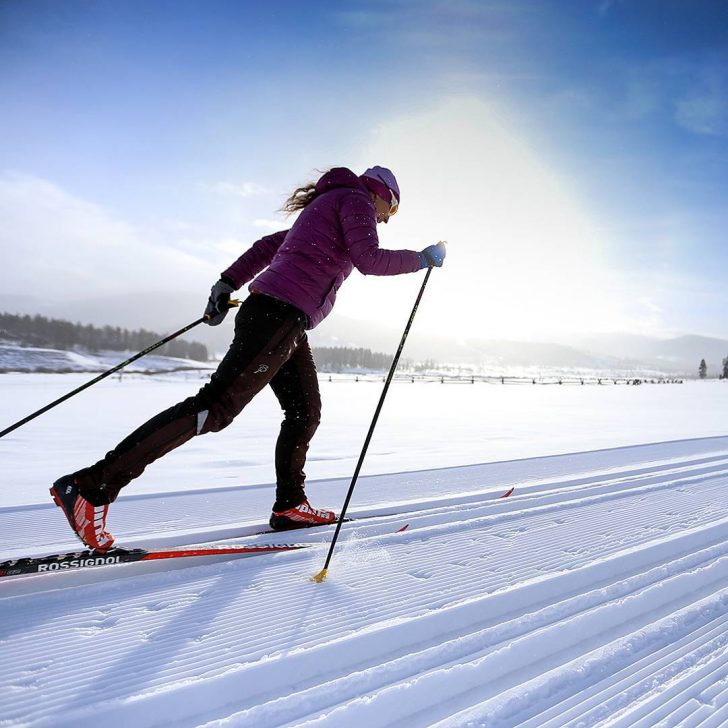
Tips to Buy New XC Ski Gear for This Winter

Cross country skiers

Last winter XC ski gear was in demand like never before and all segments of cross country ski equipment sold out, with few or no options for retailers to reorder. There also was an uptick for backcountry gear and snowshoes.

Retailers are still experiencing demand and supply issues. Coupled with global supply chain challenges, everything from the components that complete a ski binding to the actual cardboard boxes in which products are shipped have been in short supply. Demand and wait times have increased dramatically for these vital pieces, further impacting supply. 

Responding to these factors, retailers placed orders as early as possible and for as much gear as they could get. But some wholesale distributors limited the amount of equipment they planned to make available in the US.

The result? Retailers may not be able to reorder sold out merchandise.

If you want to get new gear this year, here are some tips from Burlington, Vermont retailer Ski Rack:

Start Early

The earlier you begin the process the more likely you’ll get the right winter gear for you. The process begins with your own preliminary research into what you’re looking for and how you want to enjoy the outdoors this winter. Starting early is great! However, keep checking for new arrivals.

Buy Locally

Once you’ve identified the type of XC ski activity you’re interested in (for example, skiing in tracks, on ungroomed trails, in the backcountry, or ski skating) the next step is to head to a local gear shop and talk with the retail experts. They can be a great resource to help with sizing and to discuss various details, including differences between products. Consider custom fitting for all categories, to get the right gear the first time. This way, you’ll save time and avoid having to return something down the line when you find it’s not the right fit. By then, that item may not be in stock anymore.

Flexibility

Another key piece of getting winter gear this year is flexibility. There are lots of options from many brands that will serve you well. Some models may already be sold out for the year, pre-sold, or unavailable for months. It’s advisable to explore all options to see what the best fit may be, even if it’s not your first choice, but ACT FAST! If you find something you want at the store, don’t wait. It could be gone the next day or the next hour.


Short Swings!

Would you pay an additional $49+ not to wait in the lift line? Express lines have been available for years for members of exclusive clubs and for skiers accompanied by instructors. Now it will be available for a fee on a day-by-day basis at Snowbird (UT), Killington (VT), Copper Mountain (CO) and Mount Bachelor (OR), all areas owned by Utah-based Powdr Corp.

Years ago, friends at Snowbird with “black passes,” went to the head of the line on the Tram and other lifts as a benefit of membership in the resort’s pricey Seven Summits Club.

In the late 60s I skied Chamonix with an American photographer living there. Organized lift lines were nonexistent. He pushed his way to the front of the pack and slipped some francs to the lift attendant. It was uncomfortable to me, but perfectly normal to him.

Now that privilege will be accessible to anyone with spare change. Dedicated fast access lanes are being established at the most popular lifts at each of the participating resorts (Snowbird’s Tram, not included). Starting Nov 1, skiers can purchase the Fast Tracks add-on in advance or on-mountain. Fast Tracks — quantity to be capped daily –will be available to all skiers holding day passes, season passes or Ikon Passes.

Is this new level of premium pricing a natural evolution of how lift tickets are valued? I think so. A few years back, areas assigned different values to lift tickets based on how far in advance they were purchased, day of the week, holidays., etc. Some areas discount passes based on military service, student status and age. Remember when 60 year olds got free skiing? In the US, the age threshold has been steadily increasing. Now, generally, you need to be 75 or 80 to get a deal, if any exists.

Most resorts and the bundled pass offerings discount for early purchases. Their purveyors get to invest that capital any number of ways.

Who will make the add-on Fast Tracks purchase? Anyone with a cushy account planning a trip to the mountains. They paid for the flight, the lodge, lift tickets, etc. Why spend time on the hill waiting in line? That’s the market…and those to whom the added cost means nothing.

So much about skiing, like life in general, has changed, and those changes may grate on those who have been enjoying it for decades. If this works for Powdr Corp, it’s just a matter of time before paying the additional fee to get to the head of the line will be commonplace.

The Season Is Underway…

…at least in Finland where Levi and Ruka have opened with the benefit of recycling last season’s snow. The procedure, know as “snow farming” stores snow from the previous season in protective structures and redistributes it on trails once temps have dropped enough to keep it from melting. Here in the US, Copper Mountain (CO) fired up its guns last week to prepare for US Ski Team training staring October 22 and its general opening on November 22. And, as of this writing, resorts around the West have been dumped on. Alta has about 18.” Wolf Creek opens Saturday; Arapahoe Basin on Sunday. Winter is here!

Welcome Ski Idaho!

Ski Idaho, which promotes the state’s 17 ski areas, is our newest advertiser. The best known of the resorts is Sun Valley. Less frequented but with substantial vertical and snow are Grand Targhee (actually in Wyoming but a participant in the Ski Idaho initiative), Schweitzer, Tamarack, and Pebble Creek. Many private jets are parked at the airport in Hailey, the gateway to Sun Valley. Not so at the other areas. Any senior skier wanting to expand the list of areas skied or planning a reasonably priced family ski holiday is well-advised to look into Idaho. Its official nickname is “the gem state.” Precious minerals and stones aside, it is one gem of a place to explore and ski!

Snowboarder To Be Featured on $1 Coin

Source: US Treasury

Vermont will be represented in a series of new $1 coins issued by the U.S. Mint.The coin will feature an image of a snowboarder. The “American Innovation” series of $1 coins started in 2018 and will eventually include a coin for each state, the District of Columbia and five U.S. territories. Vermont’s coin, to be released in 2022, shows a snowboarder holding the edge of her board while doing a trick.

Full Tilt to be Retired

Source: Full Tilt Boots

The 3-piece  boot, particularly popular with many SeniorsSkiing.com readers, will be retired after this season. It is made and distributed under the K2 umbrella.

Man Completes London Marathon in Ski Boots

Credit: Guinness World Records

Paul Bennett ran the London Marathon in ski boots, as a fund-raiser supporting injured military personnel. His time: 5 hour, 30 minutes, 20 seconds. He was 7 seconds faster than the last ski boot marathon runner.

On this side of the pond, last week, 87 untramarathoners in Utah ran into a blizzard that dumped 12″ – 18″ on portions of the high-elevation, 5o mile course. Officials called off the race, and there were no injuries; a far different outcome from last May’s mountain race in China when 21 runners died from exposure.

New Aspen Logo

Old Aspen logo. Source: Aspen

New Aspen logo. Source: Aspen


The original aspen leaf design was introduced in 1946. Now, 75 years later, it has a cleaner, new look. The design’s last iteration was an aspen leaf with ski tracks forming the stem. The new version is an outline of an aspen leaf. More on how the resort will be celebrating its 75th in future issues.


Big Expansion for Sunday River

Sunday River to expand into Western Reserve. Source: Sunday River

Sunday River (ME) announced a major expansion that will get underway in 2022. This, as reported in The Storm Skiing Journal website. The terrain expansion will eventually double the size of the resort. Click here for resort’s explanation.

30% Discount on Ski Books

Use code SENIORSSKI when placing online orders for any of the 27 ski titles published by Arcadia Publishing. The offer is valid through November 7.

Air Access to Mammoth Mountain Increases

United Airlines is starting flights from L.A., San Francisco and Denver to Eastern Sierra Regional Airport in Bishop (CA), about 49 miles from Mammoth Mountain. Another service, Advanced Airlines, which bills itself as providing “public charter flights,” will provide flights to Mammoth Yosemite Airport from three Southern California airports (Burbank, Carlsbad and Hawthorne). It’s 12 miles from the resort.

This Ski Film Was Made 101 Years Ago!

Arnold Fanck, a German documentary filmmaker and pioneer of the mountain film genre, is credited with creating one of the first ski films. “The Wonder of Skis” (Das Wunder des Schneeschuhs) was issued in 1920…101 years ago! It shows skiers in a variety of alpine beauty spots, executing surprisingly beautiful turns. Length of this segment: 30 minutes. Click on image to screen.


Test Your Skiing Knowledge

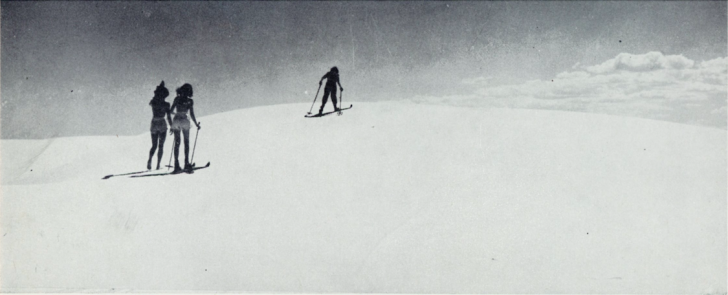
Where are these skiers? Source: New Mexicao Ski Museum

Each issue of SeniorsSkiing.com has a picture to help test your skiing knowledge. The pictures are from collections in a variety of participating ski museums, which we encourage you to visit and to support.

This image was submitted by New Mexico Ski Hall of Fame and New Mexico Ski Museum, located outside Albuquerque, at the base of the Sandia Peak Aerial Tramway. The museum collects, preserves and displays items connected with and/or celebrating the history of snow skiing in New Mexico. The Ski Hall of Fame celebrates individuals who have contributed substantially to the development of skiing and snowboarding in the state.

It is open daily year-round, and admission is free.

Where in New Mexico are the skiers in this picture? The first person to identify the correct location (email  jon@seniorsskiing.com) will receive a copy of Arcadia Publishing’s book, Skiing in New Mexico.

The correct answer and the name of the winner will appear in the next issue of SeniorsSkiing.com.

The winner of the last Test Your Skiing Knowledge (a few others had the correct answer, but were not the first to submit it) is George Treisbach of Harrisburg, Pa and Copper Mt, Co. He identified author Arthur Conan Doyle, creator of Sherlock Holmes. Congratulation for this mystery well-solved, George. Enjoy the  membership we purchased for you to The New England Ski Museum.

A Down-Under Skier Reminisces About His 2019-20 Canadian Road Trip

I was inspired by (SeniorsSkiing.com contributor) Yvette Cardozo and her excellent missives re skiing Canada and the world. Her unique turn of phrase will inspire some to write, but mostly will move others to keep skiing when they can. Those three words, ‘when they can’ are important. COVID has jolted us to the here and now, prompting many to get vaccinated. To those with a needle phobia, I would suggest that a death phobia trumps needle phobia anytime.

Which leads me to think back to the 2021-20 season and this Aussie’s Canadian skiing road trip with three good senior skiing mates brimming with optimistic youthful exuberance.

We set out to tour the snow resorts of central British Columbia…just as reports of the mysterious virus were beginning.

Source: Lake Louise Ski Resort. Image by Philip Forsey

First we skied Nakiska, a family, friendly resort, steep in places and well-resourced with lifts in all the right places (season pass for those 75+ is less than $100).  Then we drove to Sunshine and Lake Louise (season pass for 80+ is $20), two of the planet’s most scenic places. In Lake Louise, large ice sculptures adorned the area between the Lake Louise Chateau Fairmont Hotel and the lake. They’re magnificent (hotel and sculptures)!

Skiers are among the many ice sculptures. Source: Lake Louise Tourism

Next, we drove the mighty Trans Canada No.1 to Golden to ski legendary Kicking Horse Mountain Resort (season pass for 75+ is less than $100). It features views that take your breath away and fall lines steep and deep enough to keep it that way. If you go, don’t fail to lunch at Eagle Eye Restaurant for great views and food. If wallet permits, you can arrange for a helicopter to transport you to the super deluxe Eagle Eye Suites, each assigned with a personal butler and the highest accomodations in Canada.

A few days later, we plunged into the unpopulated wilderness of the Western side of the massive Canadian Rockies. Our large rented SUV delivered us to Panorama  (season pass for 75+ is $39) our next ski in-ski out accommodation. The resort has plenty of back country double blacks.

Fernie is big!

Following Panorama we drove to Fernie (season pass for 75+ is less than $100), where out friend Pat shared with us his years of skiing advice and his knowledge of Fernie’s more famous watering holes. Fernie is a destination which receives prodigious dumps of dry powder all season. If visiting, be sure to partake of a lager or three, upstairs in the Griz Hotel.

Navigating the pass at Crows Nest, on the border of BC, we were soon back in Alberta on our way to Castle Mountain Ski Resort (season pass for 75+ is $19), a great hill driven by ski enthusiasts; not accountants. My kind of place. Unfortunately, a flu virus prevented me from experiencing what my friends Ray and Allen pegged to be one of the best places skied of the entire trip.

Ski buddies at the start of their journey. Source: Dave Chambers

On this journey, we were mostly constrained to groomed runs because of a lack of fresh snow. Whenever you go, I recommend driving. It’s the best way to indulge in the culture and to experience the human kindness displayed by the Canadian people.


Yellowstone’s Winter Magic

SOURCE: YELLOWSTONE EXPEDITIONS

In 1991, while guiding a small group in Yellowstone National Park, I tried to describe walking outside as the sun rose one February morning near Old Faithful:

Morning light pours over the hills, reflecting off the frost in a blinding cloud of diamonds. Elk and bison shake snow off their backs, stirring after a long night’s chill. Duck and geese stretch and preen. Billows of geyser steam hover and settle, creating dense, lacy patterns on bowed pine branches. Yellowstone tastes of winter magic.”

Summer and Winter

To me, Yellowstone isn’t a great treat in summer. Yes, the combination of animal and geothermal activity is unique – but this year there were close to three million visitors, June to August. That’s too many vehicles and frowning faces jammed along narrow roads.

Winter is totally different. First, there’s almost no traffic (no bears either, although they may peep out of their dens in January). The only road that’s kept plowed runs east from Mammoth in the northwest to Cooke City, where it dead ends. All other roads are snow-covered and accessible by snowmobile, snowcoach (enclosed and heated tracked vehicles), or on skis or snowshoes.

Yellowstone’s winter is created for superlatives. No other place in the world has such an inspiring combination of wildlife and wild geology. It’s rich in history; has spectacular mountain scenery; and the park’s 2.2 million acres are yours without crowds or pollution.

Getting There

Yellowstone is located in the northwest corner of Wyoming, with little extensions north into Montana and west into Idaho.

To enter the park, you can travel north from Jackson Hole; west from Cody, Wyoming; or east from West Yellowstone, Montana. My favorite (fourth) route is east from Bozeman to Livingston; south through the Paradise Valley; pass through the sleepy town of Gardiner; and drive up to Mammoth Hot Springs, where you can overnight at the venerable Mammoth Hot Springs Hotel, with elk grazing outside the ground floor windows.

Using Mammoth as a base, you can drive toward Cooke City, with a lot of photos stops for wildlife in the Lamar Valley, and then backtrack.

Heading South

From Mammoth you can get to Old Faithful by snowcoach or snowmobile, sight-seeing, skiing, and snowshoeing along the way. Norris Geyser Basin and the jaw-dropping Canyon of the Yellowstone River, with ice-laden and thunderous falls, are natural stops.

The center of the park is a volcanic crater, 40 miles across, with the world’s greatest concentration of geothermal features: geysers and fumaroles, mud pots and hot pools. One of my favorite Yellowstone memories is a morning ski on a snow-covered wooden boardwalk, watching a bison standing above a steam vent, basking in the warm air billowing around his belly.

Snowpack around Mammoth can be thin, but Old Faithful has reliable conditions and all kinds of good trails. You’re guaranteed to see lots of elk and bison, maybe coyotes, possibly wolves.

SOURCE: YELLOWSTONE NATIONAL PARK LODGES

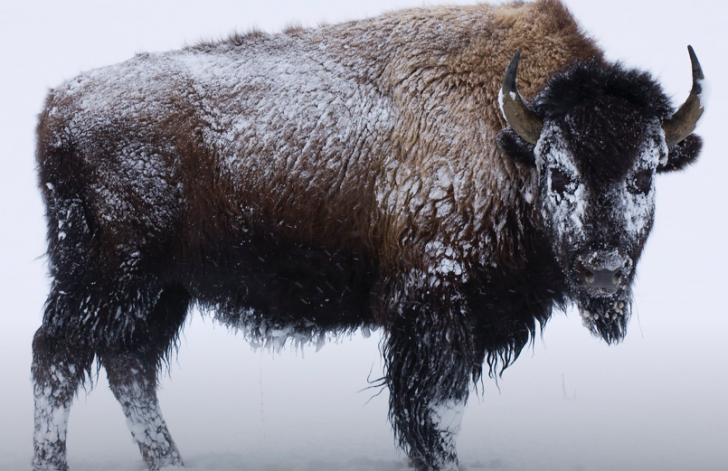
In winter, bison are relatively indifferent to humans, since they’re intent on scarce forage and surviving sometimes bitter cold, but it’s not something to count on. I’ve skied within feet of a bison, on a narrow trail with a cliff to one side and sheer drop on the other. We came around a corner and there they were. We carefully didn’t make eye contact with the cows and calves that plodded toward us, and I could hear muttered prayers from the other skiers (my teeth were chattering too hard to enunciate).

Of all the times I’ve visited Old Faithful, the most indelible and endearing memory isn’t a glorious streamside tour, two feet of light fresh snow, or being mock-charged by a bull elk. It’s the smiles on three kids’ faces as one cold morning they dropped tablets of food coloring in glasses of hot water, ran outside the Snow Lodge, and threw them in the air! It was a cold morning, and the droplets turned into rainbows of frozen mist – blue, red, green – that slowly drifted in the breeze and disappeared. So a half-dozen of us adults did the same thing.

Now, that’s magic.

Resources

The Mammoth Hotel and the Old Faithful Snow Lodge provide Yellowstone’s only winter accommodations and dining other than yurt village/guide service Yellowstone Expeditions (https://yellowstoneexpeditions.com/). They typically open for the season mid-December 20th through early March.

You can book accommodations by contacting Yellowstone National Park Lodges (https://www.yellowstonenationalparklodges.com/). For a snowcoach tour, I’d recommend Yellowstone Alpen Guides in West Yellowstone (https://seeyellowstone.com/), especially if you want skiing or snowshoeing.

mystery picture

This Issue

Welcome back, fellow Senior Skiers!!! This is the first issue of SeniorsSkiing.com for the 2021-22 season. As usual, there’s a lot of original content.

Ski instructor and contributor John Gelb offers excellent advice about taking lessons at the beginning of the season. Day 1: ski around and take notes on what you want to strengthen or improve. Day 2: Have your instructor focus on what you observed in Day 1.

Planning a X-C ski holiday? Jonathan Weisel, longtime writer, X-C area designer, and area operator, explains what to look for and where to go for the best X-C skiing vacation.

Gary Henderson

If you’re looking for an exotic Alpine skiing experience, consider the skifields of New Zealand. New contributor, Gary Henderson is a member of the Tukino Ski Club on Mt Ruapehu, where prices are reasonable, getting there takes some effort, and everyone pitches in with the chores. It sounds delightfully anachronistic.


In the August Reader Survey, 37%+ of the 3000+ respondents, indicated they intended to purchase skis in the next two years. There are some great choices for older skiers and some excellent information on what to look for in a ski that will perform well without tiring the skier.

Credit: Don Burch

Many of you have commented on Don Burch’s ski art and artistic ski videos. Don’s delightful video recap of his 2020-21 season may whet your appetite for the coming season.

mystery picture

Test Your Skiing Knowledge sources images and objects from ski museums and asks readers to submit their best guesses. It’s our way of promoting membership and visitation to ski museums. We’ll purchase a one-year membership to the New England Ski Museum for the first person to identify the man pictured in the feature.

Skiing History magazine: Sept-Oct 2021

The Fall issue of Skiing History magazine is summarized by contributor and SeniorsSkiing.com Advisory Council member, Seth Masia. Skiing History is a must-read for anyone interested in the subject. The new issue features an article on ski songs going back to the 19th Century, complete with YouTube links to actual performances!

As usual, Jon’s Short Swings! column is filled with interesting tidbits from around the industry. There’s a weird video compilation of modern individual flying machines – maybe they’ll eventually replace ski lifts.

Signs of hope for a productive season: It’s been snowing at higher elevations in the West, and ice has formed at the top of New Hampshire’s Mount Washington.

seniorski1

The Year in Review

El Nino, Stay South. La Nina, Go North.

If you haven’t already done so, it’s close to the time when the skis and snowboards get tucked away for summer hibernation.  Between Covid-19 restrictions, National Forest leases, and Old Man Winter calling it quits prematurely in much of North America, forces have conspired to end the season for the majority of winter sports enthusiasts.  This is my final posting of the season, so I thought I might take a look back at the season that was.

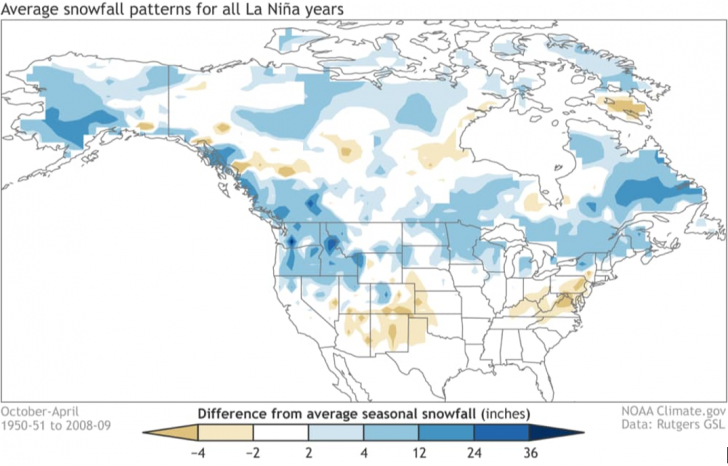
Just as is the case when putting together a winter forecast, a review of the season has to be framed by the state of the Pacific Ocean.  That is, were we in the midst of an El Nino, a La Nina, or neutral conditions with respect to the water temperatures in the equatorial regions of the Pacific?  The answer is La Nina, because those waters were colder than the long term normal throughout the season.  In the summer and fall, I am often asked by friends where the best skiing will be in the coming season.  When an El Nino is present, I always tell them to favor the central and southern resorts if they are headed west.  Conversely, if it is going to be a La Nina winter, I advise that they stay north of I-70.  Why? Well, here is a map of the average winter snowfall for all La Nina years.

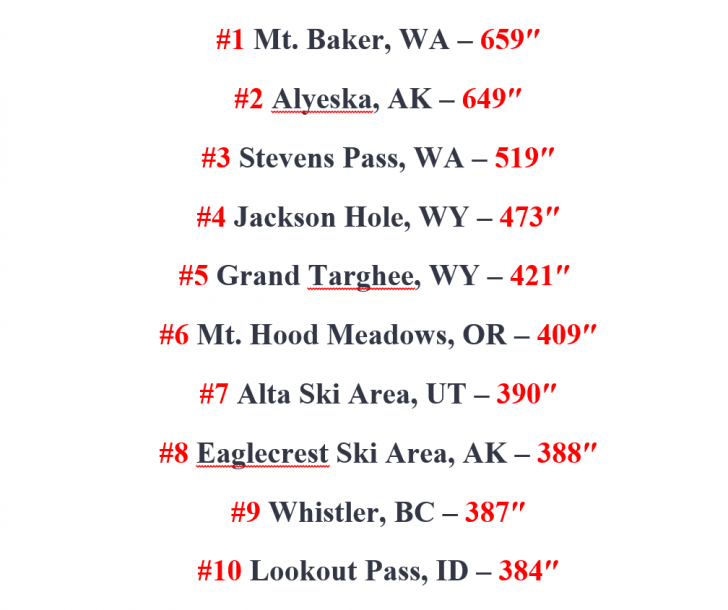
It is clear to see that when La Nina conditions are present, the jackpot for snow is typically found in the northern Rockies and Pacific Northwest, including far western Canada.  Although the correlation is weaker the farther east you go, due to the extra distance from the warm/cold pools in the Pacific, you can see that generally speaking the Upper Midwest and the northern resorts of New York and New England do pretty well.  How did this season work out?  Here’s the Top 10 resorts in terms of snowfall, through March 15th (the latest I could find).

No surprise that all ten are in the West.  Only occasionally does a Jay Peak or Sugarloaf push their way onto this list and after a paltry amount of snow in March, there will be no New England “contendahs” this year.  Now, notice where 9 of the Top 10 are located…north of Interstate 70!  Alta is the only exception, and they are only slightly south of that line of demarcation.  Also, Alta’s normal snowfall is close to 550 inches, and I doubt that they will get that extra 200 inches to reach normal snowfall between mid-March and when the lifts stop turning at the top of Cottonwood Canyon.  Moral of the story – if it’s a La Nina, stay north of I-70.  If it’s El Nino, head to the central and southern resorts.

Elsewhere, the Upper Midwest bucked the La Nina trend with a below normal snowfall season at most resorts. In a more typical La Nina fashion when a southeastern upper ridge brings spells of warmth, the season was more of a struggle at times in the mid-Atlantic and Southeast but these regions had several runs of stellar conditions if your timing was right.  The Northeast enjoyed a solid season, with a “Fabulous February,” and then the flakes stopped flying in March.

For those of you who might think on a broader scale, I leave you another way to measure how this season worked out with respect to snowfall.  It’s a graph of seasonal snow extent (in square kilometers) from December 1st through February 28th, which constitutes “meteorological winter.”

This winter was better than 5 of the last 6 and 7 of the past 10 and the data trend over the past 50-plus years is positive, contrary to what some folks want you to believe.  The models that focus on El Nino/La Nina are hinting that we may be in La Nina again next winter, something to consider as you start to put together your travel plans.  Thank you very much for reading my column the past several months.  Right now, though, “That’s a wrap!”


Anyone Lose A Moriarity Hat 35 Years Ago At Beaver Creek?

We Have It For You.


Here’s a note from Shelley Canalia, a reader, who has come into possession of this old hat with numerous pins from resorts and events.

My brother is Anthony Isham West. Great guy, comes from a Nordic ski family on his Father’s side. In 1985-86 he was working at Beaver Creek in Vail. He found this hat. Fast forward to 2021. He gives it to me. I want to find the owner or the owner’s family. Most of the pins are fromEuropean ski areas and a lot are from different Olympic events. There is a Lake Placid 1980 Olympics ABC pin. Also American Express Olympic pin. The person was definitely a skier. The hat is classic 60’s Moriarty Hat from Stowe, Vermont. So, if everyone would share this post maybe we can find the person or family this hat belongs to.

Anyone have a clue who this might belong to?  Or, what can you infer about the owner from what you see, knowing it was lost at Beaver Creek in the mid-1980s?

If you have any information or what to comment, please LEAVE A REPLY below. Shelley will be monitoring responses for leads and clues.


Look Ahead: Report From Australia

The Virus Is Contained, Resorts Anticipate Regular Openings.

Mt Hotham in mid-season. This year, the resort awaits eager visitors after closing in 2020.

We, the skiing public here in Oz, are quietly excited about the prospect of finally skiing again after a year off. While we wait for government decisions and confirm opening dates at Mt Hotham, Falls Creek and Mt Buller here in Victoria and similarly for the resorts in NSW at Perisher and Thredbo. There is a very good indication that with virus levels in Australia at zero the official opening date of Friday June 11 will happen. The ski resorts are all hiring this year.

Opening, that is, except for only a couple of people in quarantine.  There are no cases in the general community. Yes, you read that correctly. Through management (and I use the term loosely), Australia, with a little diligence, has reduced Corvid to literally just a few cases. So, our various state governments figured out, finally, that hotels and strict quarantine for returning travelers has stemmed the transmission.

Contrast this with 2020, and the disaster that unfolded then for the ski industry. By July 9, 2020, it was confirmed that two popular Victorian ski resorts had closed effective immediately due to the corvid virus in the state. They made the difficult decision to suspend operations at Mt Hotham and Falls Creek, “effective Thursday July 9 through to at least August 19,” Vail Resorts, the US company which owns the ski fields, stated. NSW followed quickly with the same decision.

Perisher in NSW is the largest ski resort in the Southern Hemisphere, opening in mid-June

We were in a bad space last year after devastating wildfires in January and February and yet the announcement about the then coming season was all rosy. “Mt Hotham welcomes the State Government’s announcement that the 2020 snow season can commence with a delayed start in late June, just in time for the Victorian school holidays.” said an official. Further adding, “Mt Hotham has experienced some fantastic early snowfalls, so we’ve been eagerly awaiting news on whether the winter 2020 season would proceed,” said Amber Gardner, CEO, Mt Hotham Alpine Resort Management Board. “We are excited about the Premier’s announcement yesterday and look forward to celebrating the season opening with our mountain community at the end of June.”

The excitement continued. Queen’s Birthday Long Weekend traditionally marks the start of the snow season in Australia, but last year it was to be a low-key affair, as Mt Hotham continued to plan for scaling-up in June in accordance with Victorian public health guidelines. The usual explainer of carrying snow chains, resort entry fees, etc. was also confirmed. During this period, the ski field would be closed to downhill skiing and snowboarding. But the resort’s cross-country trails will be open in alignment with recreational trails around Victoria, albeit under a reduced grooming regime and with limited Ski Patrol support. A limited intra-village transport service would also be available. And yes, Mt Hotham board spokesman said staff had been inundated with calls. “Please keep in mind that our staff may not be in a position to immediately answer your questions,” he said.

Here’s an interesting fact about the extent of the snow area in Australia in winter, a fact I find hard to comprehend: Australia has more snow than Switzerland. And, according to the Australian Ski Areas Association (ASAA), ski resort visits in Victoria had a $1,076 million impact on gross state product in 2018. So, you can understand how devastating another closure will have on this industry in 2021. A spokesman stated that, “People in the mountains and surrounds in Victoria continue to progress programmed summer projects ready to greet their first guests this the coming 2021 Winter.”

We wait. I am quietly confident that an opening will happen. We are seeing larger groups allowed with some isolating for crowds at sporting events still. But with vaccinations ramping up across all the states, confidence may be restored. Could I be sliding down a snow-covered slope at my favorite ski hill soon? Since skiing in Canada last year in January and February, I am yet to put on the planks. A La Nina has visited us in the Pacific and unusually large rain events have occurred across the Eastern States. But we are long in the knowledge that rain alone will not increase the snow levels. It maybe cold and wet, but I will be happy enough to just be amongst the snow guns again, real snow or not.

Mt.Hotham before the virus closed her down. Credit: Dave Chambers

Look Ahead: Despite Challenges, Chilean Resorts Are Preparing

Areas’ Marketing Campaigns Are In Full Swing, But Will The Weather Cooperate?

La Parva, Chile, sunset through the icicles. Credit: Casey Earle

For 2020, the ski season revolved around the multiple ills Chile has been suffering, including the ongoing drought that affected the skiing. This year would seem to be a continuation of those ills, including social and political unrest, economic suffering, and plague. In spite of all that, last year a few ski areas opened late in August, and the skiing was quite good. These were La Parva, El Colorado, and Corralco. Backcountry access was difficult due to covid restrictions.

Up until a few weeks ago, some optimism was brewing. Chile’s vaccination program had taken off strongly, Santiago had avoided a second wave, the elections for the constituents of the constitutional assembly were on for April 11, and rain had come to the central zone in January. Now, it would seem the Brazilian variant is ravaging the country, 90 percent of the inhabitants are in quarantine, hospitals are overflowing, and the elections are being postponed for a month. Riots flare up periodically, and the slow burn insurgency in Araucanía continues. Hard to be optimistic in this environment, but I will try.

Marketing announcing discounts for this season at La Parva. Credit: Casey Earle

The ski areas are certainly running their marketing campaigns like this season will actually happen with a semblance of normalcy.

La Parva touts their continuing commitment to opening the ski area, as they have done with their bike park during the summer.

Other areas are chomping at the bit to get the season going too, like Antillanca.

The dark spot is Valle Nevado, which is in arrears on a wide variety of debts, and recently initiated a chapter 11-type restructure of their obligations through to 2026, with large additional short term injections to keep the lifts turning. They cite the drought and covid as contributing factors to their woes.

In the weather department, the Chilean weather service just published their predictions for the fall (April, May, June).  Click here for details.

In summary, with rising subsurface temps in the central Pacific, the Niña has ended, and a neutral period begun (“La Nada”), but rainfall deficits are still expected. These will be most intense in the central zone, with the far south receiving excess rainfall. A El Niño event could occur late in 2021, if the warmer waters surge through to the southeastern Pacific, but that is highly unpredictable.

What really matters though is what sort of rainfall will happen from June on when most of the snow falls. I would not dare a prediction as drought has been the norm and is most likely to continue, but one (or god permitting, two) atmospheric rivers could change everything, as happened in late June 2020 under lockdown.

If you are thinking about a trip down this winter, it is probably unwise to plan just yet. That said, if the vaccination effort goes well, and those pesky variants calm down, possibilities for August are not out of the question.

Crossing our fingers!

Riding the Roca Jack “Va et Vient” with the US Ski Team. several seasons ago. Credit: Casey Earle

Look Back: US Season Wrap

A Wide Lens View Of How Large And Small Resorts Managed To Deal With Restrictions And Constraints.

[Editor Note: Pat McCloskey is a regular contributor to SeniorsSkiing.com.  This article first appeared in Chronicles of McCloskey.]

Ski resorts took COVID compliance seriously, allowing the season to happen. Credit: Pat McCloskey

First, let me say I was glad that we HAD a ski season. From changing my boots in the lot at Laurel Mountain to the Covid 19 security seen above at June Mountain, CA, the theme was always the same: Please comply with the mask and social distance rules so that we can stay open. Wearing a mask is a small price to pay for the knowledge that the areas were doing the best that they can to stay open during the pandemic. The gentleman on the left in the orange jacket said to me that he appreciates all the public was doing this season to help them stay open. He was concerned not only about the skiing but for the welfare of the many employees that operate a ski area. Their livelihoods depended on compliance from the public.

No matter where I went this year, the theme was the same: Please comply for us to stay open. It was interesting to see how things transpired as the season went on. The mask laws were always enforced everywhere. When Jan and I went to Deer Valley in February, they had staff monitoring the lift lines to make sure that people had their masks on and up and over the nose. Signs were everywhere in ski areas this year instructing people to social distance in the lift lines and everywhere on the premises.

The only thing that was hard for lifties to monitor was riding the chair lift. In the beginning of the season, there seemed to be more of a concern for only riding two people per chair—whether it was a triple or a six pack. That seemed to expand the lines significantly. Then there was the polite request from the lift line monitors for people to ride together if comfortable. More and more people rode together which reduced the lines, but face masks were still enforced no matter how many people loaded

Pat and Jan McCloskey at Deer Valley for mid-winter vacation.

the lifts together. Everyone had the option to ride alone. We were at Mt. Rose in Tahoe last Monday, and a guy beside me requested to ride alone. I told him I completely understood, and he was very gracious. I also told him that we were all fully vaccinated, and he said he was too but didn’t trust anybody. He was nice about it but stood firm that he wanted to ride alone and that was fine with us. Generally the line monitors everywhere gave people a chance to ride as they felt comfortable.

All in all, I had the opportunity to get a good read on how the ski areas were doing with initially skiing in the East and then two western ski trips to see how it was being handled in Utah, California, and Nevada. One of the other comments from the ski area personnel was that they knew they were being monitored by the state. And their fear was that if the state saw non-compliance or lack of enforcement on the part of the ski areas, they would shut them down. This was the fear from last summer when there was a lot of speculation about whether the ski areas would open for 2020-2021 and if they would stay open. So far so good. My intel from friends in Colorado and Vermont also confirmed that initially there were issues with chair lift lines but as the season progressed, that seemed to wane a bit. The larger areas had lift line issues but the smaller areas or more remote areas had no issues at all.

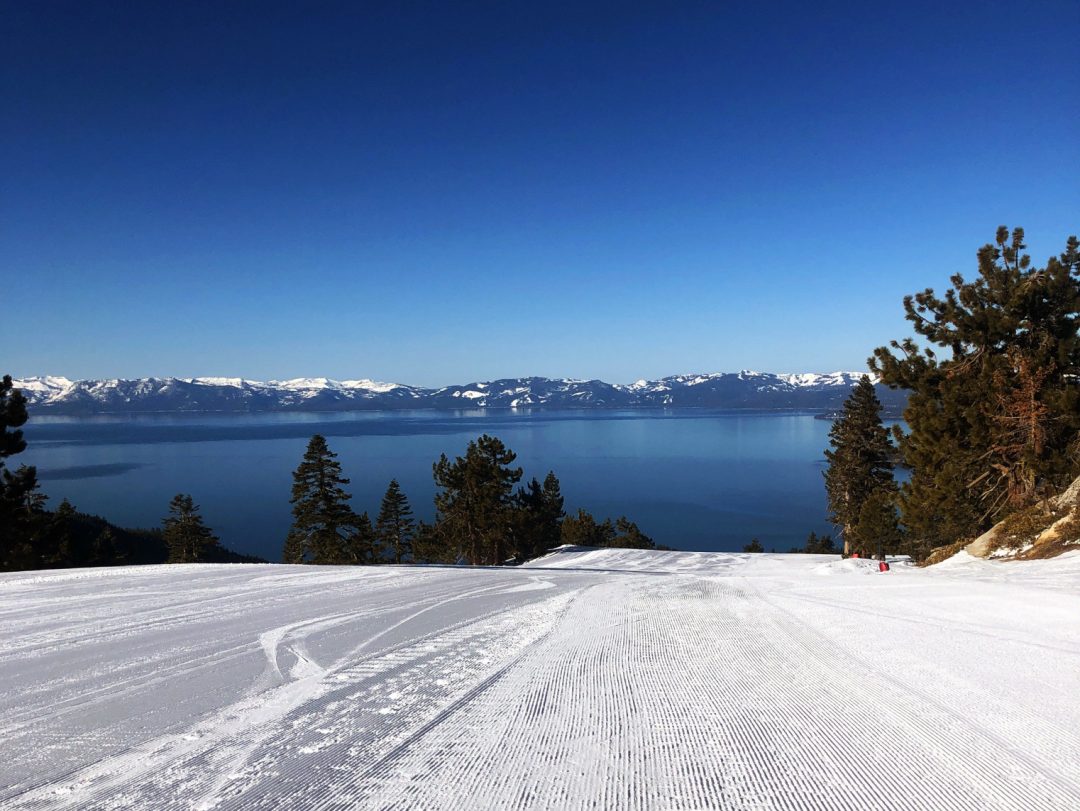
Arcing beautiful groomers at Mt Rose with Tahoe in the background: A memory to carry thru the summer. Credit: Pat McCloskey

So as we wrap up another ski season and as areas slowly start to close, I am again grateful that we had a season in these very trying times. It will be interesting to see how the areas did financially seeing that there was a different scene this year. No big apres ski scenes, restaurants at 5o percent capacity at best with the “Grab and Go” food options being the norm. Most areas got their money up front with the sale of IKON and Epic Passes which is the only way to go considering the price of daily lift tickets. But the food and beverage sales had to take a hit.

I always get a little melancholy with the knowledge that I won’t be on the slopes for another eight months. I thought about that when I was making some nice giant arcs on some great groomers at the end of the day at Mt. Rose. I thought to myself, “Pat, this is what you need to think about this summer when you are getting that ski itch.” I love the feeling of making the skis carve on some great groomers. It brings a smile to your face for sure. Even though the western snow pack was down 50 percent this year, and the really cool stuff was not accessible, it was still fun to rip the groomers and that feeling of making a nice rounded arc turn never gets old. So bring on the spring and summer. They are fun seasons too, but I will be looking forward to another ski season as the leaves start to turn in the fall.

This Week In SeniorsSkiing.com (April 9)

Spot-That-Resort, Top To Bottom Telluride, Skiing Weatherman, Question: Buy Now?, Cycling Lessons, XCSkiResorts, Focus Mindset, Killington In Spring, Ski Club Prep In Oz.

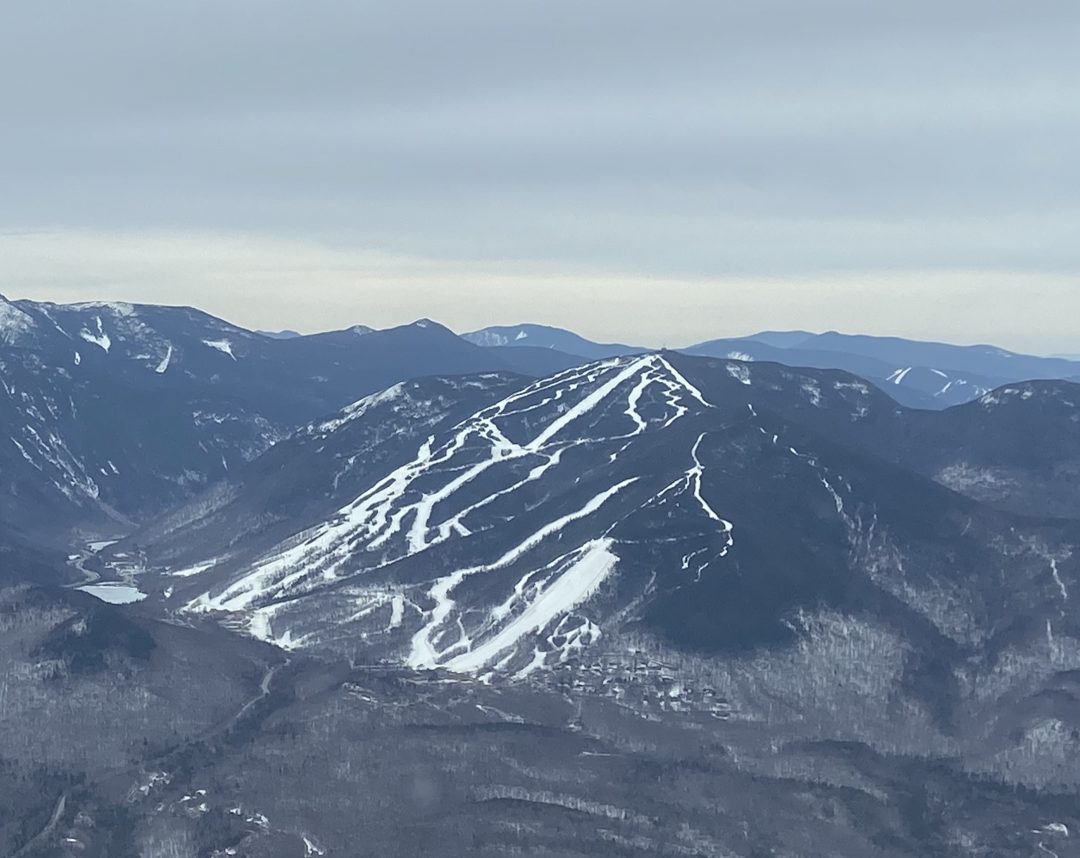
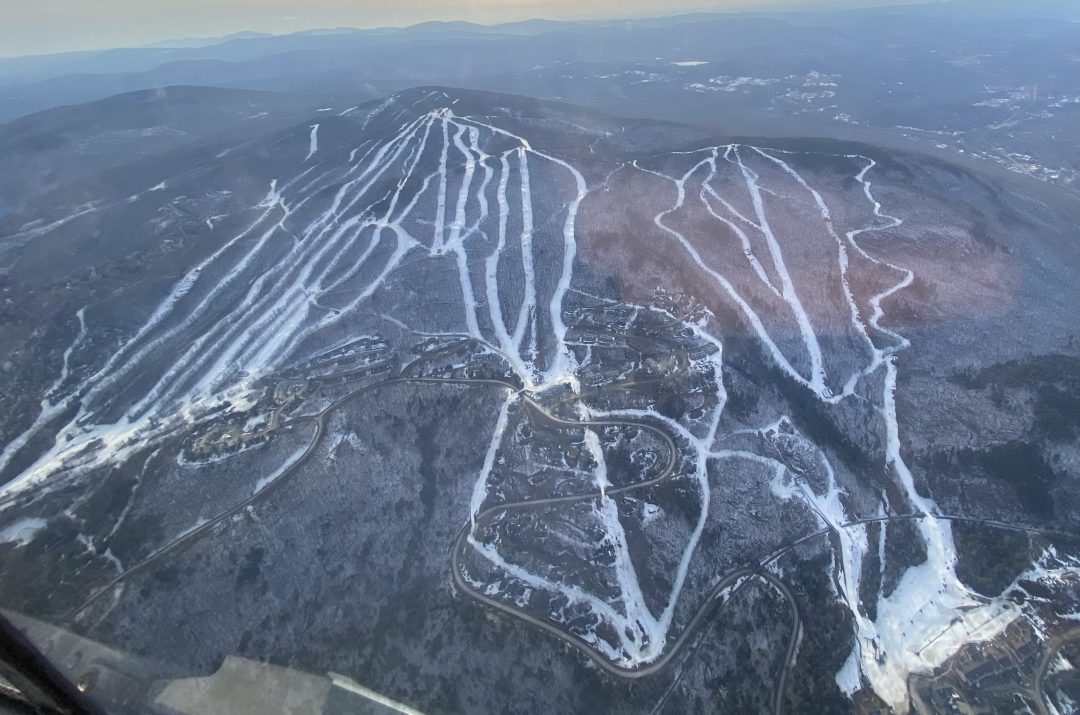
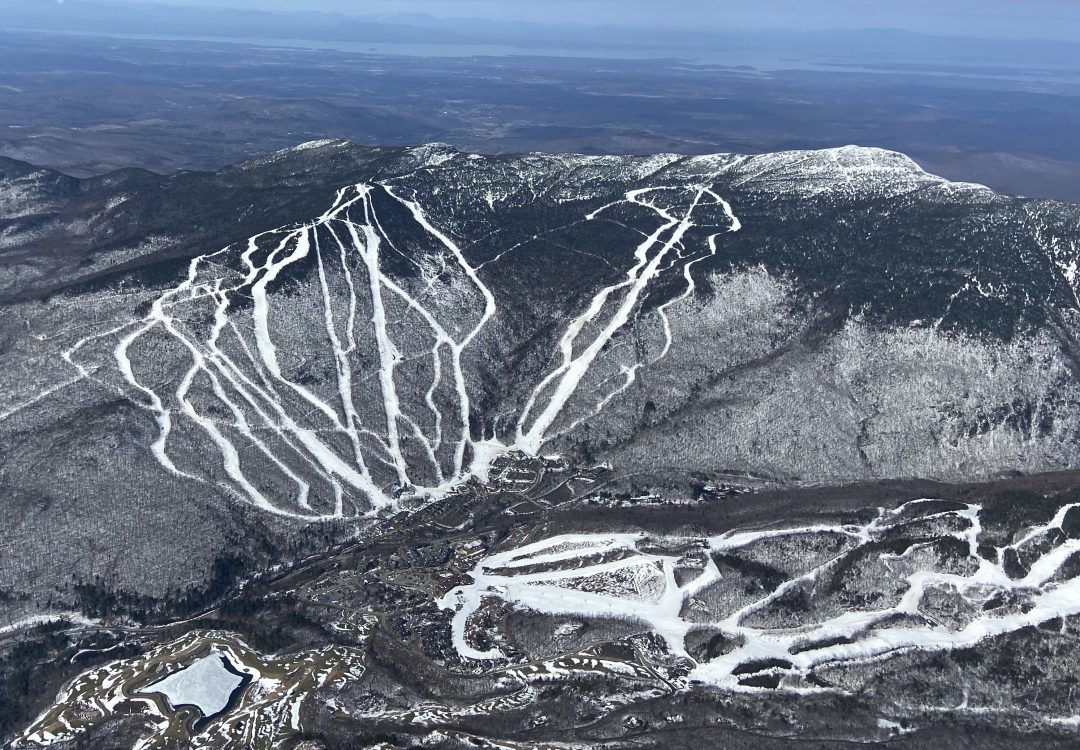
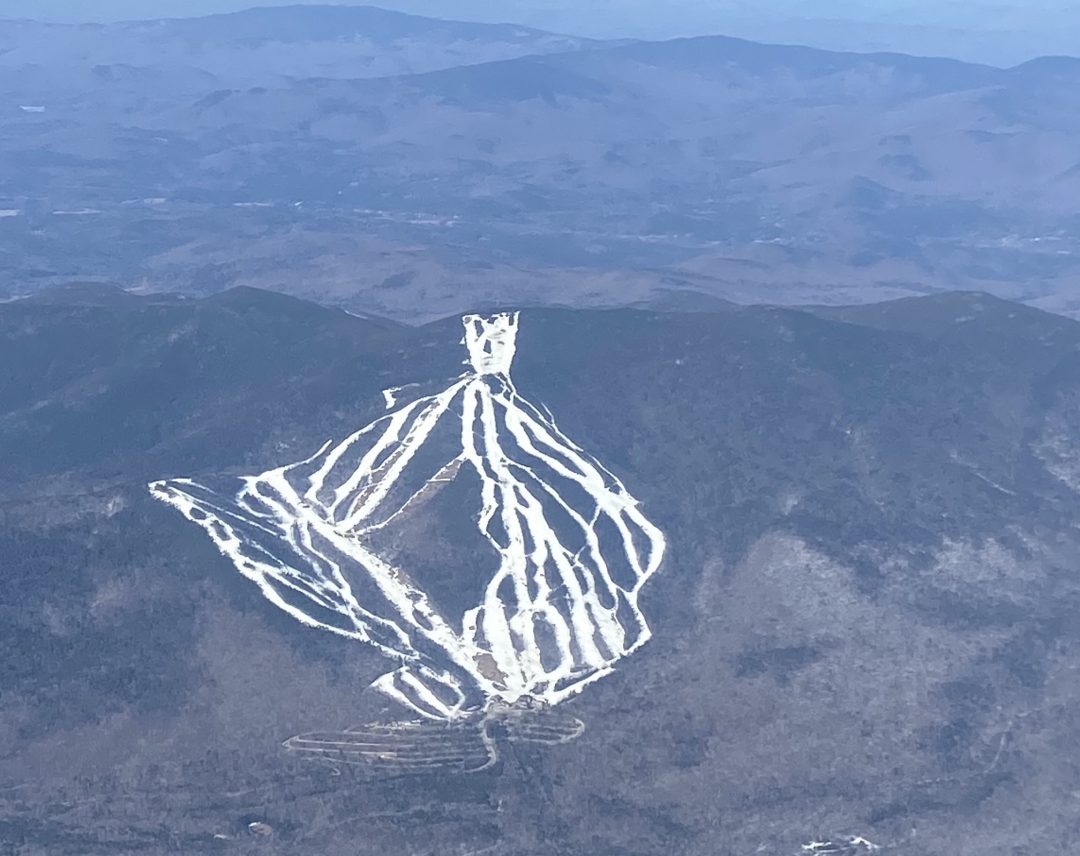
Emily Dickinson said: “A little Madness in the Spring / Is wholesome even for the King.”  So here’s a little quiz that might drive you a little nuts. See how you do in this exercise in pattern recognition.

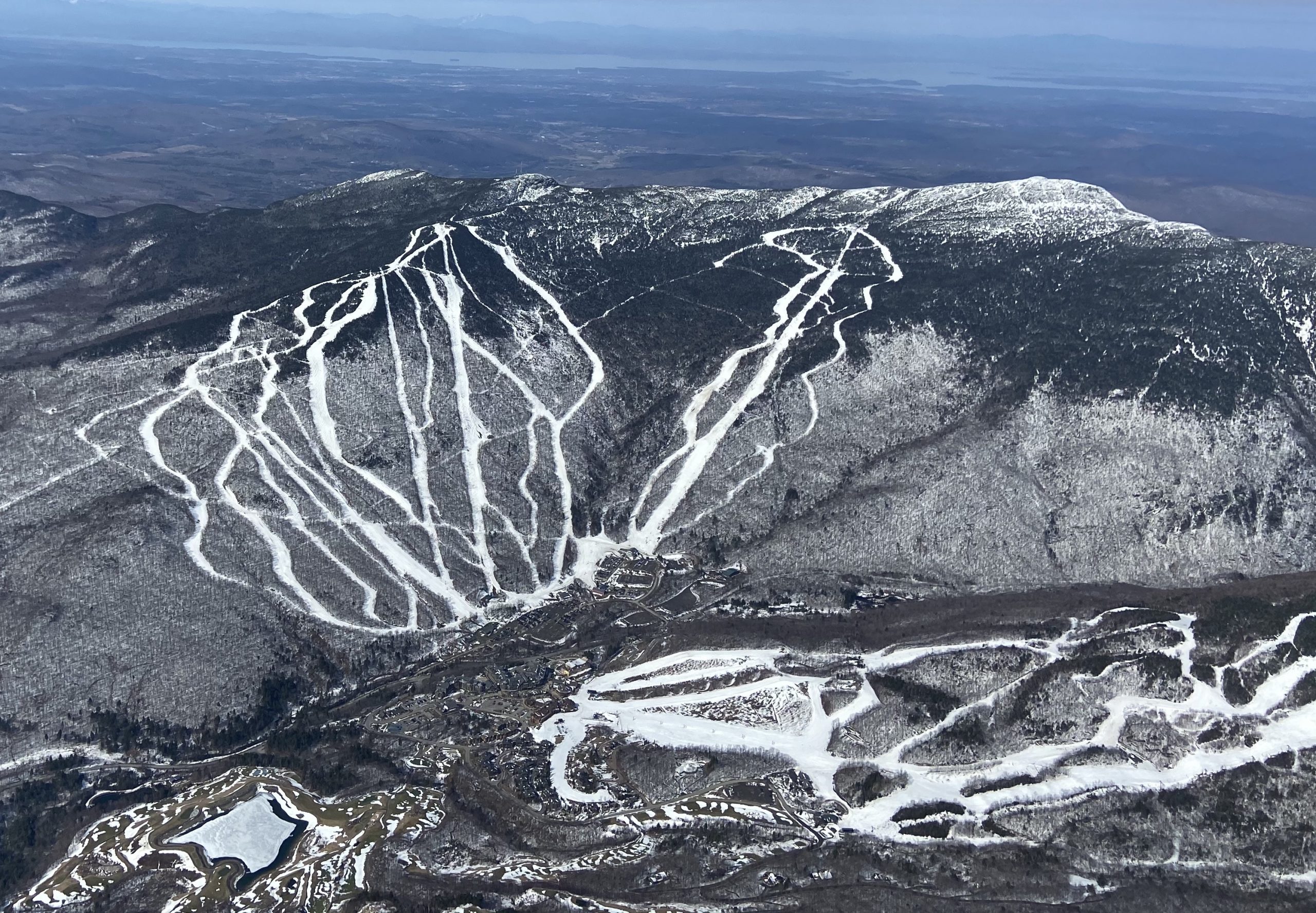
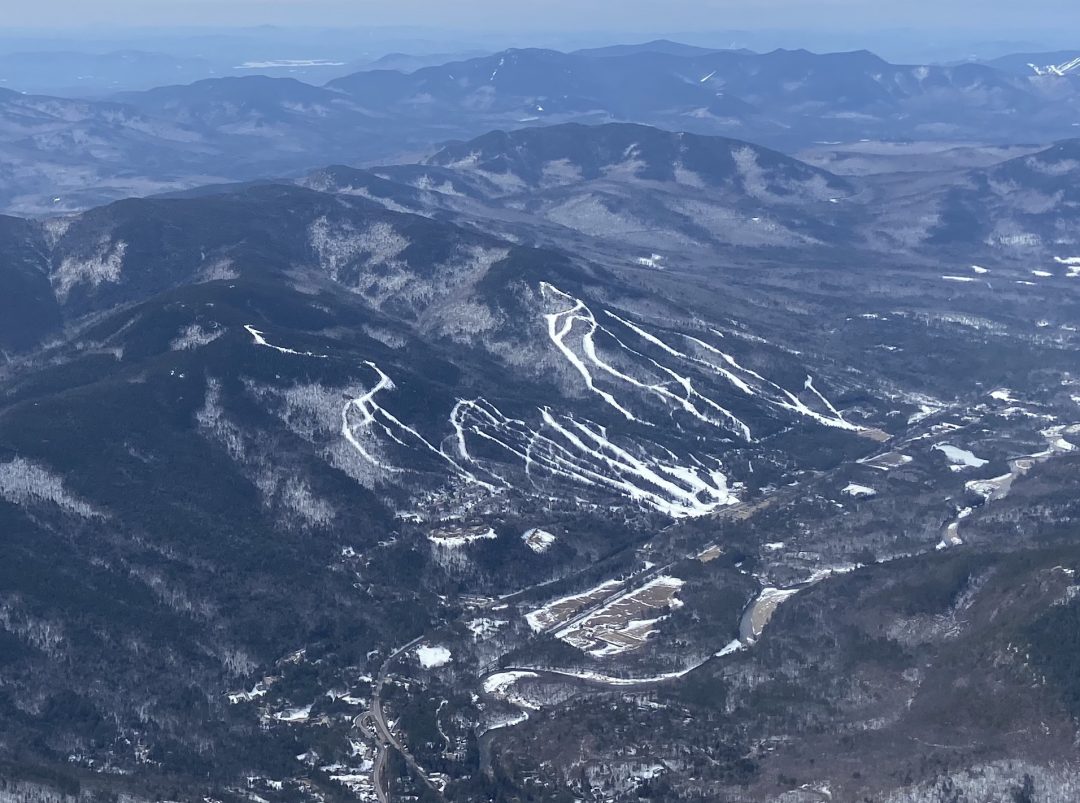
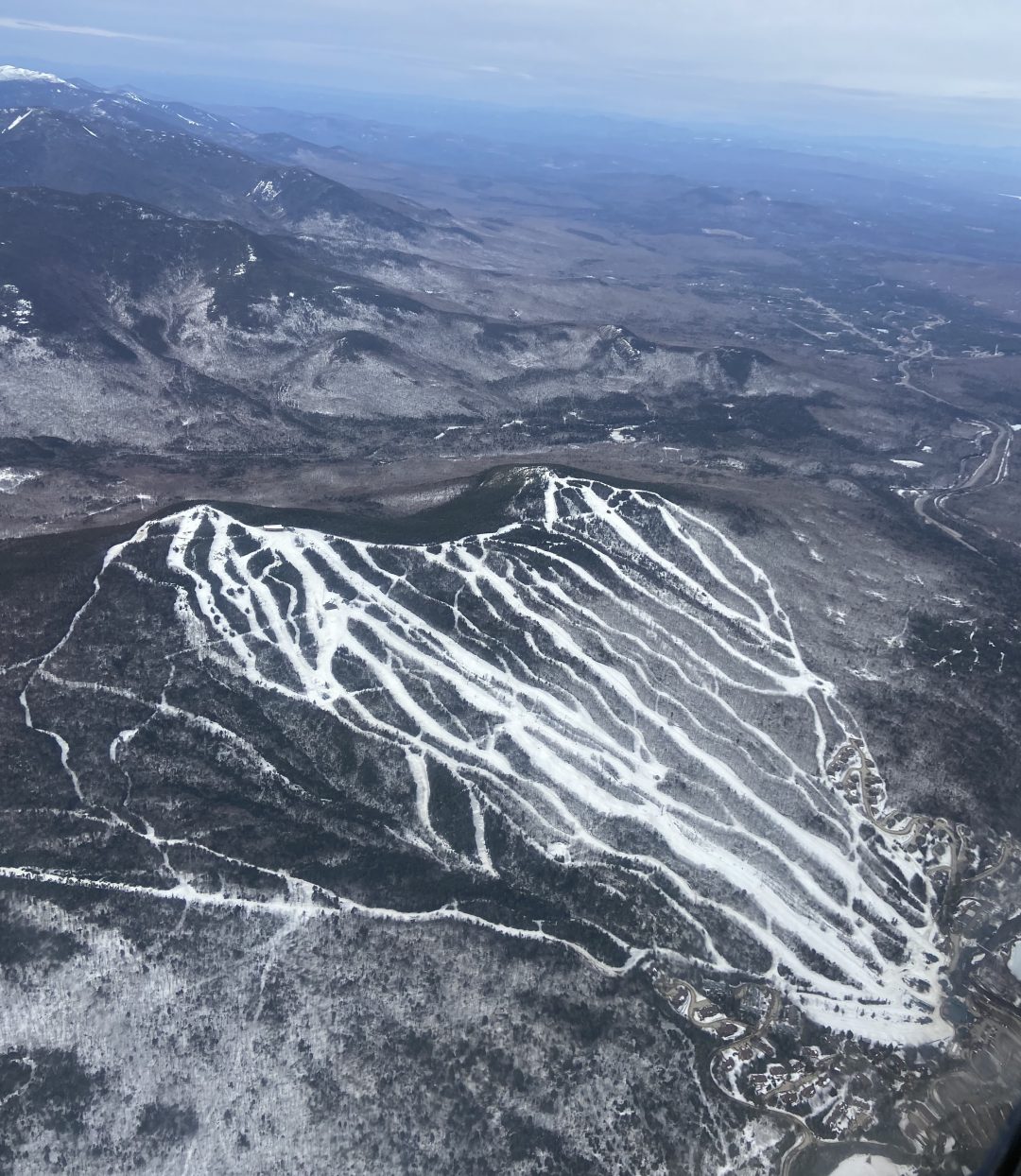
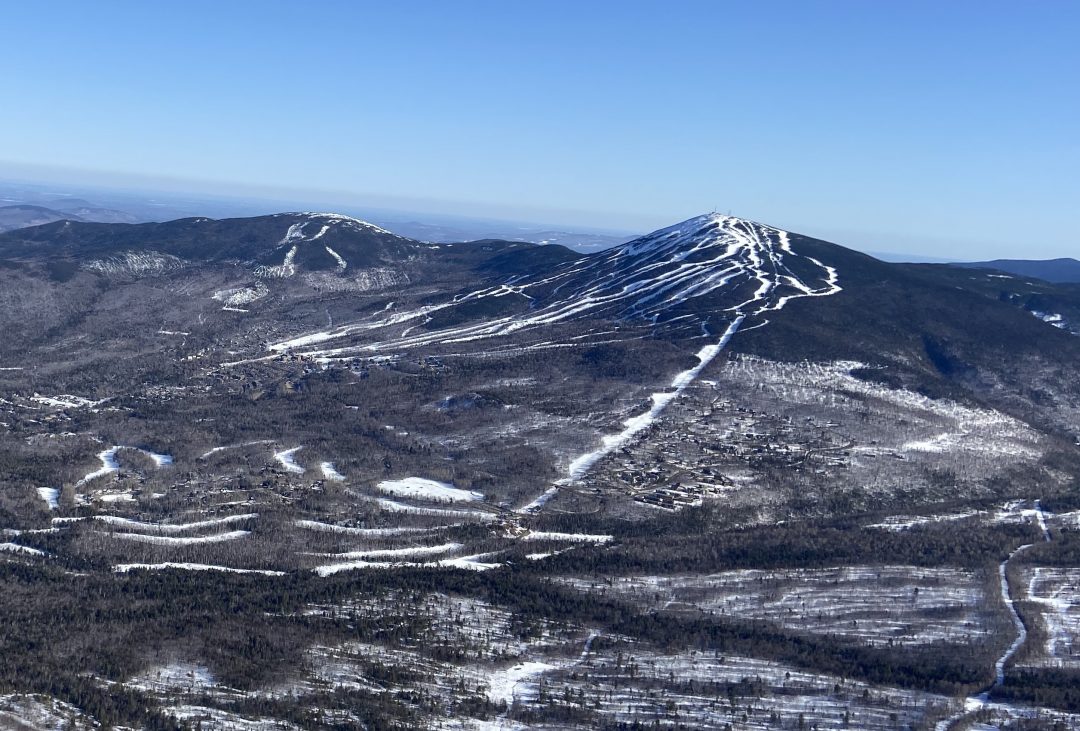
Below are seven aerial shots of New England ski resorts taken a week or so ago by an aviator friend. Can you identify them? Hint: there are three in New Hampshire, two in Maine, two in Vermont. All photos credit: C. Michael.


Mountain 1

Mountain 2

Mountain 3

Mountain 4

Mountain 5

Mountain 6

Mountain 7

Answers:

This Week:

Telluride has trails for everyone from beginners to expert. And it is certainly less crowded than the resort that starts with V.

Our Vicarious Vacation series moves west to Telluride for a top-to-bottom ride.  What’s notable about Telluride is that it is a high-altitude, long-run resort. Our skier deserves some kudos for making it down non-stop. Click here.

Herb Stevens, the Skiing Weatherman, reports that the spring skiing for the near future is West. Western and Northwestern resorts have “money in the bank” for a longer lasting season.  Click here.

Vail Resorts has dropped the price of its Epic pass 20 percent. It is certainly a strategic play to get more customers. The forecast is: cheaper passes and no reservations (also part of VR’s package) equals lots of people lining up. And we add the uncertainty of COVID, and we have some complications in deciding to buy a pass now or not or perhaps not ever. This week’s Question For You asks for your opinion. Click here.

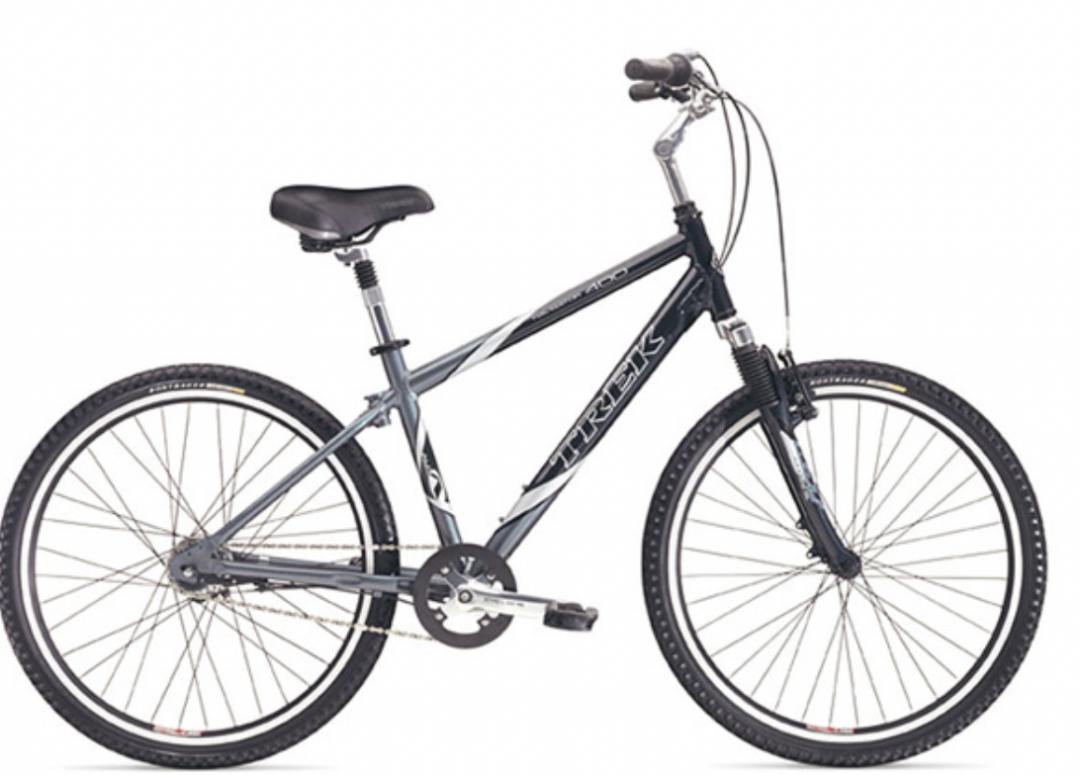
Trek Navigator allows a comfortable, upright riding position. A fat seat helps.

We are transitioning to coverage of bicycling topics, a pasttime that many of our SeniorsSkiing.com readers pursue in a serious way. Here’s correspondent Marc Liebman’s take on some lessons he learned long ago and have been reinforced by his recent training program.  Click here.

In this most unusual year, we have published a series of articles and a Resource Guide on alternative snow sports called Make More Tracks. And, as we have seen, interest in those alternatives—XC, fat biking, snowshoeing, winter hiking—has spiked.  A major contributor to that series has been Roger Lohr, publisher of XCSkiResorts.com, a directory and source of information about where to stay, equipment, and technique. His article summarizes the value that XCSkiResorts.com brings to readers.  Click here.

Ski Coach Bob Trueman (r) puts emphasis on the mental aspects of skiing.

Ski coach and contributor Bob Trueman offers some advice about how to set your mind on your ski practice.  His advice is simple and direct: form a specific goal for a specific action and do it.  The actions will lead to results.  His is an interesting perspective that has aided many skiers to leverage and improve their skills. Click here.

Killington and the blue bird day.

Videographer and contributor Don Burch offers a visual gift for us.  It’s a snapshot of Killington on a beautiful, blue bird day. What more could you ask for?  Click here.

Finally, we hear from our correspondent in Australia, Dave Chambers, who reports on his ski club’s work party weekend, prepping for the ski season coming soon down under. Oz’s ski season doesn’t get rolling until late June-early July so this club gathering is a great way to build camaraderie before the snow flies. Click here.

Thanks for reading SeniorsSkiing.com.  Remember there are more of us every day, and we aren’t going away.

Early snow at Gravbot Ski Club welcomes work party in Mt. Hotham. Credit: Dave Chambers


Skiing Weatherman: West Still Strong, East Hanging In

Some Powder. Trail Counts Good.

The weather pattern that dominated the month of March in the eastern half of the country has continued right into April…unfortunately.  I communicated with a resort manager in Vermont last week and found out that the mountain, which has a high base elevation…had received exactly one inch of snow last month.  One %#$$@*& inch!  A good number of areas pulled the plug after offering skiing during the Easter weekend as the lack of snow and late month rain beat down the base depths to the point where skiing and riding couldn’t be extended any further.

Going forward, I wish I could tell you that some late snow was on the way to sustain the sliding for several more weeks, but that is simply not the case.  The strong ridge at the jet stream level that took shape a couple of weeks ago over northeastern Canada is still there, and a piece of that ridge has extended into the northeastern U.S. the past week, leading to temperatures that continued the shrinking of the snow supply.  While it will be turning cooler in the East relative to normal for the last two weeks of this month, it looks like “too little, too late.” Lastly, base depths never got overly deep during the heart of winter, then the snow drought hit in March, and right now, we are left with a dwindling supply on the slopes.  So, in the East, get it while you can.  Grab the rock skis, bring the sunscreen and the tailgate gear and have a go at it.  This weekend there will be about 20 resorts to choose from in the East and trail counts are still pretty healthy.

In the West, the spring skiing season is also underway with the resorts sitting on much more in the way of “money in the bank.”  That is, ample snowfall through the season has built up the base depths to an extent that skiing and riding can easily continue for several more weeks.  Keep in mind that a good number of resorts will be closing, or have already closed, because their deals with the National Forest Service say they must, regardless of how much snow is still on the hill.  But overall, the season still has plenty of legs throughout the West.  In this region, there is actually hope for a little more in the way of snow.  Here’s a map of the snowfall for the next couple of weeks.

It’s not a ton of snow, but if you time it right you might be able to squeeze in a few more powder turns before calling it quits for the season.  British Columbia has been the big winner in terms of snowfall this season, which is to be expected during a La Nina winter, and they are in line for a dump or two, or more, in the coming weeks.  Unfortunately, a Covid resurgence has caused many of the resorts in that province to close for the season.

The turns are out there if you really want them, but you might have to work a little harder to make them.

REGIONAL HIGHLIGHTS:

Pac NW/B.C.:

Late week snow will set up one more weekend of winter surfaces.

Central and southern Sierra:

Perfect spring skiing weather coming up for the next week.  Sunny, mild days and overnight lows below freezing to preserve and set up the snow.

Rockies:

Mild days, chilly nights, and any precip in the next week will be light.

Midwest:

Lutsen, Minnesota appears to be the only resort still operating.  Light rain and snow most days next week.

Northeast:

Warm pattern turns cooler late next week and beyond.  Better hustle to get those turns in.

Mid-Atlantic/Southeast:

The party is over.


Top To Bottom: Telluride

Here’s A View Of A Quad-Busting Run At A High-Altitude Colorado Classic.

Telluride has trails for everyone from beginners to expert. And it is certainly less crowded than the resort that starts with V.

Our Vicarious Vacation series heads west to the major destination resort with a Victorian mining town heritage and lots of mountain to ski. At 8,750, the town sits at the base of mountains that range to 11,000 feet, making some of the highest, longest ski runs in North America.

This video was produced in 2019 with some helpful annotations pointing out lift names, mountain ranges, and…Jerry, whoever he is. In any case, the twinky music ends in a couple of minutes, thankfully, and you can just listen to skis hissing through the snow all the way to the bottom. Credit goes to RealEstateTelluride. Click image below. Have fun.

Question For You: Buy Now Or Wait?

To Buy Or Not To Buy (Yet): That Is The Question.

It should be clear by now that if you intend to ski more than two or three times a season at mid-large resort, a season pass is required. Basically, walk-up tickets are major resorts are in the $15o to $200+ range which is fine if you have limited interest, time, or abundant resources.

Now we learn that Vail’s Epic pass will be sold at a 20 percent discount from last year’s. Vails chief executive Rob Katz clearly states that the strategy is to “move ticket buyers to a pass.” Dropping the price is certainly one way to do that. It’s also a way to add to the revenue line after a year of increased expenses for COVID.  So the push is on to buy a pass.  For example, the Epic Northeast Midweek Pass for seniors 65-plus has dropped to $271.  In the west, the Tahoe Value Pass is $359 for seniors. Pretty tempting.

Predictable consequences: More people showing up, crowding parking lots, longer lift lines? Or, more darkly, not being able or wanting to ski at a resort because of ongoing virus restrictions which still may be a factor in 2021-22? Unpredictable consequences? Who knows?

Question For You: Given the bargain prices for season passes, do you plan to purchase one as soon as you can (i.e., now), wait and see, or skip it because of…what? Will you be looking forward to heading to bigger resorts with your new pass? Will you continue to be content with “mom and pop” hills where you can ski mid-week for cheap?

Please comment in Leave A Reply below.


Three Bicycling Lessons Relearned

Reflection On The Past Before Starting This Year’s Biking Season.

Marc’s Trek Navigator 400 allows a comfortable, upright riding position. A fat seat helps.

With gyms closed to Covid, way back in August 2020, I started riding my bicycle five days a week as a way to get ready for the ski season. I live in North Texas where the terrain is relatively flat. We don’t have hills or mountains, we have rises. I also decided to ride on neighborhood streets because there are crazy people driving while reading and sending texts and emails.

Arbitrarily, my initial goal was to ride 15-20 miles a day, four to five times a week at a steady speed of around 10 miles an hour. My Trek Navigator 400 has three ranges and eight speeds within each range.

My road cycling career began back in the fifties on a Raleigh bike with three speeds which we upgraded to six. Back then, I was a 13-year-old member of an Air Explorer troop in Germany. We-our scout masters, parents and us scouts- decided to take a long-distance bike trip during the summer.

Several conditioning/trial trips later, we took the train from Frankfurt to Calais, the ferry to Dover and another train to London. Four days later, we took the Tube to Watford and headed out to the youth hostel in Stratford-on-Avon. Six weeks later, we were back in London after having visited more castles and churches than I can remember.

There were other bike trips in the following two summers, and, from them, I learned three important facts about biking. One, the youth hostel or inn where we were staying was always upwind at the top of the highest hill in the area.

Two, one can ride farther than one thinks. Back then as an Air Explorer, we tried to do 50-75 miles a day, depending on the terrain. Where it was relatively flat, 75 miles in a day was a no brainer. Hills and rises, well, that’s different

Three, bike seats are uncomfortable.

Fast forward six plus decades and after seven months of biking, the lessons learned have not changed. My house/destination is at the highest point in the neighborhood and on the last mile or two, whatever wind is blowing, it is in my face.

When I started, I could barely ride eight miles.  I’d ride remembering some of the tougher legs on those three trips. When this post was sent, weather permitting, 12 miles per day, four to five days a week is the norm. Going father is more about time available than fatigue. At an average of roughly 10.6 mph, 12 miles takes an hour and 10 minutes. Twenty miles would take close to two hours which is more time than I want to spend pedaling since I have other things to do, like write books and magazine articles.

And guess what, even with a wider, padded seat on my bike, after 12 miles, my butt still hurts!

The latest from Marc’s bike app: Map My Ride.

Add Insult, Avoid Injury

“Your Problem Is, You Don’t Know What You’re Doing”.

Ski Coach Bob Trueman (r) puts emphasis on the mental aspects of skiing.

In modern times this sentence wouldn’t score well on the “how to make friends” scale. And yet it is in reality very informative. You just have to look at the real meanings of the words used, and not the colloquial inference.

In fact, from the view point of performance enhancement it is a critically important observation. Whether that performance is in something physical, like skiing, cerebral, like academic endeavor, or practical, such as business.

The most fundamental tenet of Neuro Linguistic Programming, and other performance enhancement psychologies, is that if you want to change your outcomes you must change your behaviors. “If it isn’t working, do something different”.

The instructional approach to this is either to tell you what you are doing wrong, or just to tell you what to do. It sounds reassuringly practical, but doesn’t work well in practice.

The reason for its limited efficacy is that in order to do something else, it is best to know what you are doing just now. And that is the hard part. And here, dear reader, we come to the import of the insulting first sentence above.

Frustration

More often than not, indeed I’d say pretty well on every occasion, when I first begin coaching someone (in anything at all, not just skiing), they do not have a mechanism to help them to know what they are doing. It is what they are doing, that is creating the outcomes they don’t want. And it is not having current awareness of what that behavior is that is getting them so frustrated and making it so difficult to change.

When I ask a skier after a short section of skiing, “What were you doing as you skied down there?”, it is incredibly common to get the answer , “I don’t know. What do you mean?”

Well, what might I mean?

What are you doing? You must have been doing something, or nothing would have happened. If what happened was what you wanted in all respects, then what you were doing was, for you, at that time, 100 percent appropriate.

If what happened was not what you wanted, then whatever it was you were doing, was not 100 percent appropriate to the achievement of your desired outcome.

The first, and most important job to be done, then, is to find out what it was you really were doing. To do that we’ll need to work together to discover ways that will work for you in letting you become aware of what you are actually doing as you ski.

Six Senses

We’ve got six senses: Smell, Taste, Hearing, Sight, Touch, and Proprioception

The best for skiing are the last three. You could look to see what you’re doing. You could feel for something tangible. And you could feel in a generalized “feely” kind of way.

You could also listen, say, to your skis on the snow. The remaining two require a degree of proximity to the snow which, even were they to work, you might not want to try too often!

Give this some thought. It could help you enormously.

Can you come up with some ways that would suit you for enhancing what is known as your “present moment awareness”? It is this awareness that will enable you to make the changes you are looking for.

Controlled Skiing.

Awareness example:

Here is the kind of thing I’m getting at. You will already know that leaning back in your boots is a tendency to which we are all subject. You will also have discovered through doing this, what James Thurber characterized in his “Fables of Our Time”, when he wrote that “you might as well fall flat on your face, as lean over too far backward.”

You need to be not leaning, or sitting, back. Rather, you need to be forward “in your boots”.

But how to do this? More importantly, how to ensure you are always doing this? There is often so much going on inside your head when you are skiing that you haven’t got the attentional focus required to know if you are or are not

So, we need a simple mechanism to employ that will tell us in real time whether or not we are “forward”, and if so, to what degree. Next time you ski, choose an easy—nay—very easy slope. Set yourself the challenge of skiing pleasantly, down the next 200 meters. No more.

Set yourself the additional goal of being aware of your shins. Your goal is to know, at all times, how much pressure between your shin and the front of your boot, you can feel.

Nothing more! Absolutely no other goal on this 200 meters.

At the end of the 200 meters, it does not matter at all how good bad or indifferent your skiing was. DO NOT GIVE YOURSELF FEEDBACK ON THAT ASPECT.

You must, if you wish to learn how to improve, ONLY review your original goal. Did you feel your shins against your boots?  Yes/No? Were you able to do so at all times? Yes/No?

There is NO answer to these questions which will not help you. If you answer your own question with “I don’t know”, you’ve learned something useful. If your answer is “yes, and no”,  you’ve learned something useful. If your answer is “yes, and yes”,  you’ve learned something useful.

It’s one of the few real win-win scenarios that exists.

Whatever your answer, you can reset your goal, refocus your attention, and learn something extra on the next200 meters.

The key to success with this process is to be very strict in your goal setting. It must be simple, singular, and susceptible to review.

[Editor Note: Check out Bob’s website for more articles and videos on how to ski in control. Click here.]

© Bob Valentine Trueman. All rights reserved.

Spring Skiing At Killington

Here’s Another Don Burch Video Capturing A Blue Bird Day At The Big K.

Snapshot of perfect conditions on a beautiful day.

Ski Club Work Weekend In Oz

Before The Snow Flies, Members Gather For Work Party And Find A Reason To Talk Skiing.

Heiner’s Bakery’s curry pies are in demand in Myrtleford on the road to Mt. Hotham, Victoria, Australia.

My road trip from Melbourne in my Skoda AWD has been a pleasant morning drive. With two and half hours peeling away quickly, the freeways were unusually devoid of cars today on this Friday in March. My mate Terry phones to ask me, “Is it Heiner’s Bakery, just off the main street, where they sell those fantastic curry pies?” “Yes. Remember you always get the last one available,”

We meet at Heiner’s Bakery, where the stars have aligned; they have baked more curry pies, maybe sensing our visit. Arriving in Myrtleford, the large alpine service town on the edge of the two main Victorian snowfields, is an occasion. The large trees in the wide streets are yet untouched by autumn’s cold fingers. Summer is only a week or two passed. La Nina in the Pacific has blown moisture laden winds across our state; the rain makes for benign and balmy heat levels. The previous year, devastating wildfires lit up the whole state. Every paddock and forest seemed to be on fire. It’s a stark memory still, but not this year. It’s been a year of growth and recovery in the forest and the mountains. The fields in these alpine valleys are green and nearby mountains creep up with eucalyptus trees to their summits. Summits that in a few short months will be snow covered.

Our ski club requires us to work a weekend each year. My friend Terry, an electrician, offers his services to the work party. He has missed the easy banter and mateship above the snow line since retirement. Retirement is an itch that is uncomfortable at times for him, he is someone used to being busy. He is offered work credits towards accommodation at the ski lodge. He is happy to work for no reward; it is his nature to help out.

Early snow at Gravbot Ski Club welcomes work party in Mt. Hotham. Credit: Dave Chambers

We arrive at Gravbrot Ski Lodge, Mt. Hotham, and bump in to Dave, a fellow member, here for the work party. he is somewhat surprisingly dressed in lycra and bike shoes.

“Dave, that is interesting dress for a work weekend.” I say. “Don’t you own work boots.”

Dave replies, “I have just ridden down and back from Omeo, this afternoon.”

Now to be kind to Dave, his best days and youth are well behind him.  I am very impressed. These are what we call mountains in Australia, and, while they aren’t as lofty as Aspen, they are mountains that rise to over 6,000 ft.  Dave has not only ridden down but has returned back up to the top in the thin mountain air. This fitness becomes more useful when we have to remove forty bags of cement that someone stored under the lodge five years ago. Advice to anyone contemplating this, don’t. The cool moist mountain air and cement are easy bedfellows. And the product of this union is a very large heavy brick.

We light the fire to warm the frigid air. A warming glow will greet the next couple of work party participants. Our gum trees are the scourge of summer when the temperature rises above 100F. Wild fires are all too common place now in Australia. The sap in eucalyptus trees explodes at extreme heat levels fueling the wild fire fronts. But now more benign the dry branches gathered from the base of Snowgums around the ski lodge make great fire starters. A warm glow fills the lodge quickly as we remove the corks from some very fine Cabernet Sauvignon. A cheese platter offers some aged gouda and vintage cheddar to accompany the fine red wine from Black Cat Winery, in the Yarra Valley, Victoria. Others amble in over the following two hours. A busy weekend is planned, says the Works Leader, and we need volunteers to remove forty bags of cement to the truck for disposal.

“Hey, Dave did you bring work gloves,” I call out.

Terry and I contemplate and recall stories about life above the snow line and experiences over a couple of decades of skiing Australia and the world. We make some new friends. We chat into the night, all of us hoping that 2021, this year, we will get a start to the ski season now just a few months away.

March brings autumn in Australia and an early snow in the mountains. Credit: Dave Chambers

This Week In SeniorsSkiing.com (March 26)

Spring Is Here, Quitting Time? Corn or Mashed? Beech Top-to-Bottom, Diggins World Cup, Ski Art III, Skiing Weatherman.

Spring: Time for renewal. Time for change. New directions.

“It was such a spring day as breathes into a [person] an ineffable yearning, a painful sweetness, a longing that makes [them] stand motionless, looking at the leaves or grass, and fling out [their] arms to embrace [they] know not what.” John Galsworthy, The Forsyte Saga.

The slightly updated quote [pronouns]  brings us to where we are on the calendar: Spring has descended and the “ineffable yearning” is happening as we speak.  The sap is running in the sugar bush, maple syrup is boiling (and boiling), and it becomes impossible to ignore the change in the air.

Sign of spring: Tuckerman Ravine, 1938. Credit: Mt. Washington

Especially, this year. We made it through in one way or another, and we “fling out [our] arms to embrace [we] know not what.” We are in that special place called the interim, between the way things were and the way things will be.  We know how it was this year—creative adaptations to restrictions and constraints for those who were determined to book time on the snow—but we can only hope the future season will approach normalcy.  We can hope, but we don’t know; no one does. Such is the nature of the interim.

However, we know that Vail is doing some bet hedging. The ski resort empire has dropped the price of its Epic pass by 20 percent for 2021-22.  That’s $200 off the Epic and about $150 off the local Epic, both sharply undercutting the rival Ikon pass. Season pass sales last summer helped Vail buffer the losses to revenue from the epidemic, and cutting prices dramatically will help ensure more of the same for the upcoming season. Presumably, people who buy passes intend to use them, unless they can’t because of virus restrictions.  We don’t know for sure but we can bet a number of last season’s pass buyers—Epic and Ikon—regretted buying a pass when the industry shut down and/or tried to get credit or their money back. Will those who grumbled and who didn’t get the value they expected last season step up to buy a discounted pass when the future is still behind a veil of uncertainty?

Regardless, the season pass is the future. Clearly, Vail has strategically pushed the market in that direction. Forget about buying a walk-up lift ticket, unless you intend to ski just one or two times in a season.  Let’s hope this upcoming season finds all those tricky dependent variables clicking into place: people buying, restrictions removed, and snow piling up. At least that’s what we ineffably yearn for.

By the way, the Epic Northeast Midweek Pass for seniors 65-plus has dropped to $271.  In the west, the Tahoe Value Pass is $359 for seniors. Pretty tempting.

Good luck, Vail.

——————————————————————————————

Attention Donors: We will start sending premiums from our recent fundraiser this week and next.  Please be on the lookout for our mailing to you.  And please be patient as the mails aren’t what they used to be.

Holiday Break: SeniorsSkiing.com is taking a break for the Easter/Passover holiday.  We wish everyone a peaceful and restoring holiday, hopefully with friends and family. Be safe.

Update on Co-Publisher Jon Weisberg: Jon had been hospitalized since mid-February and is finally in rehab. He is on the mend and is looking forward to getting back in shape. Thanks for all your concern.

——————————————————————————————

This Week

Our Question For You this week asks if when you will call it a season.  What’s your criteria? How has this decision been affected by the restrictions/constraints imposed by resorts to keep employees and visitors safe? Click here.

Correspondent Marc Liebman opines on corn snow—when it’s good and not so good—and mashed potatoes. He asks if you know the difference and what to do when faced with both conditions.  Click here.

Diggins says experience is teaching her about her capabilities and how to win. Credit: Cross Country Skier

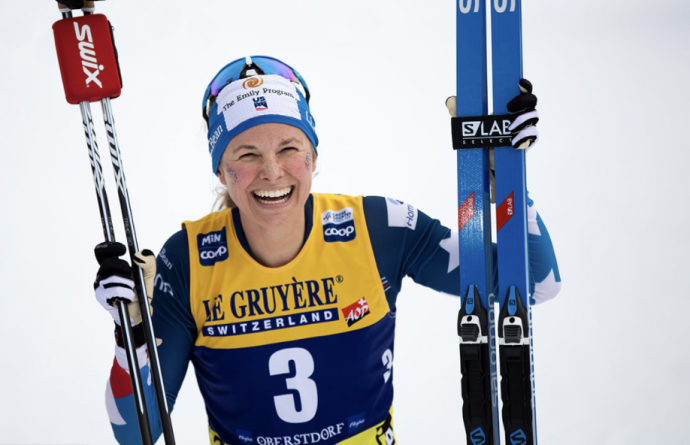
Cross-country editor and XCSkiResorts.com publisher Roger Lohr reports on Jesse Diggins World Cup victory in this year’s XC FIS competition. She’s the first American woman to win a World Cup title in history, and the first American to win gold since Bill Koch’s victory in 1982.  International competition at the World Cup level is intense, and her victory is a huge achievement for the US team and for women in sports.  Click here.

An almost unworldy mood at the start of a run.

Once again, correspondent/videographer Don Burch has produced a wonderful, expressive video in his Ski Art series. Some of these images would be great prints to mount in your den.  Click here.

Our Vicarious Vacation series continues with a run down Beech Mountain, NC, top to bottom.  You’ve seen the Alps and the Rockies in this series. Now, it’s time for a more prosaic example of Southern Skiing at a mecca for skiers in the mid-Atlantic. Click here.

Dawn at Round Vally from the grooming team. Credit: Mountain Trails

Correspondent Pat McCloskey takes us to Round Valley, UT, where he fat bikes around a network of trails maintained by a community foundation.  Pat took a break from his ski-week vacation at Park City to visit the nearby center for all kinds of winter and summer outdoor sports. Round Valley has trails for fat biking, xc, snowshoeing, and winter hiking/running, with enough space for everyone to stretch out. Pat notes the locals and local seniors are fit and take advantage of the snow, 300 days of sunshine, and the beautiful surroundings.  Click here.

Finally, the Skiing Weatherman Herb Stevens reports the pattern that continues to dominate the weather this time of year: The West is wild, the East is winding down, although there might be a chance for another dose of snow in the Northeast this week. This pattern of wild West, wimpy East seems to have hung in over the past several seasons.  Click here.

Thanks for reading SeniorsSkiing.com.  Tell your friends, and, remember, there are more of us every day. and we aren’t going away.


Skiing Weatherman: West Strong, Last Call East

Bluebird Days. Light Snow.

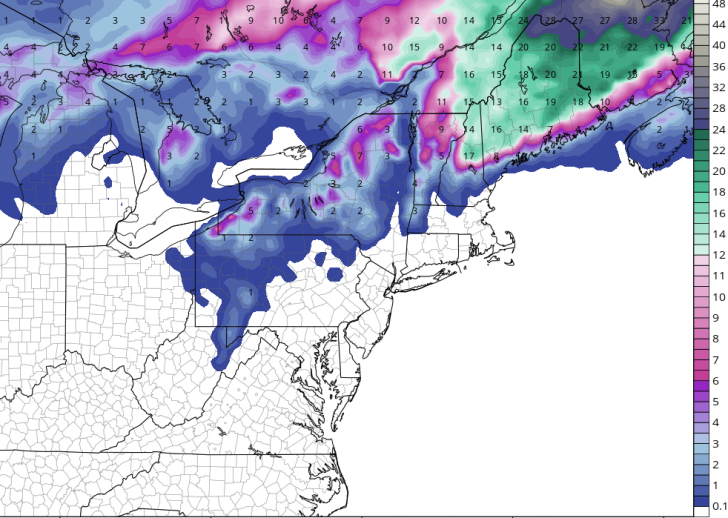
The weather pattern hasn’t changed much in the past week as the jet stream set-up has continued to feature a cold trough over the western half of the country and a milder to warm ridge over the eastern half.  It has been another snowy week in the West, although amounts of fresh snow have been a little less than the prior week.  In the Midwest, Southeast, and Northeast it has been a warm week, and both base snow and trail counts have taken a hit.  Changes in the pattern are underway, however, as low pressure centers that get ejected out of the western trough head northeast and mount an attack on the ridge.  The ridge is formidable though, and it won’t back down without a fight.  It will take three surface storms to knock down the ridge enough to cool the atmosphere sufficiently for snow to fall instead of rain.  That third storm will impact the Northeast later this weekend and into next week and could possible represent the final opportunity for significant snowfall, as the pattern will shift to a warmer regime right after Easter.  Here is a look at a snowfall forecast through Tuesday morning.

You’ll notice that New Hampshire and Maine look like the big winners.  That is because one low pressure center will move through Ontario as it weakens with a secondary low center taking shape over Cape Cod before it moves through the Gulf of Maine, strengthening as it does.  That track will most benefit the White Mountains and the resorts of Maine.  After picking up very little snow in the past three weeks, and with Easter weekend on the horizon, a healthy shot of snow would help sustain quality skiing and riding through the holiday.  Some light snow will accompany the passage of another trough and cold front on Good Friday and that will help refresh the surfaces, as well.

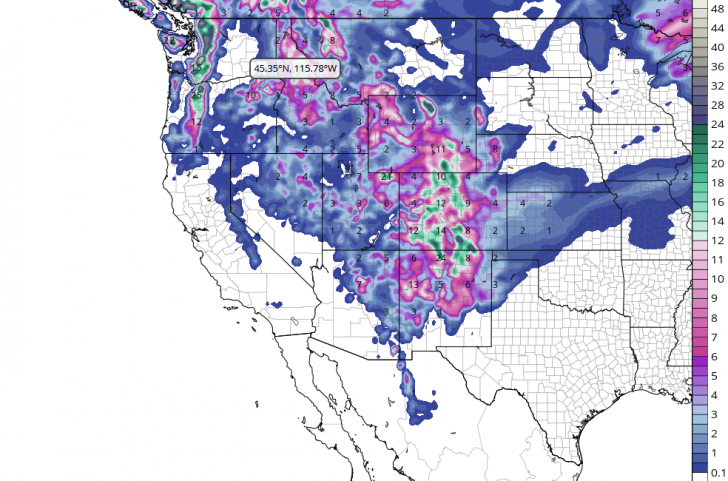
In the West, the persistent trough will produce its final shot of snow late this week (especially in CO and WY) setting the stage for a wonderful weekend with bluebird skies dominating as the trough swings out of the region and into the center of the country.  A new trough will arrive next week, however, bringing early week snow to the Northwest and midweek powder to the full length of the Rockies.  Here is a snowfall forecast through Friday for the West.

The amounts you see are pretty much split between the end of this week and the week of the 29th.

Many of the resorts in the Midwest have closed, but the larger areas are still open.  Some light snow amounts will fall across the northern Great Lakes later this weekend.  In the Southeast, about a half dozen resorts are still operating, thanks to high base elevations and aggressive snowmaking through the season.  That snow can’t hold on much longer against the strength of Old Sol, though.

REGIONAL HIGHLIGHTS:

Pac NW/B.C.:

Beautiful weekend on the slopes.  Light to moderate fresh snow early next week keeps the powder party going.

Central and Southern Sierra:

Great spring skiing this weekend. Back door cold front turns it a little colder next week, but no significant snow in sight.

Rockies:

Sunny weekend on the slopes.  New trough delivers light to moderate snow from MT to NM first half of next week. Light snow next weekend in northern resorts.

Midwest:

Light snow across the far north this weekend.  Mild start/colder finish next week with another round of light snow.

Northeast:

Spring conditions rule after mild, damp week.  Opportunity for meaningful snow late this weekend/early next week in northern NY and northern New England.  Another round of light snow late week.

Mid-Atlantic/Southeast:

Great spring skiing Saturday (3/27).  Colder air mass arrives later Sunday.  Spring skiing continues next week. Call resort before you drive, though.


Corn Snow And Mashed Potatoes: Know The Difference.

One Fun, The Other Not So Much.

Spring brings corn for a few precious hours. Credit: Jans

We’re nearing that time of year in New England and the upper Midwest where the snow melts a little during the day and freezes at night. The repetitive process creates tiny balls of ice. In the morning, they’re rock hard but as the sun comes up, they melt a little and turn into ball bearings lubricated by water. The condition is known as “corn snow.”

The skis carve when rolled on their edges, a platform builds up under the bottom making it easy to unweight, if you are old-fashioned like me, or roll your knees in the direction you want to go.

The day starts with rock-hard, frozen granular until the melting starts. Then for the next three or four hours, the skiing is divine. Depending on the temperature and the slope’s exposure to the sun, by mid-afternoon, the snow becomes sloppy. That’s when it is time to quit and start early again the next day.

Corn snow: Coarse, granular, and wet. Credit: FIS

In the Rockies, the drier snow doesn’t “corn up” as well as it does in the east. Until late in the spring, the conditions are packed powder at the top and soft and mushy as you come down in altitude.

Late spring snows in the Far West and east of the Mississippi are often full of moisture. The snow is heavy. Gloppy is an appropriate term. Way back when, we called the conditions mashed potatoes.

Venture into mashed potatoes, and you’ll find that turning requires effort and strength. Unless you have your weight equally balanced throughout the turn, the heavy wet snow grabs your skis, making turns hard to make.

Lose your balance in mashed potatoes, and you are in what we used to call a “slow, twisting fall.” If you are lucky, you get up, wetter than when you went down and keep skiing.

Mashed potatoes? Go home.

However, if you are a subscriber of SeniorsSkiing.com, danger lurks in the mashed potato fall. Even with modern bindings and shorter skis that reduce the torque on the leg, your bindings may not release immediately. Why? Because the initial torque may be below the threshold needed to free your boot. Then as you “slowly” fall, torque is slowly applied to the leg that might result in a nasty spiral fracture. The break could take weeks, even months to heal.

So how do you ski corn snow? The answer is simple. In the morning when it is hard and rutty, ski the same way one would hard, frozen granular. Then, as the snow softens, ski the same way you’d take on packed powder and enjoy the corn snow ride.

How do you ski mashed potatoes? Avoid the condition. Go home and ski another day!


Question For You: The Best Of The Virus Year?

One Year On, It Is Time For Reflection.

Breckenridge lift line in Dec 2020 when the resort had “significantly reduced capacity.”

This year of sudden shut down when everything about lives has changed has thrown a lot of plans out the window. While many readers have found a way to get out in the snow, others have given this season a bye, and still others have taken up alternative snow sports, like cross-country, snow shoeing, and even fat biking.

Whatever path readers have taken, this entire year has been a significantly different experience, so different that many folks think it is the most distinctive experience of their entire lives, except perhaps war, injury, or spiritual enlightenment.

While we have all grumbled about what has been taken away, we might have also noticed that some changes and adjustments brought about by this virus have been a gift. Perhaps that gift had to do with how we enjoy the outdoors in winter, or what we’ve learned about your local ski area or fellow skiers or your skill level and pursuit of improvement.  Or how you’ve managed to maintain fitness cooped up and socially isolated.

Question For You: On this COVID close down anniversary week, what’s the gift you have been given this year? Were you surprised? Can you keep this gift going into the future?

Please make a comment in Leave A Reply below.

Snow In Literature: Cross Country Snow

By Ernest Hemingway

(This is an excerpt from the short story which appeared in the collection In Our Time (1927). To read the complete story, click here.)

The funicular car bucked once more and then stopped.  It could not go farther, the snow drifted solidly across the track. The gale scouring the exposed surface of the mountain had swept the snow surface into a wind-board crust. Nick, waxing his skis in the baggage car, pushed his boots into the toe irons and shut the clamp tight. He jumped from the car sideways onto the hard wind-board, made a jump turn and crouching and trailing his sticks slipped in a rush down the slope.

On the white below George dipped and rose and dipped out of sight. The rush and sudden swoop as he dropped down a steep undulation in the mountain side plucked Nick’s mind out and lift him only with the wonderful flying, dropping sensation in his body. He rose to a slight up-run and then the down, faster and faster in a rush down the last, long steep slope.  Crouching so he was almost sitting back on his skis, trying to keep the center of gravity low, the snow driving like a sand-storm, he knew the pace was too much. But he held it. He would not let go and spill. Then a patch of soft snow, left in a hollow by the wind, spilled him and he went over and over in a clashing of skis, feeling like a shot rabbit, then stuck, his legs crossed, his skis sticking straight up and his nose and ears jammed with snow.

George stood a little farther down the slope, knocking the snow from his wind jacket with big slaps.

“You took a beauty, Mike,” he called to Nick. “That’s lousy soft snow. It bagged me the same way.”

“What’s it like over the khud?” Nick kicked his skis around as he lay on his back and stood up.

“You’ve got to keep to your left. It’s a good fast drop with a Christy at the bottom on account of a fence.”

“Wait a sec and we’ll take it together.”

“No, you come on and go first. I like to see you take the khuds.”

Nick Adams came up past George, big back and blond head still faintly snowy, then his skis started slipping at the end and he swooped down, hissing in the crystalline powder snow and seeming to float up and drop down as he went up and down the billowing khuds. He held to his left and at the end, as he rushed toward the fence, keeping his knees locked tight together and turning his body like tightening a screw brought his skis sharply around to the right in a smother of snow and slowed into a loss of speed parallel to the hillside and the wire fence.

[Editor Note: On April 5, PBS stations will be airing a new, three part series by Ken Burns and Lynn Novick on Hemingway, who was an enthusiastic skier in Europe in the 20s. SeniorsSkiing.com previously published an excerpt from The Snows of Kilimanjaro, describing skiing in the Voralberg.]  


Top-To-Bottom: Wildcat Polecat

Non-Stop, Two Mile Run on Polecat.

Here’s the next in our Vicarious Vacation series: here’s a nice, calm run on the longest green trail in New Hampshire. Polecat runs from the top of Wildcat to the base, nice wide trails, mostly, taken at a leisurely pace.

That’s Mount Washington on the horizon on the Tuckerman Ravine side. Spectacular bluebird day makes it all a great ride.  The producer is Beyond The Lodge. Enjoy.