


Three Bicycling Lessons Relearned
Reflection On The Past Before Starting This Year’s Biking Season.
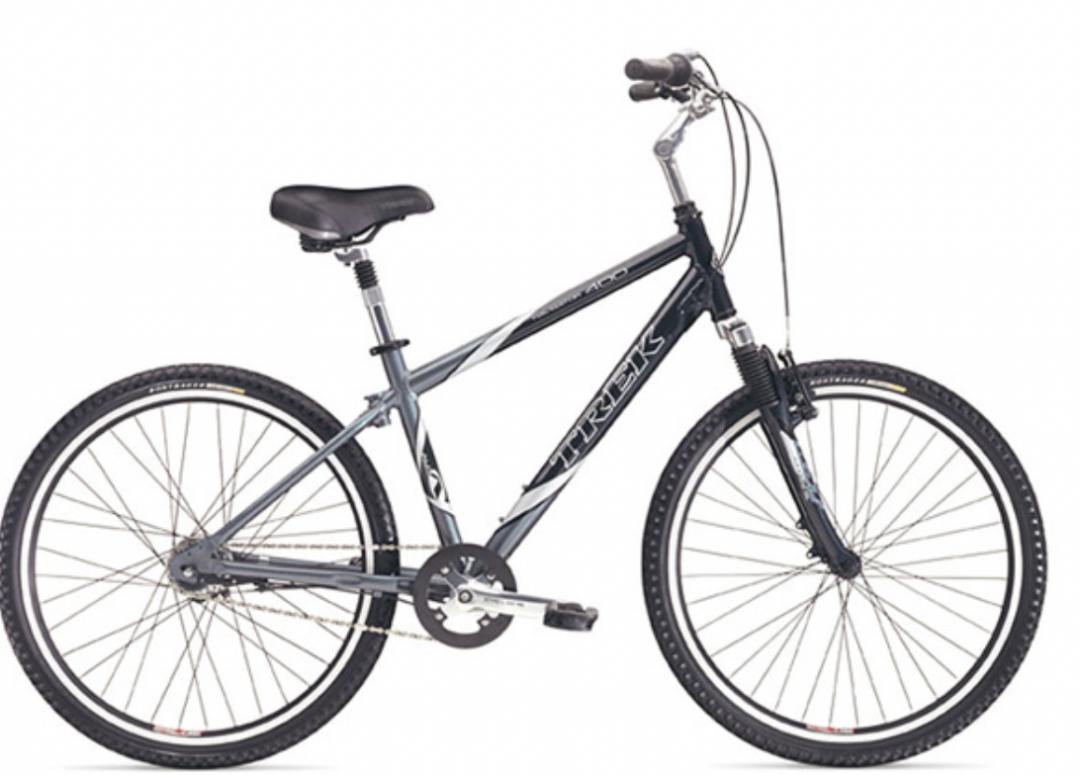
Marc’s Trek Navigator 400 allows a comfortable, upright riding position. A fat seat helps.
With gyms closed to Covid, way back in August 2020, I started riding my bicycle five days a week as a way to get ready for the ski season. I live in North Texas where the terrain is relatively flat. We don’t have hills or mountains, we have rises. I also decided to ride on neighborhood streets because there are crazy people driving while reading and sending texts and emails.
Arbitrarily, my initial goal was to ride 15-20 miles a day, four to five times a week at a steady speed of around 10 miles an hour. My Trek Navigator 400 has three ranges and eight speeds within each range.
My road cycling career began back in the fifties on a Raleigh bike with three speeds which we upgraded to six. Back then, I was a 13-year-old member of an Air Explorer troop in Germany. We-our scout masters, parents and us scouts- decided to take a long-distance bike trip during the summer.
Several conditioning/trial trips later, we took the train from Frankfurt to Calais, the ferry to Dover and another train to London. Four days later, we took the Tube to Watford and headed out to the youth hostel in Stratford-on-Avon. Six weeks later, we were back in London after having visited more castles and churches than I can remember.
There were other bike trips in the following two summers, and, from them, I learned three important facts about biking. One, the youth hostel or inn where we were staying was always upwind at the top of the highest hill in the area.
Two, one can ride farther than one thinks. Back then as an Air Explorer, we tried to do 50-75 miles a day, depending on the terrain. Where it was relatively flat, 75 miles in a day was a no brainer. Hills and rises, well, that’s different
Three, bike seats are uncomfortable.
Fast forward six plus decades and after seven months of biking, the lessons learned have not changed. My house/destination is at the highest point in the neighborhood and on the last mile or two, whatever wind is blowing, it is in my face.
When I started, I could barely ride eight miles. I’d ride remembering some of the tougher legs on those three trips. When this post was sent, weather permitting, 12 miles per day, four to five days a week is the norm. Going father is more about time available than fatigue. At an average of roughly 10.6 mph, 12 miles takes an hour and 10 minutes. Twenty miles would take close to two hours which is more time than I want to spend pedaling since I have other things to do, like write books and magazine articles.
And guess what, even with a wider, padded seat on my bike, after 12 miles, my butt still hurts!

The latest from Marc’s bike app: Map My Ride.

Make More Tracks: XCSkiResorts.com Saw Boost
Increased Interest In Nordic Makes XC Site A Place For Information.

XCSkiResorts.com publisher Roger Lohr and wife Kimberly at Bretton Woods. That’s Mt. Washington in the background.
XCSkiResorts.com was established in 2003 as a major source of information for recreational and travel-oriented cross country skiers and snowshoers and it entered uncharted waters when the pandemic hit. Would anyone want to travel to go cross country skiing?
According to site founder and editor Roger Lohr, “The response was the best year ever for the site in terms of visitation, but what I really enjoyed were the unprecedented number of phone calls to talk about cross country skiing with people.”
They wanted to talk about where to go, equipment to use, and what the different ski areas were like. Lohr commented, “Due to the COVID situation there were astronomical increases in visitation on the site in December as many people were thinking about cross country skiing, and then January and February continued growing. Obviously, getting outdoors on cross country skis was viewed as a good thing to do to stay safe.” He added, “People are looking for information about cross country skiing and there is plenty of content on a variety of topics to be found on XCSkiResorts.com.”

The site focuses on information about where to go and what to do for cross country skiers. Lohr stated, “This is a difficult segment to reach compared to cross country ski racers. I try to create interesting themes to engage these occasional cross country skiers.” There are recommendations for cross country skiing family destinations and food events, tips on getting started, romantic vacations, ski areas that have invested in sustainability, what to wear, and the newest gear. The Top 10 Page, which is the most popular page on the site has more than a dozen different category lists.
Much of the content on XCSkiResorts.com is also posted on other sites such as SeniorsSkiing.com, where Lohr joined Jonathan Wiesel of Nordic Group International to contribute content for the Make More Tracks Resource Guide and article series. XCSkiResorts.com content can also be found on SnoCountry.com, WhitebookSki.com, SunandSkiAdventures.com, BraveSkiMom.com and others as well as the @XCSkiTravel Twitter feed.
The site includes resort pages that are segmented by region featuring about 50 ski areas across the nation including a few state association pages. There are also hundreds of shorter descriptions for ski areas that do not have a separate page. The article content is separated into sections such as resort features, products, personalities, and sustainability, all focused on cross country skiing.
XCSkiResorts.com was initiated in 2003 as a partnership with SkiAmerica. Lohr commented, “I’ve been dedicated to getting more people to go cross country skiing and snowshoeing more often since I got involved in snowsports, and I expect to continue plugging away at it.”

XC resorts like Great Glen Trails in NH offer groomed trails, lodge, instruction. Accessible and affordable.

Add Insult, Avoid Injury
“Your Problem Is, You Don’t Know What You’re Doing”.
Ski Coach Bob Trueman (r) puts emphasis on the mental aspects of skiing.
In modern times this sentence wouldn’t score well on the “how to make friends” scale. And yet it is in reality very informative. You just have to look at the real meanings of the words used, and not the colloquial inference.
In fact, from the view point of performance enhancement it is a critically important observation. Whether that performance is in something physical, like skiing, cerebral, like academic endeavor, or practical, such as business.
The most fundamental tenet of Neuro Linguistic Programming, and other performance enhancement psychologies, is that if you want to change your outcomes you must change your behaviors. “If it isn’t working, do something different”.
The instructional approach to this is either to tell you what you are doing wrong, or just to tell you what to do. It sounds reassuringly practical, but doesn’t work well in practice.
The reason for its limited efficacy is that in order to do something else, it is best to know what you are doing just now. And that is the hard part. And here, dear reader, we come to the import of the insulting first sentence above.
Frustration
More often than not, indeed I’d say pretty well on every occasion, when I first begin coaching someone (in anything at all, not just skiing), they do not have a mechanism to help them to know what they are doing. It is what they are doing, that is creating the outcomes they don’t want. And it is not having current awareness of what that behavior is that is getting them so frustrated and making it so difficult to change.
When I ask a skier after a short section of skiing, “What were you doing as you skied down there?”, it is incredibly common to get the answer , “I don’t know. What do you mean?”
Well, what might I mean?
What are you doing? You must have been doing something, or nothing would have happened. If what happened was what you wanted in all respects, then what you were doing was, for you, at that time, 100 percent appropriate.
If what happened was not what you wanted, then whatever it was you were doing, was not 100 percent appropriate to the achievement of your desired outcome.
The first, and most important job to be done, then, is to find out what it was you really were doing. To do that we’ll need to work together to discover ways that will work for you in letting you become aware of what you are actually doing as you ski.
Six Senses
We’ve got six senses: Smell, Taste, Hearing, Sight, Touch, and Proprioception
The best for skiing are the last three. You could look to see what you’re doing. You could feel for something tangible. And you could feel in a generalized “feely” kind of way.
You could also listen, say, to your skis on the snow. The remaining two require a degree of proximity to the snow which, even were they to work, you might not want to try too often!
Give this some thought. It could help you enormously.
Can you come up with some ways that would suit you for enhancing what is known as your “present moment awareness”? It is this awareness that will enable you to make the changes you are looking for.
Controlled Skiing.
Awareness example:
Here is the kind of thing I’m getting at. You will already know that leaning back in your boots is a tendency to which we are all subject. You will also have discovered through doing this, what James Thurber characterized in his “Fables of Our Time”, when he wrote that “you might as well fall flat on your face, as lean over too far backward.”
You need to be not leaning, or sitting, back. Rather, you need to be forward “in your boots”.
But how to do this? More importantly, how to ensure you are always doing this? There is often so much going on inside your head when you are skiing that you haven’t got the attentional focus required to know if you are or are not
So, we need a simple mechanism to employ that will tell us in real time whether or not we are “forward”, and if so, to what degree. Next time you ski, choose an easy—nay—very easy slope. Set yourself the challenge of skiing pleasantly, down the next 200 meters. No more.
Set yourself the additional goal of being aware of your shins. Your goal is to know, at all times, how much pressure between your shin and the front of your boot, you can feel.
Nothing more! Absolutely no other goal on this 200 meters.
At the end of the 200 meters, it does not matter at all how good bad or indifferent your skiing was. DO NOT GIVE YOURSELF FEEDBACK ON THAT ASPECT.
You must, if you wish to learn how to improve, ONLY review your original goal. Did you feel your shins against your boots? Yes/No? Were you able to do so at all times? Yes/No?
There is NO answer to these questions which will not help you. If you answer your own question with “I don’t know”, you’ve learned something useful. If your answer is “yes, and no”, you’ve learned something useful. If your answer is “yes, and yes”, you’ve learned something useful.
It’s one of the few real win-win scenarios that exists.
Whatever your answer, you can reset your goal, refocus your attention, and learn something extra on the next200 meters.
The key to success with this process is to be very strict in your goal setting. It must be simple, singular, and susceptible to review.
[Editor Note: Check out Bob’s website for more articles and videos on how to ski in control. Click here.]
© Bob Valentine Trueman. All rights reserved.
[authors_page role=contributor]