


Corn Snow And Mashed Potatoes: Know The Difference.
One Fun, The Other Not So Much.
Spring brings corn for a few precious hours. Credit: Jans
We’re nearing that time of year in New England and the upper Midwest where the snow melts a little during the day and freezes at night. The repetitive process creates tiny balls of ice. In the morning, they’re rock hard but as the sun comes up, they melt a little and turn into ball bearings lubricated by water. The condition is known as “corn snow.”
The skis carve when rolled on their edges, a platform builds up under the bottom making it easy to unweight, if you are old-fashioned like me, or roll your knees in the direction you want to go.
The day starts with rock-hard, frozen granular until the melting starts. Then for the next three or four hours, the skiing is divine. Depending on the temperature and the slope’s exposure to the sun, by mid-afternoon, the snow becomes sloppy. That’s when it is time to quit and start early again the next day.

Corn snow: Coarse, granular, and wet. Credit: FIS
In the Rockies, the drier snow doesn’t “corn up” as well as it does in the east. Until late in the spring, the conditions are packed powder at the top and soft and mushy as you come down in altitude.
Late spring snows in the Far West and east of the Mississippi are often full of moisture. The snow is heavy. Gloppy is an appropriate term. Way back when, we called the conditions mashed potatoes.
Venture into mashed potatoes, and you’ll find that turning requires effort and strength. Unless you have your weight equally balanced throughout the turn, the heavy wet snow grabs your skis, making turns hard to make.
Lose your balance in mashed potatoes, and you are in what we used to call a “slow, twisting fall.” If you are lucky, you get up, wetter than when you went down and keep skiing.

Mashed potatoes? Go home.
However, if you are a subscriber of SeniorsSkiing.com, danger lurks in the mashed potato fall. Even with modern bindings and shorter skis that reduce the torque on the leg, your bindings may not release immediately. Why? Because the initial torque may be below the threshold needed to free your boot. Then as you “slowly” fall, torque is slowly applied to the leg that might result in a nasty spiral fracture. The break could take weeks, even months to heal.
So how do you ski corn snow? The answer is simple. In the morning when it is hard and rutty, ski the same way one would hard, frozen granular. Then, as the snow softens, ski the same way you’d take on packed powder and enjoy the corn snow ride.
How do you ski mashed potatoes? Avoid the condition. Go home and ski another day!
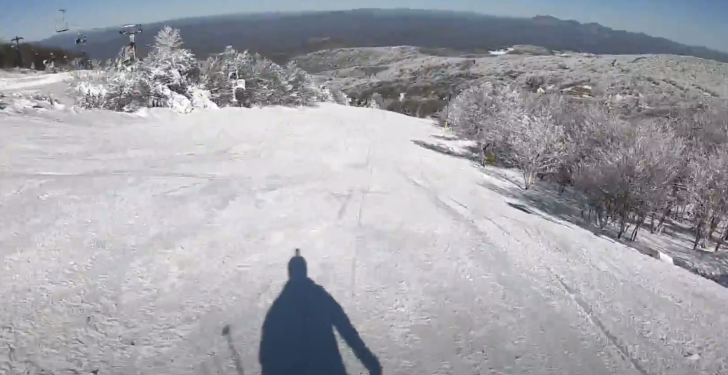
Top To Bottom: Beech Mountain
North Carolina Has The Highest Ski Resort In Eastern North America. Have You Been?
Beech Mountain has 17 slopes and 8 lifts. The longest run is one mile. It might be short but it is indeed sweet.
The next stop in our Vicarious Vacation series is a hop down to North Carolina’s Beech Mountain. Located in the western mountains of the state, Beech Mountain has a summit elevation of 5,506 feet, making it the highest ski resort on the East Coast. The mountain is a mecca for mid-Atlantic skiers.
Here’s a run from top to bottom. We found the sound track a bit irritating, so we muted our sound while we watched. We love cruising blues, and this run does it. Easy-peasy. See what southern skiing is like. No, it’s not the Rockies or the Alps, but it is fun for all. It’s from pre-COVID times, so no masks, etc.
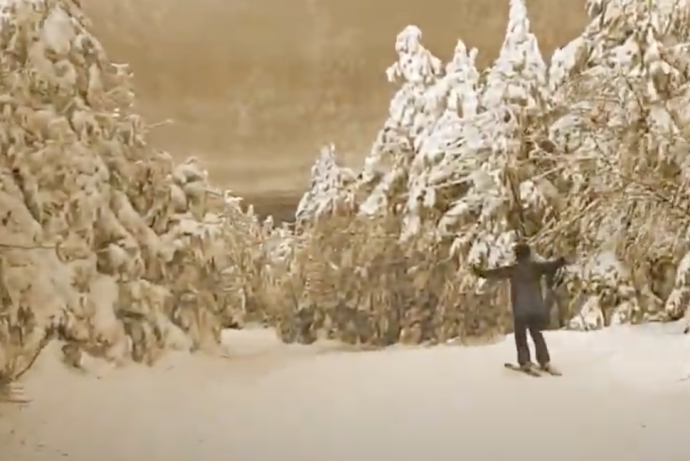
Ski Art III
Don Burch Offers Another Intriguing View Of The World Of Skis And Snow.
An almost unworldly mood at the start of a run.
Don’s been experimenting with various techniques to take ski videos into an aesthetic direction. His third offering combines a haunting melody and moody visuals. Music is Gravitated by Edgar Hopp. Click on the image below to watch the video.
[authors_page role=contributor]