


Marg’s Morzine Mishap
Poor Marg. She Becomes A Poster Person For Travel Insurance.
[Please consider supporting SeniorsSkiing.com with a donation. We appreciate your help. Click here.]
When I think back over the last two decades, our group of skiing fanatics have been largely injury free. We are a large group of friends comprised of both Australian and British skiers. But there was Morzine.
The Apartment is in the heart of Morzine.
Today our first day skiing, we vacate our Appartment Telepherique in Morzine, France. Our accommodation here in 2013 is a luxury condo with huge post card views over snow covered mountains. Our group of six skiers alight from the Telepherique Tramway. The day is a glorious blue with wisps of low thin cloud dispersed amongst the pines. As the sun rises this mist burns away as we exit the Tramway. The snow is firm pack with a centimetre or two of fresh on top.
Suddenly our day goes pear shaped within 100 metres of the tramway on a gentle slope.
Yes, there was an accident and when I say words like hip and femur, it sounds like it could be serious. It is. Our skiing friend Marg in fact has had a slight altercation with some hard packed powder. Not more than a couple of minutes from the door of the Tramway exit. She has rearranged the bones in her upper leg or hip or thereabouts. And this on her very first day skiing of our trip here in Morzine, Avoriaz, Portes du Soleil, France. In fact, her very first run right off the Tramway.

Marg is transferred to helo. First run of 30-day ski vacation in the Alps. Credit: Dave Chambers
We have hired a rental car and are now underway to a hospital on the shore of Lake Geneva (which in fact is called Lake Leman) in a town called Thonon. We have decided that our very good skiing friend Marg,who has been at the mercy of the staff for a couple of days now at Hopitaux Du Lemans, Thonon Les Bains, France, needs some cheer and mirth in the hopitaux as they call it.
No more skiing for the entire trip for poor Marg. An otherwise for us, normal ski trip, covering three countries, France, Italy, and Switzerland. Skiing for a touch over 30 days at Morzine, Les Gets, Avoriaz, Champery, Courmayer, Monte Bianco, Valle Blanche, La Thuile, La Rosiere, Champoluc, Alagna, Gressoney La Trinite, Frachey and Gressoney Saint Jean. Skiing all without Marg.
Insurance is expensive when traveling, that’s for sure. But one day that policy and your insurance representative will be among your best friends. Poor Marg required attention by five ski rescue persons and a helicopter, no less. Experts all, they very carefully bundled her up, administered some drugs and whisked her away to said hospital. Never has a girl had so much male attention. She later reflected on enjoying this and some of the best drugs for her rehabilitation.
We joke about this in her private room and generally try to cheer her up. Also there is considerable discussion as to the right angle or such of the pins and what pins are where and, well a girl can never have too much jewelry, but in this case it is medical grade stainless steel. “It’s just such a shame you can’t show it off and jiggle it around,” says Marg.
The result of all this activity, unfortunately, has demanded her complete repatriation back to Oz and her vigorous removal from Morzine by that new best friend: the Insurance Company!
But seriously we are sad to see her go, and a large portion of our day is now vacant without Marg. She is now a guest of said insurance company and a very exclusive guest she is. Having an invoice that now includes a lift by helicopter and a First Class flight all the way back to Australia for her and her new best friend, her nurse. Sometimes insurance companies are your friend indeed.

The Personal Ski
Does The World Need A Custom Ski Just For You?
[Please consider supporting SeniorsSkiing.com with a donation. We appreciate your help. Click here.]
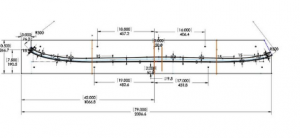
You can buy a computer built just for you. How about a ski?
Way back in the winter of 2018, long before Covid raised its ugly head, I asked the heads of marketing (none of whom would qualify for a SeniorsSkiing/com subscription) from three manufacturers a simple question: “Has ski material science and engineering reached the point where—with a simple, easy-to-measure parameters, and algorithms— a ski manufacturer can produce a ski tailored to the way an individual, recreational skier skis?”
The answer was yes, they have been making custom skis for World Cup and Olympic Ski racers for decades. But what about us common folks?
Again, the answer was yes. Physical dimensions of the skier and other limits such as artificial joints could be entered by the buyer.

All it takes is translating measurement to manufacturing.
The hardest part would be translating how a skier skis into data that can be used by a computer to then control the manufacturing process. For elite racers, they have zillions of gigabytes of footage “experts” can analyze coupled with on-snow testing.
Unlike ski racers where the variations in their technique are subtle, recreational skiers are all over the map. If you don’t believe me, watch a well-traveled slope. Even the “untrained” eye can see the differences in technique, some good, some, well, not-so-good bordering on awful, or where they are in learning to ski.
All three ski designers hypothesized that with two to three minutes of video of a skier on a a ski whose design parameters were known skiing down a known piece of terrain with measured condition, a custom ski could be done. The individuals all agreed that this approach would eliminate many variables.
From there, they could have internal experts go through their analysis, come up with whatever inputs a computer model needs, and, voilá, out would come the engineering/design specs for the ski.
Cost of manufacture is another story. Credit: Volkl
Now we get to the second issue: Producing the ski. Ski manufacturers make huge investments in equipment that can be used to turn out thousands of skis so they can amortize the investment over each ski produced. In this “personal ski” scenario, the molds and materials can still be used. Workers would have to be re-trained. How and why happens is beyond the scope of this piece, so just accept the fact that custom construction is possible.
Which brings us to cost. The custom ski would cost more than the $1,000 for a top-of-the-line ski. How much more, my informal panel wouldn’t or couldn’t agree on a number, but again, for the sake of dreaming, let’s say $3,000. Whether or not the ski was salable at that price is a different subject, again beyond the scope of this post.
So the obstacle was not cost, nor engineering, nor manufacturing, but identifying and then gathering the needed data that could be translated into ones and zeros. In the end, they all said, “Why bother?” The current designs meet the needs of 80—90 percent of recreational skiers. And therein lies the rub and why, at least not yet, everyone can’t have a custom designed ski.
Make More Tracks: XC Ski Injuries And How To Avoid Them
Either Falls Or Pre-Existing Conditions Can Cause Problems.
[Please consider supporting SeniorsSkiing.com with a donation. We appreciate your help. Click here.]
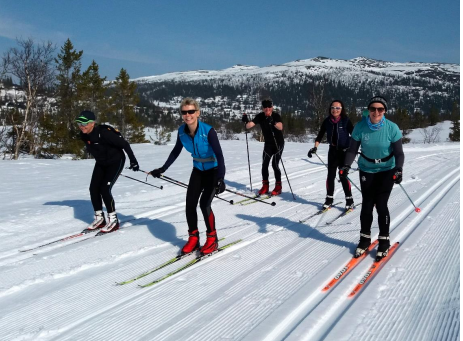
Injuries are rare in XC, and conditioning is the best medicine. Credit: SnowSportEngland
Cross country (XC) skiing is a sport with a very low incidence of injuries for a number of reasons.
It’s a low impact sport with low sliding speed, plus the free heel allows twisting if you fall. The ski boot is connected to the ski binding only at the toe, and the heel is free.
On the other hand, there may be some injuries during the ski season by falls or by aggravating pre-existing conditions. Like the Maytag repairman, ski patrollers at XC ski areas are not the busiest employees because they do not have to address many serious skier injuries.
According to Sophia Sauter, a registered physiotherapist, about 75 percent of injuries sustained by XC skiers are the result of overuse due to the repetitive nature of skiing, while the remaining 25 percent are the result of trauma. Here are some common injuries and appropriate treatment.

Traumatic XC ski injuries (25 percent), for example, include ankle sprains, thumb sprains, knee ligament sprains, groin muscle strains, and wrist sprains. Upper body injuries are often the result of falling down. Since XC skiing speeds tend to be somewhat slow, the impacts are often less severe than impacts at much higher speeds. The recommended treatment for the traumatic injuries is RICE: Rest, Ice, Compression, Elevation. Then, slowly restore range of motion, strength, proprioception (such as the ability to drive using brake, accelerator, and steering wheel without looking at your arms and legs), and power. It’s suggested to see a physiotherapist to obtain a proper diagnosis and set of rehabilitative exercises.
Overuse injuries (75 percent) from XC skiing, could include knee pain, compartment syndrome on shins, Achilles tendon problems, rotator cuff and shoulder problems, and low back pain. The recommended treatment for these problems is a bit different. In these cases it’s important to correct muscle imbalance (e.g. tight/weak), equipment faults, and possible training errors. Seek medical advice from a physiotherapist or other qualified health professional specializing in injuries common to XC skiers.
Most people skip the warm up or preparing for recreational activity altogether, but the best way to avoid injury is prevention. This means using appropriate training progressions, maintaining physical strength, balance, flexibility, adopting appropriate recovery techniques, and treating any lingering individual alignment problems, weaknesses, and imbalances. It makes sense to warm up before hitting the trails.
Physiotherapist Sophia Sauter suggests a full body analysis with a professional to identify individual mechanical inadequacies. Also consider a specific core stability and functional strength program for athletes. Popular core-strengthening strategies might include yoga, Pilates, and a regular fitness regimen.
Think about getting in shape staying, warming up, and dealing with your injuries before going out on the trails and you can continue to have a great season.

Warm ups can help prevent strains and sprains. Credit: CONCR
[authors_page role=contributor]