


Short Swings!
Every now and then, we give readers a status report on the state of the older skier and the status of SeniorsSkiing.com.
It’s fair to say that we’re all doing well. The magazine started in the Fall of 2013 with exactly “0” subscribers. Today there are 17,000 of you, and the number is growing.
We know from industry trade association statistics that in the US, 20% of all skiers and boarders are 52 and older. We also know that the number of skiers/boarders in this country has fluctuated between 8.3 million and 10.2 million for 25 years. The market is not expanding.
Our annual reader surveys tell us a lot about the older segment of that market. Almost 3500 readers – more than 21% of the subscriber base — responded to our last survey.
Your average age is just shy of 70. When we started, it was closer to 67. Two-thirds of you are male. When we started, the split was 60/40 (m/f).
A few seasons back, you skied about 15.5 days per season, compared to the national average of 6 days per season. Last season, short as it was, you skied, on average, almost 33 days!
Contrary to the perceptions of some in the industry, you are a significant economic force. When asked how much you spent on all aspects of skiing during the past season for yourselves and others, 51% reported up to $2500; 29% spent between $2500 and $5000, and 20% spent more than $5000. We expect that while there are larger numbers of younger skiers, the amount they spend in a season as individuals is considerably less. Two-thirds of you have told us that you’re financially independent.
Publishing SeniorsSkiing.com every week takes a lot of effort. No one – writers or publishers – gets paid. Ad sales and reader contributions cover costs, and the more we grow, the higher those costs. Our annual fund-raiser is conducted in February.
Sometimes we slip behind. Last season’s Trail Masters list is overdue, as is the annual report of North American ski areas where seniors ski free or at deep discount. It’s a lot for two older guys working with some younger people for technology, graphics and other specialized needs.
It would be nice to wave a wand and attract ads from companies selling pain relievers, financial services, and health plans. We’ve tried, but our audience isn’t big enough for their needs. It also would be great if ski makers and/or ski pass companies chose to advertise. When approached, they show minimal interest.
Is it because we’re focused on the older end of the market? Do they figure that SeniorsSkiing.com readers will buy skis and passes regardless of whether or not they advertise? Perhaps.
Skiing is a youth-oriented sport in a youth-oriented culture. When is the last time you saw an age-contemporary featured in an advertisement for skis or a ski destination? In an editorial feature in one of the few remaining ski magazines? In a recently released ski video?
SeniorsSkiing.com exists to show the world of non-mechanized snowsports through the eyes of the older skier. If you like what we’re doing, forward an issue to other older skiing friends.
Snow in the West

Source: Alta
Winter arrived at the Western ski resorts this week. Snowbird, in Utah‘s Little Cottonwood Canyon, got 29″. Alta, next-door, reported 30″. Wolf Creek in the Southwest corner of Colorado reports a 50’base, 7 out of 10 lifts open and 127 out of 133 open rails. Another pulse is expected over the coming weeks.
Vermont Covid Policy Places Season in Jeopardy
This week, the State of Vermont, suspended its policy allowing travelers from the Northeast to visit the Green Mountain State without quarantining. If Covid rates drop, the policy will probably allow more visitors in the state without requiring quarantine.
Utah: Too Little, Too Late
The Governor of Utah finally issued a statewide mask mandate. Cases there have been skyrocketing and wide portions of the population are defying suggested precautions. Among other reports from The Salt Lake Tribune, people in Utah County (south of Salt Lake County) have hosted large-scale, maskless dance parties. Mothers in the county are reported to be applying icepacks to children’s foreheads to help them pass school temperature checks, and coaches have been encouraging team members to conceal if they’re feeling flu symptoms. Prior to the new mandate, the governor’s mantra was that citizens of Utah “will do the right thing.“
Mask = Specs = Foggy Lenses

Using 3M Nexcare paper tape (available in most drugstores), tape the gap between top of mask and your face. It should eliminate fogging by preventing warm breath from reaching the glasses.
Joe Biden Skis
There are numerous Internet references to sightings of Joe on the hills of Aspen and Vail but no pictures of the President-elect on boards. If anyone has one, please email to jon@seniorsskiing.com, and we’ll publish with credit.
Tricks on Skis: 1937 Newsreel
This 1937 Pathe newsreel isn’t graceful but it’s worth watching.
Snowball Fight 1896
https://youtu.be/-rAMRBWy2to
This early film of a snowball fight was shot in 1897 in Lyons, France. Less than a minute long. Keep watching to see the modern, colorized version. It’s pure joy!
$1 Buys 1 Month of Classified Advertising
We’ve extended the offer to December 4. Purchase one month of classified ads for $1. Click on Classifieds on the dark blue bar at the top of the Home Page to place ad or see what’s being offered.
Nordic to be Featured in Next Week’s Edition
As part of our commitment to Nordic activities, next week’s edition will be dedicated to all things Nordic. Numerous Covid-related obstacles are interfering with the coming Alpine season. We expect many of you to shift at least part of your skiing attention to cross-country, skate-skiing, snowshoeing, etc. If you have not already done so, please visit our new Make More Tracks Nordic Resource Guide. And enjoy our weekly Nordic features.
Marketing A Rental Unit In Your Ski House: Part 2
Attracting Renters Using Online Booking Tools.
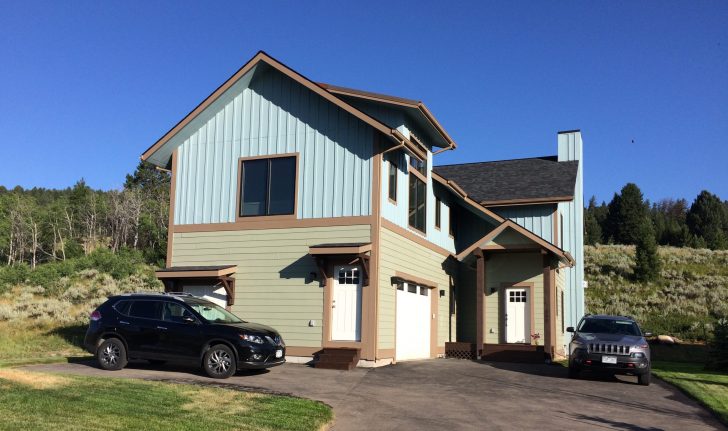
Steve’s rental unit is full most of the year. Here’s a summer view of the property. Credit: Steve Bell.
So, once you purchase the right house, how do you rent out the guest unit? You could rent on a long-term basis, but we found that to be a problem. A long-term lease gives the tenant a lot of time to mistreat the apartment. In the past, we rented to a long-term tenant. She was sweet, but she was busy. Over time she neglected cleaning, so she left us with a lot of work at the end of the lease. As a landlord, you can write security agreements into a lease, as well as periodic inspections, but these too can be problematic. In any case, we have found that short-term renting is much better. During short stays, even guests with less-than-ideal neatness (we have only hosted a very few of these) do not have enough time to create much extra work.
For advertising purposes, we started by listing on airbnb.com and vrbo.com, both of which get tremendous traffic. We rented our apartment most nights. If, for some reason, demand starts to fall, we can explore other sites and other advertising media beyond website listing. We created an entry on airbnb and vrbo without any professional help. The sites include cell phone photos that we took ourselves. To see our apartment, simply type “airbnb 36134350“ or “vrbo 1695325 “ into your browser. (Each website assigns its own unique identifying number to every listing. The preceding numbers are ours.)
Since December 2019 through the end of September 2020, except for a stretch when we stopped accepting guests due to COVID, we rented out our attached apartment for the majority of nights. We have been amazed by the demand, and especially delighted by the strong interest of summer visitors. We don’t spend that much time managing reservations, because the websites nicely facilitate the rental process. They provide a simple channel of internet communication, descriptions of the property and community, delivery of owner established rules, reservation management with calendars, seamless payment processing, renters’ reviews of their stay, and many other services. As an added bonus, we can invite friends and family to the apartment when we want to as it is simple to black out the calendars on airbnb and vrbo.
Supply The Basics
The apartment must be fully equipped with towels, bath mats, down-filled comforters, duvets for the comforters, fluffy pillows, hotel style soaps and shampoos, first aid kit, fire extinguishers, smoke alarms, etc. And for the kitchen: silverware, plates, bowls, napkins, wine bottle openers, cutting boards, pasta strainer, coffee grinder, coffee maker, etc. All-in-all, a lot of stuff to promote a blissful stay (buying on amazon.com saves us trips to Bozeman). Guests want to save money by preparing many of their own meals rather than paying hotel room service or resort restaurant prices. There is a good grocery store, nearby.
As mentioned above, the apartment has a separate entrance. Check-in and check-out are self-service. We leave the door unlocked before guest arrival, and airbnb or vrbo has already collected all monies before the departure day. The combined effect is that we often never see the guests. It’s not that we don’t love them, but due to COVID risk, separation is best for everyone. Guests are appreciative of this, too. Many resort visitors prefer an alternative to the common spaces of hotels, elevator buttons, shared door handles, and other opportunities to get sick. All communication is over the internet by email, cell phone conversations, or texting.
Before COVID was a concern, we would often invite guests for a drink to chitchat around our fireplace. Guests come from all over the U.S. and the world. They share fascinating experience and knowledge. The company enriched our lives and we looked forward to it. When the COVID pestilence is a fading thought, we expect to accept invitations to visit our new friends. And very soon, we hope to be able to resume hosting friendly fireside visits.
One final note about your rental unit: clean really, really well. We try to make everything squeaky clean or better. We have been thanked for this by our guests, who frequently indicate that cleanliness is very important to them. We are hoping that they will remember and return many times.
Editor Note: In Part 3 of this series, Steve will describe tips on operating a rental. If you have questions, just leave a comment below.
Make More Tracks: Craters Of Moon
Ocean Of Volcanic Lava Offers Awesome XC/Snowshoe Experience.
“[It is an] area of about 60 miles in diameter, where nothing meets the eye but a desolate and awful waste, where no grass grows nor water runs, and where nothing is to be seen but lava.” (Washington Irving, The Adventures of Captain Bonneville, 1868 )
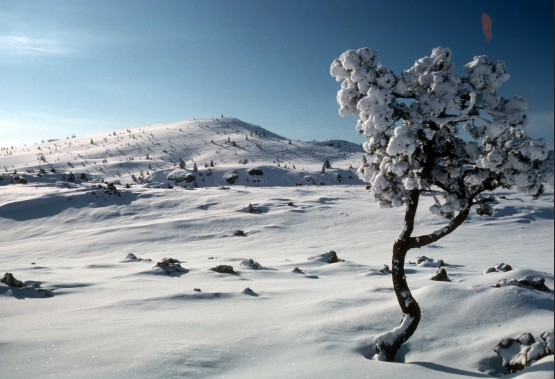
The North Crater shows the jagged lava outcrops. Credit: NPS
Some things leave a lasting impression. I flunked geology my freshman year of college—just couldn’t figure out technical things like how to measure a geosyncline or why it matters—and consequently rejected the whole science for years. And then I found that in the right context, absorbing geology can be amazing fun. Aside from Yellowstone National Park, the place that’s had the most volcanic effect on my geologic viewpoint is Craters of the Moon National Monument and Preserve in south-central Idaho.
I used to pass the entrance a couple of times a year, driving between Jackson Hole and Sun Valley, at 5,900 feet in the middle of high-desert seeming-nothingness. Hummocks, ridges, cones, lava and cinders don’t create an inviting landscape; in fact, formations are so moon-like that the Apollo astronauts studied geology there prior to their lunar landing.
Craters isn’t exactly a winter destination. There’s not a whole lot of temptation to stop because there’s not much sign of human activity; there’s no on-site lodging; the nearest restaurants, motels, and gas stations are some miles away.
Beautiful snowshoeing and XC skiing on a volcano. Credit: NPS
Man doesn’t seem to have had much impact on the Craters locale. Oh, there’s more air pollution drifting through than a few decades ago, so you’re not as likely to see the high mountain ranges along the Snake River Plain; and larger animals like grizzlies and big-horn sheep disappeared a century ago—but overall, there’s not a lot of visible change.
The region began erupting around 15,000 years ago and stopped around 2,000 years ago. There’s a school of thought that another eruption is due in the next few centuries; but it’s expected to again be flowing lava rather than an explosion like Mount St. Helens in 1980.
There are no streams and few water holes, but the ecosystem is home to 2,000 species of insect, almost 200 bird species, 59 species of mammals, plus reptiles, amphibians, and a remarkably diverse plant population. Of course, you don’t see a whole lot of any of them in winter – primarily shrubs and limber pine.
It’s a unique land of tremendous extremes that an early visitor called “the strangest 75 square miles on the North American continent.” My first visit was in mid-summer with a geologist-friend who was ecstatic to see both aa lava (a Hawaiian name that’s spelled at least three different ways, meaning a jagged surface best avoided) and pahoehoe lava (smooth and ropey-looking). The heat was stifling – air temperatures may only reach the 90s in July, but surface temperature on that black rock can reach 170 degrees Fahrenheit. That’s more than hot enough to fry an egg – if you can find a flat surface.
I remember the physical shock of following a trail into a lava tube that’s perpetually chilly. We lost perhaps a dozen feet in elevation, started to shiver, and came across ice.

Snow covered spatter cone arises from the landscape. This is a place for other-worldy exploration. Credit: NPS
Winter Landscape: Milk And Vanilla Ice Cream.
Snow can bring a gentler face to Craters, or as one guide told me, a “Sahara arctic flavor.” He added, “It’s an entirely different experience from what you can have in any other area because of the brilliant white snow and the black basalt rock. It kind of looks like cookies and cream ice cream out there.”

Explore the snow-covered lava on snowshoes with a guide. Credit: NPS
Winter conditions can see -30 degrees Fahrenheit at night, with the wind rising to 30 miles per hour and not much tree-cover. It’s a great time to have the right clothing and good judgment on how far to venture from your car. There’s usually about a four-month season for skiing and snowshoeing.
The Park Service grooms up to seven miles of two-way trail along a summertime scenic loop drive. When I visited it was double-tracked, with a skate lane shared by snowshoers plus a separate snowshoe trail. There’s no fee, no dogs, no bikes, no snowmobiles. It’s easier to ski clockwise if you’re a beginner in order to avoid a downhill on the southwest edge of Inferno Cone.
In some ways, snowshoeing around the Monument is more fun than skiing because you get more flotation so can do more off-track exploring. But if you enjoy downhills, it’s a blast to make some turns on the open-sloped cinder cones, which can give you 400-500 feet of vertical drop.
You can climb to the summit of Mt. Paisley for grand views before heading back to the Visitor Center. As a guide once noted to me, “How many places can people say, ‘Ya know, I went out Saturday and snowshoed to the top of a volcano?’”

At 6,000 feet, snow dominates the landscape from November to April. Credit: NPS
[authors_page role=contributor]