


Keeping Tight: Maintain Muscle Mass As You Age
Four strategies make fitness simple
When it comes to fitness, the old saw about “use it or lose it” is not only true, for certain age groups, it is a challenge of sorts. Why? Because, according to Dr. Frank Lipman, founder of the Eleven Eleven Wellness Center, New York, muscle decline starts at age 40 and actually accelerates every decade you grow older. By the mid-70s, there is potential for losing half your muscle mass, he says. That is, if you are sedentary and inactive.
On the other hand, if you are reading this, chances are you are an active and engaged sportsperson and have been for a good chunk of your life. Nevertheless, if you want to maintain your muscle fitness as you age and slow muscle-mass loss, there are some important strategies Dr. Lipman recommends. You may be doing some of these things already; if you aren’t, consider how you might adopt some new practices.
1. Press and pant. Dr. Lipman says exercise is the prime strategy. Resistance training and aerobics are the cornerstone exercises
Light weights are good for bone density and muscle mass preservation.
Credit: SeniorsSkiing.com
to pursue. Our personal preference is year-round group exercise classes at a good gym, fitness club or YMCA. Regularly scheduled group classes give you a specific time to show up, and keep you motivated. You can also learn a lot about muscles and the impact of exercise from an excellent class instructor. Skilled instructors will vary their workouts, and when you take a couple of classes a week, you get into a habit. And then there’s the camaraderie of working with a group of like-minded, supportive classmates from week to week. Of course, your personal doctor can give you advice about what kind of exercise is best for you.
2. Ramp up protein. Forget the low-fat diet. Raising your protein consumption is the best weapon in slowing muscle deterioration, according to Dr. Lipman.
“Take your body weight, divide it in half, subtract 10. The resulting number will give you the approximate amount of protein you should be eating every day. So, for example, if you weigh 160 lbs, then half of that is 80, minus 10 = 70 grams of protein spread over the course a day’s worth of meals…If you have renal issues, you should work with your doctor to determine an appropriate daily protein intake for your specific needs.”
3. Make it high-quality protein. Dr. Lipman advocates grass-fed beef or organic chicken. Also organic white beans, black beans,

High-quality protein comes from grass-fed cows.
Credit: Mike Maginn
chickpeas, lentils and leafy greens. He also suggests adding Whey Protein from grass-fed cows.
4. Add the right supplements. According to Dr. Lipman,
“the supplements that have shown promise in preserving and supporting muscle mass, topping the list are Omega-3 f
atty acids; Vitamin D; L carnitine; Glutamine and B12/folic acid.”
What are you doing to remain fit? Are you on a high protein diet? How’s that working for you?
This article was adapted from www.drfranklipman.com. Check with your doctor before starting any fitness or diet program.
This Week In SeniorsSkiing.com (10/2)
And So Begins The 2020-21 SeniorsSkiing.com Publishing Season.
Fasten your face masks firmly in place; this winter is going to be like no other.

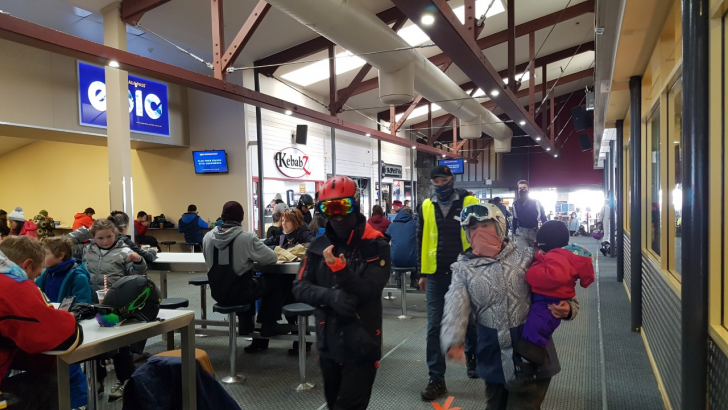
Masks were everywhere in the Perisher lodge. Credit: John Harris
The entire snow sports industry has spent the summer planning how to open up when the snow flies. Uncertainty about the future makes people anxious, however, the semblance of a cohesive, cogent plan with precautions goes a long way to calming customer nerves. The industry has done a terrific job trying to figure out how to manage this unprecedented public health threat. Changes in business as usual are keys to managing the “Covid Season.”
We’ve created some changes, too, that might help you as this strange winter starts to evolve.
Classifieds Are Coming!
 For one thing, we’re going to launch our brand new Classified Ad section next week. Starting 10/16, you will be able to place a classified ad on SeniorsSkiing.com. We’ve developed a number of categories where you can offer everything from gear or collectibles to ride shares and meet-to-ski to condo rentals. As a introductory promotion, you’ll be able to post an ad for 30 days in any category for $1. Regular rates will be quite reasonable and based on how long you want your ad to be accessible to our readers. As with all dealings online, readers are encouraged to use caution and common sense in contacting others through this service.
Alternatives to Alpine: Make More Tracks
Over the summer, we’ve been watching industry news releases and have scrutinized some of the plans for re-opening ski resorts. All of these plans are thoughtful and respectful of both the virus and customers. All contain a degree of restrictions on customer behavior which may or may not wear well as the season goes on. In fact, the Cross-Country Ski Area Association has extrapolated that the rise in walking and bike riding this spring and summer might correlate with increased interest in Nordic skiing, snowshoeing and other ways to get outside in the winter and “make more tracks”.

As a result, SeniorsSkiing.com is introducing a new section, “Make More Tracks”, initially devoted to articles about XC skiing, snowshoeing, fat biking, and other snow activities.
Nordic or XC skiing and snowshoeing are ideal for the Covid Season. Outdoors, of course, socially distanced, reasonably priced, uncrowded, the sports lends themselves as a perfect alternative to Alpine skiing. Snowshoeing, by the way, is also ideal for seniors who have given up skiing due to health, fitness ,or lack of interest reasons.
If you haven’t tried XC skiing as a senior skier, you are missing a completely different way to enjoy winter outdoors. If you’ve been away from the sport for a while, you have a plethora of new types of equipment and gear to learn about. And, if you haven’t noticed, there are many XC-oriented resorts that have grown in the past decade that offer unique winter vacation experiences.
Our Make More Tracks initiative includes a Resource Guide with tips and advice from Roger Lohr, editor of XCSkiResort.com, and Jonathan Wiesel, international XC trip planner and guide, trail designer, and resort owner, both experts in all aspects of XC skiing. We will include at least one Make More Tracks article per weekly issue of SeniorsSkiing.com and devote an entire issue in November to these sports.
This Week
 We’re publishing our new boot recommendations for seniors, developed in cooperation with America’s Best Bootfitters (ABB) and the 2021 Masterfit Buyer’s Guide. This is an industry exclusive, Subscriber-Only offering that can be accessed after confirming your name and email address. Click on the third box in the top menu to get to the story. Boot recommendations are graded by traditional or walking, including specific boots for men and women.
The ski season has just concluded Down Under. We can learn a lot from the experience of Australian skiers and how resorts managed the virus. John Harris, our new correspondent in Australia reports on the recent season, noting what worked and what didn’t. Despite a dearth of snow, the season went on, and “car parks were full.” Click here for the story.
One aspect of the Covid Season that hasn’t been discussed is what happens to shared ski houses. The problems of distancing, scheduling, cleaning and the like are important consideration. Correspondent Alice Winthrop discusses these issues and proposes some approaches. Alice is the designer of Resercal, a new app for scheduling and managing shared vacation properties. Ski clubs, this is for you. Click here for her story.

Crested Butte Nordic has rentals for $20 a day. Credit: CB Nordic
XCSkiResorts.com publisher and SeniorsSkiing.com Nordic editor Roger Lohr discusses the impact of the Covid Season on Nordic skiing. This is the first of an ongoing series of Make More Tracks articles.
As a regular early-season feature, we’ve been watching winter weather forecast conditions every year. This year, La Nina is in. Find out how warmer waters in the eastern Pacific are going to impact snow levels in North America. We also share the Farmer’s Almanac’s prediction for 2020-21. Compare and contrast.
And to celebrate the last gasp of summer, here’s an article from correspondent Josh Foss on lessons learned from surfing with dolphins.
Finally, here’s touching video below from Alta, praising the work and dedication of the ski patrol. These guys keep us safe, and they deserve this impressive shout out.
Thank you for reading SeniorsSkiing.com. Please tell your friends and remember, there are more of us every day, and we aren’t going away.

Best 2021 Boots for Seniors Skiers
It’s the skier’s truism. Boots are our single most important piece of equipment.
While many consider their main function to be comfort and warmth, their primary role is the efficient transfer of energy and movement from skier to skis.
 A SeniorsSkiing.com reader survey conducted a few years ago showed that in a given season, 25% of you purchase new boots. In that and subsequent surveys, many of you have commented on the need to change boots because the damn things hurt…or because your feet are uncomfortably cold.
But the correct boot fit isn’t that easy. Ski shops try to stock a good range of options, but they’re never complete. Custom boot shops can provide a good fit, but the customer may pay dearly.
Getting the best fit is an exercise in both science and art, which is why finding and working with a skilled boot fitter can be essential. Fitters I’ve met take true pride in their craft, often trading shoptalk about the difficult feet they’ve successfully fit.
Older feet, especially, require care in the boot selection and fitting process.
A great place to start that process is with SeniorsSkiing.com’s list of the Best 2020-21 Ski Boots for Senior Skiers. That list is now available to subscribers by clicking here.
It was winnowed from a more extensive ski boot evaluation organized last Spring by America’s Best Bootfitters, whose principals have been running North America’s annual boot evaluation event for several decades.
The listing groups boots into two categories most appropriate for older skiers. Each category has recommendations for men and for women and each recommendation is accompanied by comments excerpted from the testers’ comments.
Have a foot that’s wide in the front but has a narrow heel? There’s a boot for you. Is your instep high? There’s a boot for you. Prefer the on/off comfort of a rear entry? There’s a boot for you.
Visit the list, find a prospect or two, and click the link to the extensive boot description and testers’ commentaries, as they appear in the fantastic new Masterfit Buyers Guide, to be highlighted in an upcoming issue.
And if you’re seeking the services of a qualified boot fitter, visit America’sBestBootfitters.com.
[authors_page role=contributor]