


This Week In SeniorsSkiing.com (April 3)
Biding Time With Classic Books, Incidents And Accidents Editorial, Question For You, Mystery Racer, Nordic Walking, Transition To Cycling.
Like you, we are grounded. Yard work, walking, Zoom with old friends, carefully going to the Post Office, watching Netflix, reading, practicing new music, all the activities you are probably doing.
One rainy afternoon found us sorting through the books at the bottom of one of our many book shelves. Among old titles (Moulton “Monk” H. Farnham’s Sailing For Beginners [1967] and James F. Fixx’s Complete Book Of Running[1977]), we found two classics. Skiing With Pfeiffer (1958) was an early instruction book by the venerable Doug Pfeiffer, a natural teacher whose careful and precise dissection of turns and techniques and easy writing style set the standard for all that would follow. Doug gave me a copy of his book back in 1971 when I was at SKIING magazine, and he was the Editor-In-Chief. His inscription: “A collector’s item for Mike Maginn. Doug Pfeiffer.” That item is still in the collection, Doug.
Here’s the front cover.
And the back cover. Note the comments from “Pleasure-Loving Weekend Skiers”.

Perhaps the greatest adventure we had at SKIING back in those days was participating in the Great Washington’s Birthday Cross-Country Ski Race in Putney, VT. This race was modeled after the people’s races in Scandinavian countries, not quite the Vasaloppet, but still a large group of both racers and fun skiers all dashing across snow-covered farm fields and into the woods. We looked forward to participating along with Associate Editor John Henry Auran and some other staff members. The problem was I had never cross-country skied. In fact, I had never heard of it. After all, XC was the “newest” sport in the snow world and a little esoteric.
So, Executive Editor Al Greenberg gave me a lesson in his office, showing me how to shuffle, “like you’re wearing bedroom slippers”, and how to swing arms. Then, I bought the book below by Johnny Caldwell, Olympic skier and coach, at the Scandinavian Ski Shop on East 57th Street when I picked up my wooden skis, wax kit, and kangaroo skin boots. It is truly a classic. Note the back cover comment about how the Cross Country “contagion is spreading”. Not a great metaphor these days.


Do you still have classics like these sleeping on your library shelves? If you do, tell us about them. What surprises can you find between those covers? Why are you keeping them? Let us know in the Reply box below. We’d like to know.
This Week

Correspondent Jan Brunvand captured an incident in action.
SeniorsSkiing.com is publishing an editorial calling for action from the ski industry and resort management to address the conditions that our readers have reported all season long in our Incidents And Accidents series. We plan to promote the action item called for in the editorial and get some discussion going in industry circles. Please let us know what you think about our approach.
We are continuing our Question For You series, this time asking what changes you would like to see in the Responsibility Code that might help mitigate some of the issues readers have reported in our Incidents And Accidents series. Our readers input was instrumental in framing the problem of out-of-control skiers/boarders. Now, you can help us develop at least part of a solution.
Correspondent Pat McCloskey offers his advice for transitioning to cycling. His comments make sense, especially for those who haven’t been cycling for a while.

Add Nordic walking to your virus-beating activities to stay in shape.
XCSkiResorts publisher Roger Lohr gives tips on how to do Nordic walking, basically walking with poles that reportedly burns a lot more calories than regular walking. There are right and wrong ways to do this; watch the short video in his story to learn the technique.
Finally, our Mystery Glimpse picture from Tread Of Pioneers Museum is a racer who was in a movie. Check it out here. Last week’s picture from the Journal of the New England Ski Museum was Pete Seibert in the years just before he started thinking about where to build a resort in the Vail Pass. There’s a short video included about Pete’s famous hike into Vail’s back country where he first spotted the landscape that would become the resort.
Thanks to our Skiing Weatherman Herb Stevens who as supplied interesting, informative, and instructional weekly snow forecasts all season long. We appreciate his professional approach and look forward to seeing his column again next season.
Thank you, dear readers, for reading SeniorsSkiing.com. Please take care of yourself and be diligent about following CDC guidelines. And remember, there are more of us every day, and we aren’t going away.

Remember those blue bird days.

Short Swings!
Storytelling is one of the things that distinguishes us from the rest of the animal kingdom. Cave drawings and other prehistoric clues inform us that storytelling predates written history. It preserves memory, forms order out of chaos, and binds people together.
It shows itself in every culture in the form of religion, entertainment, and politics, to name a few.
SeniorsSkiing.com is a storytelling vessel. For the past six years, we have delivered a weekly menu of stories about our shared interest. Volunteers write the stories, Mike and I included.
I love making up and telling stories and have been doing it in one way or another most of my life. It formed the basis of my professional career, developing narratives that would help clients and employers present themselves in the best possible light or help them rise to the top in a field of fierce competition.

When my kids were young, they went to sleep listening to bedtime stories. Many were made up spur of the moment and probably lost to their young memories. One that stuck with me was the tale of the squeaky forest where trees made squeaky sounds when the wind blew. That was where the squeaky floorboard in one of their bedrooms had come from. They’re now in their 40s. I need to ask if they remember that one.
Two of our grandchildren 6 and 7, soon to be 7 and 8 are on the East Coast. When we’re together they love it when I tell them stories before they go to bed.
But now we’re separated for an indefinite time because of the virus. They’re in Rhode Island and we’re in a remote location on the Colorado Plateau. Thank God for Facetime. A few nights a week, we gather electronically, they in bed, me in the high desert, and I tell them a bedtime story.
They always ask if it’s fiction or non-fiction. Sometimes I tell them. Sometimes I let them figure it out on their own. I always ask whether or not they liked it. And in the time between those bedtime stories, I’m thinking of another theme or plot or set of characters.

They don’t know it yet, but their next story will be a true one; about the odor of fresh baked bread from the Freihofer’s Bakery in North Troy, NY. I’ll try to paint a word picture of that warm and delicious smell, and I’ll explain how a few mornings each week when I was their age a horse-drawn wagon would stop in front of our house and the Freihofer Man would walk onto our porch with a large tray of freshly baked goods, and my mother would make a selection and ask me what I wanted. I’ll pepper the story with the hay-laced horse droppings that were left on the road. They’re of an age where that type of detail will add credence to the tale and help the story become a permanent memory of their grandfather’s childhood.
Perhaps one day it will influence them to tell their own stories to their own children and grandchildren about a time long ago when they could no longer go to school or play with their friends in the park or attend birthday parties. A time when they and their parents left their home in the big city and escaped to their summerhouse near the beach. A time when their grandfather, Poppa, told them bedtime stories through Facetime and kissed them goodnight over the phone.
US Ski Industry May Lose $2B
National Ski Areas Association, the trade group for U.S. ski areas projects that the season’s early close will result in losses approximating $2 billion, about 30% of season revenues.
Ski Blandford Closes Permanently
Ski Blandford, about 25 miles from Springfield, MA, announced it’s permanent closure. The area was owned and operated by the Springfield Ski Club from 1936 until 2017 and was the oldest continuously operating club-owned ski area in North America. It was purchased by Ski Butternut which invested substantial sums in the area. Ski Blandford had 27 trails, five lifts and 465’ vertical.
Vail Furloughs Employees, Reduces Capital Improvements
The announcement was made in an April 1 letter to employees from Vail CEO Rob Katz. Year-round hourly employees in the US are being furloughed for “the next one to two months” without pay but with full healthcare coverage with the company paying all premiums. A six-month salary reduction is being implemented for all U.S. salaried employees. Katz is giving up 100% of his salary for six months. The company is reducing capital expenditures by $80-$85 million, “…with the intention to defer all new chair lifts, terrain expansions and other mountain improvements.”
Goggles For Docs
Goggles for Docs is an effort to get used or new ski goggles into the hands of healthcare workers who currently have no eye protection as they treat COVID-19 patients. Click here, select a state and hospital, fill in the form, and ship your goggles. Some states have reached their capacity with donations. Others, such as Connecticut, New Hampshire, Oklahoma and Pennsylvania are in need.
Cold War

Source The New Yorker Illustration by Thomas Danthony
That’s the title of an article about the science of avalanche study in the March 23 issue of The New Yorker magazine. Authored by James Somers, it starts in Alta, Utah and moves to Davos, Switzerland. The article covers some of the history of avalanche control, including a 1397 Swiss law prohibiting logging because old-growth trees helped minimize avalanche damage. For readers interested in avvys and what is being done to understand and control them, this is an excellent read.
R.I.P. Copper Mountain’s “First Chair Frank”

“First Chair Frank” Walter
Frank Walter, known as Copper Mountain’s most dedicated skier, died on March 5. He was 97 years old. Known locally as “First Chair Frank,” he was born in 1922, raised in Boston, graduated from Tufts University and served in WWII as a fighter pilot for the U.S. Marines Corps, rising to the rank of captain. Post-service he received a Masters degree in engineering from MIT and became a VP in the Chrysler Corporation. One year, Frank skied 160 days out of the 162 Copper was open. During another season, when he was in his early 60s, Frank skied 8.7 million vertical; about 45,000 vertical feet per day. A few years ago, Copper Mountain named a run, Frank’s Fave, in his honor.
An Idea
Some ski friends invited us to a Zoom Après Ski Cocktail Hour where we’ll discuss our respective ski seasons. We participated in a Zoom Cocktail Hour a few days ago with three friends. Two were nearby; the other was in Calgary. A very nice respite from this isolation.
Newest Issue of Skiing History Magazine

The March/April issue of Skiing History Magazine is now available online. If you’re a member of International Skiing History Association, the print edition may already have arrived. If you’re not a member, click on ISHA’s adjacent ad to receive a free digital subscription. You’re in for a nice treat.
Editorial: Too Many Incidents And Accidents
It’s Time To Update The Responsibility Code.
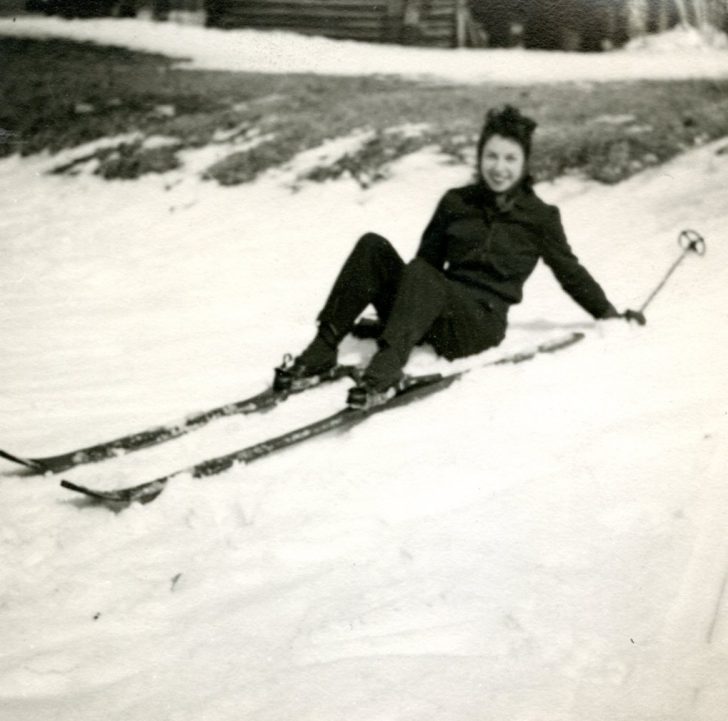
Whoops.
Many senior snow sports enthusiasts have been participating in the sport for decades, in some cases, starting as children or high school or college students. Each year, they return to the ski hills, older, less strong, less stamina, but still dedicated to the sport they love.
They come back despite the concern that most senior skiers share: Getting hit and injured by another skier/boarder.
In late spring 2019, SeniorsSkiing.com conducted its annual survey of readers. Among other topics, we asked what most aggravated them about their on-slope experience.
About half reported they experienced a variety of near-misses, injuries, or dangerous behavior of others. A subsequent SeniorsSkiing.com article reported on the writer being blind-sided by another skier who left the scene. This prompted additional comments from other readers expressing dismay and anger about being involved in similar incidents.
Sensing a need for our readers to express their views about these on-hill collisions and near-misses, we launched “Incidents And Accidents”, a series of personal reports from readers in an attempt to further understand and communicate what was happening. We asked readers to report what occurred and what lessons they learned from the experience.
The combination of comments to Incidents And Accidents and the open-ended responses to the survey formed a clear picture of what seniors saw happening on ski slopes that made them cautious, apprehensive, angry, and even frightened about the sport they’ve been engaged in for so many years.
Their observations can be grouped into three categories:
1) Skiers/boarders skiing out of control or too fast for conditions or their skill level,
2) Reckless and rude skiers/boarders distracted, stoned, intoxicated, or not paying attention, and
3) Skiers/boarders not following proper rules of conduct, ignoring trail etiquette, violating right-of-way protocols, and/or not warning about passing.
Too much speed, lack of attention, and non-compliance with standard on-slope protocols are the dangers. These behaviors result in actual or potential accidents and collisions, leaving senior skiers annoyed and disappointed in how their sport is conducted.
Readers report a) being hit from behind sometimes with serious, long-term injuries; b) being passed too close by a speeding skiers/boarders; c) reckless emergence from side trails or trail junctions, and, perhaps most unsettling, d) being knocked down and the other party not remaining at the scene.
As a result, senior skiers devised their own self-protection tactics, adapting their on-snow experience to better deal with potential injury.
Our readers report adopting a number of self-protection tactics. These include a) avoiding crowds or crowded days; b) staying away from beginner areas; c) maintaining a predictable rhythm of turns; d) vigilantly monitoring surroundings and uphill activity, and e) remaining with friends. Basically, they are skiing defensively at all times, some to the point of being ultra, self-consciously cautious on the slopes.
They have also prescribed actions to take if there is a collision, namely, get an ID from the other party, taking a picture of both the ID and the other’s face with a Smartphone, and report the incident to ski patrol and the resort. If circumstances warrant, call 911 or the police, especially if there are serious injuries involved.
That our senior readers—long time veterans of the sport—have generated their own rules and guidelines for dealing with out-of-control skiers/boarders is telling. While they have learned to adapt, they have done so in the absence of more proactive efforts by ski resorts to curb out of control behaviors.
Skiing/boarding without fear of getting hit wouldn’t be such an issue if resorts stepped up to their responsibility to keep all customers safe.
When we asked our readers for advice on what ski resorts can do to better control danger on the slopes, their solutions were insightful. Rather than put the task of enforcing rules squarely on Ski Patrol whose primary function is rescue and trail management, readers recommend ski resorts create a new role of “Safety Guard” who can be visibly monitoring critical hot spots. Safety Guards can pull tickets, track violators, and bring offenders into “time out”. The resort can establish a system where repeat offenders are barred. Resorts can also visually post the number of tickets pulled in a day. Some resorts already use these tactics. For example, Vail is a pioneer in posting and enforcing ski safe rules.
 While enforcement and monitoring is critical to making a safe skiing/boarding policy stick, there is an important role for greater awareness and education. Our readers state that resorts should invest in posting the Responsibility Code more prominently. They also recommend displaying the Code and the ski patrol’s hot line number on lifts, in restaurants, and on runs.
Where do new skiers/boarders learn the Responsibility Code? In lessons where instructors can explain the Code and interpret situations in real time so students can learn to identify what to do.
Finally, to make all these provisions work, ski resorts need to design and implement a safety process. To take the role of monitoring and enforcement seriously, the resort needs to collect incident reports in a consistent and timely manner, analyze the data collected, report it to customers, and use that data to inform policy and decisions.
Recommendations To Ski Area Operators and The Ski Industry: Update The Responsibility Code
At this writing, Vail Ski Resort, CO, has a model program that other resorts can learn from. Its Mountain Safety Program includes a comprehensive list of activities. Education, enforcement, monitoring are keystones. Slow zones and high traffic areas get special attention. Tickets are lifted and daily enforcement results are posted for all to see. At Vail, on-hill safety is a managed priority.
It would be ideal if other resorts copied or adopted a Vail-like program. It wouldn’t take much for resort management to create a new role of Safety Manager who can implement new monitoring and enforcement procedures, perhaps adding responsibilities to an existing position. Also, the national snow sport organizations can help with a set of suggested ideas for the position of Safety Manager with a job description and on-snow deployment techniques and interactions with staff and guests
Right now, resorts have a wide-ranging and inconsistent set of initiatives—and attitudes—when it comes to programs like this. Industry guidance would be helpful in creating consistency and momentum, but that’s not going to happen next season.
So we ask ski resort management and the ski industry to take a small, simple step that will bring attention to on-slope safety and may actually help invigorate awareness of the problem.
Our readers have told us they see an opportunity to update the Responsibility Code, the ski industry’s only guidelines for on-snow safety that hasn’t substantively changed since it was created in the mid-1970s.
SeniorsSkiing.com believes there should be a new provision to “Stay On The Scene” in case of an accident as well as “Provide or Call Help For A Downed Skier/Boarder”. While we’re at it, why not review the other rules and bring them up to date.
These are common sense additions that can help prevent bad situations from becoming worse. Adding these to an updated Code is doable, reasonable, and non-controversial.
It’s up to the ski industry and resort management to decide how to address the on-slope safety issue for everyone, not just seniors. Resorts can consider naming a Safety Manager, enlisting Safety Guard volunteers, and creating awareness with signage and messaging. Those steps require leadership, commitment, and investment. They are also low cost, high impact.
And, right now, the ski industry can update the Responsibility Code, one simple step that can be done easily, signaling a broad-based effort to curtail unsafe behavior on the hill.
Let’s start there.
[authors_page role=contributor]