


70+ Ski Club: Ski Trips, Fun, And Camaraderie
You Are Never Too Old To Be Young.
70+ Ski Club group photo. The club ventures to US, European, and this year, New Zealand resorts. Credit: 70+ Ski Club
Ski clubs have been around ever since people strapped skis on for fun. But the 70+ Ski Club has a unique niche. It’s the only ski club for skiers – and boarders – who are at least 70 years old.
People often give up skiing when their spouse passes away or when they simply run out of friends to ski with. The 70+ Ski Club fills the need and serves up week long ski trips and also short events so skiers can make new friends and find new ski buddies.

Red and Jim: Newfound friends become new ski buddies. Credit: Harriet Wallis
This winter, the Club’s week-long international trips included the French Alps, Vermont’s Okemo, Big Sky, Banff/Lake Louise, and Utah, where they skied a different resort every day. And the season isn’t over when the snow melts here. The Club is scheduled to go down under to ski New Zealand this summer.
There are shorter jaunts and day events especially in the Mid-West and New England. While the mountains might not be as big, the game is on with new trails to explore, ski clinics, race clinics, good natured events, and apres ski parties.
At a time when our doctors are urging us to be active, the 70+ Club members already have the message. They continue to be active skiers and they engage in living life to the fullest. Becoming 70 is just the beginning. Many members are in their 80s and 90s and even a few at 100. As the saying goes: “You’re never too old to be young.”
The Club was launched 43 years ago, in 1977, by Lloyd Lambert, an enthusiastic and accomplished skier and patroller who saw the need to keep skiers skiing as they grew older. He urged ski resorts to give discounts to older skiers. And he helped turn the tide from skiing being a sport for the adventurous young into a lifelong sport for all. The Club started with 37 members and has grown to 3,000 members.
Today, grandson Richard Lambert heads the Club and plans the trips. He gets universal praise for his thoughtful preparation and well organized trips.
I asked very modest Richard to say something about the Club for this story. Instead, he sent a note he received from skier who met some of the 70+ers.
It said: “Met several of your members and would love to be part of this amazing group. I vow not to adapt to a sedentary lifestyle and this group is an inspiration. I plan to wear out, not rust out. The enthusiasm of the group is contagious.”
Membership includes a distinctive 70+ (or 80+, 90+, or 100+) jacket patch, a helmet decal, a lapel pin, a list of ski areas that offer seniors free or discounted skiing, a twice annual newsletter, and a membership card. All for $15.
Are you old enough to be a 70+ Ski Club member?
Not quite 70? Check the website for details on becoming a 70+ Ski Club member-in-training.
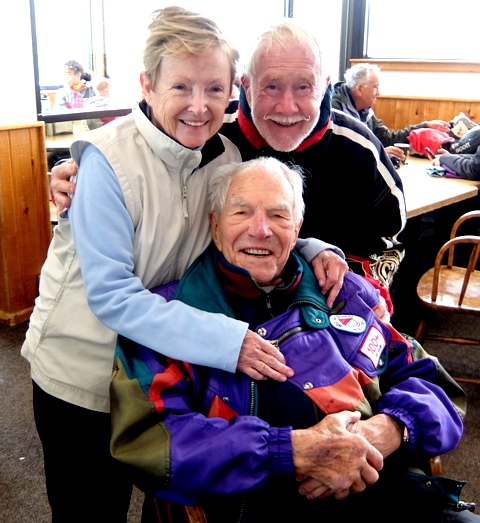
70+ Ski Club members Sandra, Red, and 102 year old George Jedenoff. Credit: Harriet Wallis

My Personal Skiing Safety Primer
To stay safe, all older skiers should prepare themselves for what might go wrong. I call this a “safety mindset,” and it’s kept me safe in more than 40- years of rock climbing, mountaineering and skiing.

Part of that preparation is answering these questions:
- What should I wear to protect myself?
- How will I be found?
- What are the most common dangers and how can I survive them?
- What skills/knowledge/training do I need?
What should I wear to protect myself?
Wear a helmet and make sure it is securely fastened. If your helmet isn’t adjusted properly and snugly attached it might not do much good. I check the helmet strap frequently. About half the time it needs adjustment. If you’re using an old helmet or one with a damaged shell, replace it with one of the modern impact distributing technologies like MIPS (Multi-directional Impact Protection System).
How will I be found?
When skiing I always carry a Fox 40 whistle. If you’re skiing inbounds, a series of three loud whistle blasts will summon help. Your phone, also is useful, assuming there’s a signal and juice. Make sure 1) it’s fully charged at the start of the day, 2) the area’s number is in your “Contacts”, and 3) you have a GPS app that will give your coordinates for when you call patrol. To keep the battery from draining, I keep my phone warm on a neck lanyard between base layer and mid-layer fleece.

Several ski clothing companies incorporate RECCO reflectors into their products. It can help rescuers find you. If RECCO is not built in to your parka or pants, Marmot makes a RECCO belt.
I also carry a Personal Locator Beacon (PLB). Mine is a McMurdo FastFind  220. About the size of a pack of cigarettes, it cost a couple of hundred bucks, is waterproof, requires no annual fee, and has a 6-year battery life. It gets registered with NOAA and, when activated, broadcasts a signal to the same rescue network used when commercial planes crash. It’s not to be used frivolously, but when it is, rescue will be on its way.
What are the most common dangers and how can I survive them?
In addition to avoid being hit by others or losing control, I try to avoid tree wells and avalanches; just a few of conditions that can lead to suffocation and/or hypothermia.
When skiing powder in the trees, I wear a Black Diamond AvaLung Sling. If I were stuck in a tree well, it would help me extract air from the surrounding snowpack and divert exhaled CO2 away from my head. It costs $130 and weighs 9 ounces.
Hypothermia occurs more frequently in seniors and twice as often in men. When it’s cold the body reduces blood flow to the extremities in order to keep sending it to the brain and key organs. I use glove warmers and boot cozies to keep hands and feet warm.
Helmets help prevent heat loss from the scalp but if there’s exposed skin on your neck, body heat will be lost there. Neck gaitors are a good preventative.
What skills/knowledge/training do I need?
The answer to that question depends on your level of on-snow engagement. If you’re a resort skier, knowing and following the responsible skier’s code and being hypersensitive at trail intersections and to the people around you may be sufficient. A step up would be basic first aid and CPR training. If you’re spending time in the backcountry, take a Wilderness First Aid course (REI offers several 2-day courses) and investigate educational offerings from the American Institute for Avalanche Research & Education.

Skiing Weatherman: Out Like A Lion
March Won’t Be Ending Spring-like.
Although I had good intentions, I must confess that I did not get on the snow in the past week. 65 degree temperatures here in Rhode Island early this week didn’t help to inspire, for sure. Much of the East has had a frustrating season, due to a lack of cold and snow, but the evolving pattern over the next several weeks is not going to please those ready to turn their backs on winter. The pattern is going to change to one that delivers cold and snow into the country, first into the West but also to the East, where the colder pattern will persist for a longer spell than we have seen since early winter. That is great news if you have plans to ski or ride Easter weekend!
In the short term, a massive high pressure center is going to deliver a seasonably cold weekend to the resorts in the Great Lakes and East. In the West, the best news is that the Tahoe area is going to receive heavy snow during the second half of this weekend into early next week. After a largely snow-free February, some lighter snow has fallen the past two weekends in the central Sierra but this event will deliver the load that the resorts really need. Amounts will range from 1 to 2.5 feet with this storm. Snow is headed for the northern Rockies this weekend, too, as this surface map from Sunday morning illustrates.

Next week will turn milder again in the East, but not to the extent that we saw earlier this week. The coastal system that impacts the Sierra this weekend will continue to rotate southeastward during the first half of next week, bringing snows to the southern Rockies. While the upper level trough that produces that snow favors the West, an upper ridge over the East will keep it mild and deflect a storm up through the Great Lakes late in the week, and that track will be unfavorable for snow in the East.
Help is on the way to the East, though, in a classic case of “better late than never”. Changes are underway in the Pacific in terms of the location of ridges and troughs, and we will soon see a configuration that has been rare this winter. An upper ridge will set up shop over Alaska, with a trough south of that spot. Here is forecast for the 22nd that illustrates the position of that ridge.
In addition to the strong ridge sitting over Alaska, notice the trough extending down from the southern flank of the polar vortex all the way to southern California…that will continue to benefit parts of the West. With a clockwise flow around the ridge and a counterclockwise flow around the trough, you can see how the air will be directed from the Yukon into the northern Plains and then eastward through the Great Lakes. As the trough presses eastward, it will spread the cold air into the East for the final week of the month and likely beyond. The season will roll along in the West, while in the East, don’t despair, a solid shot of cold and snow will set things up for some nice Easter sliding.
Here Are The Regional Details
Northwest U.S./western Canada: Light to moderate snow this weekend followed by several dry days next week. Light snows return Thursday, followed by a more substantial weekend storm.
Sierra: Good sized storm this weekend, the biggest since January. Next weekend looks promising, too. Longer term, eastern Pacific trough development will bring additional snows into April.
Northern Rockies: Moderate to heavy snow this weekend, light snows continue early in the week. Next shot at snow later next weekend.
Central and southern Rockies: Light to moderate snow this weekend, another shot at significant snow Tuesday as southern branch systems moves toward Four Corners.
Midwest: Nice weekend on the slopes. Light precip early next week, snow across north, rain south. Developing colder pattern will help sustain the season late month/early April.
Northeast/Quebec: Seasonably cold, dry weekend. Milder next week, not so much for northern New York and New England. Pattern change will make Easter viable for skiing, riding.
[authors_page role=contributor]