

Short Swings!
Uphill Without a Lift?
In this age of technological disruption, it’s time to consider the growing number of alternatives to rope tows, chairlifts, gondolas and trams.
Self Powered
Starting at the most basic level, there’s the growing practice of uphilling, the use of skins on skis to help the more fit and energetic work their way up. Long a European pastime, it’s catching on in North America to the extent that some resorts are charging for the use of their slopes.
Unassisted backcountry skiing is a version and vice versa. The boarder version uses splitboards, short skis used to climb and then lock together into a snowboard for the trip down.
Heli-, Cat-, Car-Powered
By now, all of us are familiar with helicopters, snowcats, and snowmobiles as a way of reaching higher and more remote terrain.
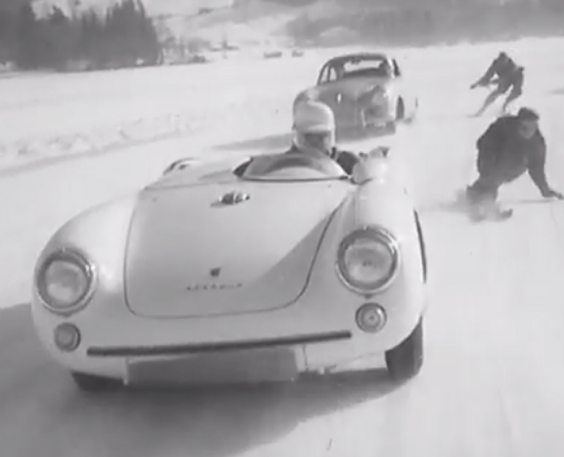
Some of you may have experienced skijoring, the sport of being pulled on skis by horse, motorcycle, snowmobile or car. If you haven’t, this 1955 video, titled World’s Most Dangerous Sport, will convince you not to try.
Mechanical Skis
Source: Popular Mechanics
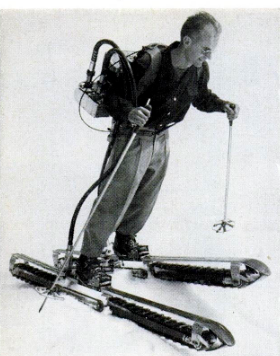
In 1953, Popular Mechanics featured Caterpillar Skis, motorized skis that promised to transport the skier up the mountain. The skis had devices that looked like tank tracks and weighed almost as much as the tank. An engine strapped to the skier’s back provided the power. This link to the article shows and tells all.
Fan-Power
Donald Steeg with the SkiBee
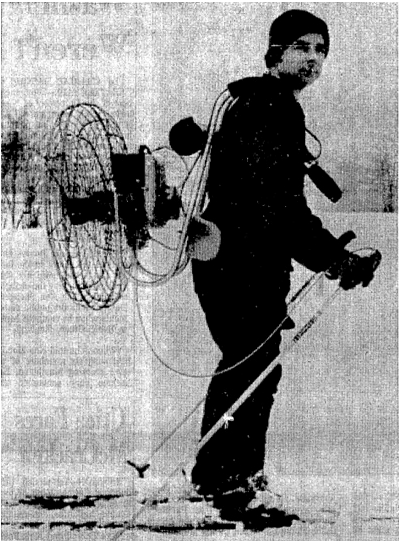
Some years ago, a guy in Turkey mounted a large fan on his back to propel himself uphill on skis. More recently, a Russian man developed this fan device from a lawn mower engine. In the early 70s Donald Steeg of Detroit came up with the fan-on-back SkiBee.
Is Something Following Me?
Skizee Woodsrunner
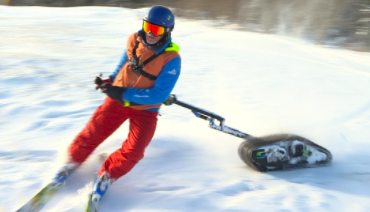
There’s the Roller Cycle Tracker, a ski-mounted motorized unit that pushes its user through snow. The demo video gives the impression it needs further development. Another product, the Skizee Woodsrunner, operates on a similar push principle but looks more sophisticated, as you’ll see here.
As fat tire e-snowbikes grow in popularity, so, too, may their use in towing skiers uphill.
Drone Alone

Samsung built an experimental drone to lift a human.This video shows the drone transporting a boarder. Peculiar and Jetson-like as it sounds, it probably isn’t that far away.
R2-D2 In Our Future?
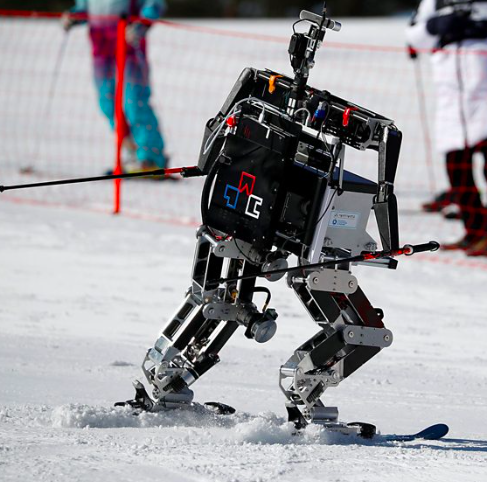
Last season, the South Koreans held a robot-skiing competition. Assuming that technology improves, there may be R2-D2s in our collective future.
Brighton, Utah’s First to Open
Brighton opened Tuesday, Nov 19, becoming the first Utah resort to kick off the 2019-20 season. Many visitors to the area overlook this gem at the end of Big Cottonwood Canyon. It is an absolute snow magnet and has varied terrain. Passes are reasonably priced for the 65+. Brighton attracts a lot of boarders, so go midweek when they’re in school.
Fantastic Senior Ski Weeks at Mountaineer Inn, Mount Snow
Mountaineer Inn at the base of Mount Snow in Southern Vermont has been hosting Senior Ski Weeks for several years. The 5-night packages include lodging, Mount Snow lift tickets, lessons and meals. Each evening is rich in conversation and entertainment, including live performances from the American musical theater. Openings are still available for the January 5-10 and March 1-6 Senior Ski Weeks. $715 pp/double occupancy. Mountaineer Inn also has special mid-week rates for seniors. Click here for details or call 1-800-682-4637.
Sweet Deal From Apex

Apex Boots
Apex is a remarkable solution for any skier living with uncomfortable or underperforming conventional boots. It combines a soft and comfortable walkable boot with a stiff open chassis. The soft boot slips on with ease, even on cold days. When it’s time to ski, step into the chassis, close the three buckles, and step into your bindings. The company has a sweet deal for SeniorsSkiing.com readers. It ends November 30. Order directly through the manufacturer’s website (use Discount code SENIOR3000) and get free shipping in the lower 48, a ski boot bag from Kulkea (value: $149.95), and free demos for friends and family through 2020 at Apex’s demo center in Golden, Colorado.
Great Gift for Older (and Younger) Skiers!!
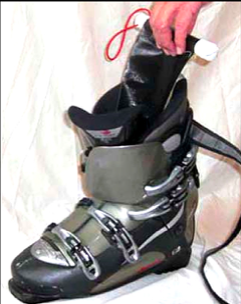
Bootster is a compact, lightweight and portable shoehorn for ski boots. It works for ANYONE fed up with grunting and groaning trying to fit foot into boot. I purchased several for Christmas and Hanukah gifts. At $25, Bootster is a bargain. The thing lasts forever. It’s a gift that keeps giving. Click here on or the adjacent ad to learn more and to order.
Discounted Skiwear For Every Size
Snow Country Outerwear is discounting its full line of skiwear for women (Reg and Plus; XS – 6X), men (Reg and Big; Sm – 7XL), and children. Click here or on the adjacent ad for details.
A Ski Gift for the Grandkids
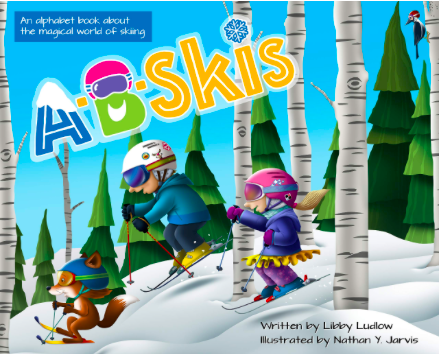
A-B-Skis is a beautifully illustrated hardcover children’s alphabet book. There’s one letter per page that covers some aspect of skiing, each in verse. The volume also has safety information and guidance for getting the young ones excited to be on the hill. It was written by former U.S. Ski Team member and 2006 Olympian, Libby Ludlow and illustrated by Nathan Y. Jarvis, a prominent illustrator and PSIA certified Children’s Specialist ski instructor. A delightful Holiday gift for grandkids. $24.99. Click here to order.
A Worthy Skiing Cause
Since it was founded 17 years ago, the Alf Engen Ski Museum in Park City has become one of the world’s preeminent ski history museums. Visitors get to see extensive collections and to experience numerous interactive mountain sport simulators. There’s no admission. Last year, alone, there were more than a half-million visitors. The non-profit foundation behind the museum is conducting its annual fundraiser. To donate, click here.
Award-Winning Animated Ski Film
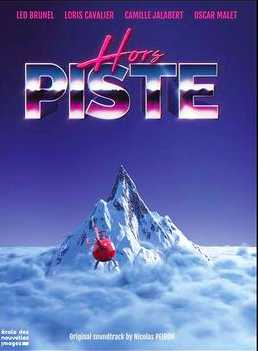
Hors Piste is an award-winning, student-produced, animated film of a hapless injured skier being “rescued” by two emergency medical crewmembers. No words. About 6 minutes. Click here.

Incidents And Accidents: 2
Accidents Can Be Self-Inflicted, Too.
[Editor note: SeniorsSkiing.com is collecting stories from readers about incidents and accidents that they have experienced. We intend to review these for patterns and themes and use that data to influence the safety policies of resorts and other stakeholders. The following is the second article submitted by a reader in our new feature “Incidents and Accidents. If you have a story to tell, please follow the format used below and send to INFO@seniorsskiing.com]
Carol Goodman, New Hartford, NY
Where: Gore Mountain North Creek, NY

What Happened: It was a beautiful powder day in the Northeast. The snow was coming down heavily and close to 18 inches of new snow had accumulated overnight. The trails were virtually ungroomed. Exciting for a seasoned skier looking for the feel of western skiing. Unfortunately, the stars did not align for me that day. It was my first day out for the season, and my second run down the mountain when I took a header; a forward twisting fall into deep snow with no release of my right binding.
As a result, I suffered a comminuted fracture of both my tibia and fibula. Fortunately the accident occurred underneath a chairlift so I was able to summon for help immediately. I was reached by a ski ambassador first, who was able to release my binding, as I was in excruciating pain. It was a very long process getting me off the mountain and into medical. The accident ended my 2018/19 ski season, as the surgical repair, with a rod and screws, required me being non-weight bearing for 10 weeks.
Role of the Ski Patrol: The goal of the ski patrol is to attend to the immediate needs of the skier and to keep the skier comfortable until the proper splint and sled arrives. This was my experience, although I spent almost an hour on the mountain in the snow. I would hope that this amount of time is not the norm. Once I was down the mountain and was warmed up, the next ordeal was getting my ski boot off, which they insisted had to take place before I could be transported to a hospital. Lucky for me, there was an MD available at ski patrol who was able to administer ketamine, a dissociative anesthetic, so that I would not feel the pain of boot removal.
Lessons Learned: Always be certain that your bindings are in good working order and that you have had a relatively recent Vermont Binding Release test done. Even though I have been skiing for many years at an advanced level, the effects of aging and loss of strength should have prompted me to have my DIN settings checked and lowered.
Advice: Keep your equipment in tip-top shape, have a binding release check done, and keep skiing, even if you have a setback! Follow a strict rehabilitation program, followed by strengthening and conditioning so that you are in the best physical shape possible for the ski season. The benefits of participating in an activity you love, far outweighs giving it up.

Changing XC Skiing Stereotypes
“Aren’t Groomed Trails Free?”
There are at least three unfortunate stereotypes that are really important to the cross country ski world:
“If you can walk, you can cross country ski”
“Oh, it looks like so much work!”
“It’s free, right?” Meaning: Well, I heard it was free, so I expect it to be free.
Okay, a lot of cross country skiers and not-yet-skiers take all three for gospel, but here is an xc ski area operator’s view of these stereotypical views:
First, if you can walk, you can ski. But “it takes time – and at least one lesson – to really improve, glide, and enjoy skiing more.”
Second, it’s a lot of work. “Well, it’s a lot of work if you ski a marathon, but what most people do is ski at their own pace for a couple of hours and still have tremendous fun and get some exercise and fitness while they’re doing it.” New cross country ski equipment performs better (glide easier, get better grip on uphills, and have better overall control) and allow skiers to be more efficient and save their energy.
Third, it’s free right? A response to the trail fee question is that there’s no free lunch. This answer is more complex than the others because there are a lot of groomed trails maintained by clubs, communities, states, provinces, federal agencies, etc. where there’s no formal fee. Also, skiers have the option of breaking their own trails.
Appreciating Trail Grooming
Grooming is something that’s not only misunderstood by the public but also sometimes goes unrecognized. Lo! Pristine tracks and corduroy appear in the morning because grooming occurs mostly at night. What you didn’t see happen, you may not appreciate.
First, grooming has huge value, makes skiing—and especially learning— easier than breaking your own path. Grooming is expensive, and running an over-snow vehicle is just the most visible part of the cost. Even “no-fee” groomed trails aren’t free. They cost someone time and money.
Groomed trails typically aren’t just old logging roads through the woods and usually don’t just follow golf course cart paths. Area operators can tell you that it can be expensive to develop the best routes, create trails, and keep them in great shape for the public to enjoy. Selecting the best paths at golf courses without damaging grass isn’t simple either. More than 230 golf courses in North America now have machine-groomed trails.
The cost of trail grooming includes machinery (purchase, maintenance, fuel, storage, payroll, depreciation, replacement), land use fees (purchase, lease, taxes), signage and marking, insurance, parking lot construction and snow clearance, perhaps warming huts or yurts, ski patrol, lighting, snowmaking , etc. Ah yes, and there’s the cost of creating some trails.
Methow Trails Example
According MethowValleyNews.com, grooming at Washington’s Methow Trails—cited as the largest XC ski area in North America—is estimated to cost $6,400 for an average night of work. Think about clearing trails, trimming trees to make a wider canopy to allow snow to land, minimize debris on the trails, and to help skiers to avoid branches, angling the surface to complement the sunshine or avoid the wind and so on. Maintaining trails covered in wet snow is very different from dry snow. Icy conditions present a completely different challenge of grinding the surface and setting tracks.
It takes about a gallon of diesel fuel to groom one mile of trail according to Methow Trails. The snowcat blade allows a skilled operator to harvest snow moving it around so it covers the trail where needed. The operators could also use a bucket on the snowcat to collect snow and deposit it to uncovered spots.
Trail groomers can be responsible for maximizing every inch of snow, provide more consistent conditions and deliver more skiable days. As you can see, it’s not a simple task. But it’s one that is often unrecognized and under appreciated.
So hats off to the trail groomer and their cross country ski trails.It’s certainly worth the cost of the trail pass!

[authors_page role=contributor]