


Ski For Light: Why A Guide Keeps Coming Back
[Editor Note: This article was written by Robert Civiak, a 25-year Ski For Light volunteer guide. It previously appeared in the Ski For Light Bulletin, Summer, 2018. For Part 1: A Skier’s Experience. click here.]

Start of the end-of-week race at Ski For Light.
Part 2: A Guide’s Story.
In 1992, after several years of bad snow in the mid- Atlantic region, I signed up to go to Colorado for a week to be a guide for Ski For Light. At least I would get to ski on some good snow. Well, I have missed only two years of guiding since then. The reason is simple. I like it. No, that is wrong—I love it.
Why do I love it? It took me some soul searching to figure that out. I have to admit that it does feel good to help other people, but most of my reasons are more selfish. Of course, even feeling good about yourself for helping people is selfish, but here are the real selfish reasons why I love being a guide.

Volunteer SFL guide Bob Civiak has been helping blind XC skiers for 25 years.
First and foremost, I love cross country skiing. Going to Ski for Light forces me to make time in my life for a full week of skiing no matter what. But I could go skiing for a week without being a guide, so there must be something else. A major reason at the beginning was that I liked racing. I was never a successful competitive racer and when I started SFL, I was already in my mid 40’s and so my prospects for winning races did not look good. However, in my first year, I guided Janice Newman, and she was the first woman finisher in the 10K race. Boy, was that a rush. My second year was even better, I guided Laura Oftedahl to first place overall, finishing ahead of several Norwegian men. That was my peak success as a racing guide. I was hooked.
I am no longer able to guide the fastest skiers at SFL, but still thoroughly enjoy guiding and take great pride in doing it well. Now my competitive juices are stoked by helping skiers who want to ski better than they have before. In 2017, I helped Ron Baron, who had never skied 10K, reach that milestone on Thursday. The next day, race day, he did it again, but was 30 minutes faster. I vicariously shared Ron’s sense of accomplishment and took pleasure in the look on his face when we finished, but I can’t deny how much I enjoy the personal triumph of being a good teacher and spurring him on to do his best.
Is there something more at SFL? We all know there is. The atmosphere at our events is totally unique. I have never been in a more supportive and positive environment. For 51 weeks a year, I tend to be a little cynical, to see the glass as half empty, and to fret about where the world is heading. I simply can’t do that at SFL. I get caught up in the passion of everyone helping everyone else, hugging, and spreading positive cheer. All of the glasses at SFL are at least half full, if not brimming over. People are there to have a good time and won’t let anything spoil that. As I’ve heard from SFL leaders, “If you cut through it all, SFL is just one big party.” What’s not to like about a big party.
After 25 times at SFL, I have made dozens (if not hundreds) of good friends. By now, I would be going if for no other reason than to have a good time with my friends. On top of that, I get a new person to guide and to bond with each year and form a new friendship.
Blind skier Chris Leghorn (l) and her guide. Chris has been attending SFL for 19 years. Credit: Pam Owen
But there are even more things I love about SFL. Before I came, I never could have imagined the personal inspiration I would get from spending time with people who refuse to let their disabilities keep them from achieving remarkable things. I am not only talking about skiing. There’s also sit skiing, traveling, finding their way around hotels, running meetings, and organizing the event. I am amazed at the lawyers, scientists, business owners, consultants, entrepreneurs, judges, teachers, bankers, and high level government workers I have met at SFL. If even a tiny amount of SFL’s motto— “if I can do this, I can do anything”—has found its way to me, I am a winner. SFL blind people take minor adversities completely in stride. Bump into a pillar—don’t complain—that just becomes a reference for future navigation.
I have left my most selfish and embarrassing reason for last. Of course I have learned that every blind person is unique and has their own mind, wants, and desires. As a guide, I respect and support that; however, when we are walking and they are holding my arm, or when we are skiing and I am guiding, they depend upon me, and I am leading the way. I never had children, and the idea that someone would rely on me and allow me to make decisions about their safety and well-being is something that I revel in. I have several other reasons I like being with blind people. They tend to be open, honest, unpretentious, vulnerable, free to ask for help, appreciative of things that I can do easily, and willing to help me when they can.
There you have it. I don’t consider myself a do-gooder. Rather, I like skiing, I take pride in being a good guide, and I like to be in charge. I also like being appreciated and hugged, getting a vicarious thrill from other people’s achievements, and getting caught up in the magical positive spirit of SFL. All of that, and seeing my good friends, is why I keep coming back.
Click here to donate, volunteer, or become a guide at Ski For Light.

Mystery Glimpse: This Lady Created The First…
…What?
Hints: New Hampshire. She went to Smith. Her husband’s last name was the name of the creation.
Credit: New England Ski Museum archive
Many thanks to the New England Ski Museum, now with an Eastern Slope branch in North Conway, NH, in addition to their home base at the foot of the Cannon Mountain gondola, Franconia.
Last Week

Lots of clues here. Who’s in the speed suit?
Yes, Buddy Werner is the skier on the cover of the January 27, 1964 edition of Sports Illustrated, harkening the Winter Olympics, held that year in Innsbruck, Austria. At the time, Werner was a vibrant, new personality in the ski world, a Steamboat native, and a persistent competitor. Werner, as many senior snow sports people know, went to the 1964 Winter Olympics with Billy Kidd and Jimmie Heuga, but never placed. It was just after the Olympics that Buddy joined other athletes filming a movie in Switzerland, produced by Willy Bogner, the fashion designer. He and German racer Barbi Henneberger were lost in an avalanche during the production. He was only 28.
What makes this photo so interesting to me is that I had a similar photo tacked above my desk at SKIING Magazine, One Park Avenue, NY, NY. That was in 1970. The photo which you can see below, you have to agree, is pretty dramatic, an airborne downhill racer coming full on, in helmet and speed suit. There was no identification on the print as to who it was or when it was taken. I always wondered.
Last week’s photograph from the Tread of Pioneers Museum archive, triggered a response. I rifled through several old files, and there it was. That old picture matched the cover shot of Sports Illustrated, but obviously a different frame from the shoot. It been taken at the same on-hill session as the cover photo, and somehow a print made its way to SKIING magazine’s offices, where I commandeered it, and pinned it to the wall. When I went on to other things, I took it with me, and it’s been around ever since. And here it is.

After almost 50 years, we now know this is Buddy Werner.

Selling Skis: 50 Years Of Gibberish
Remember Lange’s “Soft Inside”?
Now this ad turned a few heads back in 1969. Credit: Lange
I get it. It’s not easy to sell skis. With so many advances in ski design, there are tons of great skis out there. So how does a brand differentiate their products from others? Just like they always have, advertising and marketing. This means slogans, endorsements, performance claims, use of exotic materials and “systems” and of course, transference (associating the product with being sexy, unique, rugged…See Lange boot ad above.)
Sprinkled in among the gibberish is useful information such as amount of rocker, turning radius, profile, and such. But most of it is nonsensical, indecipherable, and unintentionally amusing.
Back in the 1970s, some Fischer skis had wooden cores “made up of finely-cut laminations of lightweight African Okoume”. Rossignol skis were touted as “the greatest moment-makers that ever smoked the slopes”. Regarding one of their skis, Hart stated, “If you’re a swinger who skis for the sheer fun of it, Jubilee is your baby”.
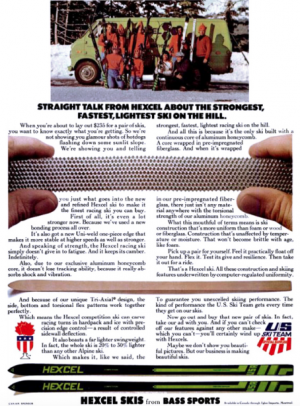
Hexcel had a honeycomb metal core. Credit: Pugski
In the 1980s, Hexcel skis had an “aerospace-proven honeycomb/prepeg technology”. Atomic advertised that their skis had a new “Hy-Vitronic System” and Dynastar skis had a “metal ‘omega’ rib for torsional stiffness”. Not to be outdone, Molnar skis had a “unique Prismatic construction consisting of two channeled fiberglass blanks mated along the ski’s neutral axis”.
In the 1990s, Tyrolia urged buyers to go with Tyrolia skis because you’ll be with a “fast and smooth crowd.” Rossignol asserted that their skis are “limited only by your courage”. Meanwhile K2 had a ski with “TRIXIAL SYSTEM 3” which “balances flex, torsion and lateral deflection”.
In the 2000s, Salomon skis had “hard elastomer transmitters”. Atomic had skis that had “the reviewers drooling, so if you want a pair, you’d better jump”, and Rossingnol had the “Powerpulson System”.
In the 2010s, Head race skis only began “to work at speeds that would get your ticket pulled.” Volkl hawked a ski that was “just a little piece of heaven in the big scheme of things, but heaven nonetheless”. Atomic promoted a ski with “double-deck construction”. The two decks were “joined by rubbery fasteners.”
And, nowadays, little has changed. Some Volkl skis have “Multi Layer reinforced wood core, powered by titanium and UVO (Ultimate Vibration Object)”, and high-end Head skis have KERS. This “technology works like a turbo charger that provides additional power and acceleration by stiffening the tail of the ski in out turns. The effect: a boost, catapulting the rider into the next turn. Just like when Formula 1 pilots push a button for that extra notch of speed.”
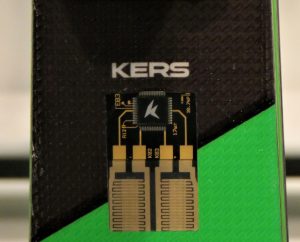
Kers, whatever that is. Credit: Don Burch
I have a pair of Head skis with KERS, and I love them. Of course, I have no idea whether KERS has anything to do with my liking the skis, but I’m hoping next year they’ll have a button I can push for that speed boost!
[authors_page role=contributor]