


Short Swings!
I write this column every week to share information and ideas about being in and on the snow. I haven’t yet had the pleasure of being there this season. It’s still a week or so off.
Sometimes it’s clear what I’ll write about: there’s a new survey; we’ve published one of our annual lists; Big Skiing, Inc. is systematically removing senior benefits. Those and other topics get a fair number of responses. Other times, the subject d’jour doesn’t present itself so easily and the dearth of reader comments reflects it. But, I always enjoy assembling the words.
More than one reader has accused me of naiveté because of comments about the amounts seniors spend when they go skiing. We explored that area in a reader survey at the end of last season and found that 56% of respondents reported they spent between $1000 and $5000 per person last season on skiing, boarding, and related activities. More than 10% spent $5000 or more, per person.
Those figures are “grossly in error,” wrote one reader who claimed the figure should be closer to $5 per day. Our data comes from survey questions that had almost 2000 responses. The resulting information reflects input that shows higher levels of spending. I can’t argue with what the reader observed in the lodge at her area of choice – those elderly $5-a-day brown baggers are found at many areas – but our surveys collect data from a large group. Unless readers have conspired in a massive fib fest, I’ll accept the survey results as closer to what actually happens when seniors go skiing.
Another recent survey result is that grandparents play a major role introducing grandchildren to the sport. This may be obvious, but I don’t think it is fully appreciated – especially by Big Ski, Inc., which relies on newbies to fuel its future. In the past 35 years, the number of skiers and boarders hasn’t grown. I have two young grandkids just starting out. We encourage them with related gifts. The survey that validated this concept. It showed that once introduced, almost 95% of the grandkids stay with it.
Like all surveys, ours are not perfect. But the questions are carefully written and the number of responses large enough to be accurate.
If you have topics you’d like explored in Short Swings!, please let me know. Alternatively, if you’d like to express your own interests on these paperless pages, we’re always open to article ideas and article submissions. They could be about your personal experience, your ski club activities, interesting skiers you know, etc. Click here for submission guidelines.
Vermont Adaptive Snow Ball Fundraiser, Feb. 2 at Sugarbush
Vermont Adaptive Ski and Sports will host its fourth annual Snow Ball fundraiser, Thursday, February 7, at Sugarbush. Tickets are $40 for individuals and $70 for couples. For more info, click here.
January is Learn to Ski and Snowboard Month

January is the 11thannual Learn to Ski and Snowboard Month. Resorts across the country have great deals on beginner learning programs. Since its inception in January 2009, resort partners have provided 957,250 beginner lessons during the month of January. For more info, click here.
Liftopia Launches Hosted Ski Bus Trips
Liftopia, the largest online and mobile marketplace for ski lift tickets and mountain activities recently launched “Liftopia Experiences,” hosted ski bus trips. Liftopia Experiences are available in major metro markets in the U.S. and Canada including Baltimore, Boston, Chicago, Denver, Los Angeles, New York City, Minneapolis and Toronto. The trips include round-trip transportation to ski area along with lift tickets, rentals, lessons, and accommodations. For more information, click here.
Join Us in the Alps

Join us the week of March 10 when we ski in the Aosta Valley with guides from Alpskitour. Each day, we’ll go to a different resort in Italy, Switzerland and France. The all-inclusive price — $4,500 to $5,500 per person– depends on where you fly to and whether you stay in a 3 or 5 star hotel. Orsden is a sponsor and giving a parka to each participant. If interested, email me: jon@seniorsskiing.com.
Coming Soon: SeniorsSkiing.com Annual Fundraising Campaign
In a few weeks, we’ll start our second annual fundraising campaign. Please support our efforts to bring you weekly information and to advocate on behalf of older snow sports enthusiasts. Thank you!
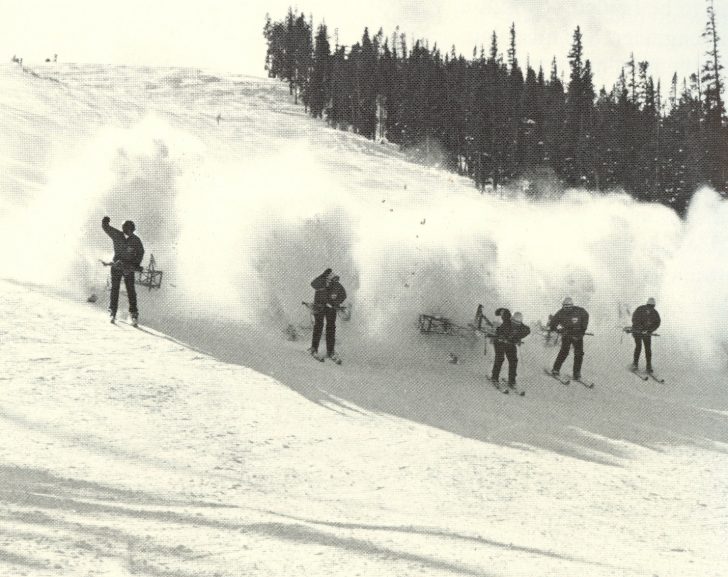
Mystery Glimpse: This Isn’t Easy
Bombing Down

What is going on here? Party? Race? One thing we will tell you is that this looks like (and was) a very tricky maneuver on skis. One resort made these famous. Name it? The inventor? Thanks again to the Colorado Snowsports Museum at Vail.
Last Week
 Indeed, this is Alf and Alan Engen doing some father and son ski jumping at Alta circa 1952. Alf was an early ski jumper who mastered Alpine skiing and helped start the ski school at Alta. He and his two brothers helped popularize skiing in the West, especially Utah and Idaho. Alf’s son, Alan, carries on the family tradition today at Alta.
The Alf Engen Museum at Park City contributed this photo.
The photo came from the Museum’s Ray Atkeson collection. Atkeson (1907-1990) was a photographer best known for his landscape pictures, particularly in the American West. His black and white ski photos are considered some of the finest ever captured.
The museum contains more than 300 trophies, medals, uniforms, scrapbooks, skis, boots, photos, films and other collectables that span some 70 years in the career of the Engen family. The museum’s educational component gives school children a skiing-based foundation to study subjects such as the water cycle, physics and Utah’s colorful history.

Alf Engen. Check those pole baskets.
The Museum recently added a fully functional virtual ski experience designed and built by Utah-based company Unrivaled. The ride takes you through an amazing downhill ski experience and even gives the authentic feeling of skiing by adding wind and even snow to the overall downhill experience.

Memoir Of A Telemark Skier
“Telemarketers” Found Each Other To Practice Their Distinctive Style.
[Editor Note:This remembrance of Telemark skiing by Roger Lohr first appeared in his publication XCSkiresorts.com.]
In the 1970s, telemark skiers were called the free heelers, telemarketers, and the Lunatic Fringe. But these skiers performing the historical telemark turn down the slopes at alpine ski areas were seen as “the vanguard of the slopes” by many for their ability and skill descending the runs at high speeds, in the moguls, and landing aerials on their cross country skis. But telemarkers were often heard commenting that they were only riding the lifts at alpine ski areas to improve their downhill skills for the backcountry. Some claimed “free the heel, free the mind”, but they became intoxicated with riding chairlifts rather than getting their thrills in the backcountry.
These days, as alpine touring and backcountry skiing become more popular, the telemark subculture may be a declining breed at the alpine ski areas. However, there was a time when they were racing down through the gates and partying hard and celebrating their differences based on what was perceived as their retro ski techniques. They were dressed in wool pants or knickers with ear flapped knit hats with elongated tassles (designed by Vermonter Poppy Gall, a woman entrepreneur, designer, and currently a co-director of the Vermont Ski & Snowboard Museum).

Today, telemarkers, or what is left of this group, are no longer counter culture, but in their heyday, telemark festivals, traveling clinics and workshops, and more were the brainchild of the North American Telemark Organization (NATO) created in 1975 by Richard (Dickie) Hall of Waitsfield, VT. In 2017, Dickie Hall was inducted in the Vermont Ski Hall of Fame, which is a long way from his first time telemark skiing with a dozen others as a group at Pico Mountain, Vt. in 1974.
According to author David Goodman’s article about telemarking in Powder Magazine, “the telemark turn was invented in 1868 by Sondre Norheim in the Telemark district of Norway. As alpine skiing and techniques took over, it was not until Rick Borkovic of Crested Butte, CO, sparked a revival and a number of Nordic skiers rediscovered the old technique.”
I found out about telemarking from the 1977 book “Skiing Cross Country” by Canadian Ned Baldwin while I was living in southern Vermont. Most of us regarded Steve Barnetts’s “Cross-Country Downhill” as the bible of telemarking as it covered downhill techniques in depth. As I improved, I got to know many of the telemarkers in the region, mostly men but there were some women, too. We ran a race series, but beside the competition, it was really a clan of telemark skiers who met on scheduled dates at different ski areas.
As a racer, I felt disadvantaged on my Trucker Light Edge skis, which were narrower and softer compared to the Rossignol Randonee skis, which handled the ruts and hard pack better and were used by most of the other skiers. Always blame the equipment. But Dickie’s motto “Ski Hard. Play Fair. Have Fun” was not so much about winning as it was about spreading the telemark gospel.
Hall developed NATO, (according to Hall, it’s the peaceful one) to conduct workshops, training courses, expeditions, and festivals. He traveled as a telemark evangelist from his home in Waitsfield, VT, and visited the states in the northeast, the Rockies, California, and Alaska among others. These NATO telemark events would feature instructional clinics for all ability levels, and equipment suppliers’ gear for demo use. Hall created the telemark ski school at Mad River Glen as one of the first in the US, and he helped others to become telemark instructors across the country. Over the years, Hall estimated that he has introduced, instructed, or just shared his love of telemark skiing to about 40,000 people!
In 2015, NATO held its 40th and last telemark festival at Mad River Glen, which attracted about 200 participants, a far cry from the 13 attendees at the original Pico event. The races held at the festivals were usually the focus point at these events, but the “group telemark turn” was an activity we all shared together. The telemarkers in Colorado and Alaska would try to top the eastern telemarking crew of deplorables at Mad River Glen, but it is believed that 128 eastern telemarkers in a group turn is the standing record.
At Mad River Glen, Dickie was a task master when it came to the group telemark. In Dickie’s mind, it was paramount that we link two telemark turns for the attempt to count. The photo in the 1984 NATO Eastern Telemark Festival Series poster (and used in many other NATO materials) exemplifies one of those record-breaking group telemark attempts. On the day of that photo (I was there), many of the telemarkers who were near the end of the line got whipped into a gully, and it ended in a yard sale of significant proportion. No injuries, lots of laughs—indeed we played hard and had fun.
NATO is now defunct but Dickie Hall telemark videos are still available via email request at nato@gmavt.net

[authors_page role=contributor]