

This Week In SeniorsSkiing.com (Dec. 14)
Open The Archives, Technique, Mystery Glimpse, Gift Ideas With Serious Discounts For Readers.
SeniorsSkiing.com’s fifth anniversary year has caused us to reflect back on the articles that have appeared on these virtual pages. Incredibly to us, we have posted almost 1,000 articles from professional journalists, ski business people, freelancers, readers, contributors-from-out-of-the-blue, and correspondents. Our archives is an amazing collection of opinion, wisdom, tips, nostalgia, commentary, reviews, jokes, and you-name-it, all focused to the interests of the senior snow sports enthusiast.
So, throughout this year, we will be re-posting some of our most popular and our personal favorite stories from our vault.
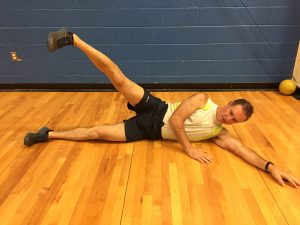
Since we get a lot of inquiries about how to get fit, here is a series of three, progressively-more challenging articles showing you five basic exercises you can do at home. These were originally published in October and November 2016. Our teacher is Rick Silverman, a physical therapist and exercise consultant, who demonstrates these basic exercises with increasingly more challenging variations.
The first is basic: https://seniorsskiing.com/shape-1-easy-starters-seniors/
The next is a little more challenging:https://seniorsskiing.com/shape-2-notch/
The final lesson is more intense: https://seniorsskiing.com/shape-3-challenge/
Check out our other hidden gems. We’ll be excavating more interesting posts in future issues.
This Week
Get an Orsden parka at 30% off thru Dec 31.
Co-Publisher Jon Weisberg opens Santa’s gift bag with lots of ideas for seniors. Note: SeniorsSkiing.com readers can get a discount on any and all of these cool products. Seriously folks, now is the time to buy those presents in time for the holidays. Just make sure you get your discount code right! Click here for the story.
We hear from correspondent Pat McCloskey who has looked at the “One Team” concept and how it relates to ski technique. It is an interesting take on the basic athletic requirement of moving through a motion. Let him explain it by clicking here.
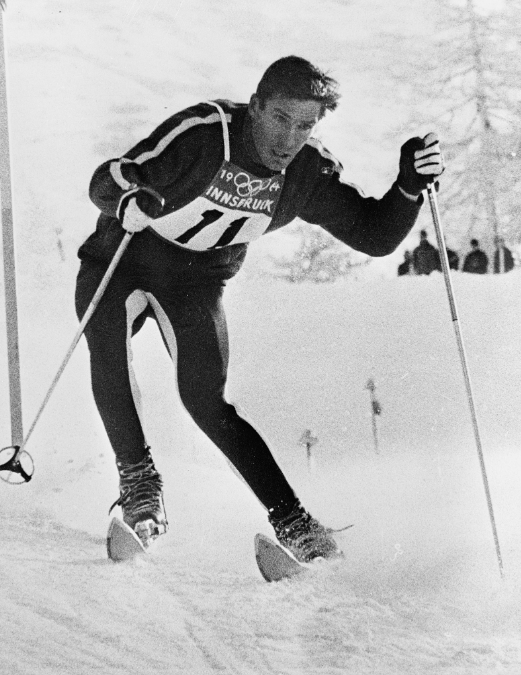
Learn who the Mystery Glimpse racer was and see the new challenge by clicking here. For the first time, we had many, many correct answers. Our racer was lost far too soon, and, had he lived, he would have been a big celebrity in the ski industry. Here’s the answer.

Buddy at Innsbruck.
Finally, correspondent Marc Liebman recalls an incident when he was testing skis for SKI magazine back in the 70s. Guess who showed up at testing headquarters and asked if he could give a few pairs a whirl?
Thanks for reading SeniorsSkiing.com. Please tell your friends, and remember, there are more of us every day and we aren’t going away!
Piece of Cake
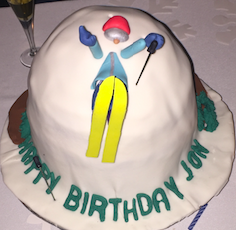
Here’s a picture of the birthday cake that, along with a lot of other things, surprised me last weekend. The side you don’t see had pine trees around the bottom. Looked good and tasted delicious.
Jon’s surprise birthday cake.
If you have a ski-related cake or other confection you’d like to share with the SeniorsSkiing.com community, send a picture to jon@seniorsskiing.com or mike@seniorsskiing.com.
Technique: The One Team Concept
No Matter What You Are Sliding On, Basic Athletic Principles Apply.
When I was a boy, my dad knew a woman who was a former USGA Senior Amateur Champion from South Carolina named Carol Cudone. She constantly reminded my dad to finish his golf swing with his “belly button to the ball.” Ultimately she was trying to get my dad not to hit his shot off the back foot. Or swing in a static position.
When I played a lot of tennis back in the day, I always was reminded by my coaches to finish the stroke on the front foot with my center of mass facing the completed shot. Again, not off the back foot.
Mikaela Shiffrin says that skiing is not static either. It is a continuous movement of working the ski from tip to tail in the turn with the center of mass always moving towards the next turn. Three separate sports with a common theme of moving the body in an efficient manner in order to complete a shot, stroke, or turn. The common movement pattern is getting the center of mass in a position to execute a turn in the direction that you wish to go and to make a shot in the direction that will be successful. Fluid movement and not static at all.
Recently, there was a commentary in the winter issue of 32 Degrees, the official publication of the Professional Ski Instructors of America, about the “One Team Concept”. The magazine was doing a series of interviews about “Interski”, a global summit of international ski instructors with the goal of sharing knowledge and technique.
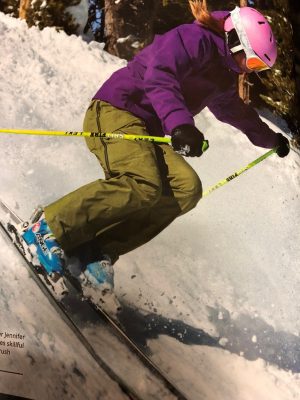
Forward, not on the back heel. Credit: “32 Degrees”
The United States team is always very popular at these events, and, in recent years, the concept of “One Team” has been a focus. “One Team” is all about representatives of alpine, cross country, telemark, and snowboarding all coming together to discuss the value and similarity of teaching techniques as they relate to how people learn and how to teach different personality types.
“One Team” also explored how similar movements in different disciplines of sliding on snow create efficiency and effectiveness. As in the movements of golf and tennis, these four disciplines of snow sports have similar movement patterns. Not only is the center of mass moving towards the new turn a common goal, but there is also the important role of a flexed ankle. As you can see from the alpine photo, the flexed ankle manages the pressure of an alpine ski turn against the terrain. So many people refer to bending the knees but the primary joint critical in the execution of a ski turn is the ankle.
Note forward ankle bend. Credit: “32 Degrees”
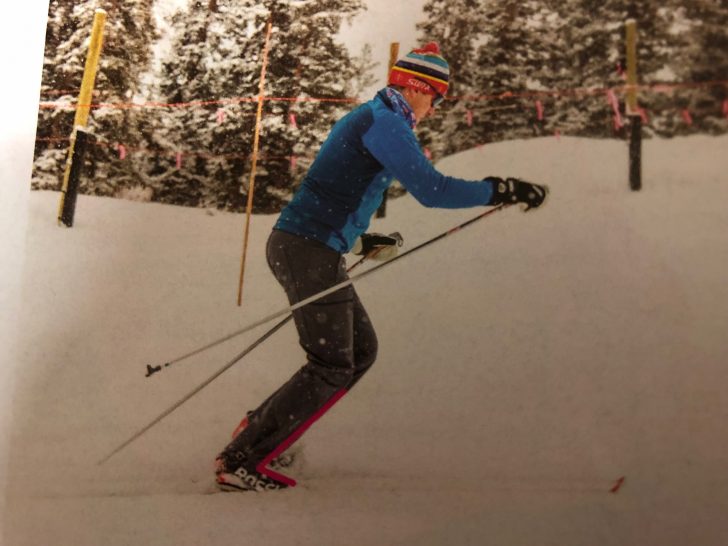
If you look at the cross country photo, the key to balanced forward movement in traditional cross country technique requires a flexible ankle to not only initiate the stride, but to keep the center of mass where it should be—forward— and not static-centered which hampers the glide process. The same technique is required for successful telemark turns with a soft ankle utilized to maintain balance and forward movement.
Finally, in the adaptive world, there is a lot of talk about the outriggers being used as legs on an upright skier. As the adaptive skier moves his center of mass towards the new turn, the outrigger extends on the initiation of the new turn and the other collapses on the inside of the turn. This is much like the flexed soft ankle of the uphill ski in an alpine turn.
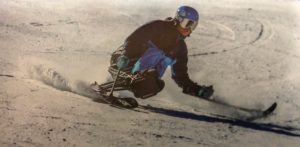
As the adaptive skier moves his center of mass towards the new turn, the outrigger extends on the initiation of the new turn and the other collapses on the inside of the turn much like the flexed soft ankle of the uphill ski in an alpine turn. Credit: “32 Degrees”
Alpine, cross country, adaptive, telemark, and snowboarding all have a common balance and ankle platform that really creates a “one team” concept both in the actual instructional technique but also in the philosophy of a united front in teaching and learning techniques. No matter what you are sliding on, the basic athletic principles apply. Have you ever pressed your outside foot down and your inside foot up in a bicycle turn to the left? The same principles apply there as well with the center of mass headed towards the turn along with the long leg, short leg, flexed technique.
As Mikaela says, nothing is static. A good athlete is fluid and utilizes good body balance, movement, and flexion to execute that shot or turn. Think about it the next time you do something other than skiing and definitely think about that center of mass movement across the skis towards the next ski turn with your ankles flexed.
[authors_page role=contributor]