


Winter Weather Forecasting: From Caterpillars To El Nino
What Will The Winter Weather Be? There Are Many Ways Of Telling, So Place Your Bets.
The Woolly Bear knows what winter will bring. Credit: The Infinite Spider
We grew up with several folk rules about forecasting the winter weather. Most people know about the width of the bands of Woolly Bear caterpillars and the increased frenzy of squirrels gathering nuts and stowing them away. But did you also know that folklore points to other, more subtle indicators that certainly must have some validity from the test of time.
Have you noticed the following having a correlation with deep, cold, snow winters? [Thanks to the Farmer’s Almanac for pointing these out.]
- Heavy fogs in August
- Two or more woodpeckers on the same tree
- Mice chewing doorways into a house
- Really big spider webs
- Pigs collecting sticks (!)
- Acorns galore
- Thicker coat on your dog
And many more. We suppose that if all these indicators appear in parallel, then winter will be a big one. Now that would be an interesting dissertation in Meteorology.
However much fun it is to tell your grandchildren that the wiggly caterpillar climbing the backyard tree with a big, thick, orange band is a sign of snow to come, we also prefer to keep an eye on the National Weather Service’s Climate Prediction Center. Granted, a forecast is subject to being wrong, but, in the grand scheme of things, it certainly is worth consideration, especially if you are planning winter activities.
The CPC has recently issued its prediction for winter conditions for January, February, March 2019, the core of the snow season for most folks. As we have pointed out earlier, this winter will be influenced by a weak-moderate El Nino that is showing up as warm water in the eastern Pacific. Below are two graphics that reflect the forecast for Jan-March 2019, one reflects Temperature, the other Precipitation. The colored areas reflect the probability of variance from “average”, that is, the historic amounts of rainfall and temperature recorded over the year. So, some areas can be “EC” for “Equal Chance”, of being above, normal, or below average, or, in other words, a toss-up. “A” is a predicted probable variance “Above”, “B” is “Below”, and “N” is “Normal” or historic average.

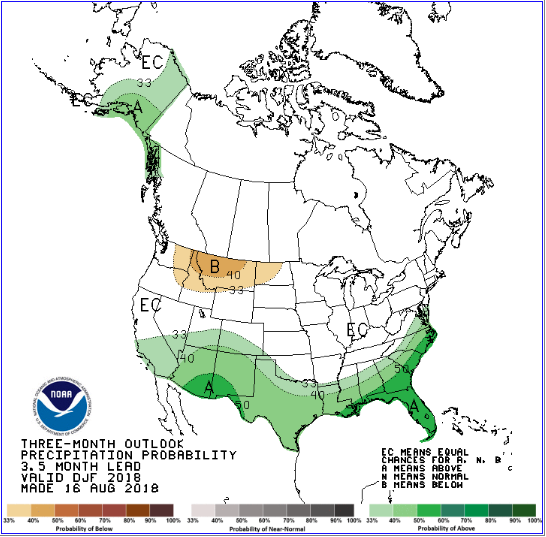
You can see at a glance that temperature predictions are forecasting above average temps in the Northwest and extending across a swath of the northern tier of the country. And, the Precipitation map shows above average for the southern tier with a toss-up for a middle band across the country, and pockets of below average precip in the Northwest and Midwest. Put the data from the two maps together, and you get the official NWS prediction for winter: Warmish and toss-up wet in the middle swath of the country, toss-up temps but above average wetness across the south.
Just remember, this is a prediction about what the weather will be four-six months from now and treat it as such. Incidentally, you may want to compare these forecasts with the venerable Farmer’s Almanac’s Official Winter Weather prediction. Alas, The Farmer’s Almanac’s secret forecast formula is calling for “More Rain, Less Snow.”
So, the stakes are set on the table; let’s see how the dice rolls.

Two woodpeckers in a tree means snowy, cold winter, or so they say. Credit: Dreamstime.com

Conditioning Can Beat Sarcopenia: Pay Attention Seniors
Sarcopenia Weakens Muscles In Aging Bodies, But It Can Be Managed.
If you’ve been lax about starting, continuing, or expanding your current conditioning program, it is time to get with the program. Many seniors are susceptible to weakened muscle as a natural effect of aging. When was the last time you picked up trash barrel, laundry basket, your bike, kayak, or even your skis, and you realized that they seem heavier than they used to be. The condition is called Sarcopenia, and it affects 13 percent of 60 year olds and as many as 50 percent of 80-plus.
Few practicing physicians alert their older patients to this condition and tell them how to slow or reverse what is otherwise an inevitable decline that can seriously impair their physical and emotional well-being and ability to carry out the tasks of daily life.
Dr. John E. Morley, a St. Louis University School of Medicine geriatrician, says that sarcopenia is to muscles as osteoporosis is to bones. “Sarcopenia is one of the most important causes of functional decline and loss of independence in older adults.”
The good news in all this is that the effects of sarcopenia can be reversed by exercise.
No matter how old or out of shape you are, you can restore much of the strength you already lost. Physical therapist, Marilyn Moffat, a professor at New York University, noted that research documenting the ability to reverse the losses of sarcopenia — even among nursing home residents in their 90s — has been in the medical literature for 30 years, and the time is long overdue to act on it.
That’s yet another reason to get back to conditioning. Start a strength-building program using weights, bands, or machines. As Dr. Moffat points out,
Start with two repetitions and, using correct form through the full range of motion, lift slowly and lower slowly. Stop and ask yourself how hard you think you are working: ‘fairly light,’ ‘somewhat hard’ or ‘hard.’ If you respond ‘fairly light,’ increase the weight slightly, repeat the two reps and ask yourself the same question. If you respond ‘hard,’ lower the weight slightly and do two reps again, asking the question again.
If you respond truthfully ‘somewhat hard,’ you are at the correct weight or machine setting to be exercising at a level that most people can do safely and effectively to strengthen muscles. Continue exercising with that weight or machine setting and you should fatigue after eight to 12 reps.
Now here’s a surprising insight. Your current exercise program might not be adequate to hold sarcopenia at bay.
The fact that you may regularly run, walk, play tennis or ride a bike is not adequate to prevent an incremental loss of muscle mass and strength even in the muscles you’re using as well as those not adequately stressed by your usual activity. Strengthening all your skeletal muscles, not just the neglected ones, just may keep you from landing in the emergency room or nursing home after a fall.
Exercise and paying attention to protein in your diet are the keys to remaining strong or at least as strong as you can be as you age. Read Jane Brody’s article and get busy.

SeniorsSkiing Guide: Portillo, Chile
Ride The “Va et Vient” Lift Up The Steeps, Ski With Ski Teams, Enjoy The Vistas Of Remote Mountains. There Is Only One Portillo.
Editor Note: Casey Earle has written several articles for SeniorsSkiing.com, introducing Norte Americanos to skiing in the Southern Hemisphere. Also click here for advice for neophytes . Portillo hosts international ski teams in training during the summer months, and it boasts amazing runs, unique lifts, and a curious sense of remoteness with luxury amenities. Here’s his Resort Review.
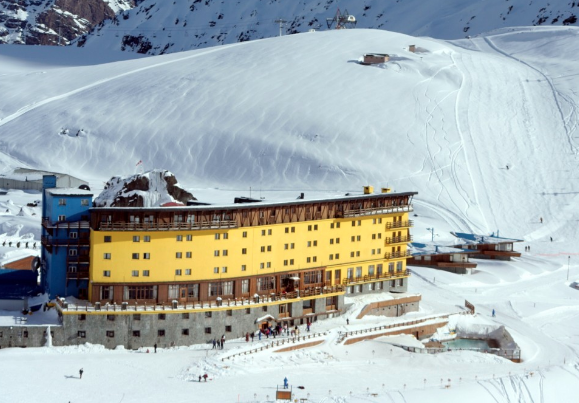
Filled with amenities Hotel Portillo is the only place to stay at the resort. Credit: ChileSki.com
Portillo should be on every skiers bucket list. It’s a beguiling combination of big mountains, a sense of remoteness, old world charm, and wild skiing. Known for intense suntans from its brutal sun, young whippersnappers pumping adrenaline to the limits, a heated pool with a lake view to make even jaded travelers swoon, fine formal dining, and great après ski, you can´t go wrong.

Riding the Roca Jack “Va et Vient” with the US Ski Team. Credit: Casey Earle
Located near the Chile-Argentina border two hours north east of Santiago, 14 miles from the Western Hemisphere’s highest mountain (the Aconcagua at 23,000ft), the area is accessed by the only paved highway to Argentina for over 400 miles. Founded in 1949, the ski area was bought in 1961 by two Americans, Bob Purcell and Dick Aldrich and is still run by the Purcell family. The original hotel has been preserved and remodeled to modern standards.
The area has five chairlifts, four pomas, and four “Va et Vient”. While most are short lifts, several will provide you with about 1,000 vertical feet on the aprons of 14,000 ft mountains, or in combination, more. The “Va et Vient” are specially designed for steep slopes, with only one tower at the bottom, and two bull wheels suspended from the rock above, giving the lift a triangular form. Four or five people load up to the platters hanging from a crossbar, and when ready, the lift starts up and whisks them up the mountain. One can release before or after the lift stops at the top, but be careful getting off on the steep slope, you do not want to fall there!
While there are several good groomed runs, notably Juncalillo and Plateau, much of Portillo’s attraction comes from skiing those steep, ungroomed runs. Famous challenges for skiers are the Garganta (throat), the Lake Run, and the Roca Jack. The most ambitious hike over two hours up takes you to the “Super C”, a lengthy couloir for extreme skiers only. Also, some great heli skiing for intermediate and advanced skiers can be had on the surrounding mountains. All the while, you will be surrounded by a united nations of skiers, and some of the world’s top racers in training.
Taking on the Lake run. Credit: Casey Earle
The only lodging available within 90 minutes of Portillo is the Hotel Portillo. With a variety of options from US$1,150 to $3,950 for a week, meals included, there is something for everyone. A range of activities are available, including a gym, game room, and a full court for sports such as basketball. For lunch, there is no better venue than Tio Bobs, at the top of the Plateau chair, where you can gaze down at the Laguna del Inca and up at the surrounding Andes, while feasting on BBQ’s, fish, salads, and of course a potent Chilean pisco sour!
For more information, click here. For a trail map, click here.

Worse case scenario, you can always just kick back in the pool, get a massage, or hang out in the bar. Credit: SkiPortillo.com

Trail map gives an orientation to Portillo. Click here for more detail.
[authors_page role=contributor]