


Short Swings!
The Kindness of (Young) Strangers
Last weekend Pam and I went canyoneering in Grand Staircase-Escalante National Monument, the vast expanse of public land between Capitol Reef National Park and Bryce Canyon National Park.
Canyoneering may not be the correct term, as it generally describes the exploration of remote canyons requiring technical equipment and skills.
Leaving Peek A Boo slot canyon.
Our destination was two popular slot canyons, Peek A Boo and Spooky, cut deep in sandstone bluffs a little over a mile’s hike down a fairly steep slickrock slope and across flat desert. Reaching the parking area required driving 26 bumpy miles through a classic Western landscape of sagebrush and rolling hills; cliffs in the endless distance.
I forgot my rule about doing strenuous things in the morning. It took two hours to get there, and we didn’t leave home until 10AM.
A lot of young families were there. As it turned out, that was a very good thing.
People tend to be friendly in the wilderness: a gemütlichkeit not dissimilar to what skiers experience on snow. Different generations attached through a common thread.
Those who had been there before were happy to explain what to expect in the slots.

Yours truly slithering through Spooky.
Website references describe Peek A Boo and Spooky as among the world’s most spectacular slots. They also characterize them as relatively easy. Peek A Boo is a series of sculpted terraces, requiring use of shallow foot and handholds to heft yourself from one level to the next.
Both of us needed assistance, and the other hikers, mostly in their 20s and early 30s, were more than willing to help. Thighs became steps, strong arms became hoists. They were strangers to us and to each other, and they took the time and effort — without our asking — to help and encourage these two older adventurers.
We should not have been there. Mid-way in, I was exhausted and we decided to turn around. A few young families scrambled down the steep rocks with ease.
Not us. We struggled, and when we reached the final descent, another stranger, this time a muscular 40 year old calmly talked us down the steep face. He literally carried Pam off the cliff.
It took a few minutes to collect ourselves, before hiking to Spooky, an adjacent slot. Except for the fixed rope assisted climb at the end of Spooky — we didn’t get that far — the primary requirement to explore it is not to be too overweight. It’s a deep, narrow, sinuous fissure. Even for the thinnest person, it is navigated with front and back to the walls.
On the way home, exhausted from the experience, we made a pact: no more attempts to go beyond our physical limits. Ten years ago — which doesn’t seem that long — Peek-A-Boo would have been a breeze. As septuagenarians, it is no longer for us. That said, we both know highly-fit and agile contemporaries who would have conquered the canyons with ease.
For the future we plan to choose hikes that will not overly tax us or place us in danger. Age-appropriate hikes where, as much as we appreciate it, we won’t need to rely on the kindness of young strangers.
If you haven’t already done so, please complete the SeniorsSkiing.com Reader Survey. It takes 2-3 minutes.
Squaw Valley Alpine Meadows topped 400″ for the season. Almost 19′ fell in March. Last day is scheduled for Memorial Day.
It’s been five months since I took a New York City public bus. Yesterday, I noticed that the signs advising younger passengers to give their seats to seniors had been replaced. The signs now advise giving some seats to those in wheelchairs and other seats to the disabled.

Jackson Hogen, realskiers.com
RealSkiers.com is the superb ski review website available to SeniorsSkiing.com subscribers for less than $10. It’s published by Jackson Hogen, ski industry raconteur and all-around good-guy. His periodic “Revelations” (sent free to those on his list) are personal insights into all things skiing. Since last Labor Day, he published 33 Revelations.
Jake Burton, of snowboarding fame, recently received a custom knee implant made with 3D printing technology. He returned to the hill 3 weeks post-op. His surgeon accompanied him for his first ride.
The lifetime National Parks and Federal Recreational Lands Senior Pass now costs $80, a significant increase from the $10 I paid years ago. But it’s still one of the best bargains around, providing unlimited entrance to more than 2,000 federal recreation areas, including all national parks that normally charge a fee. Park entrance fees are being waived April 21, the kickoff date for National Park Week. If you’re sans Senior Pass and near a park, the visit will be free.

Mystery Glimpse: First US Winter Olympic Medalist Was A Ski Jumper
Only Two Guesses, One Was Correct.
 Apparently, our last Mystery Glimpse of the season was fairly esoteric. We salute reader Patricia Gottshalk for identifying Anders Olsen Haugen, the US Ski Team member who was the first American to win a Winter Olympics medal. He won medals in the 1924 Olympics in Chamonix and the 1928 games in St. Moritz. In fact, he remains the only American to ever win an Olympic medal in ski jumping. But there is much more to Anders’s story.
It seems that he originally came in fourth in the 1924 Olympics. The third place went to a Norwegian, Thorleif Haug, who had already won a gold and a silver. However, in 1974, Norway held a 50th anniversary of the games. A ski history buff had scrutinized the scores from those long ago games and determined there was an arithmetic error in adding the results. Anders had actually won the Bronze by several hundredths of a point. So, at 83 years old, Anders Olsen Haugen, a long-retired brick layer, was awarded the medal by Haug’s daughter at a special ceremony sanctioned by the IOC.
Here’s a snapshot of Anders and Haug’s daughter. Quite a story, eh?
And with that, we are pausing our Mystery Glimpse series for the non-snow season. This feature could not have been possible without the incredible cooperation of several ski museums across the country. Each museum mentioned below contributed more than one photo from their archives. We thank them for their support and willingness to participate.
Ski museums are quite precious to us. They are typically small, even tiny, with exhibits made from contributions by skiing enthusiasts who want their souvenirs and memorabilia to live on. If you have some interesting relics from the early days of skiing, considering making a donation to a museum near you. Here are the museums that participated in this year’s Mystery Glimpse. Thanks to all.
Colorado Ski and Snowboard Museum
Vermont Ski and Snowboard Museum
US Ski and Snowboard Hall of Fame and Museum
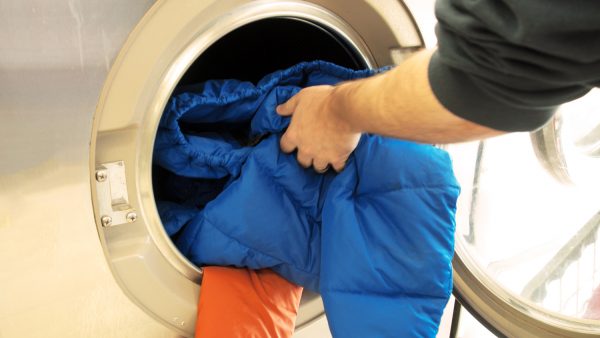
How To Wash Your Down Jacket At Home
Season’s Over; Isn’t It About Time You Get That Puffy Back To Clean?
Front loader needed for washing down. Credit: REI
Not only are your season-dirty down jackets, vests, and even sleeping bag dirty and smelly, if you left them that way, they would lose their heat-insulating properties. It is easy to destroy your down gear if you don’t follow some basic rules when washing them at home. It’s not difficult, but it does take some time and know-how.
You will need:
- a front load washing machine and a dryer (Top load machines are not recommended.)
- a bucket
- special down liquid detergent
- three-four new tennis balls or reusable drying balls
- a new sponge (for washing dishes)
- a clean toothbrush (or something similar)
- three hours of free time.
10 How To Steps
- Purchase a liquid detergent specially designed for down. Try either Granger’s or Nikwax. You will need about a cap (50 ml) for a jacket.
- Inspect the jacket and find especially dirty spots. A bright light really helps. Close all pockets, velcro, and zippers. Turn your jacket inside out.
- Soak your jacket in cold water in a clean bucket. Drip a bit of detergent on a sponge and create some foam. Apply foam on wet, dirty areas. Let foam to penetrate the fabric for five to 10 minutes. Brush the really dirty areas with toothbrush. Let it soak for 20 more minutes.
- Pull out the detergent dispensing tray of your washing machine, clean it thoroughly. Even a small amount of a wrong detergent or a softener can negatively affect the condition of the down.
-

Tennis Balls or Dryer Balls are needed to keep the fluff up. Credit: REI
Take the bucket right next to the washer and gently dump your jacket inside the washer. Add three-four new tennis balls or reusable drying balls. Hint: no balls, no worries. Roll balls out of your heavy cotton socks, wet them, and throw into the washer.
- Fill one cap of the detergent, (or the recommended amount in the instructions), into the receiver for the liquid medium. All washers are different, so ideally you need the lowest temperature, the slowest speed, and the longest time —one hour or more. Press the button and…take a break: have a cup of coffee or mow the lawn.
- After the machine stops, look at the contaminated zones. Again, a bright light is your friend. If you still see dirt, repeat step three to five. Check again.
- Now, On to your dryer. Set the lowest temperature, the lowest speed, and the longest time . One and a half hours or more would be fine. Click the button and…take another break.
Pull out your clean, dry jacket and hang it on a wide hanger. Regardless of the price and the country of origin (China, Canada, Hungary) of a jacket, feathers may come out. It is just a question of when. This is a natural process, don’t be surprised if it happens to you. Do not pull out the protruding feather because you will create a larger hole in the fabric and way more feathers will follow. Try to push the feather back inside.
9. Almost all down jackets are only water-repellent and not water-resistant (unless they have membrane fabric like Gore-tex). A few percent of all down jackets do not even have water repellent properties. Those are designed to be a mid layer, which goes under a water resistant shell jacket. All the rest have a water-repellent coating. A smart user should restore this coating after washing, otherwise the fabric will absorb and even let moisture go through in case of rain or wet snow. And water is bad for down. Use a product for water-repellent restoration, typically in a spray. Again Granger’s and Nikwax are very reliable. Apply it according to the instructions. Let it dry.
10. Done! It is time to use your downy friend.

Nixwax and Grangers are specially formulated for Down. Credit: Mountain Equipment Coop
[authors_page role=contributor]