


Roger Lohr Named X-C and Snowshoe Editor for SeniorsSkiing.com
Roger Lohr has been named cross country and snowshoe editor of SeniorsSkiing.com. Mr. Lohr is founder and editor of XCSkiResorts.com, a promotional website for recreational and travel-oriented cross country skiing and snowshoeing.
Roger Lohr
“We welcome Roger to the editorial staff of SeniorsSkiing.com. His participation will expand the site’s cross country and snowshoe coverage, two activities popular with our readers,” said Mike Maginn, editor and co-publisher. More than 90% of SeniorsSkiing.com subscribers are alpine skiers. About 60% engage in cross-country and/or snowshoeing.
Roger’s extensive background in snow sports includes working with Snowsports Industries America (the winter sporting goods trade group); serving on the Board of Cross Country Ski Areas Association; collecting data on cross country skiers; running cross country promotional programs, and writing about cross country skiing and snowshoeing for numerous media outlets.
“We always thought baby boomers would grow cross country skiing to an unprecedented level, but it simply hasn’t happened,” Lohr commented . “At SeniorsSkiing.com, I plan to encourage older skiers and non-skiers to try cross-country skiing on a groomed trail and with a lesson. It is wonderful exercise and a great way to enjoy winter.”
A Brief History of Why There Aren’t More Innovative Ski Boots
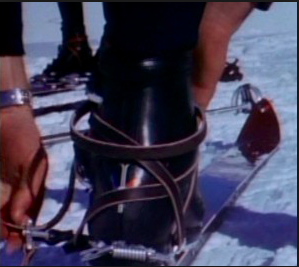
As a SeniorsSkiing.com reader, you may remember how much plastic inserts increased the lateral stiffness of your boots. Back in those days, if you were really cool, your boots were further stiffened when wrapped with a six-foot long thong.
Photo: Dick Barrymore
Then the plastic boot shell arrived, along with innovative designs from Rosemount, Scott and Hanson.

Hanson

Rosemount

Scott
The plastic boot made long skis easier to control and turn but hasn’t evolved much over the past fifty years. Liners made from foam, air, cork and other materials, coupled with adjustments for cant and forward lean, made them more comfortable. Standardized soles improved binding function.
 What has changed the sport are shaped skis. They are lighter, easier to turn, and just as, if not more stable, than the 200+ centimeter skis of yesteryear.
The molded plastic boot was designed to optimize the amount of leverage a skier could apply to a long ski. Initiating a turn required unweighting the ski, rolling the knees and pressing forward to pressure the ski tips. A job for a stiff boot.
To turn a shaped ski, the skier rolls his knees back and forth across the fall line. The technique requires less forward pressure because of the skis’ greater side cut.
Back to boot design.
Most, if not all the boots on the market today are based on designs so old they’d qualify for a subscribsciption to SeniorsSkiing.com. Each boot size requires a separate mold and most boots come in nine sizes making a set of molds a million dollar investment. With manufacturing runs in the thousands, the amount the maker can recoup per boot is limited. ROI is one holdback to new boot design.
The second is flex. In the mid-70s, when I was running the ski equipment test programs for SKI Magazine, we thought measuring boot flex patterns and creating an objective way to measure ski boot performance would be relatively simple. It wasn’t.
Boot flex is determined by the:
- Mold design;
- Material from which the boot is made;
- Air temperature;
- Tightness of buckles;
- Fit;
- Foot volume; and
- Co-efficient of friction between the skier’s socks and the liner!
In an attempt to fill the “metrics void,” boot makers created flex indexes and measurements. Each boot maker has its own formula, so comparing one index to another is an apples-oranges affair. The only real way to test/compare ski boots is to ski on them. Even then, “normalizing” the test is difficult because each skier:
- Has a different foot;
- Doesn’t weigh the same;
- Skis differently;
- Has different leg strengths;
- Buckles them differently; and
- On and on, ad infinitum.
So now you know why new boot designs are few and far between.
Next week: How Apex is Rethinking Ski Boot Design

Reader Opinion: The IKON vs M.A.X. Pass For Northeast Skiers
Compare Ikon and M.A.X. And Major Differences Are Revealed.
To evaluate the Ikon Pass I’ll compare it to what it replaces, the M.A.X. Pass, and look at what it offers in and of itself. Because they are at similar price points I’ll be comparing the M.A.X. Pass with the Ikon Base Pass. While both passes include a variety of resorts across the US and Canada, this discussion is based solely on Northeast resort offerings.

 Apologies in advance to fellow skiers in other parts of the country for I’m writing about what I know about, the Northeast—New York and New England, I’ve skied at 12 of the 13 resorts mentioned in this article. In recent posts to SeniorsSkiing Torry Hack (3/15/18) and Jon Weisberg (3/20/18) also discuss the Ikon Pass.
The early purchase price of the Ikon Base Pass for 2018 -19 is $599 while the early purchase price of M.A.X. Pass for 2017-18 was $630. The Ikon Base Pass offers skiing at six resorts in the Northeast compared to 13 with the M.A.X. Pass. The Ikon pass adds Sugarbush but eliminates Belleayre, Pico, Gore, Mount Sunapee, Okemo, Wachusett, Windham and Whiteface. There are no special price categories for seniors for either pass.
With the Ikon Base Pass, we’re offered five days at three of the resorts and a total of five days combined at Loon, Sugarloaf and Sunday River. That’s a total of 20 days, and there are 10 blackout days.
The M.A.X. Pass had five days at 13 Northeast resorts for a total of 65 days and no blackout dates.
When I contacted Ikon pass with my concerns about their new product, they responded quickly which was appreciated. However, this is the response I received:
“We feel this new product will replace former existing products by adding more opportunity, benefits, and appeal to skiers and riders. As this new product grows, there is always potential for more resorts to be added.”
I struggled a bit on how to comment on the first sentence. There were many responses I considered but after reflection I’ll just say it’s akin to fake news.
The second sentence is encouraging. It would be wonderful for additional resorts to be added to the Ikon Pass and all the better if there were more privately and publically owned resorts included.
 Though the Ikon Base Pass is disappointingly inferior to what it replaces, it will still offer value and variety for some Northeast skiers. Like any pass, if you use them enough they are a terrific deal. Multi-resort passes such as the Ikon Base Pass offer variety, and each of the Northeastern resorts included in the Ikon Pass is top-notch. If you plan a trip to any of the Ikon resorts out west, buying the pass is a no-brainer.
The full Ikon Pass at $899 offers unlimited skiing at Stratton and seven days at the other Northeast resorts mentioned. For those interested in a lot of Stratton, this may be a very attractive option.
Whether the Ikon Base Pass is right for you obviously depends on your individual preference and circumstances.
For me and my three ski buddies who also have the M.A.X. pass, we’re going to pass on the Ikon Base Pass for next season.
[authors_page role=contributor]