


Going Retro
If You’ve Been Into Snow Sports For A While, You’re Gonna Have Retro Clothes. Find Them, Take A Pic, And Send To Us.
We have hats from the 60s, sweaters from the 70s, boots from the first time we went cross-country skiing, knickers, lots of old stuff we could never toss. Well, we’re having a bit of fun wearing them around the various snow fields (slopes, trails) that we habituate, now that snow is on the ground.
Send us a picture of you in your vintage togs, we’ll publish it and put them all together on a special page. Will be fun to see what you’ve got in the back of your closet. Just send a JPEG or PNG to info@seniorsskiing.com

Even retro ski poles…Skiing at Appleton Farms, Ipswich, MA.
Credit: A. Maginn
Here’s a pic of yours truly in a 1966 Moriarty hat (bought at Mrs. Moriarty’s shop on the Stowe Mountain Road, by the way), a US Ski Team sweater by Montant from about 1972, and Mother Karen’s knickers circa 1970. (Props for still being able to squeeze into them.) Taken last weekend after Saturday’s snowstorm in the Boston Area.
Correspondent Jan Brunvand sent two pics.

Jan’s been wearing this jacket since high school.
Credit: Jan Brunvand
The first shows him wearing a nylon unlined jacket covered with ski patches, posing at main entrance of the Peruvian Lodge at Alta. This was taken on his 84th birthday, March 23, 2016. He’s had this jacket since high school and wore it through college over a heavy sweater on a regular basis. He’s added patches over the years, and is about to start putting them on the back. The label identifies the brand as “Ski Trail Sportswear” with the same name printed on the leather zipper pull.
The picture below shows Jan’s wife Judy wearing a wool Demetre sweater with a sleeve logo alluding to Spider Sabich (1945-1976), who was a participant in the 1968 Winter Olympics. She had it on at the mid mountain restaurant at Vail in 2013 when Jan spotted a young man wearing an orange, black and yellow version of the same sweater. He said his father had let him borrow the sweater for the trip west. Demetre also made a black, white and red version of this sweater, although I have never seen one, only pictures.

Spider Sabich logo sweaters from the late 60s.
Still work.
Credit: Jan Brunvand
Finally, correspondent Tamsin Venn found a picture of real people in long ago outfits from a gathering of the Ski History folks a couple of years ago at Stowe.

More than retro, these outfits are just old-fashioned.
Credit: Tamsin Venn
Send yours in and we’ll see what senior skiers have been sequestering for decades.
Top Ten Reasons I Enjoy Being A Senior Skier
#10. I have nothing to prove.
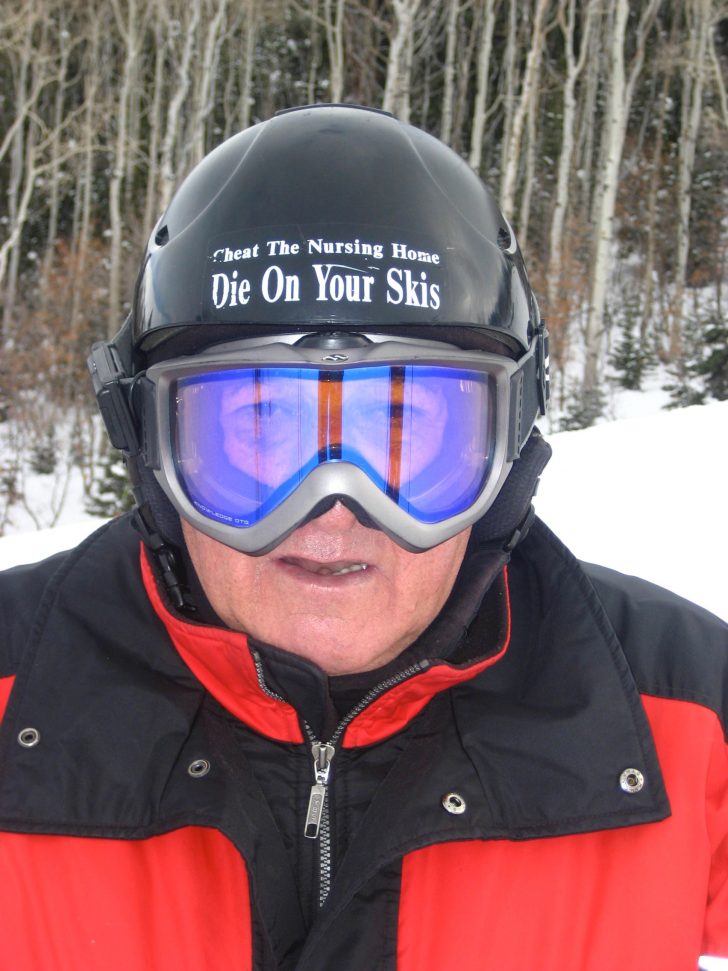
I don’t need to ski bumps, steeps or crud. It’s challenging enough just skiing blues at age 84.
A guy with the right attitude that I met at Deer Valley a couple of years ago. He told me he wanted to add to the message on his helmet, “ . . . but not today.” Credit: Jan Brunvand
#9. Skiing impresses my non-skiing peers.
When folks ask “Are you still skiing,” they mean “still” as in “At your age?” not “still” as in “Is there still any snow up there?” I try to be a ski missionary and convince some old friends to return to skiing or to try it for the first time.
#8. Everything works better than when I was a kid.
Skis turn more easily, bindings release when they’re supposed to, and boots are actually comfortable. Ski clothes are lighter, warmer, and drier than in the good old days of wool and windbreakers.
#7. I have a built-in excuse for just about anything . . .
. . . like taking green runs, skiing half days, having extra coffee breaks, asking the liftie to slow it down, and forgetting where I parked.
#6. Skiing half days.
Did I mention this? I forget. Anyway, my wife and I ski what we call the “middle half”—start about 10:00 and quit about 3:00. We take at least five runs to count it as a ski day.
#5. Skiing with grandkids.
Until they’re about ten, the grandkids ski at about the same pace as us, and afterwards they’ll fetch us a coffee while we sit out a couple of their runs on the steeper stuff. If you ski with the kids you may be able to keep them from going to the dark side—SNOWBOARDING!
#4. Skiing midweek.
We avoid Saturdays, but sometimes ski Sundays, starting early, if that’s the only other time the grandkids are free. (If brought up properly, they can sometimes be convinced to skip school.) If you must ski weekends or holidays, split with your partner and use the singles line. You might meet someone interesting, hopefully not more interesting than your partner.
#3. Meeting other active seniors.
The 60+,70+, 80+ occasionally even 90+ jacket patches give your fellow oldsters away. Thin and graying hair under the helmets IDs them in the lodge. I always chat with peers asking where they learned to ski, and moving on to other important topics like how many grandkids do they have, are they fly fishers, and do they remember Studebakers. (I have a ’53 Commander, a good conversation starter with older people.)
#2. It’s a good kind of tired.
After a nice half day of skiing, by the time I get the boards off the car and myself out of my long underwear, I’m very sleepy and mellow, ready for a nap, a shower, and a drink before dinner. Ah, bliss!
And the #1 reason I enjoy being a senior skier. Senior discounts.
At my age in my area, season passes are free at Alta, $49 at Snowbasin, $20 at Powder Mountain, with other discounts and deals elsewhere. Check out the Senior discounts where you live.

In Praise Of Urban Wilderness
Find Winter Activity Opportunities Close To Home.
Let’s define what we mean by Urban Wilderness:
- Open space – wetland, meadow, and/or forested land.
- Owned by a public entity
- No parking or entrance fees
- No visual pollution
- Offers “peace and quiet”
- Accessible by either car or public transportation from the nearby urban center
- Offers a variety of activities (year-round)
Urban Wildernesses can be found in or close to many city centers. The point is that you don’t have to venture into the mountains to find winter recreation; it’s often just a short ride away. All you have to do is find them.
Here are two examples, one from the Boston Area, the other from Portland, OR. What are your favorite Urban Wildernesses?
Around Boston
Hard to believe this view of Middlesex Fells Reservation is only a few miles from downtown Boston.
Credit: Commonwealth of Mass
Near Boston, MA is the Middlesex Fells Reservation. “The Fells” has borders in four near Boston suburbs; Medford, Winchester, Stoneham and Melrose. It’s 2,575 acres bisected by Interstate I-93. The east side of I-93 is more developed. The west side of I-93 is less developed with a border road and some homes along the road on the opposite side from the Fells. Nevertheless, the west side provides more of a wilderness feel.
Several ponds act as a water supply to the town of Winchester. The Fells have a good number of trails for mountain biking, hiking, snowshoeing, x-c skiing (ungroomed) and trail running including:
Skyline Trail
The 6.9 mile Skyline Trail follows the outer perimeter of the western Fells. There are spectacular views of Boston and the surrounding area. Most of the Skyline trail is in wooded landscape, with several steep ascents to rocky outcrops.
Reservoir Trail
The 5.2 mile Reservoir Trail encircles the north, middle and south reservoirs, and the open water can be seen from many sites (the reservoirs are for drinking water, so access to them is prohibited).
Cross Fells Trail
Beginning in the western Fells near the Medford High School, the 4.5 mile Cross Fells Trail gives a good sampling of the features of the Reservation, from wetlands at Whitmore Brook to open water at Quarter Mile Pond in the eastern Fells, to views at Cairn Hill. Use caution crossing South Border Road, Route 28, Woodland Road and the Fellsway.
For more information about Middlesex Fells Reservation, click here.
In the Boston area, there’s also Walden Pond, site of Thoreau’s cabin, in Concord, and Appleton Farms, a 900 plus acre working farm established in 1638, in Ipswich.
Here’s a brief description of a ski tour around Walden Pond.
And here’s what it’s like cross-country skiing at Appleton Farms.
Around Portland, OR

Forest Park is practically in downtown Portland, OR.
Credit: Forest Park Conservancy
At 5,157 acres, Forest Park in Portland, Oregon is one of the largest urban forests in the United States. With more than 80 miles of trails, Forest Park stretches for more than seven miles along the eastern slope of the Tualatin Mountains, at the convergence of the Columbia and Willamette Rivers. As stated in the park’s website, “Forest Park offers an unparalleled opportunity for visitors to experience a true Northwest forest without leaving the Portland city limits.” Forest Park immediately came to mind as an archetypical urban wilderness.
Activities along the 80 miles of trails include:
- Horseback riding
- Hiking
- Cycling/mountain biking
- Running – trail and road
- X-C Skiing, Snow Shoeing (when and if it snows)*
Among the park’s trails are:
Ridge Trail
Trailhead access for the Ridge Trail, which is only open to pedestrian use. To find the trailhead, park at the obvious pullout on the way down Bridge Ave (heading toward Portland). You will then need to walk back up Bridge Ave roughly .2 mile to find the actual trailhead.
The Wildwood Trail
30.2 breathtaking miles, from the southern end of the trail at the Vietnam Veterans Memorial in Washington Park to the Northwest terminus of the trail at Newberry Road.
*The city of Portland averages only 4.3 inches of snow a year, so winter activities are the often same as activities the rest of the year. But, what a place to get you in shape for skiing on Mt. Hood only 50 miles from downtown Portland!
For more information about Forest Park, click here:
Please tell us your favorite urban wilderness. What makes it special to you?
[authors_page role=contributor]