

Shape Up: How To Get Fit For The Season
Progressive Exercises From Easy To Difficult Can Help You Tone Up.
 Okay, it’s late October, and you’ve put this off long enough. You need to limber up for the upcoming snow season. Without topping up your muscles and stretching those ligaments, you can hurt yourself and have a very short season indeed. With some daily or weekly fitness routines, you can feel and move better on the slopes and trails. So, get going.
Check out our collection of Conditioning articles under the Health tab. We have recommendations for some basic yoga poses as well as advice on calibrating your exercise regime to your age. Be advised, if you’ve spent the summer cycling, hiking or kayaking, you may find that you’ve got to pay attention to muscle groups that aren’t engaged in those exercise activities. If you’re a walker, you need to think about your upper body. If you’re a cyclist, what about those hamstrings and shoulders? Rowing a kayak will build your arms, shoulders and abs, but what about your lower body? See? Even though you’ve been active, you need to think total body for the season coming up. Both Alpine and Nordic skiing require active muscles groups all over your body’s geography. So think total body work out.

Physical Therapist Rick Silverman starts us off with a basic leg lift.
Under the Health>Conditioning menu, you will find a progressive series of exercises that are designed to do just that. Physical Therapist Rick Silverman shows us a set of exercises from easy to moderate to more difficult that will get your battery charged up. In the series, Rick demonstrates exercises for abs, quads, hamstrings, and hips. You can add your own favorites to this basic set including some basic yoga poses like squats, planks, and down dog. Yes, add Tai Chi, too.
Here are some links the Rick’s series. And we have correspondent Rose Marie Cleese’s own story of her fitness journey for inspiration. Check them out and start thinking about a regular conditioning program.
Rick Silverman’s progressive exercise series:
Rose Marie Cleese’s fitness journey starts here.
If you’re reading SeniorsSkiing.com, you are typically an active senior, so the advice in this article probably make sense to you. Nevertheless, we know older folks who venture out into the snow world without preparing themselves and wind up injured and unhappy. You can avoid this; get going!

Snow Sport Leaders: Herman Dupre, An Original Maker Of Snow
Son Of Immigrant Parents, Herman Dupre Found A Way To Give The Sport Snow.
Innovator, pioneer, snowmaker, Herman Dupre is a legend in snowsports.
Aside from building the Seven Springs ski area in western Pennsylvania into a major mountain resort, Herman Dupre’s claim to fame is that he is a pioneer in snowmaking. He always tinkered with how to utilize high pressure air and water to help Mother Nature spread some snow on our local area which is hampered by cyclical warm weather/cold weather events. When you ski in the mid-Atlantic, you need some help to keep the slopes open. Snowmaking was the answer, and Herman was at the forefront.
Dupre holds 34 U.S. patents for the HKD snowmaking system. He is the chief engineer for Snow Economics, Inc. and his system is now sold worldwide. His new Backyard Blizzard home system based on the HKD concept became available in the winter of 2000. Without the benefit of his work, many winter resorts throughout the world would not have the snowmaking capability they utilize today.
In 1973, he applied for and received his first of many patents, and in 1990, he introduced the standard tower snow gun that was the first of many low energy products that he and his son in law, Charles Santry and his daughter Anni would bring to the ski area management market.
If you look at their website, you will find all the technical detail of their tower guns, and their new fan jet technology with their recent acquisition of a Canadian company which has increased their R&D capabilities as well as their engineering expertise.
Click on the video below to hear Herman tell his story.
Here’s A Special Gift Idea: Eat A Tree
If You’re Looking For Novel Gifts For Snow Country Lovers, Yummies Made From Fir Trees Are Worth A Look.

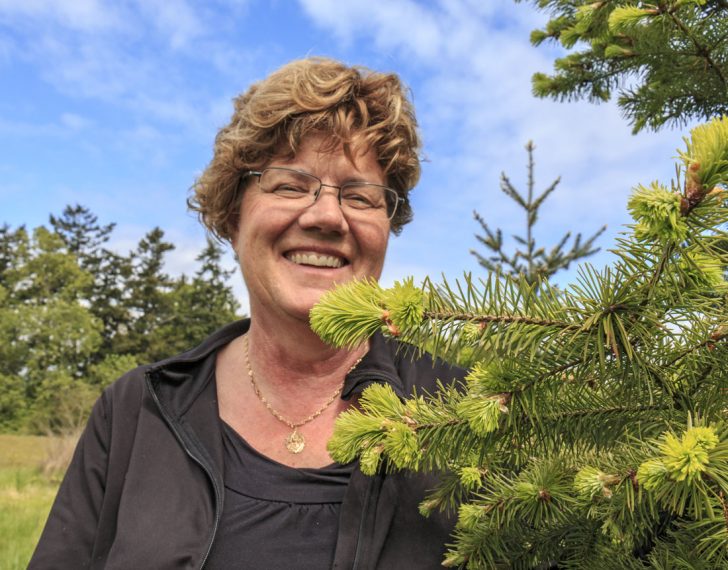
Laura Waters at her shop, Snowdon House outside Victoria, BC, Canada on Vancouver Island, where she sells edibles made from new growth on douglas fir trees. These include vinegars, jams, dried seasonings and more.
Credit: Yvette Cardozo
Of course, this is a Christmas story. What else when you are talking about eating Christmas trees?
It’s just the growing tips that you eat, actually. And the pine flavor is, well, way better than you expect if you are more used to sniffing pine sap from your fingers when handling fresh cut boughs.
When Laura Waters planted Douglas firs on her four acres of land in 2009, she intended to sell them for Christmas trees.
“But it takes six years for them to grow and then, all you wind up with is stumps,” she said one late spring day as we inspected the bright green growing tips of her trees.
“I was out there, hot and bothered, mowing to keep the grass down between the trees and I had a pot of strawberries on the stove in the kitchen. I cut a branch and out of curiosity, tossed it in.”
The same way that vinegar adds an essence of sweet/tang to fruit compote, the fir tips added … something. And it was a sweet and tangy something good. That experiment became Laura’s first strawberry fir vinegar.
A bit of research revealed that First Nations people in the area used to make tea from the fir tips. It was not only tasty, it provided more vitamin C than citrus fruit.
“When Capt. James Cook was on the BC coast, everyone had scurvy and the local natives told them to make tea out of the Doug fir tips. That took care of the scurvy,” Laura added.

There are lots of way to take the essence of fir trees and make edibles. Laura Waters has literally “botted” trees.
Credit: Yvette Cardozo
Laura’s first vinegar led to carbonated drinks, which led to fir seasoned bread, brie toppers, a drinkable vinegar that you add to evening cocktails, dried seasoning blends and more. She sells all this in her shop, Snowdon House, in North Saanich, a suburb of Victoria on Vancouver Island. While I was there, a group of visitors arrived. They had come up from Seattle by ferry and taken a cab out to the shop.
Along with the visitors, I tasted the fir essence drink, a bottled non alcoholic drink that was amazingly refreshing. It had a piney back woods flavor that hit the top of my tongue, along with citrus and floral notes. I learned I could pretty much make my own with Laura’s fir vinegar, so I bought a bottle to add to tonic (with a bit of vodka) at home.
We also nibbled our way through her Fir and Fire Brie Topper, which is actually a sweet, piney red and green chili jam that offsets the stringent brie flavor really well. Plus I bought a packet of dried seasoning blend (parsley, lemon peel, Doug fir, dried spinach, ground juniper berries) with which I plan to make a party dip.
There’s a bread mix (with an added blend of Doug fir tips and juniper berries) that results in fresh bread with a pine accent. Laura also makes gift papers by hand and sells outside products such as organic hot chocolate mix wrapped in her hand made gift papers, plus there’s racks of her handmade gift cards. And fresh eggs she sells when her crowd of chickens are in a producing mind.
In addition, she has created a collection of recipes and holds cooking classes. The one she did the day before I visited featured chicken thighs marinated in apricot and bay leaf vinegar, cooked in the vinegar, then wrapped in flat bread with mayo and her apricot/mango topper (yes, she makes toppers that don’t involve fir tips).
If this isn’t enough, on her drawing board are plans to dehydrate the tips for a tea and she was experimenting when I visited with pickling fir tips to make into capers. And then, there was also the Doug fir flavor to be whipped into butter for popcorn topper.
Plus the B&B she opened this year.
Meanwhile, her shop is open Tuesday through Saturday 10am – 5pm.
Yes, Laura Waters is a very busy woman.
[authors_page role=contributor]