

How Not to Learn How to Ski
Editors Note: This article comes from SeniorsSkiing subscriber Chet Kaplan from Brooklyn, NY
Credit:4maksym
I tried to learn to ski in my early 50’s, going on a day trip whenever I could. I rented equipment and was always eager to get as much free advice as possible. “Lean forward!” “Hold your arms out as if you’re carrying a tray!” “Bend your knees!” “ “Always face down the hill!” “Breathe!” Somehow, despite all this slightly confusing information, I managed to begin to parallel ski because I got very tired of snowplowing.
The second season of my ski career I was invited join two friends who were excellent skiers at Whiteface Mountain. Knowing that we could not possibly ski together, they urged me to join the Mountain Tour to become more acquainted with the area, so I signed up.
The guide took us up a lift to the top of a run and said, “Follow me!” As I looked down at what seemed to be Mt. Everest, my brain went into overdrive as I struggled to comprehend what I had gotten myself into.
I realized I had not yet made out my will, if I did go down and did. An instant later, I convinced myself I’m probably a much better skier than I imagined, so I began down the hill at what seemed like 100 mph.
Within a few seconds, I fell and found out later that I tore some cartilage in my chest. But I was alive! That ended my ski season, but I healed in time for ski season number three.
The next season a group invited me to join them in Utah. I thought that this was a wonderful opportunity to become a good skier, so I quickly signed on. My friends were supportive, offering me lots of advice, all for free! “Press down with your big toe!” “More flexion!” “Stand taller!” “Bend your knees more!” “Move your hips forward!” My favorite was “Chet, relax, this is supposed to be fun!”
I did begin to ski more parallel until the day we went to the Canyons and opted to do the Mountain Tour. I was directed to join the more advanced group. Instead of changing to the slower group I followed some advice which was, “The only way to improve is to take more risk and go with more advanced skiers!” This was my golden opportunity!
My group got off the lift and went to the top of a steep mogul run. After looking down, I quickly told the guide that I had never skied anything like that. He said not to worry, just follow him. The last time I heard “follow me” it did not turn out well. So, I decided that if again I made the wrong decision, the first thing I would do after returning home would be to immediately register for a new IQ test. Falling very hard on the first mogul, I tore a calf muscle. After some time in PT, I was advised that this is all part of learning to ski!
Determined that I would start having fun by becoming a good skier, I then joined “Ski College” in Park City in early December for several seasons. This involved 5 hours each day of group instruction for 5 days with a “Certified instructor”. One day, I asked the instructor for any advice on how I was doing. He said “Fine”. The next season I had an instructor who only advised, “More angulation!” That was all he ever said. At the end of the week, I asked how he thought I progressed, and he said, “More angulation!”
It’s very possible that the best advice I ever received was from myself. When I am completely balanced, relaxed and comfortable on my skis, I register what my body needs to do to achieve that feeling. I’m also very lucky to ski with wonderful folks in the 70+ Ski Club who rarely give me advice. Maybe I’m finally learning to ski?
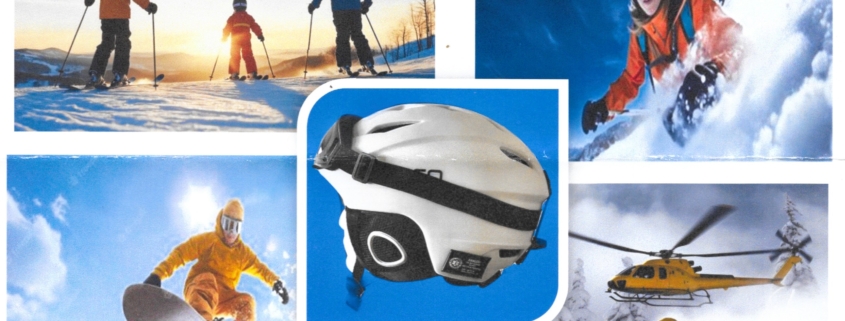
The Alpine Helmet ID+ Kit transforms your helmet from just protection to a first responder’s info source
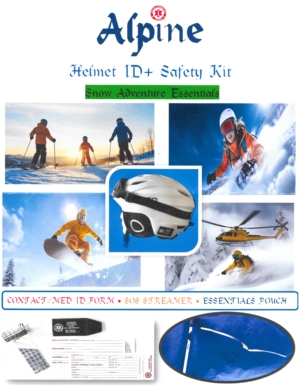 Safety on the slopes is consistently the top concern of SeniorsSkiing.com readers. Now you may elevate your safety, and that of others, with the Alpine Helmet ID+ Kit.
This unique skier/snowboarder safety solution integrates Emergency Medical Services (EMS) with Search and Rescue (SAR). The ultra-compact and durable Kit combines your medical/contact ID with a high-visibility Trail Marker designed for maximum emergency assistance. The “dual-purposed” Kit allows instant access to your essential personal information while empowering another skier to provide a SAR tool to deploy the high-visibility Trail Marker that helps rescuers pinpoint your location rapidly. The Alpine Helmet ID+ Kit is your ideal “ski buddy.” The Kit offers peace of mind by combining critical information with high-visibility rescue features, helping ensure rapid response to unanticipated events on the slopes.
This Kit includes:
- Waterproof/Weather-Resistant Medical ID and Contact Form: Safeguard your important medical details with this durable, easy-to-access synthetic ID that can withstand the harshest conditions.
- 30” High-Visibility SAR SOS Streamer: This long, reflective streamer ensures you will be quickly spotted in an emergency, enhancing your visibility to Ski Patrol (and SAR) on the slopes.
- The 1”x 1 7/8” Vinyl Essentials Carrying Pouch adheres to the helmet using an industrial-grade weatherproof adhesive for secure attachment, making it easily accessible in any situation. The adhesive used is a unique industrial/automotive formulation that performs well at high speeds, is weatherproof and unaffected by low temperatures. The formulation is free of plasticizers found in most adhesives that degrade helmets over time.
- The pouch includes an EMS Identifier logo to notify first responders plus also features a WARNING label to prevent helmet removal by non-professionals. The Pouch explicitly warns bystanders “DO NOT REMOVE THE HELMET” as any movement could exacerbate a spinal injury. Keeping the helmet on also provides physicians with information indicating the mechanisms of trauma to guide their evaluation and treatment.
- The pouch is universally positioned on the left rear of the helmet. This allows emergency personnel to quickly and easily locate your vital information. This instant access to your information saves valuable time and eliminates the need to search through clothing layers.
- The medical data form is a synthetic material impervious to moisture and tearing. Your information is easily printed with a pencil. The pencil is recommended as the synthetic form is non-porous and ink is not absorbed leading to smudging and fading. The graphite “lead” lasts indefinitely yet is easily erasable, permitting you to “Edit with Ease” to keep your data current and avoiding 3rd party intervention.
- Once affixed to the helmet, your “Safety Companion” now travels with you automatically everywhere you go and is always ready!
- The holographic SOS Streamer/Location Identifier is highly reflective both day and night. Each streamer is designed with a short flap that makes opening much easier, especially when wearing gloves.
- The dual purpose of instant access to medical ID plus the SOS trail marker is a unique concept of combining EMS with SAR to better facilitate response to an incident.
The Alpine Helmet ID+ Kit is very well thought out, quite simple, yet very effective in an emergency. The retail cost of a 2-pack is normally $6.99 Thanks to an agreement between SeniorsSkiing.com and the makers of the Alpine Helmet ID+ Kit SeniorsSkiing.com readers can use Coupon Code SS65 and get the 2-pack for only $5.00 total. Isn’t your safety and that of your loved ones worth $2.50 a person? We think so. That’s why the Alpine Helmet ID+ Kit will be on our helmets this season. To get your discounted kit, click on their banner ad.
Your helmet protects your head. Now use it to protect your life with the Alpine Helmet ID+ Kit
For more information visit https://www.emergencyid.net/. If you want to purchase the Alpine Helmet ID+ Kit in bulk for your group or organization, simply contact them at info@emergencyid.net for special pricing.
XC Skiing-What It Is, What It Isn’t, And Who We Are
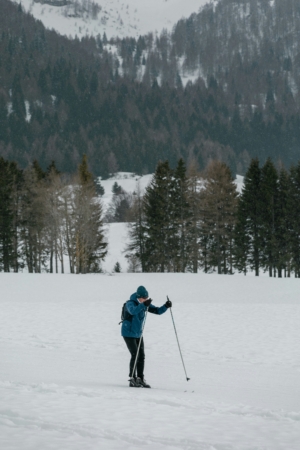
Photo by Laura Lezman on Unsplash
Cross country skiing has a complex and formerly unenviable reputation. Many North Americans, including ski media, used to visualize it as acceptable only when there was no downhill alternative. Couch potatoes and many alpine skiers took know-nothing or condescending attitudes, and XC often was viewed as technically simple to the point of boredom, granola-and-wool dowdy, and primarily practiced by young masochists.
Dr. Bob Arnot, former NBC News Chief Medical Correspondent and himself in the mid-70s, writes that “Aerobically, XC is the finest recreation you’ll ever find. It builds muscles and lowers body fat – a single hour of moderately-pace skiing burns 800 calories…”
Here’s a true story about XC stereotyping, from my conversation in the 1980s with a Colorado alpine resort manager. He told me they wouldn’t allow cross country skiers to take up valuable parking spaces because “He’s a guy who heads into the woods on Friday and comes out Sunday without having changed either his $5 bill or his underwear.”
Times have changed. Today, aficionados recognize the sports’ cardiovascular benefits, and also love it for the grace, variety, conviviality, and the taste of clear air, pure light, sighing wind. Today, it’s more than mere recreation, it’s exhilaration.
XC can be enjoyed from the moment you attach boots to boards, but it takes time to become an accomplished skier. As to the familiar “It looks like so much work!” misunderstanding, running a marathon is physically demanding too – but like jogging, XC is something you can do at your own pace.
As to the lycra-wearing-loner-male-athlete-with-a-frozen-mustache stereotype, it was sorta-kinda apt decades ago, mostly before machine-groomed trails..
Fewer Mishaps
Another XC attraction is very low injury frequency, and even then, the damage is almost always minor. Hypothermia and frostbite are possible but infrequent. Yes, you can get hurt, or lost, or chilled, but if you’re at a XC ski area properly clothed (no sweat-inducing parkas!), it’s very unlikely – and as with downhill, there will be people around to help.
Over the past 50+ years, I’ve skied thousands of kilometers -including silly things such as skiing backcountry solo – and twisted an ankle once, and I was back out on the trails within days.
Finally…
Cross country ski areas come in all shapes, sizes, settings, and qualities. Generally, they offer instruction and often also accommodations and dining. They may be community parklands, alpine ski area affiliates, guest ranches, golf courses, centuries-old inns, even real estate developments, with activity options, too.
It’s quite all right to take an afternoon or a full day to enjoy other forms of recreation such as relaxing with feet up, reading a good novel, glass of wine in hand, glancing occasionally at falling snow. Give a thought to museums, antiquing, night life, toy factories, bookstores, snowshoeing, ice skating, ice fishing, sporting clays, disk golf, enjoying local accents, country stores, arts and crafts, hot tubs, even horseback riding and dogsledding. OK, snowmobiling too.
Fellow XC ski writer Roger Lohr says,” I prefer to go Nordic skiing on the weekend or when it is colder because groomed Nordic ski trails are very skiable, there are no crowds as fewer people go XC skiing and the skiers are spread out along miles of trails, it’s easier to keep warm… (muscle utilization warms the body), and Nordic area trail passes are significantly less costly compared to the weekend/holiday rates at alpine ski areas.”
There are elegant and vast operations along with small and intimate, moms-and-pops, in mountains, valleys, meadows, forest. Some destinations are intriguing only for a couple of days, with not be much to do but ski. However, many lodges, ranches, and resorts can be immensely fulfilling for a week or more. Thes merit annual visits, combining beautiful settings with dependable snow and fabulous food. The folk who run them often do it for love as much as for money, and their affection for the land and way of life imprints every aspect of the business.
In choosing your destination, there’s so much variety that it’s worth defining vacation priorities. Is cross country skiing the primary objective, or part of a mix with downhilling? Is magnificent setting the overriding interest? Wildlife? Lodging and dining quality? A quiet or a lively ambiance? Do views of the Continental Divide justify altitude acclimation time? (Adjusting to elevation isn’t an issue in most regions, but above perhaps 6,000’, it’s sensible to take it very easy for at least a day.)
There are more than 100 alpine resorts in the USA and Canada with major Nordic affiliates, lodging, dining, and other services on the premises for multi-day visitors – think Sugar Bowl (Royal Gorge), CA; Silver Star, BC; Crystal Mountain and Boyne Mountain, MI; Mont-Sainte-Anne, QC; Bretton Woods and Waterville Valley, NH. Or, go wild and take in a Nordic-with-no-downhill destination. Whether your goal is beauty, entertainment, romance, history, family time, fellow souls, or endless exercise, there is an ideal cross country ski vacation.
P.S. XC trail distances are measured in kilometers (1 km. = .6 miles). You’ll notice that saying “I’ve skied 10 kms. this afternoon!” marvelously improves the appetite and frequently justifies a second dessert. It’s all part of the fun!
[authors_page role=contributor]