


Fitness Focus: Plank, Plank, Plank
This Pose Is Considered The Simplest, Most Effective Core Strengthener.
Pretty basic, but effective. It’s easy to do it incorrectly so study up.
Credit: Yoga Lily
“Plank, plank, plank,” says Jan, the exercise instructor at the head of our class. After an hour of kick boxing, we start the floor exercises to end the session. We get into plank position as she intones, “Plank, plank, plank”. The seconds roll by.
High plank or Phalakasana pose. The most glorious of simple exercises, body weight held in place by core strength. Arms, wrists, shoulders, lower back, abs, gluts, all working to hold the position.
The proper plank position can be found by putting your hands under your shoulders, extending up to a full, high plank on your toes, body a straight line from heels to back of head, eyes focused about a foot ahead of you, chin tucked. Basically, it’s like the top of a push-up, making sure your body is straight and not sagging or arched. While you’re up there, you can flex your feet, bend one knee in, then the other. Put one foot’s toes on the heel of the other foot, then switch. If you hold yourself still, you can feel your muscles adjusting and keeping you balanced.
High plank can be modified by resting on your knees versus your toes. That might be a good place to start if you haven’t done core exercises in a while.
If your wrists are sensitive, you can support yourself on a pair of dumb bells or yoga blocks. If you have hand or wrist issues, like carpal tunnel or rotator cuff, you’ll have to get some advice from a physical therapist or yoga instructor to help mitigate those conditions.
You can also move from high plank to low plank, moving down to resting on your forearms, arms extending in front of you, one arm at a time. Then, back to high plank. And then down to low plank. Do this slowly while mindfully keeping your body in a straight line position. Man, that’s a work out.
The benefits are impressive; you get toned up in the middle, and you will find yourself using those newly strengthened core muscles to support your back when lifting, twisting, even walking. We’ve found that lower back problems can be addressed with a strong core. Your posture will improve, too. Your mileage may vary, but plank and other exercises focused on the core can definitely help that lower back.
The experts say you should shoot for 30 seconds as a beginner to get into this. Eventually, if you can hold plank for two minutes, you’re doing very well.
You can find more advice from experts on how to safely and properly do plank here. Jen Reviews has a number of pointers and caveats on doing this exercise. More advice from the Yoga Outlet here. Jen Reviews sums up the major benefit of planking:
Planks are a very versatile exercise that target a lot of the most important muscle groups in the body. The core muscle groups are responsible in some way for helping us carry ourselves through almost every action we’ll perform in a day, so making sure your core strength is in check is absolutely vital for someone who wants to leave a healthy lifestyle.
Plank pose is also one of the Sunrise Salutation series of connected poses that cycles through all your muscles, flexing, and strengthening all of you. We’ll talk about the Sunrise Salutation in another Fitness Focus because it is a really awesome way to start the day.
You can incorporate plank as well as last week’s squat exercise along with others in a regime of strengthening, stretching and flexing that will keep you feeling good.
As with all new activities, please consult your doctor, physical therapist or exercise professional if you have any issues that might cause concern.
Cycling Series: Around Old Seattle
Biking With A Mission: Hit The Historic Parts Of Town.

Start the ride at Occidental Park, once a salt marsh. Historic bike rides bring a new dimension to a city. Credit: John Nelson
It turns out the bicycle is a great time machine.
I recently devised a tour to take in some of Seattle’s most famous historic sites. You can do it too, no matter where you live. Using a bike and a little imagination, it’s fun to explore your city in different way.
Come along on my 23-mile tour back to the 1800s, and let’s see what was happening here in Seattle.
Pioneer Square
Our journey begins in Occidental Park. Today it’s a vibrant brick-covered gathering place, but when the first settlers came to Seattle, it was a salt marsh.
As we travel three blocks north toward Yesler Way, notice how wobbly the ground is. You can thank the workers of Yesler’s Mill, who started filling much of this ground with sawdust as the city was being built. Streets throughout this part of town are uneven and unstable, as fill material was added over the years, including the refuse from a major fire in 1889.
Shoreline to Denny Hill
Heading north along Western, imagine we’re traveling on the shoreline of Seattle. Back in the 1850s, this was the waterfront—none of those piers 300 yards to the west were here.
As we pass Spring Street, take a moment to look up the hill to the east. Nine springs provided water to the early settlers in the city, and Spring Street is named for the biggest of these. To appreciate this spot, let’s take a long drink from our water bottles, and continue north toward what is now Pike Place Market.
From the market, it’s time to do some climbing, although today, our climb is much shorter than it would have been in the 1800s. Denny Hill once stood between Pike and Cedar Streets, now called Belltown.
Starting in 1897, the hill was shaved off in what is known as the Denny Regrade. Over the next 33 years, giant hoses, dynamite and steam shovels were used to remove the top 120 feet of the hill in the name of growth and development.
Lake and Forest
For now we’re done with historic downtown Seattle. Our journey takes us south and east, toward Lake Washington. But we’re not done with regrades—our tour takes us along Jackson and Dearborn streets, both of which were regraded to help the city grow bigger.
The regraded streets are nice for biking today, but back in the 1800s they were quite hilly. Jackson at one time had a 15 percent grade. In the early 1900s, the city’s busy earth-movers shaved down Jackson and Dearborn, using the dirt to fill in much of what is now the SoDo neighborhood of Seattle.
Hopping onto the Mountain to the Sound Greenway, we travel through a tunnel to Lake Washington and down to the lake shore.
Heading south along Lake Washington Boulevard, we travel to Seward Park, one of the few places we can still see old-growth trees in the city.
Along the Duwamish
Leaving Seward Park, we ride west over Beacon Hill to a pioneer farming location, Georgetown. It’s an arty, hipster hangout now, but back in the 1800s, Georgetown was on the edge of the tidal flat and had rich alluvial soil deposited by the Duwamish River.

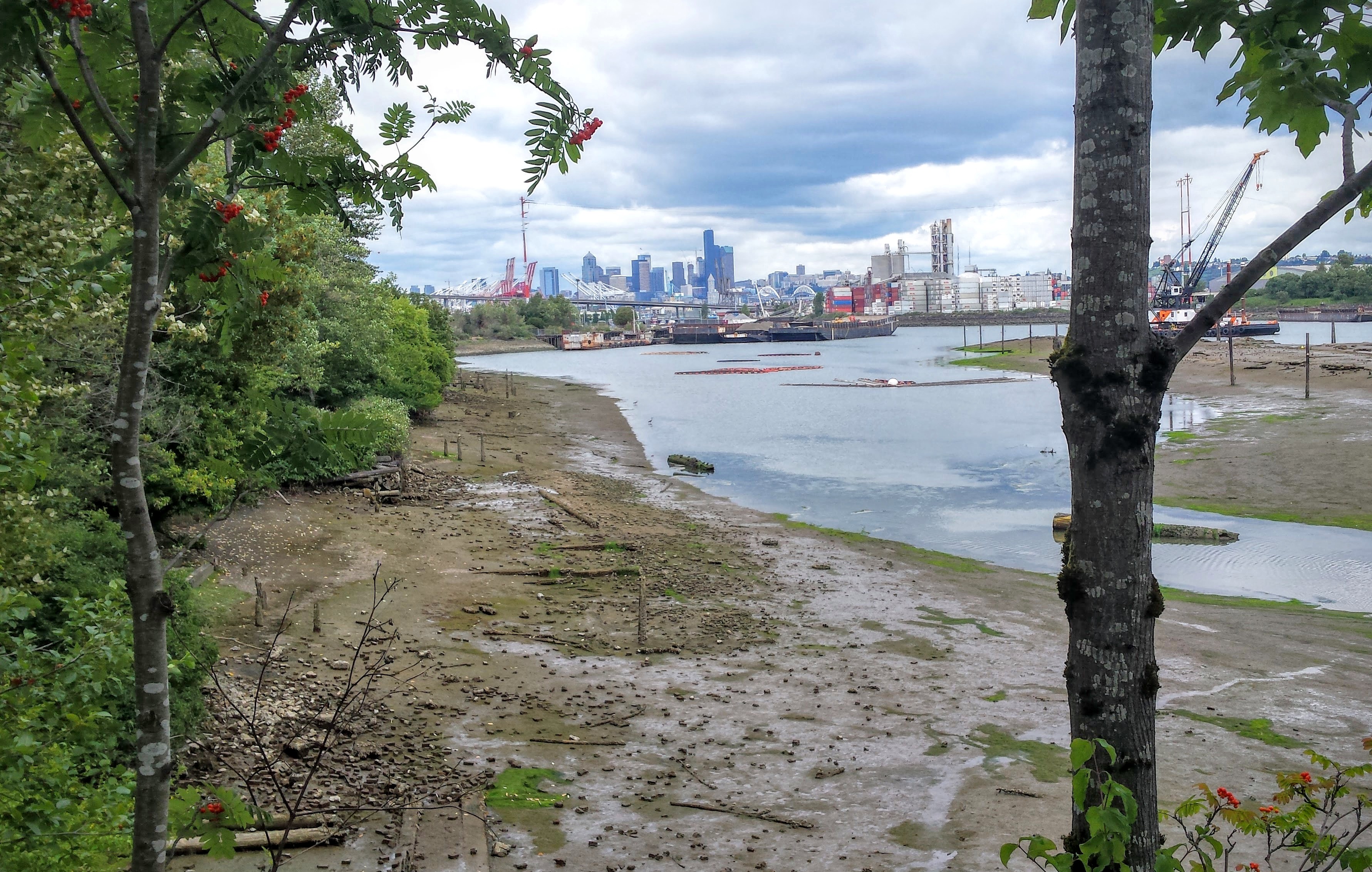
Duwamish River, looking to downtown Seattle, used to meander through the salt marsh.
Credit: John Nelson
Today, the Duwamish River is a major industrial waterway, engineered to handle huge ships. Little remains of the old river that once wound among the mud flats.
But we can see a hint of the past at Terminal 107 Park, the site of a former Duwamish Indian village. Step off your bike and take a walk along a gravel path to the shore of the river.
As we peek at the earth along the riverbank, we may find evidence of a midden —a place where shells and refuse were discarded by native people.
The home stretch
From here, we’ll be riding back through the stadium district to our starting point. Hopping on the West Seattle Bridge Trail, we pedal into SoDo and take in the former tidal flat. If this was 1850, we’d be under water now, or at least stuck in the mud.
Hear that crowd roar? It’s the sound of modern times as we pass Safeco Field (Seattle Mariners) or CenturyLink Field (Seattle Seahawks, Seattle Sounders) back into Pioneer Square.

Shells are visible in the embankment of Terminal 107 Park in what is called a midden, where Native people discarded refuse.
Credit: John Nelson
_____
John Nelson is a freelance outdoors writer based in Seattle. Follow his blog at skizer.org.
This Week In SeniorsSkiing.com (June 2)
We’re Starting Our Summer Schedule!
From Memorial Day to Labor Day, SeniorsSkiing.com will be publishing on a bi-weekly basis. We’ll still be continuing our Cycling Series, our new Fitness Focus, articles about hiking, profiles of senior skiers, and interesting places our readers and correspondents are visiting. And, we’ll be publishing our list of 78 Trailmasters, super senior skiers who skied their age and more last season.
So, see you next week with more stories. As for now, there’s this:
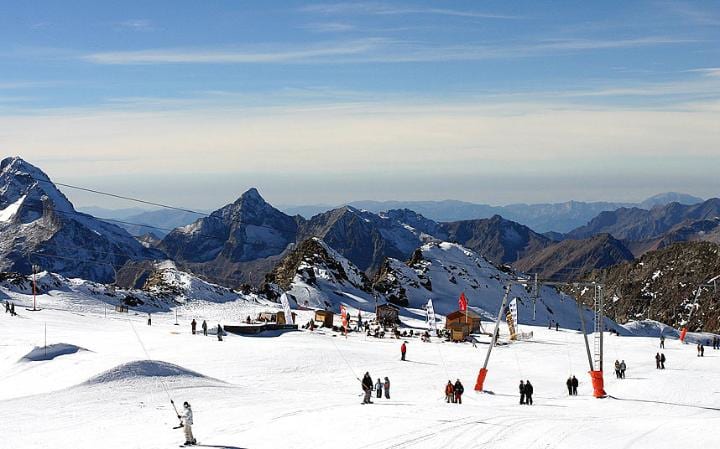
Where To Ski In Summer: Best Glaciers For Skiing [From The Telegraph (UK)]
Les Deux Alpes has skiing all summer.
[authors_page role=contributor]