


2016-17 Winter Forecast Outcome
How Close Were NOAA Predictions? The Surprise Was California.
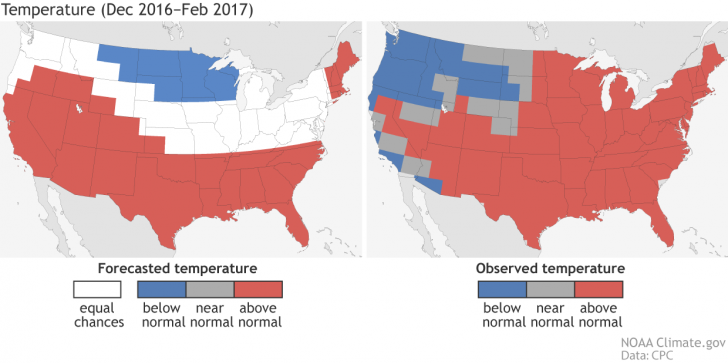
Temperature: Forecast vs Actual, 2016-17
Credit: NOAA
NOAA’s Climate Prediction Center recently published a review of its forecast for the 2016-17 winter. As you know from horse racing, the stock market and Las Vegas, predictions often do not reflect realities. The question really is how close to reality the predictions are.
In October, 2016, the Winter Weather prediction was focused on factoring in a weak La Nina pattern in the Pacific. La Nina and sibling El Nino, as you may be aware, are warm or cool water conditions roughly in the latitude of Peru in the eastern ocean. These conditions impact the air masses above them and, subsequently, the jet stream which steers weather patterns in the atmosphere.
Climate Prediction Center thought a La Nina (cooler water) would bring generally warmer temps across the lower US and cooler in the Pacific Northwest, Upper Midwest and Ontario. For precipitation, the prediction was below normal precip across the southern US, continuing the drought situation there, and above average precip in the upper band across the US-Canada border.
In reality, the La Nina was weaker and faded away earlier than predicted. That factor plus multiple “Atmospheric River Events” off the California coast, narrow regions of heavy moisture transported from the tropics, and general randomness brought different outcomes.
Temperatures across the US in the 2016-17 winter were the warmest ever recorded. That was in line with the prediction for warmer temps across the whole country. But it was colder than average in the Pacific North West rather than the Northern Plains. And, while precipitation for wetter than average in the Northern Tier was spot on, the forecast for drier than average only worked out for Florida, where drought conditions persist.
As we know, it was wetter than average in California with ongoing storms racing up from the Pacific. Not predicted.
In general, Climate Prediction Center’s own objective evaluation of its predictions show it was much more accurate for the temperatures this year than precipitation.
We will be bring you predictions for the 2017-18 Winter when they emerge.
Precipitation: Forecast vs Actual 2016-17
Credit: NOAA
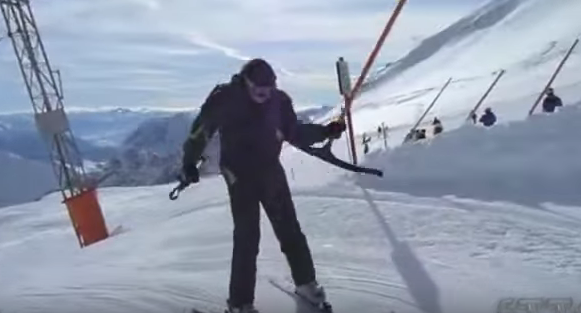
Ski Fails On Video
A Compilation Of Major Flops And Embarrassing Flips.

It’s the silly season in these last days of April. We’re sending along a collection of video clips of those skiers and boarders who tried…and failed. The T-bar episode is actually hysterical. Thanks to FailToTheGail for putting this together. Who was it that said the difference between comedy and tragedy is distance?

The Case For The Local Ski Area
So It’s Not The Rockies. But What Makes Mom-And-Pop Special?

Ski Butternut in the Berkshires: All you need for a fun day with friends at a typical local area.
Credit: Ski Butternut
[Editor Note: As we are seeing in a month of startling industry news, the ski business is rapidly consolidating. Big corporations are buying portfolios of resorts. Vail has added Stowe to its collection. Aspen and its private equity investors, KLS Capital Partners are plucking up Stratton and Mt. Tremblant, among others. Other consortia have been formed or are forming. Where does this leave the mom-and-pop local area, probably closer to home, less exciting facilities, average food, but nicely discounted mid-week tickets for seniors? This is an important question in an industry that is moving away from smallness.]
Support your local ski area. You know the place. It’s likely the place you learned to ski at and/or where you brought your children to teach them. If you have grandchildren, its the place you are bringing them to ski. It’s likely the ski area is privately owned and supports the surrounding area by employing local workers. Simply put, we go to local ski areas to ski. We don’t go to see others or to be seen. We don’t go for après ski activities or plush lodging.
Small is better? Accessible, economical, family-friendly, local ski areas have a community feeling.
Credit: Ski Sundown
We need to support our local ski areas by skiing at them. Increasingly smaller mountains are being bought by corporations or going out of business. Local ski areas are by definition closer to home, they are less crowded and have less expensive lift tickets. Midweek skiing at one of my favorite areas, Ski Butternut, in Western Massachusetts, is $25 for all skiers! Every season, I make it a point to ski at Butternut and several of my other local ski areas, and each time it’s a wonderful experience.
Aesthetically my local ski areas fit into their surroundings rather than dominate them.
When I go to my local ski area, I don’t race there. I know I’ll park close to the lodge, I won’t have to wait in line for tickets or in lines to get on the lifts. The entire day is more relaxing. I know I’ll get plenty of great skiing, and I don’t have to jockey to get a place in line or compete for a table to have lunch at. I do less racing down the mountain (though I can do that if I want) and spend more time stopping, looking at the scenery or talking to people. I feel safer skiing at my local area because there are few, if any, rude or aggressive skiers. While skiing, I don’t have to keep looking over my shoulder to make sure I’m not going to get run over.
It’s a more relaxing day, because everything feels manageable. First time visitors are not going to be confused about where to park, how to get to the lodge or what trails go where. At the end of the day, families don’t have to worry about finding their children because everyone ends up in the same place. Since local ski areas are less overwhelming and feel safer, parents are more likely to give children the freedom to ski on their own. As a child, one of my favorite memories was being allowed to ski with my friends and explore the mountain without our parents.
Because I skied these areas as a child, I get the added benefit of a wonderful sense of nostalgia. When traveling, I’ve also had great fun skiing at independently owned mountains that I’d never been to before.
Spend a day or so exploring a local ski area and experience the charm and fun they have to offer. Just take a look at a small sample of season pass senior deals for next season:
Ski Butternut, Western MA: $175 (70+)
Ski Sundown, Northwestern CT: $109 (70+)
Catamount: Eastern NY: FREE (80+), before 6/1 $150, before 9/1 $155 (70-79)
What’s your local area? How are the deals shaping up for seniors?
[authors_page role=contributor]