


Ski Areas Versus Ski Resorts
There Is A Clear And Distinct Difference. Which Is For You?
Hangmans at Mammoth. Pat calls the big mountain a hybrid between corporate and local.
Credit: Pat McCloskey
Just returned from my annual ski adventure with my group of guys from all over the country. We all converge on our friend in Tahoe and enjoy the Tahoe areas and then head to Mammoth to end the week. Have to tell you folks, there is a lot of snow left out in the Sierra. Most likely skiing at least until Memorial Day for many Tahoe areas and Mammoth is reputed to be skiing well into July. We had a lot of interesting conversations on the lift about our experiences at the corporate ski areas (Northstar at Tahoe), the local community supported ski areas( Mt. Rose, Nevada), and the hybrid – Mammoth Mountain, which has the feel of a ski area even though it has a large village which has that corporate resort feel.

No doubt about it. Snowpack in the Sierra is 160% of normal.
Credit: Pat McCloskey
We love Mt. Rose. It is definitely the local area for the skiers of Reno and they take pride in the fact that it is there primarily to service the day skier. Where else do you get 25% discount on food if you are a season pass holder? They have specials on daily lift tickets like “Two fer Tuesdays”—two lift tickets for the price of one. Ladies day is Thursday, and they also offer a discounted ticket if you show up the day you flew in. I came in from Denver and was on the chair by 11:30 with a $59.00 ticket. Pretty reasonable. Good skiers at Rose, and most of them are either local Reno skiers, retired folks who ski there regularly, and visitors who stop to ski there on the way to Tahoe’s other areas. The Chutes are pretty special, too, with challenging runs serviced by a chair that brings you back to the main Slide area.
When you ski Northstar at Tahoe, you can definitely sense that corporate-ish Vail feeling. Very chic, lots of shops and restaurants in the base village which is surrounded by well developed condo complexes. Bring your wallet because most things like food, lift tickets, and lessons, are pretty pricey as per the corporate ski resort theme. There is a lot to be said for the ambiance created by Vail and the logistical expertise to bring good food, grooming, and snowmaking to a mountain for all to enjoy. But a different feel altogether.
Finally, Mammoth is what I call a hybrid. My friend always parks early in the lot by Chair 2, where we change into our boots. My father in law would call us “trunk slammers” –like the guys changing their golf shoes in the parking lot. Heading up to McCoy Station and ultimately to the Summit, we avoid most of the village rush by parking in this removed location. Most of the people are regulars. Like Mt. Rose, there are enthusiastic Mammoth loyalists who ride the gondola all day long reveling in the epic conditions. Again, more of a locals area than the more corporate resort areas. People drive five hours plus from the LA area and also from the Bay Area to get there. Ticket deals and lodging are best located on line. A little tip if you go, we ate at Giovanni’s Pizza in the Timber Ridge Resorts property—437 Old Mammoth Road. Really good Italian food and reasonably priced. We liked it so much, we ate there every night. Typical senior skier behavior.
So, all in all, when visiting the Sierra as a senior skier, you have a lot of choices. But we tend to like the ones that cater to the skier rather than the resort dweller. But that is just us. Go and enjoy it.

Pat (second left) and his mates who take an annual trek to the Sierra. This year they found big snow.
Credit: Pat McCloskey
Me To My Face: No Need To Freeze!!
Anti-Freeze Face Tape is Quite the Experience.
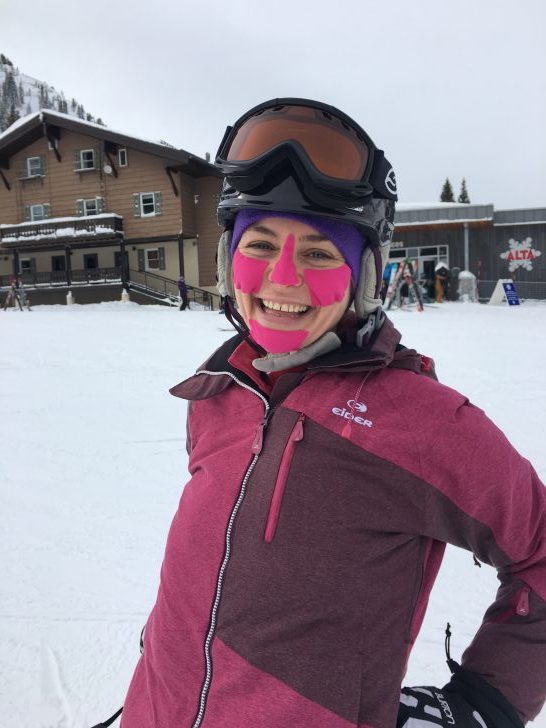
Jen Carlson wearing Anti-Freeze Face Tape
Okay, it’s Spring and for most of us the cold is fast becoming a distant memory. However, on January 8 at Alta, temps ranged from 12F to 18F. Sunny but chilly. So I took a package of Anti-Freeze Face Tape —a gift from a friend—followed the instructions and skied that day with a well decorated mug. War paint comes to mind.
The package states, “For downhill and x-country skiers, winter runners and cyclists, and those who wish to protect and insulate their skin.” It’s definitely a different way to reduce risk of frostbite.
I did what the package advised and applied the four pre-cut pieces to my nose, cheeks and chin. That was after washing and drying my face.
During the 4 1/2 hours wearing the colorful, flexible fabric, there was a burst of social engagement. It ranged from people doing double takes to straight-up staring, especially from little kids. Gotta love children with their unfiltered responses! Lunch was interrupted by the curious and those who simply pointed. Quite a few bemused people asked about this unusual new product. Who would’ve guessed placing some tape on my face would’ve sparked so much intrigue and commentary? Loved it!
It’s an interesting product, and I’ll use it again, especially on a cold day. I’d skip the cheek and chin covering in favor of my head/face sock. Would definitely use the tape on my nose. With it on, I didn’t have to deal with a cold nose or worry about sun exposure.
Removing Anti-Freeze Face Tape was fine, except from my cheeks, where there was some discomfort. A slight pattern from the adhesive remained on my face, which for a while was red and feeling a little raw.
Bottom line: It felt a bit odd at first. I quickly got used to it. A few times during the day it itched a bit, but wasn’t much of a distraction. Overall, I felt as if my skin could breath while being protected.
Wearing Anti-Freeze face tape brought some extra joy and playfulness to a beautiful day with friends. Hell, it even caught the attention of the Alta photographer for the area’s Photo of the Day.
Anti-Freeze Face Tape comes in three colors: Flesh, Blue and Pink. Available in select stores and online.
The Top All-Mountain Skis of All Time
Excerpted with permission from realskiers.com where the full article was published March 20, 2017.
All-mountain skis — those that purport to do everything reasonably well – started appearing in the mid-90’s.
Following, listed roughly in order of their debut, are the iconic models that emerged since the term “all-mountain” came into common usage. My picks aren’t necessarily the most innovative or game changing, but they were, for a while, the best at handling any condition the mountain might dish out.
Völkl Snow Ranger
Völkl didn’t invent the fat ski – that distinction goes to Atomic – but they were the first to make an expert powder ski using elite construction. When fat skis were first making a dent in the market, no other model was as powerful and versatile as the original Snow Ranger, which still holds its own as an all-terrain ski today.
Volant Chubb
From today’s perspective, it’s hard to believe that the Chubb, born in the first generation of fat skis, had a 90mm waist. When Shane McConkey began to straight-line steep couloirs on the Chubb, any lingering resistance to fat skis as cheater sticks evaporated. Applying the Chubb’s construction to a water ski’s shape resulted in the Spatula, creating new dimensions in ski design that endure to this day.
K2 Four
K2 wasn’t an early adopter of shaped skis, but once the brand put their marketing prowess into promoting the concept, there was no turning back. A young Bode Miller started to win races on the funky red, white and blue skis, validating the technical capabilities of the deep sidecut. America followed suit, setting the table for K2’s run of dominance in the U.S. market.
Dynastar 4×4
Shaped skis were still by and large a carving club when Dynastar debuted the 4×4 as an unabashed off-road ski, inspiring comparisons to SUV’s for their all-terrain adaptability. Although absurdly narrow by today’s standards (a shade under 68mm underfoot), the first 4×4 would later morph into the 4×4 Big, one of the most popular fat skis of its era.
Salomon X-Scream
Like the 4×4, Salomon’s X-Scream was one of the first shaped skis that wasn’t intended as an on-piste carving tool but as an all-terrain implement. The first X-Scream earned instant acclaim when it rolled out in 2001, spawning a string of successors that made the X-Scream family the most popular in Salomon’s history.
Stöckli Stormrider XL
Stöckli tends to build all-terrain skis with DNA extracted from Super G race models, making their Stormrider series among of the burliest all-mountain skis. The Stormrider XL, sporting a waist of 75mm, was an ancestor of the current crop of Stormriders, which range in width from 83mm to 115mm. The one constant has been a stout, wood and metal lay-up that takes no prisoners as it slashes through any and all snow conditions.
NOTE: This highly unscientific exercise isn’t meant to identify the very best skis, nor the most popular and not necessarily the most innovative or influential. The common thread is that they epitomized versatility in their respective eras.
Six other picks will appear next week.
Subscribe to realskiers.com and receive newsletters, commentary, and expert advice all season long.
[authors_page role=contributor]