


Senior Skiers: Take Care in the Sun!
Advice From a Dermatologist Nordic Skier.
The sun is by far and away the most common cause of both (1) skin cancer and (2) skin aging.
More than two million cases of skin cancer are diagnosed annually in the USA. Caught early, most skin cancers can be removed, leaving a cosmetically acceptable scar. In more advanced cases, valued anatomic parts such as noses and ears can be partially or completely lost. Unfortunately, ten thousand deaths occur yearly in the US from skin cancers.
Many Nordic skiers, blithely dedicate ourselves to going outside as much as we can whether skiing in the winter or running, biking, and hiking during snowless times. My recommendations to preserve skin health while frolicking out of doors:
- Exercise early in the morning (before 10) or later in the after- noon (after 4) when the sun is less damaging.
- Wear clothing that covers or shades the skin (e.g., a broad- brimmed hat is better than a visor).
- Apply a “broad-spectrum” (protects against UV-A and UV-B) reasonably thickly with an SPF of at least 30. If downhill skiing or hiking all day, consider re-applying at lunch
- Consult a dermatologist periodically, especially if you’re over 50, have a non-healing sore/bump, or have a changing or new brown or black spot.

Learning To Ski As An Adult
The Number Of Senior Skiers Is Growing By Leaps And Bounds Every Year. Join The Gang.
[Editor Note: This article first appeared in Liftopia Blog. SeniorsSkiing.com thanks Liftopia for sharing Rose Marie Cleese with us.]
Statistics show that many people who give skiing a try—regardless of age—never return after their first day. Why? Because it wasn’t the most pleasurable of experiences. They didn’t prepare (wrong clothing, out of shape, etc.) and they didn’t start with proper instruction on Day One. To give skiing and boarding an honest shot and ensure that you’ll want to go back for Day Two, be prepared for Day One and make sure that day includes a good ski lesson. You’ll be rewarded with a lifetime of exhilarating days on the slopes. Here are four important first steps…
Step #1: Check yourself out.
Before you sign up for those beginner senior lessons or if you’ve been off the slopes for a number of years and you’re itching to get out there again, the first step is to have a physical exam and get your doctor’s blessing.
If you’ve turned into a couch potato, get back in shape. Attend aerobics classes weekly; walk a lot; start a daily regimen that includes balancing exercises, weights, and some cardiovascular activities.
Here’s the recommended conditioning checklist for older skiers issued by the Professional Ski Instructors Association (PSIA):
- Check with your doctor before starting any physical training
- Choose a low-impact exercise regimen that includes stretches, half-squats, drive-ups, lunges, leg curls, crunches—avoid polymetric exercises, such as box jumps
- Include weight training in your exercise program—start with light weights and low reps, gradually increasing both
- Don’t over-train; alternate among walking, biking, stretching, and active rest.
If you’re over the age of 50, see important tips for cardio, balance and strength exercises that senior skiers can do to prep for the slopes. Click here for some ideas from Liftopia and here for the beginning of an exercise series from SeniorsSkiing.com.
Step #2: Gear up.
If you’re a first-timer, either purchase ski apparel that you can wear both on and off the slopes or rent ski clothing. You can also rent a helmet and equipment (boots, skis, poles, boards) until you’re sure that you’re going to continue. If you’re returning to the sport after a hiatus, consider upgrading since ski equipment has improved markedly in the past couple of decades and makes skiing easier, safer, and more enjoyable. And buy a helmet!
Step #3: Start smart.
Seek out mountain resorts that offer special instruction programs or workshops for adult or senior skiers. For your first day, pick a day with great weather and good snow conditions and go on a weekday when the slopes are more empty.
Choose a ski area that employs PSIA-certified instructors who have been trained and accredited to instruct skiers 50 years of age and older. PSIA’s Accreditation I offers its Levels 1-, 2- and 3-certified instructors two days of training to address the instructional needs of beginning and intermediate senior skiers; Accreditation II is three days of training available to Levels 2- and 3-certified instructors to enable them to teach all levels of senior skiers modern ski techniques that will optimize their strength, balance, and enjoyment of the sport.
Step #4: Be enlightened.
Talk to other older skiers about skiing at a certain age. What are the pluses? The minuses? Helpful hints?
To sum it up…
 When considering sports that seniors typically take up, Snowsports Industries Association’s Director of Research Kelly Davis says, “While golf and sailing and hiking are amazing activities, skiing gives you an experience of freedom that’s difficult to match. While working your core, you get the thrill of flying down a snow-covered hill. Plus the bonds you form on the slopes and on ski lifts are second to none.”
Her message is obviously resonating. The number of senior skiers is growing by leaps and bounds every year. In 2014, skiers aged 55 and older accounted for 6% of all skiers (double that of 1994); today in 2017, approximately 15% of all skiers are over the age of 50. Make this the year you join (or rejoin) the growing ranks of older skiers. You won’t be alone!

SeniorsSkiing Guide:Tamarack’s Cruising Ground Is Wide Open
Almost Down And Out, This Resurrected Resort Returns As A Bargain For Senior Skiers.
The base at Tamarack Resort with sports and cafe domes and a snow rainbow.
Credit: Tamarack Resort
Tamarack is the original comeback kid.
It opened in 2004 to great fanfare and serious celebrity cred, the first new ski resort in the US since Beaver Creek in 1980. With tennis star Andre Agassi and wife Steffi Graf at their publicity helm, the idea was to focus on real estate. And for four years, this worked.

Skiing powder at Tamarack, Donnelly, ID., near McCall.
Credit:Tamarack Resort
Then came the recession; the resort was forced to close for a year and one ski lift was repossessed (a helicopter actually carried it away). It took years to sort out the financial problems, which finally, were laid to rest in 2014.
And now, the homeowners have taken over, the lifts are running, the grooming could be mistaken for Deer Valley manicuring, and you can ski on a budget ($69 adult, $44 senior) while feeling like the place belongs to you and you alone.
Today, the resort remains in a somewhat half finished state. The original village was never completed (you can see uncovered Tyvek on the side of the unfinished lodge), and the base lodge consists of “temporary” domes covering the sports shop and restaurants.
And while powder hounds are not disappointed, what truly makes this place shine is cruising that will never, ever, put you to sleep. No straight down the fall line, yawn stuff, the cruisers here twist and turn, drop over unexpected humps, sift through widely spaced trees and, heck, are adrenaline fun.
Snow, Terrain and More
Location: Tamarack is in Tamarack, ID, close to Donnelly, ID, about 20 miles south of McCall, and 100 miles north of Boise, in west central Idaho.
Snowfall: 300 inches average.
Terrain, lifts: 42 runs and 6 lifts, including 2 high-speed quads across 1,000 acres of lift- served terrain. 17 percent novice, 45 percent intermediate, 38 percent advanced terrain. Ski season is usually early December to early April. 25 percent of terrain is covered by snowmaking.
Vertical: 2800 feet, top at 7,700 feet, base at 4,900 feet.
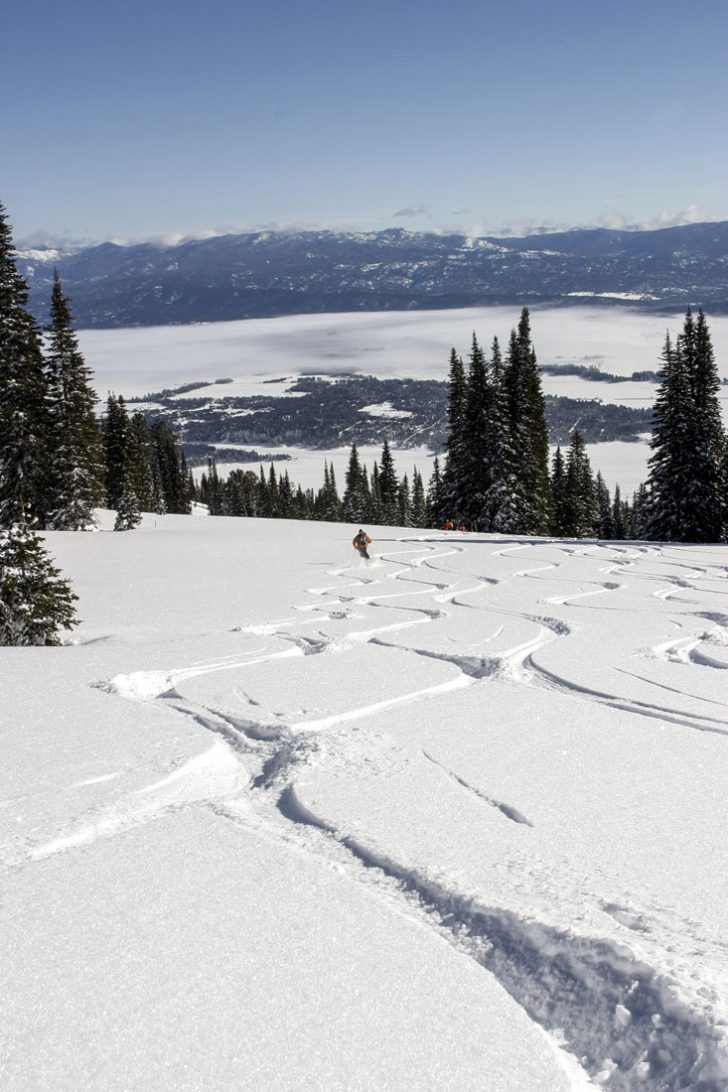
Skiing powder at Tamarack Resort.
Credit: Tamarack Resort.
Nordic and more: The Tamarack Nordic Trail system offers a variety of trails that wind through open meadows and forested paths. Choose your own adventure through the groves of Aspen, fir, pine and Tamarack trees on classic or skate skis, fat tire bike or snowshoes.
Lot to lift access: One main parking lot about 100 feet from the Sports Dome that serves as Tamarack’s base lodge. On the rare occasion this fills, there’s a second lot near the unfinished village along the main entrance road. You can also easily walk to the lifts from this lot.
Public transportation: None. You really need a rental car.
Accomodations: Options at Tamarack Resort are numerous and reasonably priced. Hotel rooms during regular season this year were running $150 a night and a four bedroom chalet could be had for $309 (though fees and taxes are extra). These run from the Lodge at Osprey Meadows to cottages, chalets, town homes and estate homes, all located in the resort. For lodging, click here.
Culture
The vibe: Do you want a resort with killer slopes, grooming and powder all to yourself? This IS the place. Sometimes, it’s a bit lonely out there. But, except on school ski days, you don’t have to worry if some out of control boarder is going to take out your shoulder blades. While the “temporary” domes give the place an incongruously rough and ready feel, the service, the food and, yes, the accommodations, are closer to Deer Valley than Bogus Basin.
Dining: Five options for dining running the gamut from burgers and pizza at Canoe Grill to a nice selection at Seven Devil’s Pub at the resort base (don’t miss the stuffed chicken breast).
Mountain life: As with other area ski resorts from Brundage in McCall to Bogus Basin in Boise, you don’t come here to lounge around a fireplace. It’s snow. More snow. Even more snow. You ski downhill. You ski nordic. You snowshoe. You fat tire bike. You don’t sit.
Webcam and Conditions click here
[authors_page role=contributor]