


How Old Is “Too Old” To Start Skiing Or Boarding?
[Editor Note: This article first appeared in Liftopia’s Blog and is used with permission.]
What’s the cut-off age for starting to ski or snowboard? The answer is simple: you can take up—and keep—skiing or boarding at any age! You can never be too “over the hill.”
It’s unanimous. Just as health experts have been saying for years about exercise and fitness programs, ski industry experts say it’s never too late to start, whether it’s downhill skiing, snowboarding, cross-country schussing, or snowshoeing. And never too old to stick with it. As long as you don’t have a debilitating health issue that your doctor says is definitely a wintersports “no-go”, there’s no reason you can’t go out and do it. In fact, here are four reasons to start or return to skiing later in life…
- You’ll live longer.
To be able to start or continue with skiing or snowboarding at an older age, you’ll HAVE to stay in shape. You’ll learn how to improve and maintain your balance, your cardiovascular fitness, and your muscle strength—extending your life span in the process!
- It’s easier than ever to learn.
Thanks to huge improvements in equipment, apparel, and ski run maintenance in recent years, it’s easier than ever to learn to ski or get back on the slopes. Skis are lighter; boots fit better and are warmer and more comfortable; waterproof outerwear is more breathable; many instructors have special training to teach skiers over 50; and the slopes get groomed to perfection every night.
If you’re a first timer, you won’t have to unlearn any bad habits or old styles of skiing. On the flip side, if you’re a returning skier, you’ll need to learn how to adapt your skiing to maximize your experience on today’s totally reconfigured skis.
- Being “of a certain age” has its perks.
You’re likely in a better position to afford wintersports than when you were younger; conversely, you’ll be able to take advantage of the many senior discounts on lift tickets that are offered by most ski resorts.
If you’re retired, putting in fewer hours at the office, or now working as a consultant with your own hours, you’ll be able to ski midweek, when the slopes are wonderfully devoid of people and the atmosphere more chill.
- You’ll be off the couch enjoying fresh mountain air and spectacular views.
Not only will your family, friends, and colleagues be majorly impressed when they hear that you’re now or still participating in a wintersport, you’ll get to enjoy one of the most sublime participant sports there is!
Art And Nordic Happenings In Jackson, NH, XC Capitol Of The East
Up To The Minute Trip Report From Roger Lohr, Publisher Of XCSkiResorts.com.
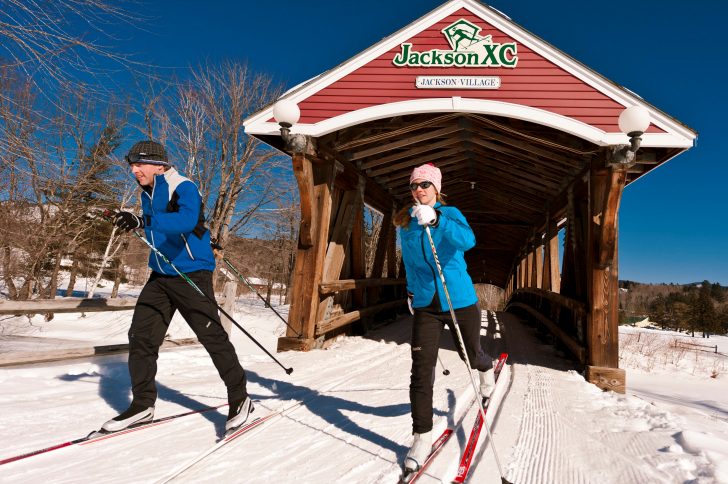
Jackson’s famous covered bridge, a symbol of this charming New England town.
Credit: Jackson Ski Touring Foundation.
[Editor Note: SeniorsSkiing.com thanks Roger Lohr for this update. XCSkiResorts.com is the premium resource for nordic ski vacation and resort information in North America.]
We excitedly planned a weekend trip to Jackson, N.H., because it is a true Mecca for Nordic skiers. This is the quintessential New England Nordic (XC) skiing experience with a covered bridge, white steepled church, brookside trails, and the accompanying village with all of the trappings.
Many of the trails lead right to the doors of local inns, shops, and restaurants. It’s no wonder that Jackson Ski Touring Foundation has been rated the top cross country ski area in the United States by America’s Best Online and is recognized in numerous polls as a favorite destination.

Abstract art in the woods, a natural gallery creating an unusual setting for art appreciation.
Credit: Roger Lohr
The Foundation is a non-profit organization chartered to maintain XC ski trails in and about the village of Jackson. There are about 76 landowners that allow trails to cross their property. Country inns are spaced throughout the region, and the base lodge is a golf country club located on the village loop. This full service ski center has its own parking area and houses the ski school, rental equipment, and a retail shop run by Gorham Bike & Ski with XC ski equipment, clothing, and accessories. The center has a fireplace with couches and tables and seating. Snacks and drinks are available in the lodge, too.
The Cocoa Cabin is a warming hut serving hot cocoa on the weekend, located three km from the center on the gentle Ellis River Trail. This is a popular trail often with many cautious yet courteous skiers. Snowshoers can take a rustic narrow marked snowshoe trail from the center to reach the Cocoa Cabin, and this trail avoids the ski trail.
Our accommodations were at the Christmas Farm Inn & Spa, which is set on a hillside overlooking Jackson Village. It has the personal touches of a country inn with the amenities of an upscale modern resort. The inn has a full service spa, restaurant and pub, fitness room, indoor pool, family rooms, spacious suites, and handcrafted cottages. We had breakfast there during our visit and scheduled massages at the Inn’s Aveda Spa for some earned relaxation after skiing. After skiing and some massaging, we dined at the Christmas Farm Inn for a scrumptious dinner and dessert.
The next morning, we skied down to town, stopped by the Jackson Ski Touring Center and heard about the Art Along the Trails exhibit staged on trees behind the lodge near the Jackson covered bridge. The lodge was bustling, and we passed hundreds of skiers and snowshoers along the Jackson trails, who were friendly and saying hello as they passed. The art exhibit featured two local abstract painters in a their works displayed with nature. Instead of a white walled art gallery, in its place were “walls” made from snow, hemlocks, and birch, all places for paintings to hang from, and the beneficiaries were on snowshoes and cross country skis.
During the four-hour show, Art Along the Trails was enjoyed by hundreds of cross country skiers and snowshoers, who were instilled with the energy of culture experiencing the avant-garde gallery in nature that included more than two dozen paintings installed on tree trunks and limbs. Prices of the different paintings (some as big as three-by-four feet) ranged from $125 to $2,900. The exhibit had titles such as “Illuminated Icefalls” and “Cosmic Wash”.
We lunched on soup and salad at the Wildcat Inn Tavern in downtown Jackson and stayed for some live music and libations. The tavern walls display classic ski posters and some antique gear such as snowshoes and a pair of red Jarvinen XC skis. The seats in one of the rooms were built to look like double chairlifts, and there were soccer jerseys from around the world pinned to the ceiling.
We browsed at some local retail establishments in Jackson including Flossie’s General Store & Gift Emporium, which has a potpourri of gifts, candy, and local keepsakes.
The Jackson Ski Touring Foundation maintains 154 km of varied and breathtaking XC ski and snowshoe trails and is about two hours north of Boston. Foundation trails connect with A.M.C. trails in Pinkham Notch and White Mountain National Forest backcountry adventure trails.

Here’s a New England classic. Christmas Farm Inn has a warm, welcoming old-school ambiance as well as many modern touches.
Credit: Roger Lohr

Something Different For The Grandkids: Idaho Elk Feed
When It’s Time For A Diversion Excursion, Visit The Elk Herd.
Sleigh pulled by Percheron horses takes people out to help feed elk in Donnelly, ID, near McCall. Light snowfall speckles the scene. The Points family has been feeding wild elk on their land to help them survive winter for three generations.
Credit: Yvette Cardozo
Yes, Idaho has some delicious skiing. Yes, some people want to do something else. In winter. In the snow.
And so, in the McCall area, there’s the elk feeding trip.
Back in 1983, Lyle Points’ pop, Vernon, started to worry about the elk on his land. These were wild animals. And in harsh winters, they were doing badly.
“No elk is going to starve on my place,” he declared.
Why not give them a bit of help?

Hungry elk come in to eat from hay bales on a sled which takes people out to watch the elk feeding.
Credit: Yvette Cardozo
So he started dragging bags of hay out, sometimes breaking trail through five feet of snow, to give the elk a bit more food when food was REALLY hard to find.
Thus started a family legacy which has now stretched to three generations.
These days, the public helps. For $20 (less for kids) you climb into a sleigh, sit on bales of hay and go out to the nearby woods where the herd of Rocky Mountain Elk are patiently waiting.
They, meaning the elk, not Lyle, have worked out a system. They actually take turns, some coming to nibble the hay from right under your rump, others sitting a few yards away until the next sleigh comes along.
Sometimes, it’s three sleigh loads a day. Sometimes only one. Sometimes none. But they still don’t go hungry because, as Lyle explained, “This is just the appetizer. Later, I will go out with more bales, cut them into chunks and drop them in a line.”
Like crumbs on the floor.
This winter was the snowiest, the coldest, the harshest in 30 years. Food was even harder to find than normal. And there are the wolves.
“I figure giving the elk some extra food is an extra bit of help to survive,” Lyle explained.
As it is, the herd is down to 180 elk from previous years when it could sometimes reach 300.
And so, my friends and I climbed into Lyle’s sleigh, pulled by his two handsome, coal black Percheron horses and headed for the nearby woods.
We all sat on fresh bales of hay and it didn’t take long for the elk to come over.
It’s the cows (females) and young males with tiny antlers that nudge in. There ARE bulls, some with seven point antlers (yes, that’s a LARGE rack). But the bulls just sit there, keeping watch.
Okay, it is truly a bit strange to have a large wild animal nibble eagerly at something your rump is resting on. You can actually feel them chew. And certainly hear them as they crunch.
There’s a temptation to reach out and pet their furry heads, maybe stroke the small antlers of “teenage” males. But don’t.
Lyle has rules. You don’t touch. You don’t get up. You certainly don’t feed them if you brought snacks for the kids.
Meanwhile, during the ride, Lyle talked about elk, about how they eat and digest in their four-part stomach, what they eat on their own (any plant they can find), how many bales he takes out a day (16 – 20) and how his family got into the elk feeding thing because, well, they couldn’t bear so see such beautiful animals suffer.
We were out there for more than an hour. Plenty of time for everyone to take a LOT of pictures and videos.
Click here for the website. Or call 208-325-8783. It’s $20 for adults, less for children. This is strictly winter. You ride out on a sleigh, sitting on hay bales. Grandkids LOVE it.

Visitors sit on hay bales while elk come in to feed on the hay. Kids know Lyle’s rule: Don’t touch.
Credit: Yvette Cardozo
[authors_page role=contributor]