

What New La Nina May Bring To Snow Forecast
The Latest Update Shows Impact Might Good for Some, Uncertain For Others.
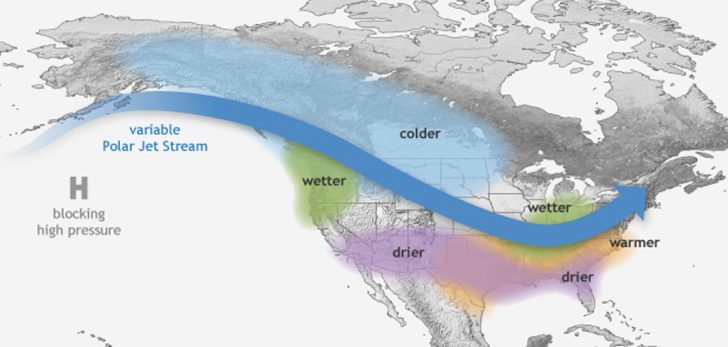
La Nina impact how the jet stream bends over the Pacific. Here’s NOAA’s prediction as of end of Oct.
Credit: NOAA NWS
NOAA’s National Climate Predication Center announced that La Nina has returned. She’s weak but still might pack a sting for our winter weather.
La Nina means cooling of water in the eastern Pacific. As remote as that may seem to North America, that coolness effects how weather masses form and move around the globe. As we reported earlier, the Climate Prediction Center said that La Nina hadn’t developed as expected after a record El Nino (warming water) in 2015-16. But just last month, a weak La Nina was detected.
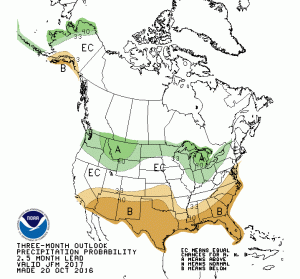
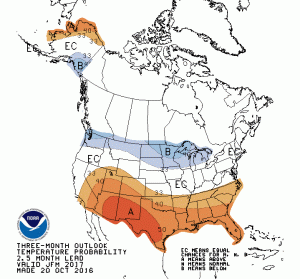
What does that mean for snow forecast? Weather forecasting is about probabilities. A look at the temperature map below (right) reveals that temps are expected to be generally warmer across the lower US and cooler in the Pacific Northwest, Upper Midwest and Ontario. The precipitation map says below normal precip across the southern US, continuing the drought situation there, and above average precip in the upper band across the US-Canada border. This is pretty consistent with the snow forecast we reported on last month. Confirming an La Nina just ups the odds.
So, good news for the Pacific NW and BC, Montana, Wyoming. Uncertainty for just about everyone else.
Remember, these are probabilities and not definitive. Variance will happen. NOAA will update their forecast in a few days. We’ll let you know.
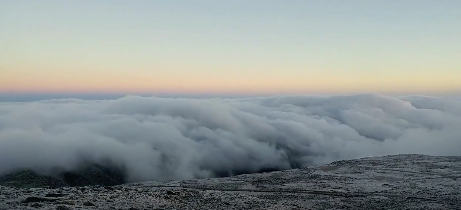
Here Comes Winter: From Mt. Washington, NH
Home Of Big Time Extreme Weather Looks Over Dramatic Moving Clouds.
Mt. Washington is the Northeast’s highest summit. At 6,288 feet above sea level, the mountain is a mecca for campers, hikers, and fast-changing weather conditions. This video was taken from the Observatory on the summit in late October this year. It reveals an “undercast”—opposite to overcast—as the dawn sun warms it up and it begins to move.
Watch while meditating. Or just watch. We love mountains.
Snowy Winter Ahead? Ask A Wooly Bear
Some Say It’s Folklore. Some Say It’s Real.
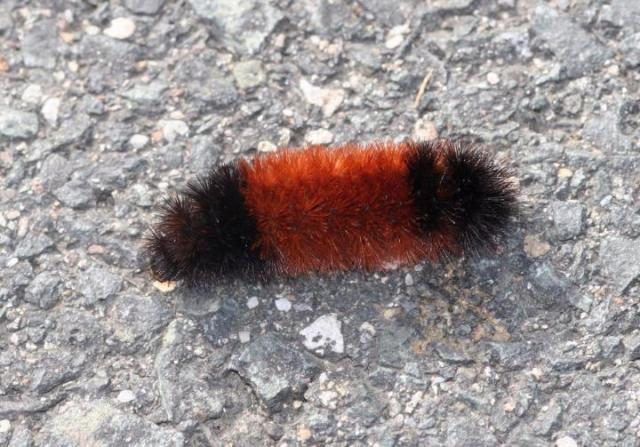
Wooly Bear caterpillar may predict snow. How do they do that?
Credit: Harriet Wallis
Wooly Bear caterpillars are cool dudes. Their fuzzy bodies are black at both ends and orangish in the middle.
Winter enthusiasts examine that orangish band to learn what the coming winter will bring. A narrow band predicts a cold winter with precipitation. A broad band foretells a warm winter.
The bug’s celebrity status began in 1948 when Dr. C. H. Curran, a curator of insects at the American Museum of Natural History in New York City, gathered the critters and took measurements trying to correlate the width of the band to the weather.
He did this for eight years. Perhaps Wooly Bears were a good excuse to get out of the city in the name of science.
Wooly Bears are found throughout the country, but they’re more prevalent in the eastern states.
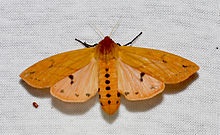
Winter forecaster Wooly Bear produces a Tiger Moth. Credit: Harriet Wallis
The caterpillar is the larval from of the rather bland Tiger Moth (Pyrrharctia Isabella).
I know old time Vermonters who use a different method to predict the winter. They sit on the porch and count how many loads of firewood go by.
There are other folklore methods. If the weeds grew extra tall in summer, it means a snowy winter. And ample acorns and apples with thick skins predict a cold, snowy winter.
Please excuse me now. I’m going to look for some Wooly Bears and bite into an apple.
Read more about skiing and from Harriet Wallis at www.skiutah.com
[authors_page role=contributor]