

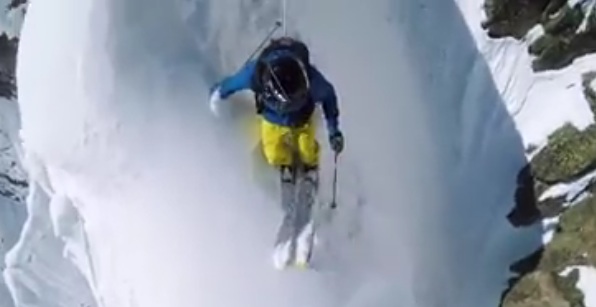
From The Tippy Top Of The Matterhorn
When You Run Out Of Challenges, There’s Always The Matterhorn.
Nicolas Falquet, a 37 year old athlete from Switzerland, starts his run from the top of the world’s most impressive mountain. He has a GoPro camera attached to a wand device from the top of his helmet. Bet there was no line for the lift. Thanks to Milkyway Scientists and GoPro for this one.
The Matterhorn is 14, 692 feet high. And it certainly looks like it has a very pointy top. That’s where Nicolas filmed this clip. Hold on, folks, it’s a long way down. Yikes!
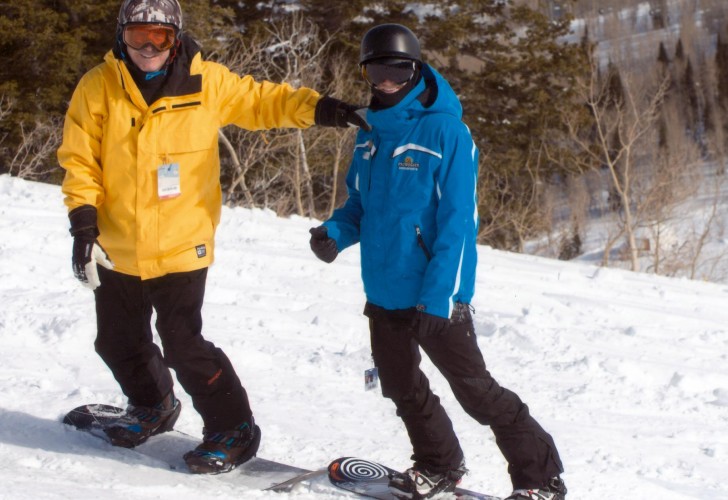
Confessions Of A Senior Snowboarder
He Went To From Skier To Boarder. Here’s How And What Happened.
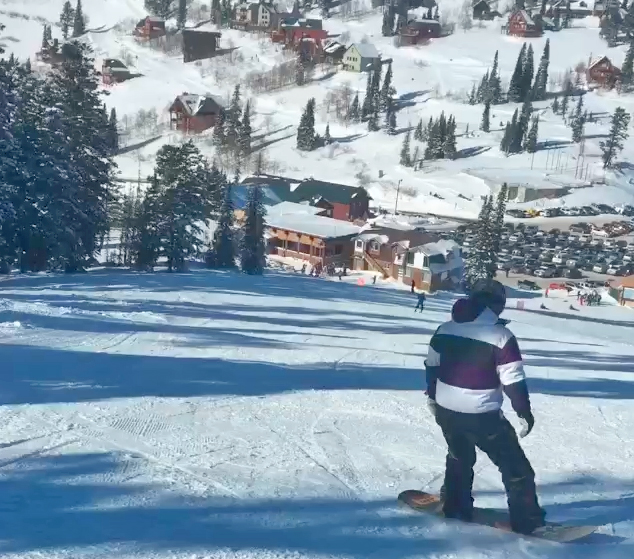
Heading down to Powder Mountain lodge, Dave Hayes took a couple of years to make the transition from skier to board.
I have to confess, I was once one of you before I moved to the Dark Side. Yes, I skied in the East Coast and the West Coast, in the Rockies and also in Austria, enjoying the feeling and stability of two boards under my feet and with poles to move me along when needed.
Former skier, now boarder, Dave Hayes with son learning how-to.
Credit: Dave Hayes
However, with two young sons and the misguided idea that I could spend more time with them if I took up snowboarding, I dropped the two for one and took up Boarding. As an older adult I joined the Dark Side where most of the much younger participants seem to be oblivious to common sense or at least common manners as they drop down to sit in front of you blocking your path. As skiers we all enjoy being edged off the trail as the boarders race by often jumping on nonexistent drifts and seem to purposely nudge you out of their way.
I was once like you but now, I am committed and far happier as a Boarder. I truly enjoy the sensations of a snowboard on powder with the glide and edging making the effortless turns that seem to be only available on a Board.
OK, you skiers need to know that there are two forms of falling while learning to Board, front — which means your hands and wrists are at risk, or, like me, backward fallers —where you learn the meaning of word coccyx, which means tail bone. I hurt my tailbone so badly in my attempt to learn boarding that after my return home I decided to go to the Doctor convinced that something had broken. I learned that severe bruises also hurt like hell and that even a Doctor can laugh at his long time patient who seemingly is not acting his age.
The learning curve was, well, both long and painful. I remember during my private lessons (pride would not allow me to take group lessons) spending a lot of time on my rear to the point that after the end of the day of lessons (ok, mostly falling) I had a real challenge sitting down. After the first week and a very sore backside I spent most of the time standing on the 4.5 hour flight home. Which, you might understand in a post 9/11 world, makes you the object of a lot of suspicious glances until you explain that your tail hurts from learning to snowboard. I believe I noted a few snickers from the cabin crew.
The next vacation on the snow and after more lessons, a very patient instructor told me of the padded appliance appropriately named Azz Pad that snow park participant’s sometime use during training. Quickly getting on the internet and with the gift of overnight delivery I was quickly proud owner of the aforementioned Azz Pad and I have never looked back. My wife shook her head at my new found rear end protection and my two sons derided my apparel but I found comfort in the added padding and when combined with a highly recommended beginner’s board I developed courage, stability and the dissipation of fear (or at least in regard to my tailbone bruises).
Moving ahead a few years and with more than just a few snow days behind me, I am no longer wearing the Azz Pad, I have now five snowboards for differing conditions and also, well, just because I can! I regularly board black runs and often do the snowcat program at my favorite ski (I mean snowboarding) resort.
One son is now a certified snowboard instructor and the other is seemingly an Olympic class snowboarder (at least in my eyes). So, I looked forward to boarding with my sons; at leasst, that was the plan. Guess what, not a chance, they prefer hitting the slopes without old Dad holding them back.
However, I am grateful that my boys were the catalyst for me learning the sport that I now love. I still enjoy the feeling of one board in powder and the sense of victory that comes with learning a difficult (at my age) skill, and with no small measure of pride, learn it well.
Look around you, boarders of all ages are now on the slopes and if you see a gray haired nattily attired boarder with a smile on his face and a groove in his glide from the tunes in his helmet music system, ask him if he is named David.
Editor Note: If you’re interested in snowboarding as a senior, check out GraysOnTrays for the adult snowboarder.
About The Author:
David Hayes is an engineer turned contractor living in central Florida but in his mind is in Ogden Valley’s SnowBasin and Powder Mountain, UT. Click below for a short video from the world of the boarder.
SeniorsSkiing Guide: Stevens Pass—Low, Low Prices For Seniors
It Is Hard To Beat These Lift Ticket Prices For 70+.
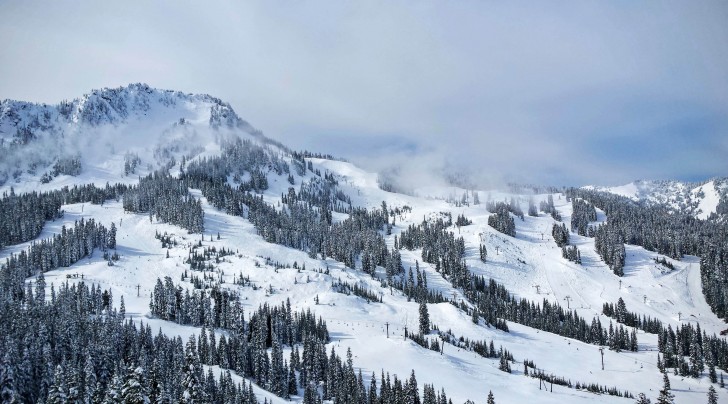
Clearing skies over Cowboy Mountain at Stevens Pass.
Credit: John Nelson
I learned how to ski at Stevens Pass, so whenever I return, it feels a little like a trip back in time.
The lifts are updated, of course, but I can’t help reminiscing about those days more than a half-century ago as I learned how to make a parallel turn on the rugged slopes. For many skiers of a certain age who grew up in Seattle, Stevens Pass served the same purpose.

Skiers enjoy the soft snow on Hog Heaven, an intermediate run on the frontside of Stevens Pass.
Credit: John Nelson
On this trip, I arrived to a classic late-winter storm that brought 10 inches overnight. Instead of the narrow wooden skis of my youth, it was a day for rockered powder planks. As the morning progressed, the skies cleared, revealing Stevens’ dramatic scenery.
If I can hang on for a few more years, Stevens will offer another reason to return: exceptionally low pricing for 70-and-older skiers.
Snow, Terrain and More
- Location: The ski area is 75 miles east of Seattle on U.S. Highway 2, a major east-west route through Washington state. It takes about 1½ hours to drive to the ski area on good roads.
- Snowfall: More than 450 inches fall annually on Stevens’ 1,200 acres. The pass is often in the stormtrack for Pacific systems that hit Washington, with major dumps a common occurrence.
- Terrain: The “frontside” is dominated by two peaks rising from a base of 4,061 feet: Cowboy Mountain (5,845’) and Big Chief Mountain (5,600’). The “backside” is called Mill Valley and drops from the top of Big Chief Mountain into a south-facing basin that bottoms out at 3,821 feet. About 35 percent is rated advanced, with 65 percent rated beginner and intermediate. A large and popular terrain park is located on the Brooks Chair, keeping the boarding tricksters in one location.
- Lifts, lights: Stevens is designed to handle large crowds. Three high-speed quads ferry passengers, along with four triple chairs and and three doubles. Much of the frontside terrain is lighted for Stevens’ popular night-skiing.
Lot to lift access
- Parking is a problem on busy weekends and holidays. Arrive early. On weekdays, it’s much better, but you still may need to park some distance from the base area. A passenger and gear unloading zone is available near the lodges.
- Bus and shuttle services bring passengers from Seattle to the sometimes-busy area.
- Accommodations: Stevens is an easy day trip from Seattle. The best option for overnight lodging is Leavenworth, Wash., a tourist hub 37 miles to the east.
Culture
- The vibe: Stevens is a big resort, but it’s much less tony than rival Crystal Mountain. A fun-loving party scene occurs during night-skiing.
- Dining: The base area has three lodges with busy bars and restaurants and the best coffee (T-Bar Market) of any ski area in the Northwest.
Bottom line
- If you’re 70 and older, your ski day is a bargain: Just $15. Regular adult passes (ages 16-69) are $69 during peak days and $64 for off-peak days.
- Grooming is exceptional on the area’s lower slopes. Upper-elevation lifts take skiers into a challenging world of powder and steeps.
- The south-facing Mill Valley side offers sunny-day exposure in an open bowl.
Stevens Pass Webcam Click Here

Sunny side of the mountain: South-facing Mill Valley.
Credit: John Nelson
[authors_page role=contributor]