


Have You Tried Learn-And-Ski Trips With Other Seniors?
Before Road Scholar, there was Elderhostel.
My wife and I did 11 downhill learn-and-ski trips with Elderhostels from 1999 through 2009 when the programs were listed in a paper catalog, and registration was mailed in. We drove to most of the Western resorts from our home in Salt Lake City. For Tahoe and Winter Park, we took Amtrak, which was convenient, scenic, and relaxing. The skiing always top notch, and we were always lucky with snow conditions.
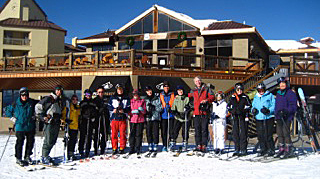
This is the average size of a Roads Scholar group. Taken at Crested Butte.
Credit: Jan Brunvand
Every program was first rate. I assume the Road Scholar downhill skiing programs are similar. [Editor note: Road Scholar ski trips include Alpine and Nordic destinations.] We’re signed up for the one at Telluride in February.
Each program started Sunday with a get-acquainted dinner. Most participants meet then for the first time, although sometimes a ski club or group of family or friends had signed up together. We skied four or five days with guides or instructors available.
As with all Elderhostel/Road Scholar programs, the price covered everything, and participation was flexible. For example, I was not interested in early morning stretching or warm ups (OK, maybe I should have been) so, with other fanatics, I would ski first tracks on the mountain while the prudent others were tuning up. If someone, after a day of skiing, was too bushed to show up for an evening lecture, nobody criticized.
On a couple of occasions when it had snowed hard the night before our guide would suggest that we simply hit the fresh powder on his favorite runs instead of taking our scheduled guided tour. Nobody argued with that.
Lodging was usually a motel or hotel in town, but at Schweitzer Mountain and Grand Targhee we were housed right at the resort—ski-in, ski-out. The most impressive housing we experienced was Buck’s T-4 Lodge near Big Sky resort. The simplest was the Red Fox Alpine Lodge in Vermont where we had bunk beds, and the facilities were down the hall. All places we stayed were clean, comfortable, and cozy.
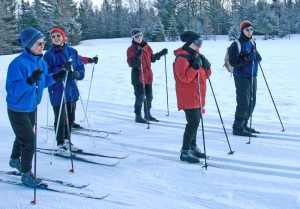
Here’s a portion of a Roads Scholar group at Craftsbury Outdoor, VT., enjoying the XC trails.
Credit: Road Scholars
Breakfasts were in the lodging; lunches were usually vouchers for on-hill restaurants or in a sack. Dinners were either at the ski area or in town. Our favorite experience was at Crested Butte where we stayed in a remodeled miners’ boarding house with a self-service cash bar. Dinners were at a different place each evening.
Educational components varied, ranging from avalanche awareness, winter ecology, and local history, to Shakespeare’s sonnets, jazz history, and Western films and art. At Tahoe’s Cal-Neva hotel, we learned about casino gambling from a blackjack dealer. At Grand Targhee, high school students illustrated their research on capturing and tagging Wolverines.
I’m not sure why Judy and I drifted away from Elderhostel ski trips after 2009. Possibly, it was influenced by the weak pun of changing the name to Road Scholar (just kidding) or the necessity of looking up programs on the Internet instead of browsing paper catalogs.
We are looking forward to our February trip to Telluride, a place we skied just one day long ago. Here’s our chance to get to know the area better. Road Scholars on skis, here we come!
Five Senior-Favored Products
I found them at the Outdoor Retailers Winter Market.
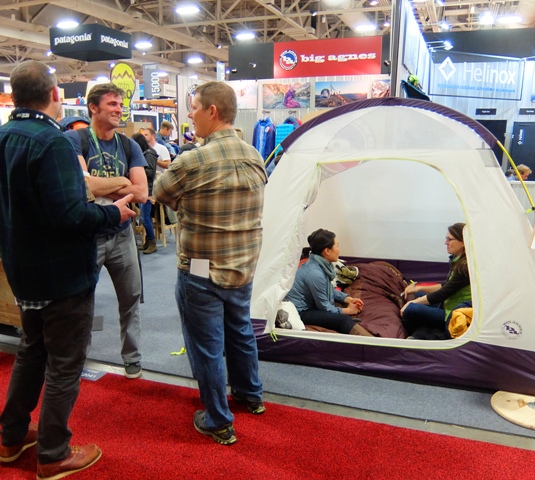
“Come into my office and let’s talk business.” A buyer and seller seal a deal while sitting in the OR Show’s prime office space—a tent.
Credit: Harriet Wallis
It’s the largest show of its kind in the U.S., and it’s where manufacturers strut their stuff and retailers place orders for next year. The show is the launch pad for innovative products as well as redos of existing products.
I was on the hunt for products that would appeal to senior skiers. After walking down aisle after aisle, my eyes glazed over with too many socks, boots, jackets, snowshoes, and gadgets.
The show covers acres within Salt Lake City’s convention center. A limited number of passes are issued for media writers and photographers – such as SeniorSkiing.com. That’s how I got there.
I kept asking myself: “What would seniors like?” Here’s what I found:
 Wool. This natural material regains popularity. The Johnson Woolen Mills in Johnson, Vermont, has produced American made wool products for 173 years. It’s a 4th generation company.
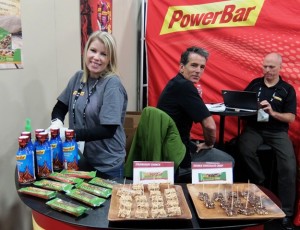 Refuel. Power Bar just launched a gluten free protein shake. Drink it to refuel at lunchtime or as a recovering drink as you head home. I tried it and like it. Currently available in convenience stores and bike shops.
 Rehydrate with electrolytes. Drop a Nuun tablet into your water bottle and hydrate with electrolytes and without calories. New and improved with many subtle flavors. Nunn was invented about 11 years ago by a triathlete who wanted just water and electrolytes. I learned of Nuun when I did a story about the U.S. Ski Team’s executive chef and his recommendations for just regular athletes like us.
 Sun protection. Sol is a highly effective sunscreen compounded from rub-in zinc and pharmaceutical-grade ingredients. Testing shows it doesn’t sting eyes or destroy fabrics and it stays on until you wash it off with soap and water. Available at dermatologists, some resorts and online. I tried the lip protector and it really stays on.
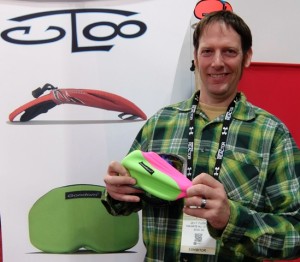 Goggle saver. It’s hard to stuff your expensive goggles into their snazzy bag to protect them. This elasticized cover does the job quickly.
All photos—Credit: Harriet Wallis

Product Review: Shake It With TomTom Bandit
Action Camera Comes With Instant Editing.
It’s good to have a rival—Macy’s has Gimbel’s, the Red Sox have the Yankees, Holmes has his match in Moriarty. Everyone gets much sharper with a decent competitor. And so it is with action cameras.

TomTom Bandit Action Camera has a 4-way navigation button on top. The camera has many attachment devices.
Credit: SeniorsSkiing.com
The ubiquitous GoPro, the current market leader, has almost become a verb, as in “I GoPro-ed my last run, and I can’t wait to see it.” Enter a new rival in the action camera market—the TomTom Bandit from the company that made its mark in GPS technologies, bringing navigation features to running and golf watches, car dashboards, motorcycle handle bars, fitness devices and more. Now, the TomTom Bandit has not only quality optics and a variety of choices for video or photo making, but a unique way to get your clips spliced together and posted to social media.
You’d expect a competitive action camera to have a high standard for video and photo quality; it’s the price of admission for this kind of product. And the Bandit certainly looks terrific on a cell phone display. TomTom Bandit has slow-mo, time-lapse, standard video and stills, with options for wide angle or normal lens, and different speeds.

Key Feature: Shaking your SmartPhone assembles a collection of clips into a video. Add music and viola.
Here come the differentiators. When on your skis (bike, sky-dive, etc.), the Bandit uses built-in motion sensors to tag clips that mark action segments, based on your speed, rotation, g-force, vertical descent and acceleration (and optionally, your heart rate). You can also mark these manually as they happen by hitting a button on the camera or using a remote button linked to the device.
When you combine these highlights, you get a video that can be instantly available for sending into cyberspace. How? The TomTom Bandit connects wirelessly to your SmartPhone which has an awaiting, free TomTom Bandit app . Now get this. When you shake your phone (like a Martini, kind of), the highlight reel shows up on your phone. The app actually edits together a collection of six-second snips from your clip collection. You can add a music track (from your music library on your SmartPhone), audio narration and then blast it to whatever destination you choose from Facebook to Instant Message to email or whatever. A key benefit of all this is rapid and simple dissemination of your exciting moments.
We had a chance to give the Bandit a test flight. Because of the snow drought here in New England, we went for a walk around Appleton Farm, just across the street instead of cross-country skiing which was the original plan. Here is what we learned about using the TomTom Bandit.
It is good to have a tech-savvy son, daughter or son-in-law handy to give you the big picture instructions before you get going. The instruction manual that comes with the packaging is limited to the very basics. Only after doing some online searching did we find the main, down-loadable reference/instruction manual. That was thoughtfully done and thorough.
Pairing my SmartPhone (iPhone 6) with the camera took some trials; referencing the steps to take in the online reference manual helped. The controls aren’t intuitive; you do have to find and follow the instructions.
When we went for our trial walk, we tried to walk fast (to simulate exciting moments), pressed the Highlight button on the camera several times. (Note: You can use your SmartPhone as a view finder for the camera.) Back in the office, we followed instructions on the SmartPhone app to “Create a Story”, shook our phone, (that felt a little odd, but it worked) added a sound track from our iTunes library and sent it to family via instant message. We repeated the process with a series of videos around the office, but we couldn’t immediately lock on to the wireless connection to our phone; it eventually did pair up, though.
We also found the On-Off buttons—they are separately mounted on the camera—were a little hard to press with gloves in. Having a remote control would most likely help a lot.
The TomTom Bandit comes with various devices that allow you to attach it to helmets or poles. There’s also a waterproof lens; the Bandit is waterproof to 50 meters. The camera retails for about $396.99 on Amazon. There’s a premium pack with remote control, various mounts and waterproof lens cover for $496.99.
Bottom Line: TomTom Bandit has some nice features like shake-and-edit-then-send, but it does take some fiddling and diddling to get comfortable in operating them. Video quality is excellent which makes all that learning worth it. In all, a camera for seniors who want to show their grandkids the thrills and beauty of the outdoors.
[authors_page role=contributor]