

Rediscovering John Jerome: Looking Closely At Everyday Things
Leafing Through An Old Magazine Reminds Us Of A Great Writer
Back in the early 70s, as assistant editor at SKIING Magazine, then located at One Park Avenue in New York, we would occasionally watch a typescript from John Jerome arrive in the mail and work its way through the editorial process. After reading a couple of paragraphs, it became clear that these words were not the usual ski article patter. John was a skilled observer, first requirement of an essayist extraordinaire, and was able to tell stories and administer advice about simple things in a way that revealed a writer was at work.
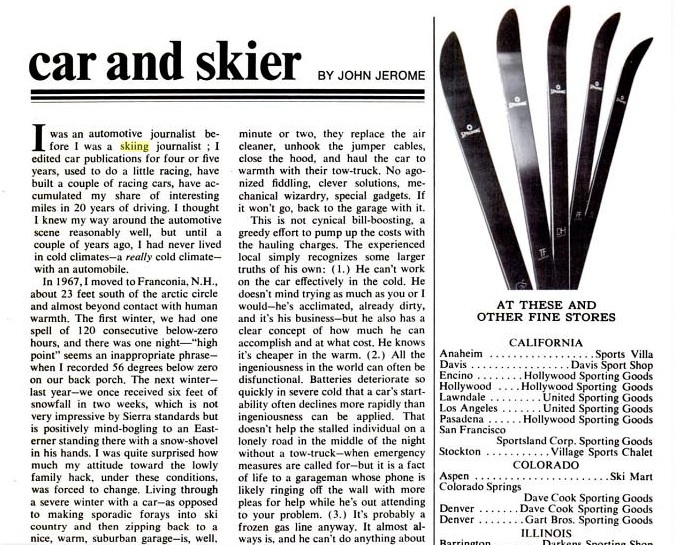
John Jerome was a polymath; he started in automotive journalism (he was editor at Car and Driver), became a skiing savant (he was editor at SKIING), re-located from the “city, working for magazines, wrestling with words and paper in tall buildings under fluorescent lights” to New England. There, as a freelance, he wrote books and many articles about running, building stone walls, becoming an aging athlete, mountains, the value of stretching, and, yes, skiing. And the halo of subjects around skiing, like cars and winter. Here’s an excerpt we just re-discovered by glancing through a November, 1969, SKIING article, “Car and Skier”. He’s talking about one of the two main problems of winter driving he learned by living in cold-winter New Hampshire, getting unstuck:
“Getting unstuck, or not getting stuck, is a much more diffuse problem, against which logical, ordered stops are not so effective. I hate and despise snow tires, but I put ‘em on, and they saved me a lot of grief. My prejudice was based on their noisiness and feel at highway speeds; what I didn’t realize is that a large part of the process of not getting stuck is a kind of metaphorical shifting of gears that takes place when you are a severe-winter resident. You simply slow down. When winter closes in, you bank your metabolism and your frustrations, and settle down into a calm and bumping 25-mile-per hour way of life. It does wonders for keeping you out of snow banks, and it also overcomes a lot of prejudices about snow tires. You can spot winter tourists by how fast they drive more quickly than by their plates. So can the cops.”
The first problem of winter driving, if you’re wondering, is getting started. Solution: Bring car battery into house at night.
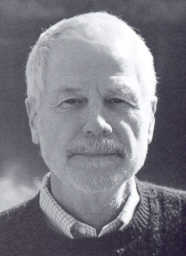
John Jerome, prolific writer, observer, athlete, contemplator of things.
Good writers see connections between things in the world that others either don’t see, or don’t see until the writer points them out. John Jerome was good at that. Here—in this excerpt from his book Stone Work— he makes a link between the rhythm of placing stones on a wall and making linked turns in skiing. On finishing the placement of a stone—the last step of the cycle: start, the move, the finish—he says:
“Sometimes, there is more difficulty in finishing moves than in starting them. I first ran across this principle in downhill skiing, where great instructional emphasis is placed on completing one turn in order to get the next one started right. This didn’t make a whole lot of sense to me: you have to stop turning in one direction if you’re going to start turning in the other, don’t you? I flailed and flummoxed my way through a lot of awkward moments before the significance of the advice sank in. Finishing is a positive act. A ski turn carried to its logical physical conclusion ends with an edge-set that make a stable platform from which to start the next turn. ‘Finished’ means your weight is in the right place, your body and skis prepared for whatever comes next. Without it, you’re in trouble. You have no ‘timing’.’
John Jerome was contemplative writer who wrote in a way that made you feel you were talking with a very interesting friend over a very good drink.
His books are still available on Amazon.com. Have you read Truck, Staying With It, or Staying Supple?

1964: Was It Really So Simple Back Then?
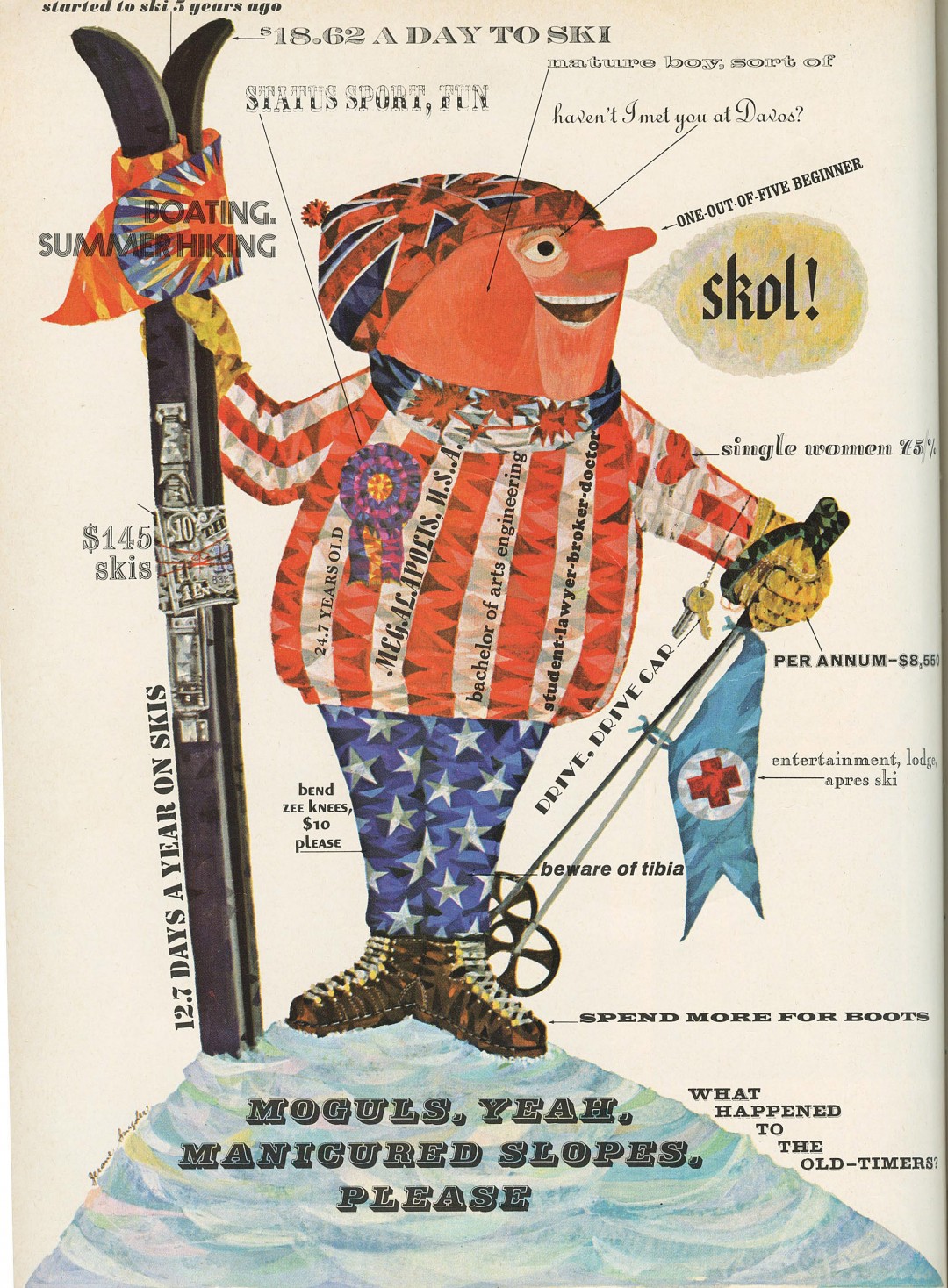
From a 1964 SKI magazine, a skier poses with his attitude.
Illustrator: Jerome Snyder

My Fitness Journey Continues: Part Four

The Ritz-Carlton, Lake Tahoe is nestled in the forest halfway up Northstar’s Mount Pluto.
Credit: The Ritz-Carlton, Lake Tahoe
Exercise your right to stay fit when you go on that summer trip!
To all you senior winter sports aficionados out there who still have your summer escape ahead of you: Is fitness a part of your plans? It should be, and it should be easy to pull off. Those days of lazing about day after day, taking afternoon naps on an Adirondack chair on the lawn of a summer resort or reading a pile of paperback novels on a deck chair aboard a big ocean liner are long gone. Although relaxation is still a major part of summer getaways, the operative words today are “go, go, go!” That bodes well for us skiers, skaters, snowshoers and boarders who want to be ready to fly when the snow does. Staying in shape during the off-season has never been easier because resorts and cruise companies have geared up handsomely for today’s active senior vacationers.
With my very public fitness journey in the forefront of my mind, I decided to test out this fitness vacation thing and spent three days sampling the fitness options offered by The Ritz-Carlton, Lake Tahoe, a luxury resort situated in the forest halfway up the mountain at Northstar ski area. In addition to all the activities one can do right at the resort, the staff can also arrange any number of active adventures available in the Tahoe area for its hotel guests.

Kayaking is a great upper-body workout for skiers in the off-season and especially relaxing on the calm waters of Lake Tahoe, one of the clearest lakes in the world with water clarity of more than 70 feet. Credit: The Ritz-Carlton, Lake Tahoe
Before we had even checked in, we stopped off at Tahoe Vista on the shores of Lake Tahoe and took the Tahoe Adventure Company’s “Discover Kayaking” tour with a guide, learning how to get into and maneuver a kayak (we were both first-timers), and paddling over to King’s Beach and back, learning about the geology and natural wonders of the lake along the way. One of the beauties of kayaking is that it can be as laid back or as rigorous as you want to make it. And for first-timers, you can’t beat a placid lake!
Our fitness vacation was now officially launched, and after checking in at the hotel, we plotted out the rest of our activities for our short stay. Our main venue would be the hotel’s fitness center, which offers an array of one-hour classes free to hotel guests on selected days, classes such as Active Stretch, Core Focus, and Healthy Back. There’s also a full complement of cardio equipment—treadmills, elliptical machines, recumbent and upright stationary bikes—as well as free weights, etc., available for use 24 hours a day. (It’s amazing how much more enjoyable exercising is when you’re looking out onto a forest.)
Ritz-Carlton guests can also enjoy a lap pool (in addition to the regular hotel pool), and staffers can help guests plan rounds of golf, hikes, mountain biking, white water rafting (when there isn’t a drought!), tennis, or fly fishing. There’s enough active outdoor stuff to do here that you don’t even have to feel guilty when you overindulge in the resort’s superb Manzanita dining room.
Of course, when staying at a five-star establishment, one must spend a certain amount of time luxuriating, which we did: Sunning and swimming at the main pool in between sips of daiquiris served poolside, chilling in the hot tub, and wrapping up our stay with a soothing massage at the resort’s beautiful spa.
Whether you’re headed for a luxury resort or Uncle Joe’s log cabin in the woods, with a little research ahead of time and a little planning,

Ritz-Carlton fitness instructor Nancy Brest demonstrates “dynamic stability” during her Active Stretch class, one of several fitness classes offered by the resort hotel on selected days.
Credit: Katie Cleese Photography
it’s easy to make sure that your vacation has a robust fitness component. Make a list of all the things you can partake in within a 20-mile radius of where you’re staying, then prioritize the items on the list and commit to the top however many. And every time you overindulge at mealtime, make sure you’re out there the next day, hiking or biking or swimming or running. You’re most likely in a very scenic place, so get out there and enjoy the view!
For more information on The Ritz-Carlton, Lake Tahoe, go to www.ritzcarlton.com/en/Properties/LakeTahoe/Default.htm
To contact Tahoe Adventure Company, go to www.tahoeadventurecompany.com or call (530) 913-9212.
[authors_page role=contributor]