


Grow A Hiking Habit: Part Two–More Stuff
Outdoor Guru Steve Hines Offers More Ideas For Taking A Hike.
Summer hiking season is in full swing. The temperatures are warming and trails are dry. After covering the ten essentials in Grow A Hiking Habit: Part 1, some other items will help you more enjoy your hiking.
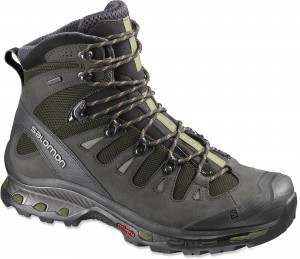
Real hiking boots are lightweight and support your ankle. Sneakers don’t cut it on the trail.
Credit: REI
Boots: Stout boots with good support are a must. Look for boots with waterproof liners. Boots should come to the ankle or above to keep trail debris out and protect the ankles. You should be able to wiggle and spread your toes and walk down hill without “jamming” your toes. Your boots should be wide enough in the forefoot that there is no pinching of any of the toes. Your heel should be held in place without constricting them. If your heel moves around side-to-side with the boot untied try another style/brand. Get fitted at outdoor shop by a qualified boot fitter. If you use orthotics, be sure your boots accommodate them.
Trekking Poles: These are telescoping poles that look like ski poles. When not in use, they can be strapped to the outside of your pack. When in use, they support the legs and lower back. They help with balance and help burn 25 percent more calories.
Comfort Items Now that I’m a little older, several items in my pack make the hike more comfortable.
- A Dry T-Shirt: A dry shirt mid-hike is great. Avoid cotton; get Dri-Fit or Performance shirts that evaporate quickly.
- Extra Socks: Even the best socks can’t always keep up with amount of moisture you produce.
- Foot Powder: Changing socks and rubbing on some foot powder mid-hike is a treat!
- A Sports Drink: Water is essential. But, a sports drink like Gatorade reduces the risk of dehydration among older hikers.
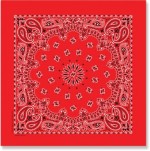
The classic bandana is an invaluable partner on the trail.
Credit: REI
Bandana: The ubiquitous hiking buddy: Towel, handkerchief, sun protection, signal caller, sling, and bandage just to name a few uses.
Watch: I like to know how long it takes me to get from Point A to Point B on a hike. If I know the length of the trail I’m on and how long it took me to get there, I can judge my fitness level better. During these last few years, I’ve been aiming for a 1 mile/hour pace on mountain hikes and treks.
Cell Phone: Many people believe cell phones on the trail ruin the wilderness experience. But a phone can be a lifesaver. For many years I left my phone home but now, especially on solo trips, I take it along. Just be aware that in many remote places reception can be spotty or non-existent.
Camera: Helps with memory if you have a time/date stamp option.
Binoculars: Helps with both navigation (identify landmarks for triangulating your position) and spot/identify wildlife.
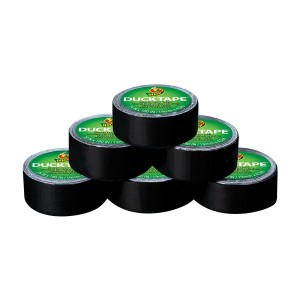
Is it Duct Tape or Duck Tape? Regardless, it comes in small-sized rolls, perfect for a backpack.
Credit: Amazon
Small Notebook And Pen: Record hiking times and observations, list hiking companions for later memory making.
Duct Tape: Blister treatment, gear repair, unknown problems. A small roll of duct tape can do miracles.
Please feel free to make comments and provide feedback and additional wisdom. I also welcome questions and clarifications. This can be a wonderful forum for getting your hiking habit started and sharing experiences with others.

My Fitness Journey Continues: Part Three
How and what we eat is the second half of being fit.
Well, they never said it would be easy. Although the exercise part of my journey to fitness is going well (I’ve lost another inch in my upper body measurements), the changing of my diet is going a bit more slowly (I’ve lost only two pounds this month). The good news is that I’m going in the right direction, weight-wise, and I’ve also read that you gain heavier muscle mass as you get into better shape, which means my body composition is better than the scale would indicate.
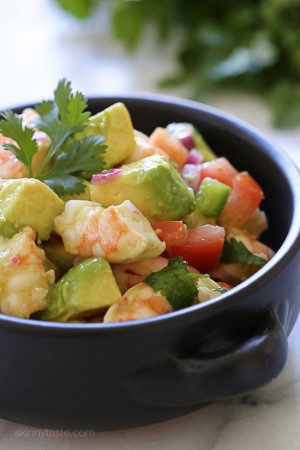
In this Zesty Lime, Shrimp and Avocado Salad recipe, healthy avocados play a starring role! (Credit: skinnytaste.com)
Regarding food management, we’ve probably all followed some popular diet (or several) over the course of our lifetime, with varying degrees of success. We’ve likely lost some or a lot of weight in a matter of weeks or a few months. But as we all know, within a year or two, we’ve put the weight back on. The problem is that diets with extreme components are not sustainable (or even healthy) over the long term. The key is to instill lifelong healthy eating habits that we can live with (both literally and figuratively!).
Long-popular diet plans (such as the South Beach Diet, the Atkins Diet, Weight Watchers, etc.) and even the more extreme ones (e.g., the Cabbage Soup Diet, the Fast Food Diet) can be good “jump-starters” but over the long haul, the only way to keep the weight off is to develop good eating habits. I’m finding out changing decades-old habits is not something you can do overnight. I’ve made a few changes, such as eliminating a roll or piece of bread with dinner and saying “no” to myself a few times a day when I feel compelled to grab a nibble of something, but I plan on doing a better job of practicing what I preach in the coming months, so hopefully I’ll have great news to report in this area by fall.
And what do I preach? My jump-starter, as mentioned in an earlier article, is Weight Watchers, which I plan to continue for another three months. What’s been good about the program this first three months is that it’s gotten me in the habit of recording everything I eat and drink every day. Over the next three months I plan to do a better job of staying within my allotted daily points.
When it comes to lifelong habits, I’m working on developing the following behaviors:
- Drink several glasses of water a day (in lieu of diet soda; a study cited in the University of California, Berkeley Wellness Letter showed that people over 65 who drank diet soda every day had gained two more inches in their waist over a nine-year period than those who hadn’t imbibed). Often, when we feel hungry, we’re actually thirsty. A glass of water can subdue hunger pangs, plus it helps keep your body hydrated, which becomes more challenging as we age. Nancy Brest, who’s been a fitness instructor at The Ritz-Carlton Lake Tahoe for five years and works with the U.S. snowboard team, adheres to drinking daily in ounces half your body weight, so if you’re 160 pounds your daily allotment would be 80 ounces.
- Eat a few small meals a day rather than one or two large ones, and nearly every article I’ve ever read on nutrition and diet has stressed how important it is not to skip breakfast. Save bigger meals for earlier in the day; I try not to eat any meals later than 7 PM.
- Practice “mindful eating.” In a nutshell, it’s all about chewing slowly and consciously tasting your food. It’s about savoring every mouthful as opposed to shoveling it in. Take twice as long to eat a meal than you usually take. Google “mindful eating” and you’ll find many articles if you want to delve deeper into developing this habit.
- And finally, you don’t have to eat plain steamed vegetables on a plate to eat healthily. One way to make the transition from bad habits to good ones is substitution: e.g., putting Greek yogurt on your potato instead of butter. And one of the best sites around to find incredibly delicious and savory recipes of your favorite dishes that have been made more healthy is skinnytaste.com. Be sure to check it out, especially the black bean burgers (better than beef ones!).
One final surprising diet tip: the feature article in the latest issue of UC-Berkeley’s Wellness Letter is packed with incredible facts on the health benefits of avocados. Don’t be put off by the calories. There are so many other health benefits packed into the little fruits that outweigh the calorie count. The story won’t be available online for a couple of months, but in the meantime, here are a few avocado facts you can check out on the website now, just click this link.
Bon appetit!

Which Ski Areas Are In Survival/SunsetMode?
Industry Expert Stacks Up Ski Areas From Healthy To Sunset.
Doom and gloom seemed to poke through the otherwise good news presented at the end of January, 2015 Snow Sports Industries America trade show in Denver. Gathered for an “Assembly” by marketing analyst Destimetrics, marketing gurus opined that there was good news in the data: economy upbeat, lodging and gear purchases all on the positive side. The spoiler was a presentation by former ski resort CEO, now marketing consultant Bill Jensen whose presentation sorted ski areas in a hierarchy. At the top were the handful of healthy, name-brand resorts. But, at the bottom of the stack were 300 ski areas who were either in Survivor or Sunset mode. Bear in mind, according to the National Ski Area Association, there are 470 active ski areas in the US, not counting 50 or 60 in Canada. Of course, the name of the game is which areas are on those lists. What do you think?
Here’s a report from Curbed Ski, a Colorado city-ski blog.
[authors_page role=contributor]