

How Much To Exercise And Why Bother
Is There A “Right” Amount Of Exercise Time?
Most readers of SeniorsSkiing.com are active, engaged folks who enjoy snow sports in the winter and lots of different non-snow activities in the summer. And, most of us like to keep active, because it makes us feel good. That’s important as we become more experienced in years.
You might wonder if the amount and intensity of the exercise you are doing is enough or too little or too much. For what purpose, you ask. If you want to lose weight, keep fit and nimble, then you already know the answer: If what you are doing now in the gym or on the roads or golf course gives you that bounce in your step, it’s working. But if your goal is longevity—pushing back that time horizon—then there are some specific numbers you should pay attention to.
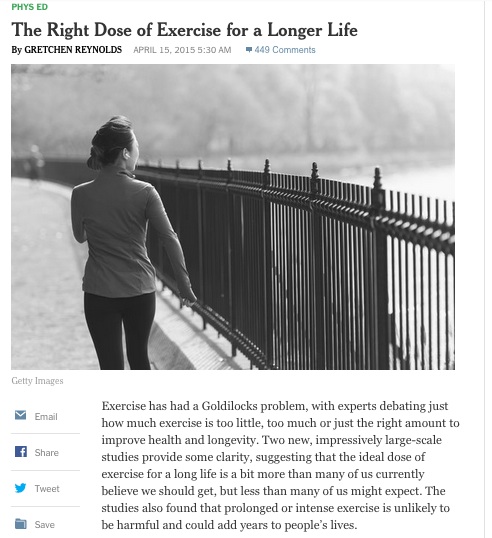
An April 15 New York Times article by Gretchen Reynolds reports on two different studies that now give a prescription for the amount and intensity of exercise that is linked to increased longevity. We learned that “broad guidelines from governmental and health organizations call for 150 minutes of moderate exercise a week to build and maintain health and fitness.” For those who exercise more—450 minutes a week—then longevity goes up almost 40 percent over non-exercisers. And, if 20 to 30 minutes of that activity switches gears from moderate to intense, the longevity number goes up even more. If that’s your goal, then those are your guidelines.
In reading readers’ comments accompanying the article, there are many who just think feeling good is a good enough reason to hit the slopes, roads, trails, links and by-ways. What are the right numbers for you? And why bother? Let us know.

Ski Lessons Improve Senior Skiers’ Technique
It’s Never Too Late to Take A Lesson.
William Smith, age 91, started skiing at Mt. Cranmore, N.H., after WW II. His wife even took lessons from ski legend Hannes Schneider. She quit skiing when she was 73, but Smith continued. He was skiing with his son that morning when I rode the lift with them at Waterville Valley Resort, N.H. Father Smith taught his kids and grandkids to ski, but he doesn’t want to take lessons himself.

Senior Skiers take lessons at Waterville Valley Resort. Good technique means more enjoyable skiing.
Credit: Steve Bryan
“I’m skiing as well as I’m going to. My legs aren’t holding up as well.” I then watched him push off down the slope swiftly in well balanced short parallel turns. So much for weak knees.
Like Smith, many seniors are skeptical of what they call teaching old dogs new tricks, unless they plan to do something very different, like ski powder in Utah for the first time. However, a senior ski lesson can actually lead to more enjoyment.
“Most senior skiers like the medium to long radius turns and cruising the mountain and enjoying it,” says Peter Weber, Snowsports Director at Waterville Valley Resort for 15 years. But that is no reason not to ramp up your technique.
“Whether you’re 7 or 77, technique trumps all. The better you are technically, the easier everything gets,” Weber says.
In teaching seniors, an instructor would most focus on pacing—how fast you ski, how many time outs for trailside chats vs. pushing top to bottom runs, and the need for biobreaks.
Fitness level in general is key, adds Weber. “Skiing anything above a moderate level is an athletic endeavor,” he says.
Like other resorts with comprehensive snow sports schools, Waterville Valley Resort matches you to the right instructor, so you don’t end up in a class with a bunch of young hot shots. Weber also recommends a private lesson as well as taking several group lessons.
Mark Hanabury, an instructor at Waterville Valley, says, “I think it’s more important for seniors than anyone else to take lessons.” He feels seniors will be safer and will enjoy skiing more if they embrace the new techniques including a wider stance and shorter, wider shaped skis.
“Skiing has evolved so much,” he says.
He knows first hand. Last year, he took his dad Dick Hanabury, age 83, to ski Snowbasin, Utah, after convention in Las Vegas.
“He’s been an avid skier all his life and skied on long Head Standard skis when he was younger. I told him he had to retool his techniques to ski safely at his age. I drilled it into his head,” says Hanabury.
“My dad’s outside ski was getting hung up. He was used to stepping onto the outside ski, but his balance wouldn’t allow that. So, a fellow instructor told him to slide the ski forward and free it up. That allowed him to keep both skis on the snow so it was no longer a balance issue,” says Hanabury.
“My son Mark is keen on knowing the latest technique, so he’s done a good job for helping me to keep up as far as turning techniques,” says Dick Hanabury.
“I used that technique, letting the skis do the work, not throwing your body into the turn but just weighting the skis properly and making sure the outside ski in the turn is well weighted, that’s about the best way I can explain it,” he adds.
“If you’re in good condition, I would recommend skiing at any age. I play tennis a couple of times a week, exercise daily, so I’m ready when the time comes,” says Dick Hanabury.
No matter if seniors are updating old technique or learning for the first time, “I feel it is never too late to learn. Skiing is a dynamic sport and seniors enjoy learning just as much as younger folks. This enables them to ski longer and enjoy more terrain with family and friends,” says Mark Hanabury.
Many ski areas have created programs for those interested in new movement patterns associated with shaped skis or improving techniques. They list these programs on the resort website under the snowsports school tab.

Force Majeure: Skiing Is Back In The Cinema
SeniorsSkiing’s First Movie Review A “Runaway” Hit From The Alps
We remember the New Wave of French cinema in the late-50s to mid-70s when going to a “Foreign Film” was an intellectual exercise. That’s when you and your date went to those black and white, sub-titled classics, The Four Hundred Blows, Shoot the Piano Player, Breathless or Jules and Jim, and afterward settled into a discussion about what it all meant. To jog your memory, check out this scene from Annie Hall, where Woody Allen squelches an academic babbler by dragging none other than media theorist Marshall McCluhan into the scene to settle an argument. We were all into interpretation, the more philosophically zealous the better.
Which brings to mind the 2014 movie Force Majeure, from the Swedish director Ruben Ostland. We were attracted to it because it takes place in a French ski resort in the Alps. Since the last film we remember that had skiing as a central element of the plot was Downhill Racer (1969), we thought we’d take it in. It certainly brought back the old-days of trying to “figure out” the message.
A vacationing Swedish family of four enjoys lunch on the deck of a mid-mountain lodge when an avalanche envelops the scene. It’s actually an
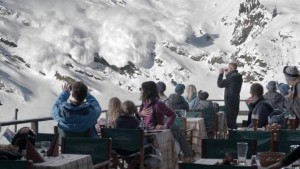
An avalanche triggers a family crisis.
Credit: Ruben Ostland
astonishing sight as the assembled lunch crowd first marvels, then gasps, and finally panics at the approaching cloud of snow. What happens then propels the plot: The father of the family runs away, leaving his wife and two children behind to fend for themselves. The avalanche evaporates into a mist, the father returns, but the wife and mother is left with doubt. That uncertainty grows in several uncomfortable scenes including long, slow takes without dialogue, semi-humorous encounters with other couples at the resort and a foggy ski run that ultimately leads to the climax of the movie and its equally foggy denouement.
While the plot may drive some reflective conversations with your date, we loved our new insights into European-style skiing, the silent actor that we feel stole the show. The movie was filmed at Les Arcs in Savoie, France, which is a cluster of different resorts near Mont Blanc.
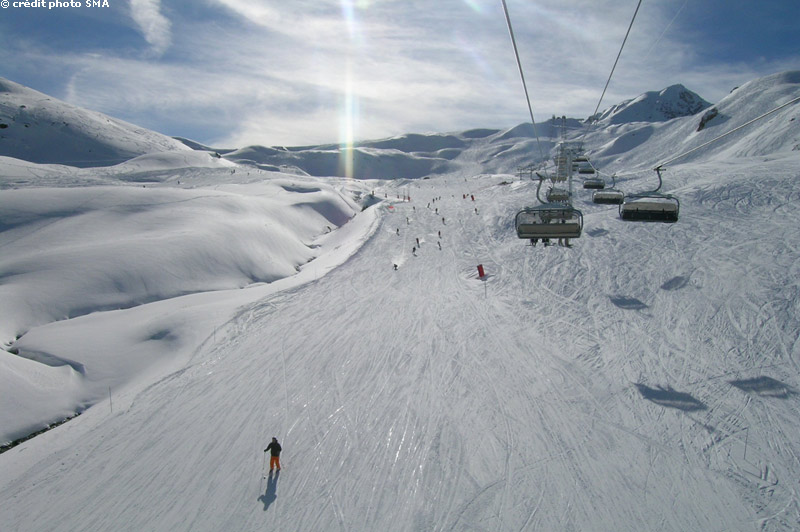
Open-piste skiing is a featured character in Force Majeure
Credit: LesArcsNet/SMA
We got a sense of what it is like to spend a week in the alps, open-piste skiing between different resort areas, taking tele-cabine gondolas from place to place and living in a tres chic, modern hotel with luxury dining and service. Les Arcs has a series of large, apartment-block-like hotels located at different altitudes, all connected by a web of lifts. When two characters in the movie head off-piste for some adventure skiing, the solitude and the scenery are exquisite.
Aside from a few thrilling mountain chases in James Bond films, we’ve not noticed ski resorts, skiing or ski racing in any recent movies. So, thanks to Force Majeure and director/writer Ruben Ostland, perhaps another auteur de cinema can realize the dramatic opportunities in alpine vistas. Force Majeure is currently available on Netflix.
https://youtu.be/3nTJIc_e6Ns
[authors_page role=contributor]