

Seniors See Anywhere: ThinOptics Reading Glasses
Accessible reading glasses, even on a ski lift, make reading fine print do-able again.
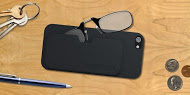
You’ll love these reading glasses, because you’ll always have them with you. No more passing glasses around to read the trail map or the menu. You’ll have your very own glasses, and you’ll know exactly where they are—because their case is on your phone. Now that’s the coolest thing since sliced bread.

ThinOptics “cheaters” are handy wherever your phone goes.
Credit: ThinOptics
Teddy Shalon, the inventor and CEO of ThinOptics, is a serial entrepreneur who spent many years innovating in the Life Sciences. He’s constantly looking for ways to help people enjoy healthy and active lifestyles.
The “ThinOptics moment” happened on a bike ride with his friend. When they stopped for a break, his friend handed Teddy his iPhone and asked him to read a text message from his son. “Is there something wrong with your son?” Teddy asked.
“No, I just don’t have my reading glasses, and I can’t read the message,” his friend said. That’s when Teddy realized that phones are useless if people don’t have their reading glasses. On the ride back, the idea of ThinOptics was born—glasses that are always with you, right there on your phone.
Here are some of the nitty-gritty details. ThinOptics are powerful, durable and fit virtually every nose. They’re made from thermo-injection molded
ThinOptics super-convenient reading glasses can be stowed with your phone!
Credit: ThinOptics
optical grade Poly-Carbonate which is shatter-proof and often used in safety and ballistic eyewear. The lenses are made by one of the largest and most advanced optical lens manufacturers in the world. The bridge is made of Nitinol—an alloy of nickel and titanium— which is 10x more elastic than spring steel, and it’s encased in medical grade silicon tubing and anchored in an injection molded Poly-Carbonate frame. ThinOptics readers come in three optic strengths from +1.00 to +3.00 and case sizes that will fit on your phone.
The bottom line: You get all this technology and convenience for under $40. Click for details on ordering. And there’s a great referral program, too.
Still not convinced? Check out ThinOptics’ torture test on this video.
Still Time for a Winter Tune-up
Get Ready Now to Ski and Snowboard!
Cold weather is approaching fast. Don’t procrastinate. There’s still time to get ready for the ski season. Fitness can help prevent injury, improve abilities and ensure a long, safe season.
Alpine fitness programs routinely include movements to enhance balance and stability, strength, power, agility, mobility and flexibility. Workouts

Exercise ball crunches tune up those all important abs.
Credit: Harriet Wallis
often combine exercises in a circuit-type workout which includes an aerobic component. Although alpine sports are anaerobic in nature with short hard bouts of activity followed by rest, basic aerobic fitness can help the average winter enthusiast avoid fatigue related injuries. In addition to training more specific skills and energy systems, it’s prudent to include 60 minutes of aerobic activity 3-4 times per week.
Focus strength training on core, legs and shoulders. Incorporate exercises that require some twisting movements since many of our summer activities like hiking, biking and running are performed in a single plane of motion. Quad muscles and those in the lower leg are important for balance and turning. Hamstrings help protect knees. Hips play a role in lateral movements. Core and shoulders function as stabilizers.
Although gym machines can be helpful and certainly convenient, considerably larger benefits can be reaped with routines that use body weight, dumbbells, stability balls, kettle balls, medicine balls and exercise bands. Or check out TRX Suspension Training. Originating in Navy SEALs training,
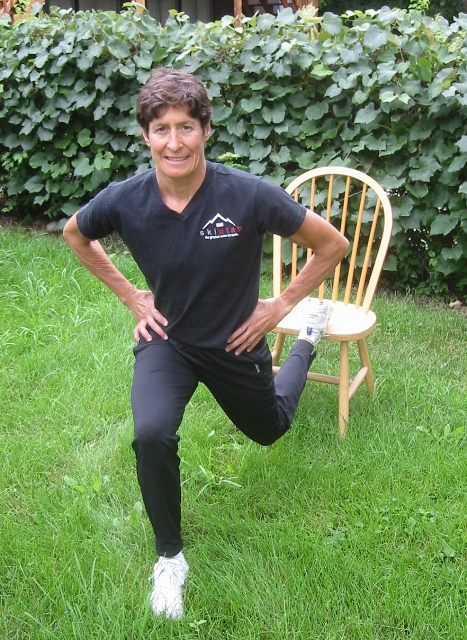
Work on balance with one-foot lunges.
Credit: Harriet Wallis
TRX is used in the NFL and in USA Ski and Snowboard Teams to prepare for the season. TRX classes have also become extremely popular at many fitness clubs and recreation centers.
Look for exercises that include multiple joints because that’s how we move in all sports. Squats, leg curls and dead lifts, overhead press and rowing movements are good examples. With the lower body, progress from two-legged exercises to one-legged and then add some instability to the exercises to improve balancing abilities. Eventually add plyometric—explosive movement exercises—for power. Progress from two-footed hits to one. An easy activity associated with this ability is jumping rope.
Don’t neglect flexibility. Stretch after training and include muscles that were worked during the session as well as problem areas. A good yoga class is great way to improve flexibility. Pilates is another option and adds a little more of a strength component to the mix.
I hope this will help guide your quest for winter fitness. I wish I could individualize an actual exercise routine for each of you, but you can get help by looking for a trainer or class instructor in your area who has a solid understanding of the concepts covered above.
Jo Garuccio is a PSIA Trainer and Examiner, and she teaches at Snowbird. She’s also a Triathlon World Champion and a USA Triathlon Certified Coach. She’s a mega athlete and a mega sports enthusiast who loves to get people moving to be their best.

Knee Replacement Isn’t For Sissies: Part 2
Tips to Kick Start Your Research
A Brighton, Utah, ski patroller with two artificial knees assured me there’s definitely life – and skiing – after knee replacement. Her unbounded success motivated me to launch into research. I’m glad I did my homework. What I learned affected the direction I took, the outcome and ultimately my success. Here are some tips to help you get started.
Metal Knee Model: Is there one in your future?
Credit: Harriet Wallis
Don’t be duped. Learn about the whole knee replacement process. Don’t be duped by a well-meaning friend who says: “I’d go to Doctor Smith. He’s such a nice man.”
That would be as stupid as buying a car because your friend says: “I’d buy a Honda. It’s such a nice car.”
Do your own research
Get on the phone. Call athletes you even vaguely know who might have some insights on artificial body parts, surgery, and rehab. I called several ski instructors, an operating room nurse, and a 75-year-old mogul skier. I picked their brains .
I also plopped down at the table with ski patrollers while they ate breakfast in the lodge. My question to all of them: What should I learn about?
They’ll all have different angles, so write their answers down or they’ll become scrambled mush in your head.
Knees, glues and cadavers. With clues you gather from the athletes about what’s important, get on the internet. Do not start on the internet. There’s so much information you’ll get overwhelmed and quit.
Read up on bone-to-metal adhesives, quad-sparing technique, risks, new knee limitations and more. Be sure to separate information from marketing hype. If you have the stomach for it, I recommend that you watch a YouTube video of a knee replacement on a cadaver. Warning: it’s not for the faint of heart.
Find the top docs. Use the internet to review potential surgeons. They’ll all have illustrious credentials, so do some creative screening. Call each one’s office and ask what his/her specialty is. The phone-answerer should be well informed. Listen carefully. If you get mixed vibes or uncertainty as to whether this is truly a knee replacement guru, it should be a red flag.
Get the inside track. Physical therapists work with patients after surgery. They have refined knowledge about which surgeons give the best outcomes. But they might be reluctant to blurt out a doctor’s name. You’ll probably have to phrase it subtly: “Do you think Doctor A’s outcome is better than Doctor B’s?”
Good luck with your research. Check back for the next installment: Questions for surgeons and how to interview them.
Note: This is a five- part series in which I describe my knee replacement journey with tips to guide you if you’re anticipating knee replacement. Part 1: Inspired by a ski patroller with artificial knees. This is Part 2. Upcoming will be Part 3: Interviewing surgeons and questions to ask. Part 4: How I found the right doctor for me. Part 5: Rehab and why to love it.
[authors_page role=contributor]