

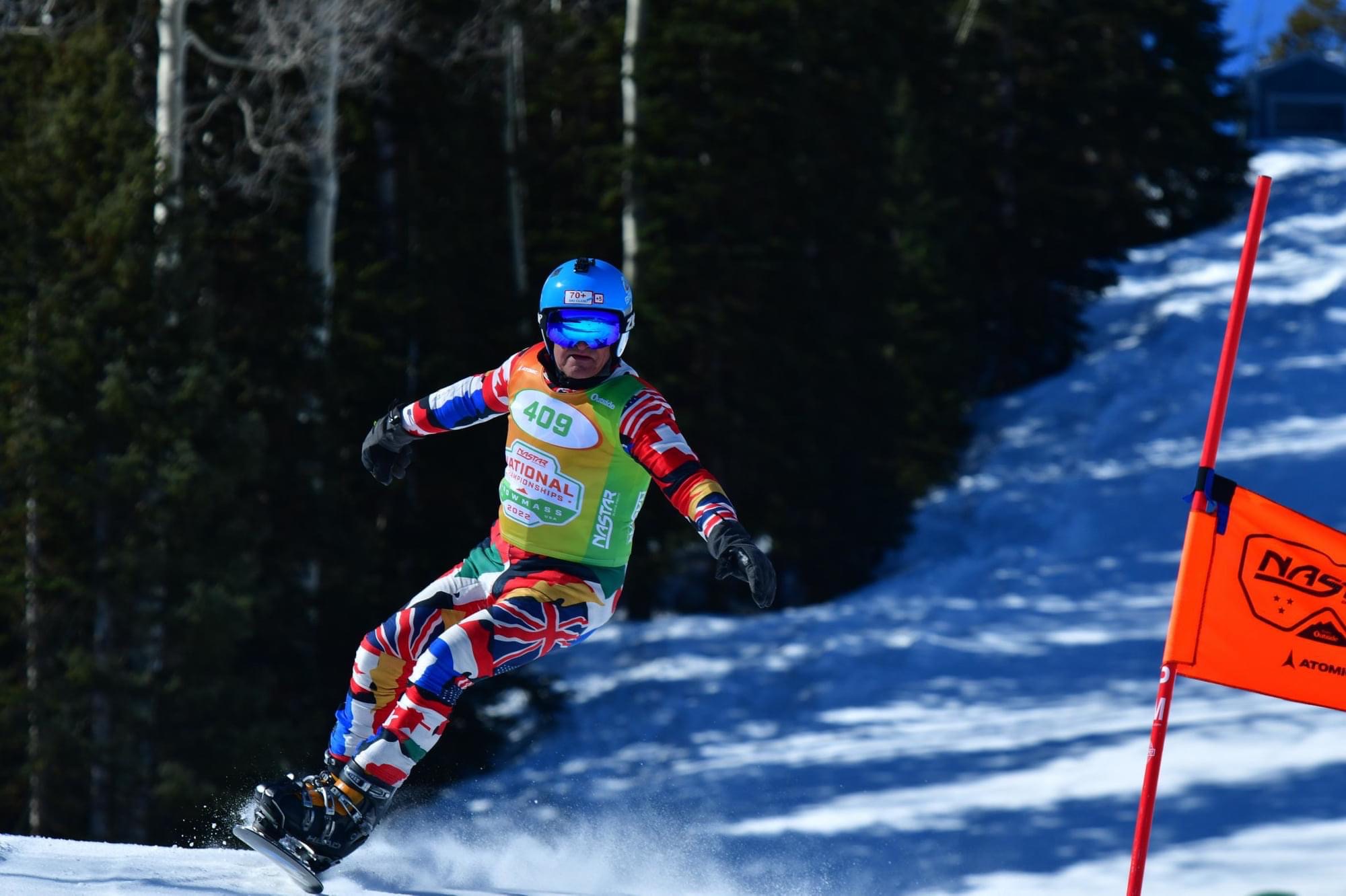
NASTAR Racing for Seniors
Pat Moore
Have you ever tried ski racing? Maybe now is the time. Resorts throughout North America offer NASTAR, the world’s largest recreational ski and snowboard racing program.
It’s not just for the young! Age groups in NASTAR run as high as 95+ and participation among us senior skiers is very high. The 70+ Ski Club participates in a popular race at Okemo Mountain in Vermont every year.
Begun in 1968, the program has seen more than five million participants. Many current and former US Team members got their start in the program.
Participation is open to everyone regardless of ability. Here’s how it works:
The system determines which medal you earn, based on age, gender and – of course – how fast you go. At each resort, there are certified Pacesetters whose performance has been measured against NASTAR’s National Pacesetter.
When the pacesetter at your course makes a run, the system factors in the difference between his/her ability and that of the National pacesetter to determine the theoretical time that the National Pacesetter would have recorded. Then, when you run the course, your personal “handicap” is calculated into the mix.
If you were 25% slower, your handicap is 25. Then according to a chart, you can earn Platinum, Gold, Silver, or Bronze medals.
The thrill of winning your age group at the Nationals is felt in all medal divisions, from pre-teens to the seniors who are their grandparents.
NASTAR has a National Ranking system you can follow online and compare your progress with folks of similar ability in other parts of the country.
You don’t need to have been an accomplished racer when young! Following a 34 year hiatus from skiing, I returned to the sport (and took up snowboarding) in the winter of 1996-97 at the age of 50. It was another two years before I stumbled across Okemo’s NASTAR course and tried a run.
An older skier encouraged me to try it and then raced me head-to-head. He beat me decisively.
Over the next couple of years I made only a handful of runs, but then caught the bug in 2004 and I attended my first National Championships at Park City, UT.
Since then, I’ve raced on skis and snowboard at nearly every National Championship and have made many friends across the country.
I had been told by more than one person that racing improves your overall skiing and I found that to be true. Instead of turning when and where you want, the course of gates below you dictates the path you need to take. On crowded slopes, when free skiing, that skill is invaluable – especially for us senior skiers.
Visit NASTAR.com to find a venue near you.

5 Tips from a Senior Skier

Stanley and Son on DH course
Having celebrated my 80th birthday in November, 2022, I guess I’m an old skier, not just a senior skier. It was the pandemic which stopped me from skiing in 2020 and 2021, not age.
In January, 2020, I skied a week in Chamonix, and then the pandemic nixed my downhill program for the remainder of the 2020 season, along with the 2021 and 2022 seasons.
Now I’m back on skis, older than I was, and noticing a few things which have become apparent in two years of not skiing.
Flat light and white-outs
These never bothered me much before, but now I’m paying a lot more attention to seeing the piste I’m skiing. Finding the right goggles to accommodate my eyeglasses has become an issue.
As an older skier, make sure you’re seeing the piste with all its contours and changing snow conditions. Get new goggles if you have to.
A bag can save your knees
Walking around in ski boots won’t help your arthritic knees. Minimize the distances you walk in ski boots, get a good sized back pack and carry your ski boots to the base lodge or lift station.
Senior skiers also should consider so-called “cat tracks”, which are rubberized soles that slip over the bottom of your boots. They cushion your walk on hard surfaces while protecting you from slipping and sliding, and also saving both your knees and wearing down your boot heel.
Looking for a nice place to ski?
Find the pistes where the racers train or race and ski there, or on an adjoining parallel piste.
Race courses and training pistes have the best slopes, not agonizingly steep with no long flat sections, pure skiing!
Use the best equipment to maximize enjoyment.
If you are renting equipment, take skis that are appropriate for your level of skiing and make sure the ski edges are properly prepared to minimize “sliding” around.
Use boots which are not too soft. You want the pressure transferred to your skis and not absorbed by boots.
If you’re using your own equipment, prepare the edges at least once a week, or after 3-5 ski days, and more often if you are skiing on artificial snow and/or ice.
Stretch
You can’t really ski well unless you can FLEX. Always stretch before your first run.
Stretch your calves and quads, which work so hard during a downhill day.
Stretch your arms, because you might be skating and poling for a stretch of flat terrain.

US Ski & Snowboard Team Race Suits Have Climate Message
Goodbye traditional red, white and blue suits. Hello race suits with a climate message. It’s a whole new concept in race suits.
The blue and white pattern is based on satellite photos of icebergs breaking up and floating in the ocean. The design is intended to draw attention to climate change.
The new suits were showcased by the U.S. Team skiers at the recent FIS Alpine World Championships in Meribel, France, where the Mixed Team Parallel won its first ever gold medal, besting Norway, the frequent winner of the event.
 Mixed Team Parallel includes both men and women, with two racers in head-to-head competition on parallel courses.
Also wearing the iceberg race suit, it was gold for Mikaela Shiffrin in the Giant Slalom and then a silver in the Slalom. The world saw the new race suit on the iconic ski champion.

Three organizations teamed up for this unique race wear design –
- U.S. Ski & Snowboard;
- Kappa, a high end Italian manufacturer of technical sportswear and speed suits; and
- Protect Our Winters (POW), a non-profit that promotes non-partisan climate policies and urges outdoor enthusiasts to help protect the winter sports they love.
“A warming winter is one of the biggest threats to the future of snowsports,” said U.S. Ski & Snowboard. “In the 2022-23 winter, teams around the world have had to cancel races due to lack of snow. Some courses are made entirely of machine-made snow, and athletes are racing in 50-degree temperatures in the middle of winter.”
This year, it’s iceberg design race suits. Will there be a new message on race suits in the future?
Kappa will outfit all teams with outerwear, speed, and race suits for events at home and the FIS World Cup events through the 2032 season. In addition, the company will outfit all U.S. Ski & Snowboard athletes who compete in the 2026 Olympic Winter Games in Italy and in the 2030 Olympic Games.
Will their race suits have an iceberg theme, or another climate message?
[authors_page role=contributor]