


ICYMI January 2023

Photo by Roman Kraft on Unsplash
There’s so much happening at ski/snowboard/X-C resorts this season. So, in addition to regular posts, we also offer this monthly calendar of this and that tidbits ICYMI (in case you missed it).
Here’s what’s happening in January.
22nd X Games at Aspen
Competitors from across the globe – as well as local Olympians Hanna Faulhaber and Alex Ferreira – gear up to take the world’s stage the weekend of January 27-29 at X Games Aspen. Watch the action in Women’s and Men’s Snowboard and Ski Slopestyle, Big Air, SuperPipe and Knuckle Huck at Buttermilk Mountain – for FREE.
New this year, X Games is offering special packages including athlete meet-and-greets, front-row viewing, hospitality experiences and other events.
For the latest X Games Aspen 2023 event information, visit xgames.com
Fire & Ice Shows at Whistler/Blackcomb
Skier’s Plaza lights up every Sunday night through March 12 with a spectacular display of skills at the legendary Fire & Ice Show, where Whistler’s best skiers and riders jump and flip through a blazing ring of fire accompanied by an electric mix of music and dance.
It is an exciting evening of FREE live entertainment to enjoy with family and friends, starting at 9pm. Dress warmly, grab a hot chocolate and prepare to be amazed.
Uphilling in Jackson Hole
Snow King, the town’s “other” ski area – a favorite of locals – and the only one which allows uphilling.
Uphill skiing at ski resorts is a special privilege, as millions of dollars are invested into snowmaking, grooming, and keeping trails safe. In addition, the liability of collisions between uphill and downhill skiers is a major concern (and resort expense). Please follow uphill travel policies posted online and be sure to purchase an uphill travel season or day pass for your visit.
Expect to be greeted and turned around by a staff member if you do not have your uphill pass displayed as you skin up the hill. Dogs are not allowed on the mountain at any time lifts are running, and single file uphill travel is required.
New Boutique Hotels in the Catskills
If you are skiing at Belleayre, Hunter, Plattekill or Windham, there are some interesting new so-called “design forward” boutique hotels in the area with upscale amenities. Check out Eastwind, Hotel Lilien and Bluebird Hunter Lodge.
Also new is AutoCamp Catskills in Saugerties, the first in New York and second on the East Coast, with high-end, boutique-style amenities. There are classic 31-foot Airstream campers, high-end tents, suites, and modern cabins situated among hiking trails and a Clubhouse gathering space.
Ski Up to Six Utah Resorts in One Day
The Ski Utah Interconnect Tour is for skiers with strong legs and lungs and an equally strong desire for bragging rights. It’s also for advanced and expert level skiers with equipment capable of going backcountry in between some resorts in the Wasatch Range. Sorry, no snowboarders, because Alta and Deer Valley do not allow snowboarders.
The interconnect operates daily – conditions permitting – with guides trained in backcountry safety and etiquette (top of both lists is never ski ahead of your guide). There are group tours at $475 per person and private customized tours at $1,499. Bragging rights included. https://www.skiutah.com/explore/the-interconnect-tour
Dine Out Deal
If you are visiting Whistler/Blackcomb January 20th to February 5th, you can enjoy the 21st Annual Dine Out Vancouver Festival downtown and taste the world across the city at more than 350 restaurants with multi-course meals and unique culinary experiences. During a normally slow time of the year, the festival has become a popular time for Vancouverites and visitors to Whistler/Blackcomb to support local restaurants. There are set menus at three price ranges: $20-$34, $35-$50, or $50-$64. Details here.
Background – Such dine-out meal deals started in NYC a couple of decades ago, to boost business in the slow post-holiday weeks. The NYC Restaurant Week template has been copied by hundreds of cities, from Albuquerque to Vancouver.
Next Season News – Winter Park
Winter Park is replacing its Pioneer lift with a brand-new six-pack for the 2023-24 season.
The new lift will include a mid-load station that will allow guests to avoid arduous catwalks at the bottom of the current Pioneer zone.
This season – and hopefully next season, also – take the train to the chairlift. See our article on the Winter Park Ski Train.
https://seniorsskiing.com/take-the-train-to-the-chairlift/
See you for another ICYMI next month – or on a chairlift, gondola or magic carpet before then.
Ageing Skiing Concerns – AKA, Skiing on the Edge
 As I get older, skiing is still a thrill I look forward to every chance I get to go. My major concern these days is skiing safety and skiing with courtesy, which go hand in hand. As a senior, I worry about falling (which doesn’t happen very often, I might add), but even more about being “taken out” by a reckless skier or snowboarder.
In my skiing past I have learned courtesy on the slopes, following the rules of skiing that were posted then. Today those rules may be posted here and there, but I fear that people either don’t know how to read today or just don’t care about other people sharing the skiing terrain.
I have seen notifications posted on the monitors at lifts at Stratton and placed in very conspicuous places in the cafeteria at Mount Snow and other resorts, but it doesn’t seem to matter. When was the last time you heard someone coming up behind you making the statement, “on your left” or “on your right”? In the 60’s and 70’s, you heard it all the time. Now never!
I have kept track of this lately and of all the times of my being passed, it was just one or two times out of 100. Not very good odds. I call it out it every time I am going to pass someone, because they do have the right of way.
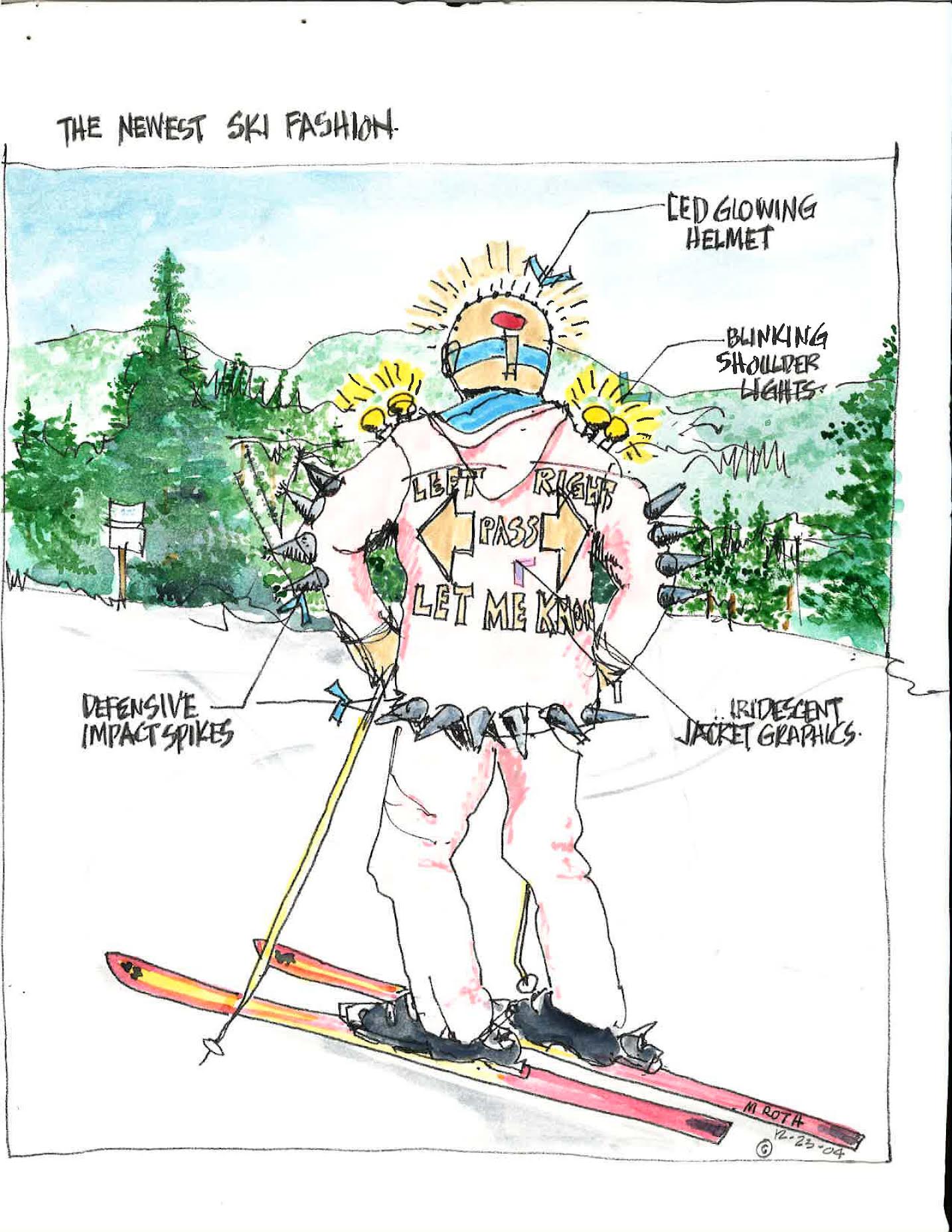
The other day I saw a truck on the highway with the notification to be careful when passing.
If you note the sketch included in this post, it does the same.
I ski very cautiously. For one, I ski along the edges of a trail. Yes, I do run the risk of falling into the trees, but that’s my decision. The reason for skiing along the edge is two-fold – the snow is always better there since it’s pushed to the edges as the day progresses, and if someone is going to pass me it will be on one side only. That reduces the chances of collision by 50%! However, I must admit that I have been passed on the tree side at least a couple of times in my life.
In addition to skiing along the edges, I ski totally under control at a pace that is comfortable to me. I also have reduced my choices of trails to cruisers rather than steeps and for the less traveled trails on the mountain rather than the more popular ones.
As we age, it is also a problem to be able to turn our bodies and look behind us as we decide to turn, so I am going to try something new this year. I am putting rear-view mirrors on my poles to see if that will help – or will it even work?
I am always looking for suggestions as to what can be done to improve, even solve the safety situation. We shouldn’t have to just take our chances. I will continue to take my chances because I am not going to give up skiing. I plan to continue skiing untill my body won’t let me anymore. I don’t want someone else to make that decision for me – other than my doctor. And he’s a skier.

Lessons Ski Resorts Learned from Their Covid Experience

Photo by Glade Optics on Unsplash
The pandemic caused ski area management teams to change how they run their resorts. Covid affected every business function from technology to marketing and communications to day-to-day operations.
As a group, ski areas were forced to learn how to react quickly to an ever-changing set of guidelines emanating from the Federal government as well as those from state governments that were often not in sync with Federal rules. Coupled with travel restrictions, the covid pandemic forced management teams to become more agile in ways they never imagined.
The lessons learned emerged from the “covid years” fell into three large buckets – technology, staffing and marketing.
Bucket “one” were the marketing and operating challenges that accelerated implementing automation at almost every level of operations. For skiers, the most visible were RFID (radio frequency identification) tags that reduced the number of lift ticket checkers at lift entry points.
Resorts updated their apps for mobile phones so skiers could buy food at kiosks, order meals at on-mountain restaurants, and pick up their lift tickets and season passes with touchless technology. Keeping websites current to reflect the changing guidelines and the impact on the area required management teams to drastically shorten their web site updating cycle-times.
Each new set of guidelines affected the marketing and communications messaging which drove new content to be incorporated quickly on the website. Websites became a primary means to ensure that skiers knew the area was open for business and what precautions they needed to take to be allowed to ski or snowboard. Social media also played a role, so Facebook pages and other applications became increasingly important ways to communicate with skiers.
The technology fell into two groups – the ones an area implemented and will continue to use and improve. The second were applications that were needed or planned to cope with covid and now are in their hip pockets in case of another similar set of challenges.
The second bucket of lessons came were changes in their marketing message and how areas communicated with skiers. Traditional messaging changed from “come to our area, the skiing is great and you’ll have a wonderful time” to “we’re open, conditions are great, and here’s what we’re doing to comply with the guidelines”.
How to operate a ski area with less than the full staff is the third bucket of lessons learned. Management teams made difficult choices as they wrestled with ensuring guests had a great vacation while running at the area with roughly 70% of what would be considered the desired staffing level. Operating hours of some facilities were curtailed; some services were eliminated; how and when trails were groomed was changed while at the same time, the area operated as many lifts as possible to minimize lift lines.
Staffing shortages forced area management teams to increase cross- training so with little notice they could, for example, move a lift operator to a food and beverage site or to a customer service desk. Positive covid tests forced daily changes in staffing plans.
Overall, ski area managers said the changes made during the Covid pandemic will benefit both skiers and ski areas in the long term.
First, covid forced managers to learn how to react to rapid changes in the regulatory environment, the market and the economy knowing that what worked yesterday and today, may not work tomorrow. Second, technologies that before covid would have taken two or three years to implement were created, tested and in use in a year or less.
Senior skiers will benefit from these changes. For example, if you have an IKON or Epic pass, you never need to stand in a line to get your lift ticket. Soon data from your trips up ski lifts will be used to create models that forecast skier movements. In a few years, you may be able to look at an app on your smartphone and see where the lift lines are! How cool will that be!
[authors_page role=contributor]