


Here’s How to Store Ski Gear and Clothes for the Off-Season
[Editor’s Note: We’ve published Don Burch’s article on storing gear in the past. It’s an excellent reminder that a little care goes a long way.]
Hopefully your ski equipment has taken good care of you all winter. It’s time for you to return the favor. Some simple steps now can save you the frustration of rusty edges, musty clothing and mouse-invaded boots.
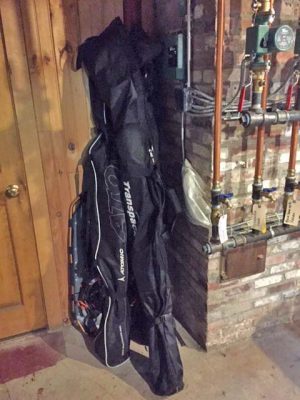
Are your skis still in the bag by the furnace where you left them after your last ski day?
Credit: Mike Maginn
Skis: At the end of ski season, the bottoms of your skis will be dirty. This will especially be the case if you did a lot of spring skiing. With today’s black bases it may not be that noticeable. Back in the day when a lot of bases were white the grime was obvious. Before having your skis waxed and sharpened, you want to clean the bases with a gentle cleaner. If you wax dirty skis, you’re just going to embed dirt into the wax.
I wet my skis bases with a garden hose, spray on Simple Green, wipe them down with a rag and then thoroughly rinse everything off. While you’re at it, thoroughly rinse off the tops of your skis and bindings. I don’t recommend using cleansers on the tops, as these can interfere with the lubricants in your bindings.
Some people use commercially available ski base cleaners or Dawn dishwashing soap. Cleaning ski bases will dry them out so it’s imperative that you have them waxed afterwards and don’t let them sit all summer without a wax cover.
Racers and others who are demanding about their equipment will clean their bases using the hot scrape method. This involves hot waxing the skis and scraping the wax off before it cools. This process literally pulls the dirt off the ski. The process is repeated until the warm wax scrapes off clean. This method works, but it’s time consuming.
A good edge sharpening and hot wax will ready your skis for next season and prevent the edges from rusting.
Boots: It’s essential that your boots and liners be totally dry before storing them. I use a boot dryer after every day skiing and before storage. If you don’t have one, I highly recommend removing the liners in order to get the boots thoroughly dry. I know getting the liners in and out can be a pain. Warming your boots to make the plastic softer makes it much easier to deal with liners.
Store your boots in a place where mice can’t get them. A friend of mine stored his in a shed and in the Fall found them chewed on and full of things you’d wouldn’t want put your foot into.
Poles: These get the same attention as they did all winter, none.
Parkas and Ski Pants: At the end of the season, I wash my parka and ski pants in the washing machine with Nikwax TX.Direct® Wash-In. This is a product that cleans and restores water repellency and breathability, and I’ve been happy with the results. I’m not an expert on clothes washing so please go online to learn more and read the washing instructions listed on the label inside your garment.
Anyone else have equipment maintenance tips for the off-season?
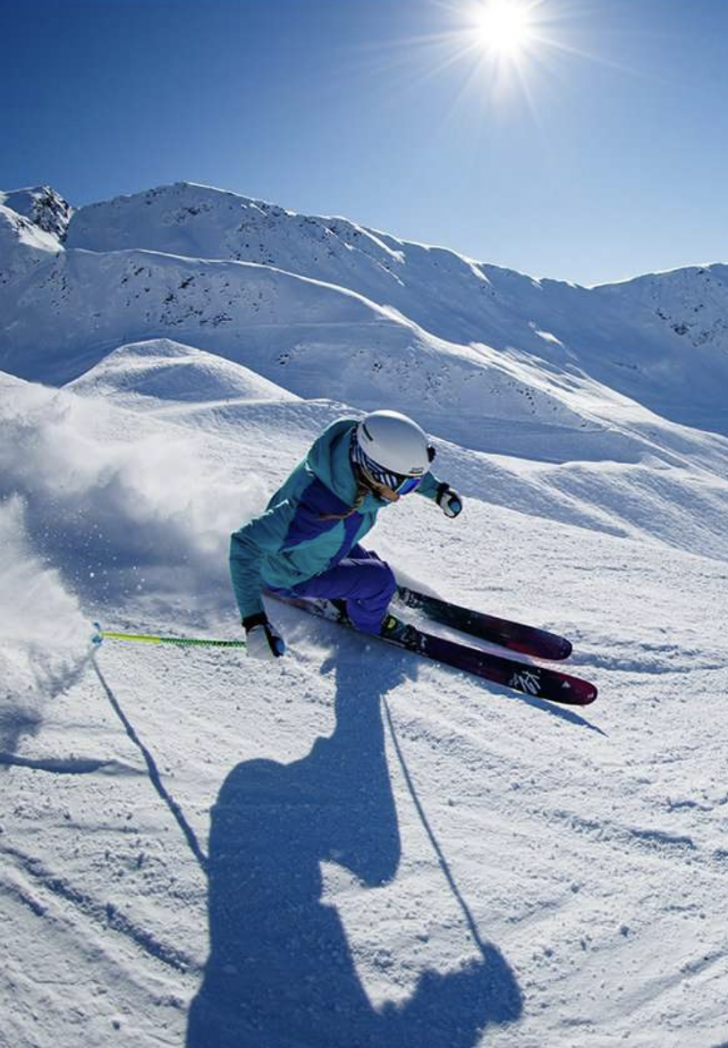
Season Ending: The Last Perfect Turn
Source: Alyeska Ski Resort

The last turn of the last run on any ski day is a bittersweet moment. If it’s the last day of the trip, it is sad, if not melancholic.
As I come down the mountain on what will be my last run of the day, I go through the same routine. Partly because I am tired, partly because the beginner runs are easy skiing and take me to the bottom, and partly because I want to be able to imprint the memory of the perfect turns I made, so they will carry me, mentally, to the next trip.
Feet close together, tap the pole, unweight, roll your knees.
It’s also about muscle memory. I want my body to remember how it felt to have the skis carve through the snow in a perfect turn.
As skis come through the fall line, press the knees forward and into the hill to get the skis on edge.
It is also about knowing that life is short and we never know what tomorrow brings. As a senior skier, I am closer to the end of my skiing life than the beginning. It’s depressing but true and makes the desire to carve the perfect turn even more intense.
Feel the edges bite into snow; keep the turn coming across the fall line to control speed.
At the end of every ski day, I want my mind and body to remember the turns, not just one, but a series of linked, perfect round ones.
Body square over skis, or maybe angled down the fall line. Hold the turn long enough to control your speed.
It has to be close to perfect so that even an instructor examiner would smile in approval.
Hands out in front, mid-chest high; feet less than shoulder width apart, ready for the turn.
The last turn was nice and round with the skis on edge that tossed a little snow. Now time for the next turn, hopefully as good as, if not better than, the last one.
Stay in rhythm. Reach out, tap the snow, unweight, roll the knees.
The process goes on until I reach the bottom, trying to make each turn better than the one before in an attempt to end a day on the snow with a perfect turn. It may be never-ending, but the quest is reason to head back to the slopes as soon as I can.
Why? Because at my age, this could be my last day on the slopes. I want to remember that I did all I could do to make the perfect turn.
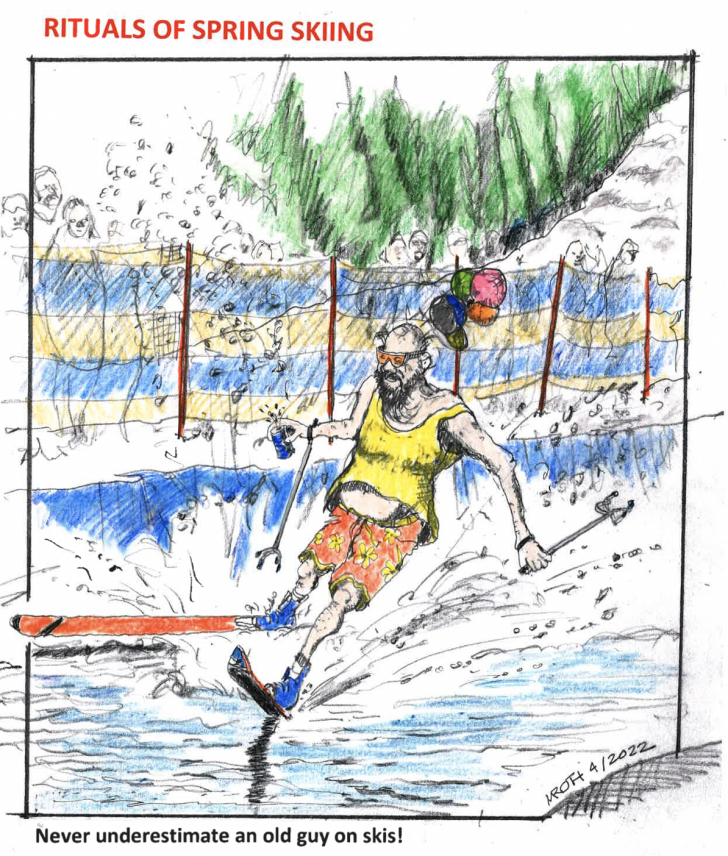
Mike Roth’s Take on Spring Rituals
As demonstrated throughout the season, Mike Roth is a master at capturing those funny and fearful moments on skis. Here he combines several end-of-season rituals in one cartoon: the pond skim; the shorts; the funny costume, can of beer in one hand; BBQ fork in the other…all centered on one gnarly senior skier. Thanks, Mike!!!!
[authors_page role=contributor]