


This Issue: March 18, 2022

In Short Swings!, Jon pairs French philosopher Simone de Beauvoir’s thoughts about aging with giving the finger to some disrespectful kids at Park City.
Skiing Weatherman, Herb Stevens, previews what to expect in ski country over the coming weeks.
Wendy Clinch of TheSkiDiva discusses what the women on her forum are saying about the state of on-hill safety.
Tamsin Venn profiles Deer Valley and the pleasures it delivers for senior skiers.
You probably didn’t know about Alta’s role in the development of a national approach to ski-teaching. Alan Engen, who headed Alta’s Ski School, shares that important chapter in American skiing history.
Jonathan Wiesel, President, Nordic Group International, encourages readers to propose that local golf courses start cross-country ski operations. He establishes a strong case and provides information resources to help make the pitch.
Finally, Mike Roth illustrates a verrrry long fall he took years ago in the French Alps; Test Your Skiing Knowledge poses a new puzzler and announces the winner of the last one, and LUV2SKI presents a few new reader-submitted license plates for your pleasure.
Enjoy the issue. The entire site, including our archive of more than 1,700 articles is accessible at any time. The next editorial package will be distributed Friday, April 1.
Make lots of happy turns, and, remember, Senior Skiers Rock!
Email jon@senorsskiing.com to request the new Senior Skiers ROCK! helmet sticker.
Short Swings!
This edition of Short Swings! is dedicated to the many readers who generously donated during the fundraiser. The funds will help us continue to send you, free, original articles and other content created specifically for older snowsports participants. Thank you!
—————————————————————————————————————————————-
As in other areas of our culture, we older skiers become less and less visible as we age. You may not have noticed this if you’re in your fifties or sixties. But become a septuagenarian or older, and it becomes obvious. Some cultures honor, respect and value the experience and wisdom that often accompanies longevity. There are exceptions, but it is less common in ours.
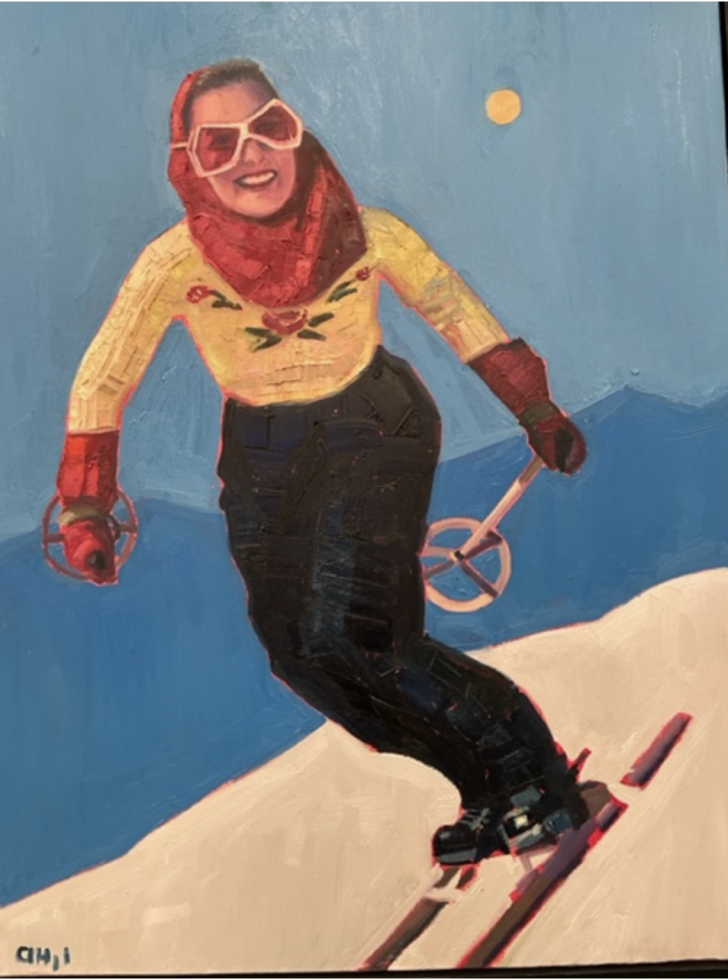
Bluebird. Artist: Aaron Hazel
French philosopher, Simone de Beauvoir argued that aging isn’t only biological decline; societal ageist discrimination helps add insult to that injury. These and other observations by Beauvoir about the psychological effects of aging appear in an article by Skye C. Cleary in the March 11 edition of aeon, the free online magazine exploring big issues in science, philosophy, society and the arts.
According to Beauvoir, while, inside, we may not feel old, others judge us as old when they look upon our faces and bodies. That helps form a context in which we’re excluded.
Obviously, you won’t feel that alienation in the lift line or on the slope. But get into a conversation with younger people on a gondola where you’re face-to-face, and it’s quickly evident.
A few weeks ago, on a long gondola ride at Park City, I was, by far, the oldest. One couple was in their forties. The others were in their twenties. I broke the ice by asking if they were visiting. Once they recognized my age (one of them may have asked), I was promptly left out of the conversation.
Beauvoir wrote, “There is only one solution if old age is not to be an absurd parody of our former life, and that is to go on pursuing ends that give our existence a meaning – devotion to individuals, to groups or to causes, social, political, intellectual or creative work.”
I agree with her thinking but would add one more factor for good measure. Do what you do well and to the best of your ability.
When I exited the gondola and clicked into my skis, I saw that several of the youngsters who had excluded me from the conversation were standing nearby, looking at the old guy with whom they had ridden up. I took some slow, graceful turns down the edge of the steep trail…my quiet way of giving them the classic one-finger salute.
Cautionary Tale
Reader David Engel was hit while skiing. He’s been told it’s unlikely that his shoulder can be repaired. Read the following (slightly edited) account he posted in Comments and his appeal to ski areas to take action to improve on-snow safety:

On a recent ski trip to Northstar, California, I was skiing on Burnout, an easy black diamond groomer with a friend. We were skiing at a moderate speed, working on our technique and staying well clear of other skiers.
After trips to the emergency room, to other doctors, x-rays and meetings with surgeons, I’ve learned that it is unlikely my shoulder can ever be repaired. A separated clavicle and three torn ligaments causes my arm to hang limply. Prior to this, I was an avid rock climber and raft guide, even at age 66. The surgeon said that I should wait 6-12 months, and if I decide surgery is needed, there is still a 30% failure rate.
A teenage girl skiing out of control has changed the trajectory of my life.
I write this because it’s imperative that ski patrol, courtesy patrols and ski instructors start to take an active role in stopping skiers/boarders from skiing out of control. There needs to be an enforcement of a safe area around each snow participant. There is no need to pass within 20 feet of someone else. This is a very serious situation that winter resorts MUST start to enforce.
Now I live a compromised life because ski areas are not taking enforcement of safe skiing rules seriously. Safe skiing can only result if all those involved in the ski industry take this seriously and stop out of control and wild skiers/boarders.
Ski Town Game-Changer

Vail Resorts announced that a $20 minimum wage is being instituted at its 37 North American resorts. The minimum for Patrol, maintenance technicians and drivers will be $21. The much-needed increases should give VR a hiring advantage and, hopefully, cause other resorts to up their minimums.
RIP: Suzy Harris Rytting

Suzy Harris Rytting Source: J. Willard Marriott Digital Library
In the 1940s and 50s, Suzy Harris Rytting was one of America’s greatest feamale ski racers, winning one important event after another. She was a member of the 1950 US Women’s FIS Team and the 1952 US Olympic Team. While training for the Games in Oslo, she and her husband learned she was in her early days of pregnancy. Doctors cleared her to race, but Avery Brundage, in his first year as president of the International Olympic Committee, was outraged upon learning of her situation. She was removed from the US team and sent home. Born January 21, 1930, she passed away February 28, 2022.
The Future of Skiing?

A ski through the park.
An article about Big Sky in the March 15 edition of The New York Times suggests that the resort’s modern lifts, vast terrain, and high ticket prices provide a glimpse into the future of successful ski resorts. Like so many other prognostications, there may be some of truth in the piece. High prices are a barrier to access, which, combined with thousands of acres of terrain, keep slopes and trails uncrowded. But doesn’t that run against the industry’s current emphasis on making skiing more accessible and inclusionary?
Happy Birthday, Bob!

Happy 98th, Bob!!! Photo: George Ramjoue
At 98, Bob Murdoch of Salt Lake City is the oldest member of Alta’s Wild Old Bunch. Many of his fellow WOBs showed up a few weeks ago to help celebrate his birthday. Even though he hung up his boards a few seasons back, he enjoys memories of many years on Utah’s trails.
The Failure of the Mt Hood Skiway
The Mt Hood Skiway was a bizarre engineering project intended to transport skiers and tourists from the small community of Government Camp, Ore to Timberline Lodge. This video tells the story of its creation, its short life, and its demise.

The Skiing Weatherman March 18, 2022
Your Support Helps!
Help us keep SeniorsSkiing.com free. Please support SeniorsSkiing.com with a donation.
The Skiing Weatherman 3/18 One step forward, one step back…
While Upper Midwestern and western U.S. resorts have seen some meaningful snowfall at times the past 2-3 weeks, areas in the East have battled the back and forth pattern that has been dominant much of this winter. La Ninas typically produce enhanced variability in the winter, and this winter has been a very dramatic example. Significant snowfalls have often been followed by a system that tracked through the eastern Great Lakes into the St. Lawrence Valley, leading to a warmer outcome and rain not long after newly minted snow. Sleet, freezing rain, and strong winds are also eastern hallmarks of La Ninas and we have seen more than enough of all three this season. The result of the changeable weather has been to limit the growth of base snow, and many areas are now in need of fresh snow to ensure that they can stretch their seasons as far as they had planned.
Transition months like March and April are a challenge for forecasters, in large part because the wavelengths between troughs and ridges shorten. The pools of cold air that are available to dynamically support the troughs start to shrink as the hemisphere heads into spring, and more storms become events with marginal temperatures for snow. In addition, the contrast between lingering cold across the north and advancing warmth to the south makes the flow across the country speed up, so changes tend to come often. The following jet stream map, valid on 3/22, illustrates the busy state of the upper levels of the atmosphere…
You can see the trough over the Maritimes, which will help to keep it cool over the Northeast next week, helping to preserve the modest bases. A mild ridge will cover the Midwest, but bases depths there are more substantial. Then you have another trough that will have just produced snow in the central and southern Rockies, with a ridge blanketing the west coast. Gone are the midwinter days of western ridge/eastern trough or vice versa.
This second map shows the pooling of the cold and mild air masses at 5,000 feet associated with the ridges and troughs. The 5,00 foot level is a proxy for surface temperatures.

The fast flow across the country will make it very difficult for either air mass to remain in control at a given location. However, during the week of the 28th, the pattern will slow down somewhat, with a trough favored in the East and a weak ridge in the West, as you can tell from the 5,000 foot temp anomalies on the 29th.
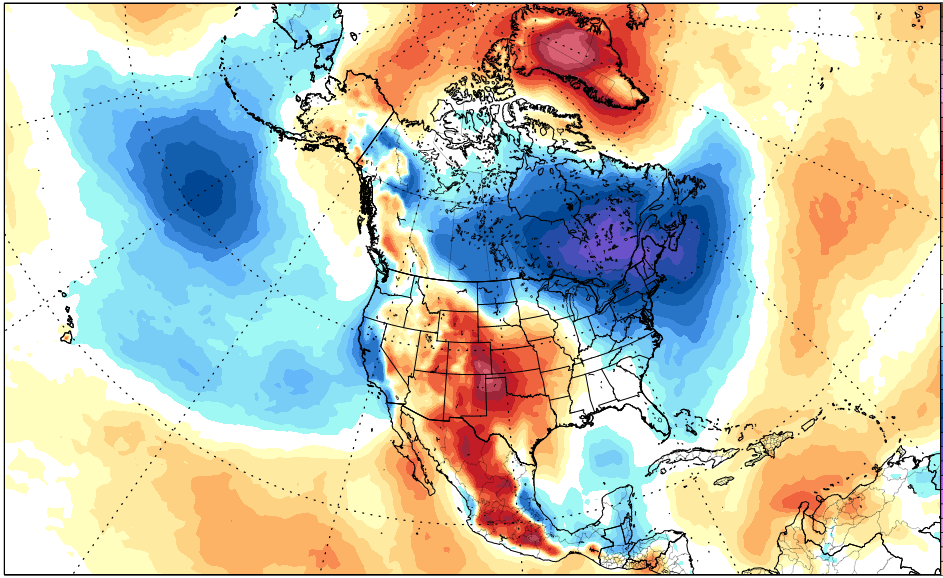
What does this mean? Well, it means some snow will fall in the West, starting this weekend in coastal ranges, and early next week in Colorado. And it suggests that help is on the way to the northern mid-Atlantic and Northeast (next week), where base snow is going to have to fight off some rain this weekend. In the Great Lakes, fresh snow will provide reinforcements for the stretch run, pretty much ensuring a season that will carry on into April. Here’s a map of potential snowfall for the next two weeks…

Regional details…
Northwest U.S./Western Canada: Snowy pattern this weekend into next week, especially in B.C. Snow levels rise thereafter.
Sierra: Light snow this weekend…mild and dry next week. Next snow around the 28th.
Rockies: Substantial snowfall for Colorado late weekend/early next week. Lighter snows northern and southern Rockies.
Midwest: Several snowfalls in the next ten days in the central and northern Great Lakes. Excellent prospects for skiing/riding in early April.
Mid Atlantic/Southeast: Central and northern resorts…at elevation…looking okay for the next 10-14 days. Potential for some snow there late next week. Southern resorts will have to stretch the snow they have on the hill.
Northeast/QB: Some rain will fall this Saturday, ending as snow far north. Cooler next week. Potential for snowfall late next week. The final week of the month looks promising.
The Skiing Weatherman 3/18 One step forward, one step back…
While Upper Midwestern and western U.S. resorts have seen some meaningful snowfall at times the past 2-3 weeks, areas in the East have battled the back and forth pattern that has been dominant much of this winter. La Ninas typically produce enhanced variability in the winter, and this winter has been a very dramatic example. Significant snowfalls have often been followed by a system that tracked through the eastern Great Lakes into the St. Lawrence Valley, leading to a warmer outcome and rain not long after newly minted snow. Sleet, freezing rain, and strong winds are also eastern hallmarks of La Ninas and we have seen more than enough of all three this season. The result of the changeable weather has been to limit the growth of base snow, and many areas are now in need of fresh snow to ensure that they can stretch their seasons as far as they had planned.
Transition months like March and April are a challenge for forecasters, in large part because the wavelengths between troughs and ridges shorten. The pools of cold air that are available to dynamically support the troughs start to shrink as the hemisphere heads into spring, and more storms become events with marginal temperatures for snow. In addition, the contrast between lingering cold across the north and advancing warmth to the south makes the flow across the country speed up, so changes tend to come often. The following jet stream map, valid on 3/22, illustrates the busy state of the upper levels of the atmosphere…
Insert Seniorsskiing1
You can see the trough over the Maritimes, which will help to keep it cool over the Northeast next week, helping to preserve the modest bases. A mild ridge will cover the Midwest, but bases depths there are more substantial. Then you have another trough that will have just produced snow in the central and southern Rockies, with a ridge blanketing the west coast. Gone are the midwinter days of western ridge/eastern trough or vice versa.
This second map shows the pooling of the cold and mild air masses at 5,000 feet associated with the ridges and troughs. The 5,00 foot level is a proxy for surface temperatures.
Insert Seniorsskiing2
The fast flow across the country will make it very difficult for either air mass to remain in control at a given location. However, during the week of the 28th, the pattern will slow down somewhat, with a trough favored in the East and a weak ridge in the West, as you can tell from the 5,000 foot temp anomalies on the 29th.
Insert Seniorsskiing3
What does this mean? Well, it means some snow will fall in the West, starting this weekend in coastal ranges, and early next week in Colorado. And it suggests that help is on the way to the northern mid-Atlantic and Northeast (next week), where base snow is going to have to fight off some rain this weekend. In the Great Lakes, fresh snow will provide reinforcements for the stretch run, pretty much ensuring a season that will carry on into April. Here’s a map of potential snowfall for the next two weeks…
Insert seniorsskiing4
Regional details…
Northwest U.S./Western Canada: Snowy pattern this weekend into next week, especially in B.C. Snow levels rise thereafter.
Sierra: Light snow this weekend…mild and dry next week. Next snow around the 28th.
Rockies: Substantial snowfall for Colorado late weekend/early next week. Lighter snows northern and southern Rockies.
Midwest: Several snowfalls in the next ten days in the central and northern Great Lakes. Excellent prospects for skiing/riding in early April.
Mid Atlantic/Southeast: Central and northern resorts…at elevation…looking okay for the next 10-14 days. Potential for some snow there late next week. Southern resorts will have to stretch the snow they have on the hill.
Northeast/QB: Some rain will fall this Saturday, ending as snow far north. Cooler next week. Potential for snowfall late next week. The final week of the month looks promising.
[authors_page role=contributor]