


IS RESORT SKIING GETTING MORE DANGEROUS?
Your Support Helps!
Help us keep SeniorsSkiing.com free. Please support SeniorsSkiing.com with a donation.
Editor’s Note: TheSkiDiva.com is an online community of women skiers without the male orientation. The forum’s founder, Wendy Clinch, recently posted this report, comprised, in part, of comments by forum participants.
In the past few weeks, there have been at least 10 deaths at North American ski resorts. While one death is way too many, The National Ski Areas Association says ski fatalities are pretty rare: as low as one for every one million visitors to a ski resort. (It’s also noted that more men are victims of skiing accident deaths than women).
Despite this, many participants on TheSkiDiva forum believe that resort skiing has become increasingly dangerous.
This season, stories of near misses, collisions, and risky behavior are all too common. And while I don’t have the data, it seems like the situation is getting increasingly worse.
What’s the cause? Some say the slopes are more crowded because of multi-resort passes and the ability of high-speed chairs to get more people on the hill. Some believe the problem is caused by ski movies and social media glorifying risky, extreme behavior, treating it as though it’s part of the norm. Others believe skiers and riders are distracted by music, texting, and selfies. And some feel that equipment has evolved to the point where people are skiing beyond their abilities.
HERE ARE A FEW EDITED COMMENTS POSTED BY FORUM MEMBERS:
- I’ve been quitting earlier these days because I’m concerned that someone will hit me. It’s not fun when the slopes are crowded with hotshots or folks who are skiing beyond their abilities. We avoid weekends when we can.
- As someone who only skis weekends, it seems the mountains are more crowded, and people aren’t being mindful of those around them. I’ve noticed many near collisions and had a few incidents where someone got way too close while trying to pass me. In two cases they whizzed right over the tips of my skis causing me to lose my balance.
- Cheap season passes have resulted in dangerous slopes on busy days, primarily Saturdays. Way too many people I know have been hit by others. The way the terrain parks are laid out where I ski adds greatly to the kamikaze attitude, ineptitude, and general disregard for anyone else on the mountain. I am sad to say that all I hear are excuses. I’m pretty over it. The perspective definitely changes when you have a child out there.
- I quit skiing at our local bump because of crowds and out of control skiers. It’s been a zoo. I was working with a friend on the long beginner run when an out of control kid scared the sh*t out of her, causing her to fall and break her wrist. I was done after that; it could have been me.
- I was hit hard enough to be knocked out of my bindings. Ski patrol did notpull the person’s pass even though he had been straight lining down the mountain while I stood stopped in plain view with other skiers at the bottom
There’s no question that ski safety is an important issue that needs to be addressed. Here are a feww suggestions from forum members about what can be done:
- Limit ticket sales:Crowded slopes are more dangerous slopes. Require skiers to go online and reserve their spots at least 24 hours in advance. This might help reduce overcrowding.
- Require everyone who buys a pass to go through interactive safety presentation. Make it mandatory for those under 18; give everyone else an incentive (e.g. $10. off or special lift access for completing training.
- Hold people accountable. Don’t tolerate unsafe behavior.This requires policing from resort personnel. Mammoth patrollers take photos of violators’ passes. Guests with a second speeding offense are required to screen the “Ride Another Day” video and take a quiz before their pass is reactivated.
- Better regulate/police alcohol and marijuana use.Many on the forum believe that the mix of skiing or riding with alcohol and/or weed, particularly among minors, results in alarming behavior. No one should be allowed to ski or ride under the influence.
- See something, say something.Let resort personnel know when you see unsafe behavior, and make it clear that this is something you will not tolerate. The more we make our feelings known about this, the better.
WHAT CAN YOU DO TO IMPROVE YOUR OWN SAFETY?
- Wear a helmet. This can reduce can reduce the risk of sustaining a head injury by as much as 29 to 56%.
- Make sure your bindings have the proper DIN setting for your size and ability.
- Always look uphill before taking off, and always be aware of your surroundings.
- Give the downhill skier the right of way.
- Always ski in control.
- Don’t ski alone in the trees or backcountry.
- Avoid tree wells.
Stay safe out there, everyone.

Deer Valley Resort: Great Skiing; Great Service; Great Food
Your Support Helps!
Help us keep SeniorsSkiing.com free. Please support SeniorsSkiing.com with a donation.
Like many of its patrons, Deer Valley is extremely well-groomed. Source: Deer Valley
Deer Valley Resort is just easier. Easier to ski, easier to get to, easier to gear up for the day (free overnight ski and boot check). As a senior skier, I’m totally on board with that.
A few minutes drive or free bus from ski town Park City, UT, the base at Snow Park Lodge (7,200 feet) is the main starting point to these well-manicured slopes and to the reliable, friendly staff in their forest-green uniforms. Some will still carry your skis from the car.
Most of the skiing (snowboarders not allowed) rises above Bald Eagle Mountain (8,400 feet), putting you at Silver Lake Lodge. From here, you have access to skiing at Bald and Flagstaff Mountains with intermediate runs. Quincy Express offers short, fun intermediate trails off Northside Express like Sidewinder, Lost Boulder, and Lucky Star. Use the singles line to lap these more quickly. Veer skiers’ right on top of Bald and ski the double blues and blacks and iconic Stein’s Run overlooking the Jordanelle Reservoir off Sultan Lift.
It’s a feast: 2,000 acres of skiing over six peaks. All have a beginner or intermediate run from the top. When we were there early March, groomed runs numbered 62 out of 103, more than half.

Deer Valley Winterscape. Source: Deer Valley
Grooming status is posted on boards at the top of lifts. For the chutes and trees, do what my daughter and her boyfriend do, use a walkie-talkie. One goes first, and the other radios back, “Don’t come down here.”
After a splendid lunch at Empire Canyon Lodge (fish tacos with grilled Scottish salmon, Deer Valley turkey chili, seasonal salads, Mac and Cheese with raclette – the resort is well known for good dining — hop on Empire Express to Empire Peak (9,570 feet, highest elevation). Here you ski bumps or powder in the steep bowls. Most cruise the intermediate groomers. More options are one lift over at Lady Morgan Express.
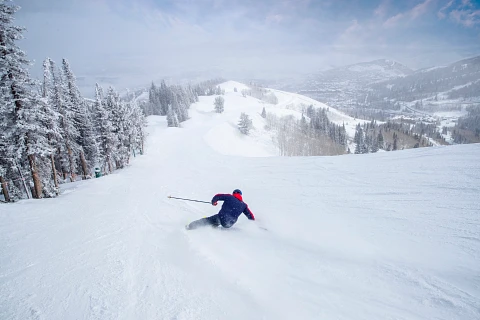
Deer Valley is always fun… especially on a powder day. Source: Deer Valley
The mountain ops staff clear the glades for well-spaced tree skiing. This year they thinned out three new low-angle, easily accessible, glades, giving seniors a chance to ski the trees like they used to, no tree hugging. Ask a mountain host stationed at the trail map billboards for their locations.
Deer Valley was crowded on the weekend we were there (parking lot and access road full) and was close to restricting ticket sales. The 12 high-speed chairlifts keep people moving though.
Next season, it will only offer access (seven days) on the Ikon Base Plus Pass, not the Ikon Base Pass, presumably to help keep skier numbers down.
I met several older skiers on the lifts, transplants from the East, skiing on a DV senior season pass grateful, despite a recent price hike, they could freely choose the best conditions.
DV Stats
2,026 acres
Base elevation 6,570 feet; summit 9,570 feet
103 ski runs, 6 bowls, 21 chairlifts
Longest vertical, 1,380 feet off Little Baldy
Average annual snowfall: 300 inches
27 percent beginner, 41 percent intermediate, 32 percent expert terrain
Prices:
Full day senior pass, 65 and older: $134-$187 (to April 17, conditions permitting)
Season Pass (22/23 season) 65 and older: $1,995

Your Next (or Last) Ski Lesson Can Be Traced Back to Alta
Your Support Helps!
Help us keep SeniorsSkiing.com free. Please support SeniorsSkiing.com with a donation.
The origins of the Professional Ski Instructors of America’s (PSIA) harmonized approach to ski instruction in the United States can be traced back to Alta.
When skiing was first taking hold as a participation sport around the Intermountain region in the mid- to late-1930s, ski instruction was informal; limited to tips provided by anyone who had been on a pair of skis more than once.
By the early 1940s, many people were taking up the sport, and it became evident there needed to be some form of training, control, and certification for people teaching others how to ski.
During the 1946-47 season, the Intermountain Ski Association (ISA) took the first steps to form a unified approach to ski teaching in the Intermountain region. One of the organizers was my uncle, Sverre Engen, at the time, head of Alta’s ski school.

During the 1946-47 season, the Intermountain Ski Association (ISA) took the first steps to form a unified approach to ski teaching in the Intermountain region. Source: Alan Engen Collection
Two years later ISA conducted the first Intermountain region instructor examination at Alta. According to Bill Lash, former Alta ski instructor and founder of the Professional Ski Instructors Association (PSIA), “Alf and Corey Engen ran the program. The test was given in three grades: master instructor, instructor, and apprentice instructor. The cost of the exam was $10.00 and the renewal fee was $2.50 per year. In 1950, instructor pins were given out. There were two pins and classes of certification: apprentice and instructor.” My father was Alf, who headed the Alta Ski School from 1948 to 1989 and for whom the Alta Ski School in named.
Early December,1950, another certification examination was conducted at Alta. This time, under the direction of Friedl Lang, a noted ski instructor who had been certified by the U.S. Eastern Ski Instructors Association. Lang had taught skiing in North Conway, New Hampshire for Hannes Schneider, father of the Arlberg Technique. He brought special insights to the new ski instructor certification process.
At the same time, the Intermountain Ski Instructors Association (ISIA) was created to oversee certifying instructors.
1958 National Ski Association Certification Meeting at Alta Source: Alan Engen Collection
Throughout the 1950s, Alta hosted numerous Intermountain Ski Instructor Association examinations. And in 1958, coordinated by the Alf Engen Ski School, Alta hosted the first National Ski Association “on-snow certification conference” to establish national certification standards. A significant outcome of this gathering was Outline of Ski Teaching, by Bill Lash. The first complete ski-instructors manual, it was distributed nationwide and became the basis of the American Skiing Technique. A few years later, in 1961, representatives of the National Ski Association met and agreed to formalize teaching the American Skiing Technique under a new umbrella: the Professional Ski Instructors of America.
So, wherever you take your next ski lesson at an area in the United States, if the instructor is PSIA-certified, she may not know it, but Alta played a role in bringing professional, harmonized instruction to the sport.
[authors_page role=contributor]