

Okemo Debuts New Express Lifts
Now in its 66th winter season, Okemo is one of the most technologically advanced ski areas in the East.
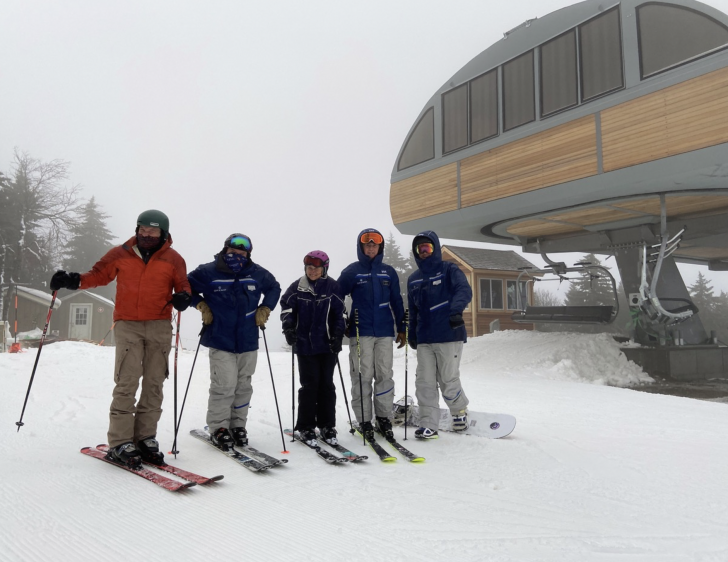
The first -chair passengers of the new Quantum Six at the top terminal: (l to r) Resort Guest James Kraft, Okemo GM Bruce Schmidt, Journalist and Ski Historian Karen Lorentz, Okemo Director of Resort Operations John Neal and Director Of Skier Services Steve Clark. Photo:Bonnie MacPherson
This year’s installation of two express lifts maintains that tradition with the debut of an express replacement for the Green Ridge Triple and the new Quantum Six Express lift at Jackson Gore, providing greater and quicker access to upper Jackson Gore, home of several expert trails and Tuckered Out, a classic winding New England run.
This is great news for seniors like me who enjoy skiing from Jackson Gore to South Face and getting lots of runs in less time. It has the added bonus of comfort of quick rides on really cold days. Fifty years ago, I might have gotten eight runs all day. Now, thanks to these new, fast lifts, I can get 12 to 20 runs in four hours. The Evergreen lift will put the frosting on my exercise cake by making possible upper mountain laps on blue favorites.
Quantum Six will disperse people more quickly from Jackson Gore to Okemo’s main summit when they’re skiing to the Evergreen Summit Express. Okemo recycled its Quantum Four Express bubble lift to replace the fixed-grip Green Ridge Triple and named it Evergreen Summit Express. The renamed lift increases rider capacity, cuts ride-time in half, and adds a bubble, providing greater comfort on cold, windy days.
A new, short connector trail with snowmaking re-routes skiers from the Mountain Road trail to the Evergreen’s loading station. For those coming from Jackson Gore, the new trail and lifts not only reduce the time it takes to access the main Summit, it cuts the time to access the summit of South Face from Jackson Gore’s base from approximately 40 to 25 minutes.
Senior Director of Mountain Operations Eb Kinney noted the Evergreen lift offers a good alternative to the Sunburst Six for skiing a host of upper mountain trails — like Timberline, Sapphire, Tomahawk, and Jolly Green Giant, several tree runs, and some easy greens. Greater usage of this underutilized lift/skiing area will reduce lift waits at the popular Sunburst Six, he said.
Installations of the new lifts followed existing lift footprints and skier loading areas.
Part of Vail Resorts’ multimillion-dollar capital improvements plan for Okemo this year are upgraded snowmaking infrastructure, addition of a new grooming machine, improvements to the Clock Tower base area, and new shuttle service between Okemo’s main parking lot to the Clock Tower base.

BLINDED BY THE (FLAT) LIGHT: SENIOR SKIERS CAN SEE CLEARLY IN SNOW
A version of this article first appeared in 2015 in Huffington Post.
I was hardly able to move; disoriented on terrain I’d skied for years. Other skiers seemed to be managing fine. But the light was flat, and my eyes could no longer pick up contours in the white on white.
Flat light sucks. Credit: Jan Brunvand
“Flat light,” a version of whiteout, greatly reduces the contrast that helps anyone on snow see where the dips and moguls are.
In extreme conditions, every skier of every age is affected, and the best way to get to where you’re going is to ski near trees, where their dark forms create visual contrast against featureless snow.
But these were not extreme conditions. Skiers and boarders were easily moving around, while I was in a featureless and confusing snowscape.

Credit: Jan Brunvand
Older skiers have older eyes. According to Dr. Jeff Pettey, Assistant Clinical Professor at the University of Utah’s John A. Moran Eye Center, all skiers eventually experience decrease in on snow contrast sensitivity. The most common culprit is cataracts, the cloudiness that forms on the eye’s lenses, causing loss of clarity and decreasing the quality of light focused on the retina. Cataracts can start forming when we’re in our 40s and 50s, though they’re more commonplace in our 60s and 70s.
Less common are processing issues related to diseases such as glaucoma and macular degeneration. They decrease the quality of the signal transmitted to the brain.
For me the eye opener was the other skiers who hardly slowed down while I was straining just to find the trail. I had been treated for age-related macular degeneration. But cataracts? A few weeks earlier, the ophthalmologist told me they were early stage. Those baby cataracts compromised what I could see in the snow!
After a minute or so of discomfort, I donned my goggles and headed down.
Getting Goggles Right
Choice of goggles and goggle lenses can make a big difference helping senior skiers with compromised vision navigate flat light conditions.
Most goggle manufacturers agree that the more light entering the lens the greater the definition and contrast. The trick is to select a lens whose color helps enhance depth perception. Amber, yelloe, rose, green and gold lenses tend to transmit more light. Photochromatic lenses, which change color under varying light conditions, can be effective.
While some industry experts recommend polarized lenses, the glare-reducing technology used in many sunglasses, others advise that in extremely flat light a little glare helps distinguish between ice and snow, making the trail more readable.
No More Fog
Regardless of light quality, fogged lenses get in the way of good vision. Having lived through many seasons of foggy goggles, I’ve explored many approaches to reducing the curse. Wipes, saliva, goggles with built in fans, products and technologies that claim to keep lenses clear under all conditions. Some work better than others, but none do a really good job.

SnowVision Rx goggles integrate prescription with inner lens
The unique SnowVision prescription goggle, virtually eliminates foggy goggles by positioning the presciption lens at a distance from the face where it remains cool, while providing a full range of vision using bi-focal or progressive lens technology.
Gee Whiz!
Some inventors have gone beyond goggle and lens with ideas that would remove the “flat” from flat light. Among them, twin laser beams projecting a contoured grid of the surface in front of the skier. The idea is to navigate, videogame-like, through the contours. Lower tech, but equally out there, is a built in spray gun system that skiers would activate to send a fine blue color onto the snow, forming the contrast needed for better visibility. Similar sprays are used to make race courses easier to read in flat light.

Artist’s concept of Earth and Sun. Credit: NASA
While lasers and sprays remain in the planning stages, Michael Barry, past-president of the National Ski Areas Association has this advice for those of us with aging eyes: Get to the mountain early and ski until early afternoon. This strategy works best for the first half of winter when light tends to flatten as the day progresses.
As the Earth’s axis shifts and daylight lengthens, pop on those rose-colored goggles and enjoy every last run.

December Skiing Video
Don Burch sent in a video treat: “December Skiing.” It’s one of his signature short productions that makes you want to be back on the mountain. Click on the image to screen. I’ll also include it in the next issue, which will be distributed Friday, January 7.
Many thanks to readers who sent notes of appreciation for SeniorsSkiing.com.
Best wishes for a Healthy, Happy 2022 with many great turns! Jon
[authors_page role=contributor]