


LUV2SKI: Skiing Vanity Plates
There’s a joy to walking through the parking lot, skis on shoulder on the way to the lift or at the end of the day. People wishing you a good day, asking how the day went, commenting on the snow, sitting on a lawn chair sipping a cold one.
The often-unnoticed backdrop to this gemutlichkeit is the ski-oriented vanity license plate. This aspect of skiing passion extends across the spectrum. You’re as likely to spot one on a beaten up 4-Runner as you are on a new Range Rover.
I started collecting pictures of these bad boys a few years ago. Most were shot at Alta and other Utah resorts. (There was a time when Alta posted its own gallery of plates reading ALTA.) Some were captured in big cities, far from mountains.
If you have a skiing license plate or run across one and want to add it to the gallery, take a picture (preferably close up and straight on) and send it to info@seniorsskiing.com. We’ll do our best to credit each contributor.
In the meanwhile, enjoy these…

Latigo Ranch: High-Country Nordic
Sometimes life exceeds expectation. That’s what I’ve found with winter ranches in the Rockies.
In summer, hundreds of dude ranches draw thousands of visitors. They’re crazy-diverse: homespun and elegant; private and heavily peopled; mostly self-service or with staff at your call. You’ll find Spartan working ranches as well as places with canapés and kidney-shaped swimming pools.
The few ranches open in winter are outstanding – magnificent settings and staff, excellent facilities and food, and snow so delicate it drifts through the air like cold smoke. They’re run for cross-country skiers, snowshoers, and, increasingly, fat bikers by people who love the season and their profession.
Wecome to Latigo Ranch
A prime example is Latigo Ranch, near the town of Kremmling in north-central Colorado’s Gore Range. It’s owned and managed by Lisa and Randy George and their kids.
Latigo used to run cattle, sheep, and “dudes” before it totally converted to guest ranching in 1987. Once you turn off Highway 134, you start climbing, trading sage for pine, spruce, and aspen, interspersed with vast meadows. It feels like the top of the world.
Latigo can cater to pretty much any culinary taste, be it red meat, vegetarian, kosher, low carb, or low fat. Breakfast is my favorite meal. I have fond memories of buttermilk pancakes imprinted with the ranch brand, complemented by genuine maple syrup.
Latigo comfortably handles 22 guests, but you’ll seldom find that number except during holidays. Cabins are ski-in/ski-out, nestled in pines above the lodge with wood-burning stoves. This is a ski ranch, not a resort (no phones or TVs in the rooms).
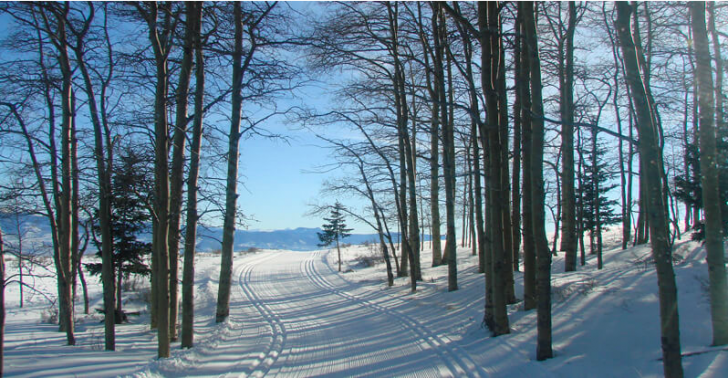
50km of groomed trails lace through Latigo
Latigo grooms 50 kilometers of trail for track, skating, and fatbiking.
This is gorgeous, rugged country, with some of the most enjoyable skiing and diverse trails I’ve ever experienced. For example, the descent on Arena Run can be like silk in fresh snow; lightning in the spring.
High up on windswept Jumper Flats, you’ll find a broad panoramic view. You can tear down The Luge at sunset, when you may be greeted with a spectacular play of colors over the Indian Peaks Wilderness – 70 miles of mountain and valley snowscape.

If you’re altitude-sensitive, book a longer stay and take it easy for at least the first day. (Latigo’s trails range from around 8,600’ to 9,400’ above sea level.)
It’s a wonderful thing to ski back to the ranch on a crisp afternoon, saunter over to the Social Center, and finish the day with a sybaritic Jacuzzi soak!
When You Go
Latigo is 150 miles from Denver International Airport. In addition to trails, you can go sledding, tubing, and snowshoeing. Skis, snowshoes, and pulks can be rented at the ranch, but you’ll need to bring your own fat bike.
Adult rate for winter 2021-’22 is $225/day and covers lodging, meals, trails, and “100 % free views.” The season begins just before Christmas and runs into early March. Interested in learning more? Call 970-724-9008; email Randy@LatigoRanch.com, or visit www.latigoranch.com.
Skiing Technique: Where should you be headed?
Several responses to a recent article under the same heading suggest I left the wrong impression on some readers. That’s anathema for a coach, so this is an attempt at clarification.
Source: Bob Trueman
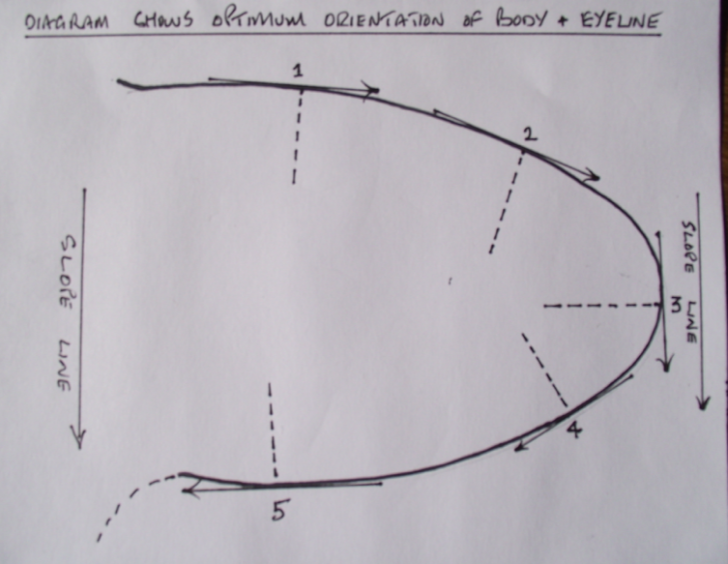
The sketch is my attempt to explain the direction in which the skier’s torso is best oriented; not the direction your skis will be taking.
In reality, every arc comprises an infinite number of “points”, not just the ones I picked out for illustrative purposes. For now, let’s consider those few identified points.
RADII AND TANGENTS
At each of the points I have drawn a dashed line at a 90º angle to the radius. Focus on the direction of the line.
That dashed line indicates the direction in which your body would travel if you suddenly became detached from your skis. (Where your skis went after such an event is anybody’s guess and of no importance to anyone other than the poor unfortunate who happened to be in the way!)
Good skiers orient their torsos in the direction of the dashed line, with the axis across their shoulders and their hands at right angles to the dashed line. That is to say, facing slightly outward of the arc. If you imagine an arrow glued smack in the centre of the skier’s chest, facing forward, it would point in the direction of the line.
The optimal degree of difference between ski direction and body orientation will vary; on this sketch it’s noticeable if you look at the point where the arc is “sharpest” – in this case just momentarily as skis and torso encounter the slope line (aka fall line).
This “outward” orientation is counter-intuitive, which is why unskilled skiers have a strong tendency not to do it, instead consistently aligning torso with ski tips or rotating into the arc; sub-optimal movements to be avoided.
LEG ROTATION
A more effective and controlled technique is to utilize the hinge-like mechanism of our bodies. While legs travel in the direction of the skis and the torso faces outward in the direction of the dashed line, the thighs rotate in the hip sockets. Importantly, this is why skiers must be flexed forward at the hip joint. When standing upright on skis, effective and efficient turning are impossible.
Lito Tejada Flores, celebrated ski instructor, author and filmmaker used to call it being “anticipated”. What it gives you is enhanced stability and improved form.
I hope this helps.
[authors_page role=contributor]