


The Skiing Weatherman-November 12, 2021
Cold air supply growing…
Before I look forward in this discussion, let’s look back. October was a very warm month relative to normal across the country, in large part because a sizable upper level dome of high pressure stretched across Canada and the northern states. Early snow cover over northern Asia and Canada are typically harbingers of a fast start to our winter sports season, and although Russia stocked up with snow early and often, the upper ridge over Canada meant that a buildup of early season snow cover there was a non-starter. Now that doesn’t rule out a quick start to the season, but it does make it tougher. The good news is that the pattern in the high latitudes has been changing, and snow cover is accelerating. That has led to a rapid buildup of the cold air that we need for snowfalls and snowmaking. Forecasters use temperatures at 5,000 feet as a proxy for predicting surface temps and just a couple of weeks ago, there was a warm anomaly at that level spread out from the Canadian Rockies to the Maritimes. But take heart, the supply of cold is growing and the jet stream mechanism for delivering the cold…upper level troughs…have started to appear. Here’s proof. First, the jet stream setup for 11/13…
That large blue ball of yarn centered over the western Great Lakes is a deep trough that has delivered snow to the northern Plains this week, and it will generate lake effect and mountain snow showers as it pivots east this weekend. It has the goods in terms of cold air, as you can see on this map of the temperature anomalies at 5,000 feet.

In November, we find smaller “chunks” of cold air than we will a month or two from now, and that is why you see orange to the west and east of the cold shot in the middle of the continent. That tells me that the pattern will be rather changeable through the end of the month, with the cold shots alternating with brief warmups…very typical for a transitional month like November. As time goes on, the supply of sufficiently cold air for snow will grow, and we can see that if we look at the 5,000 foot anomalies for the Sunday before Thanksgiving…

Notice that is appears as though the Lakes and East will be well supplied with cold air and the next cold air mass will be linked to the piece over the eastern third of the continent. The purple color you see over NW Canada suggests that the cold will be deepening, as well. So, it appears to me that the resorts in the Great Lakes and East will have opportunities for snowmaking leading up to Thanksgiving, and the air masses will, at times, be cold enough to support natural snow. In the West, more of an upper ridge will be in place and that will limit the opportunities for significant Pacific storms to lend a hand. The northern Rockies will catch a glancing blow from the NW-SE push of cold air masses, and that could generate some snowfall in the next couple of weeks. Let’s break it down by region…
Northwest U.S./Western Canada: Best shot at snow in the next week is higher elevation slopes in B.C. NW U.S. prospects very limited for now.
Sierra: West coast upper ridge keeps it mild and dry until further notice
Rockies: Glancing blows from systems diving into central/eastern U.S. trough brings light snow every few days to northern resorts. Central and south quiet for now.
Midwest: Upper trough, cold shots, and lake snow become commonplace up through Thanksgiving. Solid prospects for early openings.
Mid Atlantic/Southeast: Enough cold air penetrates from the north to get snowmaking started at times over the next couple of weeks.
Northeast/QB: Good snowmaking opportunities will develop leading up to Thanksgiving. Several shots at mountain snow, as well.

Around Walden Pond
There are two trips around Walden Pond near Concord, MA. The first is a ski tour through a picturesque New England landscape, with sharp and steeply wooded hillsides surrounding an ice-covered, lambchop-shaped lake.
Around the same pond is a second trip, a pilgrimage that passes the cabin site of Henry David Thoreau, “self-appointed inspector of snowstorms”, conjuring the spirit of a special place and inspiring the thoughts of the pilgrim visitor.
Henry David Thoreau in 1856. Source: Wikipedia
If you choose the first trip, you‘ll find a pleasant ski tour: maples, birch, and oaks, rubbing branches in the wind, a frozen-solid pond to ski across, varying widths of trails in and out of sunlight, all free of charge, all well-tended, all convenient to the Walden Pond State Reservation parking lot on the Concord Road.
But, if you choose the second, be prepared to confront a man who discovered himself in those very woods and hills of Walden Pond, giving us a model of independence and renewal. One thing is for sure; if you take this trip around Walden, you won’t come out the way you went in.
What is it about Thoreau that initiates such pilgrimages? Why are visitors on foot and on skis so drawn to this singular place, the site of a small cabin gone long ago?
The answer is in the subtle message Thoreau left in those winter woods. To know the message, you have to know why Thoreau went to the woods to live alone by Walden Pond and what changes the woods made to his life.
Born in Concord in 1817, Thoreau went to Harvard College where he was homesick for the fields and forests where he once had played. Upon graduation, he and his brother, John, started a school in Concord. John became ill, the school closed, and Henry went to live with Ralph Waldo Emerson, serving as the philosopher’s gardener and handyman. Shortly after moving in, John Thoreau died, and Emerson’s five-year-old son passed away; their mutual grief bonding the two.
Now, Thoreau turned his attention to the community of thinkers surrounding Emerson, splitting his time between handyman and writing philosophical essays.
He was 28, an unsuccessful writer and poet living among the most dynamic American literary and philosophical giants of the time. Frustrated by the complexities of society, Thoreau returned to the woods, to think, write, learn and sort out his life.

Replica of Thoreau’s cabin. Source: The Walden Woods Project
On July 4, 1845, he moved into the cabin he had built on the northwest shore of Walden Pond on land owned by Emerson.
You can ski up to the site of Thoreau’s cabin by following the shoreline trail on the north side of the pond or by a ridge trail also to the north of the pond but in more rugged terrain. If conditions are right, you can ski right across the frozen surface.
All of these trails are short, about a quarter-mile from the parking lot. A circumnavigation of the pond is less than three miles. If you want more skiing, cross Concord Road and link into the web of well-tended trails that spread around Sandy Pond and into the town of Lincoln.
But this is a pilgrimage.

Thoreau’s house site and cairn. Source: The Walden Woods Project
The cabin site is in a clearing of pine and hickories “on a pleasant hillside.” A cairn nearby has been building since the site was discovered in 1947. Stone markers indicate a small cabin, about 11 by 15 feet, the door facing the pond.
Much has been written about Thoreau’s two-year residence in the woods as a practical experiment and a naturalist’s odyssey. However, as you stand in that clearing by the cabin site, imagine Thoreau writing on his little desk, remembering his brother and struggling to express his thoughts about life, values, and simplicity. Surely, the time spent at Walden was a time of renewal.
“I went to the woods because I wished to live deliberately, to front only the essential facts of life, and see if I could not learn with it had to teach and not, when I came to die, discover that I had not lived,” he wrote later.
In September 1847, Thoreau left Walden and moved back to his father’s house in Concord. He left knowing he could live the life he wanted. For the rest of his life until he died in 1862 at 43, Thoreau wrote, lectured, travelled, and continued to wander the woods.
Walden had been a turning point; the woods were a catalyst that helped him recognize who he was and where he was going, a man marching to a different drummer.
If you make this pilgrimage in winter, go early. You’ll find yourself alone in the woods next to Walden Pond. Stop skiing and stand quietly. The wind will crackle the branches, and you’ll hear your heart pounding.
Like Thoreau, let the woods give you respite. Recall what these woods have done, what any woods can do to vexed souls. Reflect on the simple beauty around you, read aloud from Walden, go back to the parking lot, different than when you went in.

The Day Three Slump
This is my shortest ever blog, but it may have a significant impact on your next ski holiday.
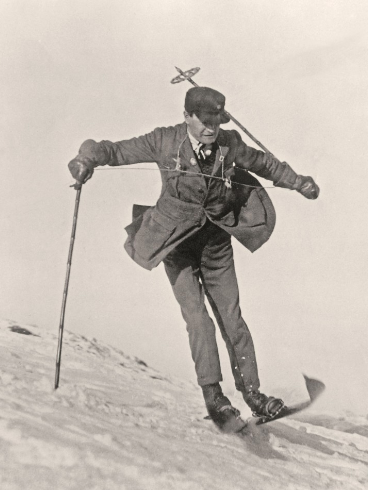
Should have taken the day off.
It’s your first day back on the slopes, and you want to hit the ground running. You don’t want to miss a thing, so you‘re up early, on the first chair, and skiing like a mad thing all day. It feels so good!
The next day you’re just a wee bit sore, but not enough to stop you.
But on the third day you hit the “Day Three Slump”. Your skiing seems to have got worse. Your energy levels have slumped. You hoped you’d get better; it’s frustrating. At the end of the week you feel you’ve made no improvement; got no better than last year. This is how your week may go:

Source: Bob Trueman; Bobski.com
I have a suggestion for “slump day”: take it easy, be patient, don’t push it, do lessthan you might.
Would it be sacrilege to suggest taking a later breakfast? An even greater sacrilege to suggest starting at 11:30 and finishing at 2:30? Or, if it pleases you, consider taking a half day out and visiting a local place of interest. You could spend an amusing hour or two in a ski shop trying to guess which of this year’s new wonder skis is actually last year’s but in different livery.
Tomorrow do just a little bit more. On day three you’ll be ready to fly; stronger, your muscle memories will have kicked-in. You’ll find yourself skiing better, not worse.
At the end of the week, you’ll be skiing better than last year, and you won’t get home feeling frustrated that your skiing is in decline.
Your week will go like this and end on a high:

Source: Bob Trueman; Bobski.com
It will be a better feeling and well worth a try!
[authors_page role=contributor]