

Move it or lose it
Moving seedlings at Brighton
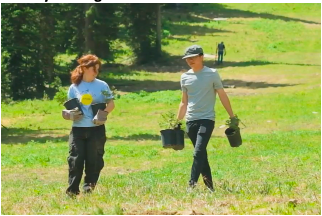
In a sheltered, out-of-the-way spot, a tree nursery suddenly popped up at Brighton, the ski area gem at the end of Salt Lake City’s Big Cottonwood Canyon. That’s where 266 saplings are adjusting to life in pots until they’re big enough to be planted back onto the mountain.
Mother Nature inconveniently sowed seeds on ski trails where they took root. But the young trees didn’t know they’d get mashed down by heavy snow grooming machines or mangled by skiers and boarders. Solution: Move them or lose them.
It’s a small part of Brighton’s environmental sustainability commitment.
“Brighton Resort is known for its terrain parks, exceptional annual snow fall, and, most importantly, it’s amazing tree runs. We’re … investing in preserving these areas with our new forestry program,” said Director of Sustainability Erika Kazi.
Brighton kicked off the tree moving project by partnering with Tree Utah whose mission is get people excited about trees and plant trees in public spaces throughout Utah – parks, schools, along trails, in national forests and more. On the days when trees are being rescued, an arborist trains volunteers on-the-spot before they head onto the trails to find, dig, and pot vulnerable trees.
But its more than shovels and pots. Tree rescue has gone high tech. “With new technologies we will be able to map out our trees in a more succinct way through GIS mapping,” Kazi said, and we’ll have a better understanding of our forest.

Brighton’s Ski with an Arborist program. Source: Brighton Resort
Brighton invites guests to ski with an arborist on free tree tours and learn about the mountain’s ecosystem. Meanwhile, the rescued trees are snug and safe under their winter blanket in the secluded nursery.
Buying NEW XC Ski Equipment
For newcomers to cross country (XC) skiing, deciding on the best skis can be intimidating, especially if you don’t want to rely entirely on retail sales people or on-line outlets for advice.
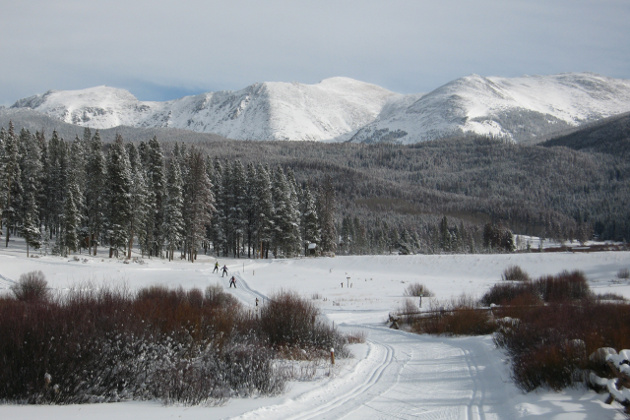
Devil’s Thumb Ranch, Colorado
The following guidance about selecting and using XC gear is general and intended to help you be an informed consumer.
Note that as a rule of thumb, standard XC equipment packages include skis, boots, bindings and poles and are less expensive than purchasing components individually.
Which pair of cross country (XC) skis is right for you?
Average recreational XC skiers should rule out light weight very narrow gear (used by racers) and waxable XC skis and/or wide steel edged XC skis (used by backcountry mountain skiers). Instead, consider looking at a lightweight XC ski with a waxless base. In general, these bases include skins or a pattern milled into the base (e.g. a crown or fish scale pattern) which allow one ski to grip the snow, while the other is pushed off to glide. They also keep the skier from slipping backwards while traveling up a hill. Note that ski length should correlate to skier’s weight.
Ski choice also is a function of where the ski will be used. Places with groomed, packed trails are best experienced using narrower skis. Wider (e.g. 55 millimeters in the shovel) and softer skis provide some stability in places without groomed trails (e.g. many golf courses and city parks).
Many people try to compromise and get wider XC skis to accommodate both groomed trails and ungroomed areas. I recommend choosing one type or the other or purchasing separate skis for each type of skiing.
For many newbies, the biggest obstacle to XC ski control is the incomplete use of the snowplow. Unlike heavier Alpine equipment which accommodates snow plow turns, with XC skis it’s important to feel the weight on the boot heel against the edged ski and command it to push outward to plow. Without this “feel the heel” and push movement, the skis won’t plow and speed will increase rather than decrease.

New gear makes XC fun for newbies
XC ski boots are an important component of the package. Most boots have similar characteristics such as an ankle cuff, covered easy lacing, dry, warm, comfortable, etc. In general, higher boots with more substantial plastic cuffing provide better control compared to a lowcut soft boot. Stiffness or softness is associated with the torsional rigidity of the boot. Determining whether or not a boot’s sole is stiff is as easy as twisting the sole. Stiffer boots provide more stability.
Now that you know, make the right choices and enjoy your time in the snow!
Test Your Skiing Knowledge
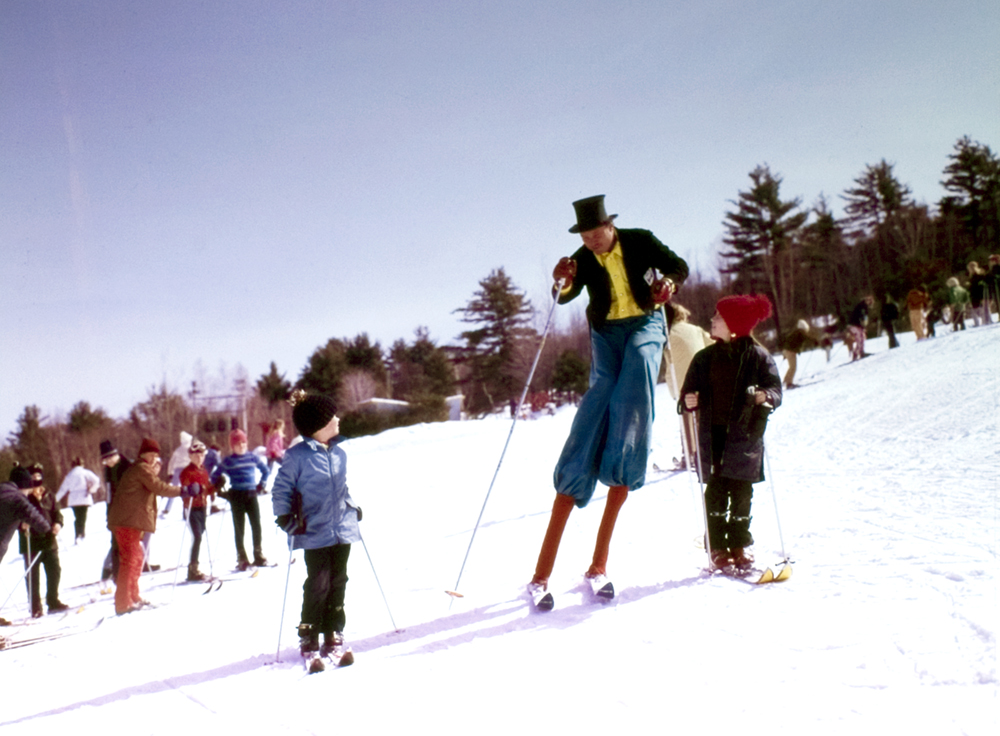
Each issue of SeniorsSkiing.com has a picture to help test your skiing knowledge. The pictures are from collections in a variety of participating ski museums, which we encourage readers to visit.
This big time skier was hardly stilted when it came to skiing or to publicity stunts. He was ski school director of the ski school of a New England area which has since changed names. The New England Ski Museum submitted the image for Test Your Skiing Knowledge.
Be the first to identify both the stilted skier AND the name of the ski area (before its name change) and receive a one-year membership to Outside+ ($79.00 value) with access to this season’s Warren Miller film, Winter Starts Now, plus two annual print subscriptions to your choice of SKI magazine, Outside, Backpacker, BETA MTB & more; access to extended gear reviews and instructional video from SKI from bumps to backcountry courses; Gaia GPS Premium access to thousands of maps and backcountry navigation recommendations; member-only content on all 18 sites in the Outside network, and full access to OutsideTV premium adventure films & series. Only answers sent to jon@seniorsskiing.com will qualify. Please do not submit your answer to Comments.
The correct answer and the name of the winner will appear in the next issue of SeniorsSkiing.com.
The winner of the last Test Your Skiing Knowledge is Kay Geitner of Centennial, Colorado. She correctly identified the ski jumper as Alan Engen, past diector of skiing at Alta and currently a member of SeniorSkiing.com’s Advisory Council. Kay taught at her home resort, Copper Mountain, for 28 years. She was the first American woman to graduate with the National Diplome from Ecole National de Ski and Alpinisme in Chamonix France. She represented the Pacific Northwest Ski Association at the US Junior Nationals and for five years represented Washington State at the Western States American Legion Championship in Sun Valley. Kay reports she’s been a SeniorsSkiing.com subscriber since we started in 2014. She wins a free pair of EZFIT Universal Insoles from Masterfit (retail value: $44.95).
[authors_page role=contributor]