


The Skiing Weatherman-October 29, 2021
Mother Nature picks up the pace…
Halloween is upon us and it’s now reasonable to think snow. In the past week we have seen some major amounts of snow fall in the West, particularly in the Sierras of California. After a very dry summer, a veritable firehose of moisture pointed at the coastal ranches and let fly. Thankfully, there was just enough cold air around to convert it to bountiful, base-establishing snowfall. Tahoe resorts hit the jackpot with 30-40 inches burying their higher terrain. Further south, Mammoth Mountain will be kicking off its season late this week. In the East, a major storm battered New England but it was too early to expect much in the way of snow…the higher elevations of northern New England did see snow, however, which put some pep in the step of the locals.
The Nor’easter was a classic case of what my grandmother called a “line storm”, which she said drew the line between an extended warm autumn and the start of a more winter-like pattern. That is exactly what is happening to the jet stream pattern now. “Endless Summer” is an iconic surf movie, but not a term that skiers and riders like to hear at this time of year. After weeks and weeks of an upper level ridge sitting over the eastern half of North America, keeping temps above normal, upper level troughs, which support storms and deliver cold air, have become more common. A solid cold shot will move through the Lakes and into the Northeast later next week, potentially producing the first meaningful snowfall of the season. Here is the 10-day forecast for snow from the European model…
It won’t be a massive event, but it will deliver at least a couple of nights of productive snowmaking temps across the higher terrain of NY and northern New England around the 6th/7th.
Here is the western snowfall forecast for the same 10 days…

Much of the snowfall that you see in CO and NM will come from an upper level disturbance that will track east and lead to the eastern event. Clearly, the northern Cascades and the ranges of BC and AB look to be the big winners as we head into November.
Last time, I referred to “analog” forecasts that are a big part of my long range forecasting methodology. I don’t just look at models, but rely heavily on “pattern recognition” and analog forecasting. Pattern recognition simply means that at my age, I have seen a lot of cold fronts come and go. Analogs are developed by looking at historical patterns and phenomena that are similar to what’s in place right now…on a time frame of weeks and months. Like many other things in nature, the weather tends to repeat itself. If you do the detective work and find setups in the past that match up with the present, you can forecast the future quite accurately. One set of analogs have me bullish about the start of the season over the central and eastern U.S. The common factors are a colder than normal May, a busy hurricane season with a significant landfall on the U.S., and widespread warmth in October, all of which occurred this year. Here is the temperature regime of the Decembers of the years that shared those events…
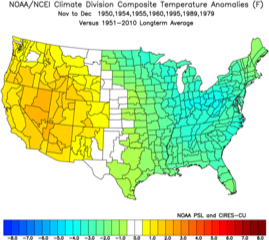
The pattern is changing, and this is where I feel we are headed, temperature-wise, for the next 60 days or so. Look for the Great Lakes and East to get off to a quick start. The West will be fine, too, as warm anomalies at elevations can be overcome. Next time I will start the regional breakdowns…here we go!

“Intermediate Breakthrough – IB” at Alta, Utah
Hello readers, super great comments and questions on my “Secrets for Your Best Ski Season Ever” piece. Also spoke with two readers in follow up. I can sense everyone’s excited for this ski season – me too. Shoot me your thoughts or questions and I’ll reply.
Alta’s Intermediate Breakthrough program help people go from blues to blacks
Previously I mentioned my good friend (60+) who improved bigtime from only four group lessons at Alta, UT last March. Result: his skiing improved from confident “blue” skier to eager “black” skier. In just four lessons. So let’s dig in to what Alta’s program looks like and why it works.
And it’s worth doing even if you’re NOT going to visit Alta. Here’s why: it’s a great template for asking the right questions of any ski school or instructor. As a ski instructor, I LOVE when any skier in a group or private lesson tells me what they want to be able to do better/different.

Source: Alta
Now, back to Alta’s “Intermediate Breakthrough” group lessons. Curious, I reached out to both Alta’s Ski School Director, and to the instructor who led the program my friend had found so helpful. A few key observations:
- They seek decent “blue run” skiers who want to improve.
- They want skiers who will put some thought into their skiing, actively thinking of improvements they’d like to make.
- And, they want skiers to go out and practice the improvements a lot, and talk about what they’re seeing and feeling in their skiing.
I spoke with both Jonathan Doty, the on-snow instructor who led the Intermediate Breakthrough (IB) program, and with Jeremy Moore, Alta Ski School Director, who helped design it. IB consists of one half-day group lesson per week for four consecutive weeks; a total of four group lessons. Talk to your ski buddies and try to pull together 3-4 who could join the lesson; next, talk to ski school and try to schedule a half-day morning lesson for four consecutive Sundays with same instructor.Many Sundays are QUIET at ski schools, so you may have better luck creating a special deal.
Jeremy insisted “the IB program is well-suited for anyone who’s skiing at least easy blue groomed terrain comfortably, and also is willing to put some time and energy into thinking about and hopefully improving their skiing”.

Source: Alta
Best preparation? Here’s Jeremy again, “You don’t have to prepare in any specific way. However, it would potentially help improve your overall experience if you took some time to think and feel your skiing and come up with some concepts of what you like or don’t like about your skiing so you have a baseline to start from with your coach.”
From my friend, I learned that the IB format focuses on several “themes”, specifically one per week. I asked Jeremy to unpack this a bit for me. Jeremy: “The Alf Engen Ski School at Alta is a skills-based ski school, and we help students understand the How/What/Why they are doing with their skis.” He added, “There are only 3 things you can do to your skis: rotate them, pressure them, or tip them on and off their edges”. Sounds like a little, but it’s a lot!
Jonathan expanded on the “theme” focus: “We want skiers to succeed not only with us but on their own. Each week we focus on a specific task they can practice outside of IB lessons, and a theme creates a flow to the lesson where the skills build on each other.”
As an instructor mostly doing private lessons, I know many people are concerned about “being judged” by others, particularly their friends. Jonathan insisted: “This is a common thought, but everyone is putting themselves out there, and are on a personal journey. This is a judgment-free zone!”
Like I wrote last time, whenever we improve our skiing proficiency…we have more fun! Try to create this program at your favorite ski area…or just go to Alta.

Things to Remember when Choosing Alpine Ski Equipment
Source: FreeSkier
SKIS
- The ski shop makes more money renting out or selling higher performance equipment.
- Be honest with yourself – if you don’t ski hard and fast you probably don’t need it.
- Higher performance skis perform worse when not skied hard – they need higher momentum, and more force to get them to work well. Skied slower they can be harder work. Is that what you want?
- It may well have been a year since you last skied – maybe more. You likely won’t ski too hard on days one and two. Try renting an easy, flexible ski first. If you find you ski hard enough to make it “chatter”, you can always change up.

Dizzy of Dizzy’s boot fitting shop at Big White ski resort shows off an early 1970s ski boot that boasted fantastic ski technology that, sadly, was ahead of the boot’s ability to support it. The boots famously would come apart during skiing.
Credit: Yvette Cardozo
BOOTS
- Same rules apply. Boots designed for beginner/early intermediate will be less expensive.
- Priority number one is comfort. Don’t put up with anything less.
- Very few skiers need boots as stiff as the ones they have; or rent. Most skiers are “over-booted” and it holds back their skiing. Plus it’s often painful.
- Start off the vacation with a lower grade boot: it’s easy to exchange them.
- Why do I say this? Because if you cannot forward flex your ankle very readily, your skiing will never be as good as it could be. And you’ll never be as stable.
- When you do-up your boots don’t have the higher buckles too tight.
- When the buckles are done flex your shin forward and hold it there, and only then fasten the unfortunately named “power strap”. It will be somewhat slack until you flex your shin forward. At first you may feel this is a bit “wobbly” – but for heaven’s sake you don’t have your ankles clamped when you move about at home! And it doesn’t make you lose control.
Source: Praxis Skis
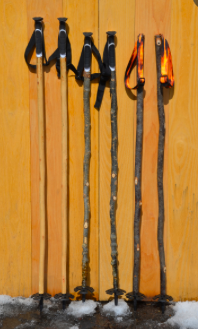
SKI POLES (The ski shop will have a small fit when you tell them this.)
- You want them
- They hate it. They will patiently explain to you as if you were a child that they know what length you need, and will explain how they derive it.
- At this point listen attentively, take the pole they proffer, and then tell them you want a pair like that but 3” (7.5 cms) shorter. Insist on it. They will suggest that if you do, you will die. You won’t.
- Why shorter poles? Because the length ski shops always hand out, makes skiers stand upright and almost lean back every time they do a pole plant.
- Try it – all experiments are worthwhile. You will very quickly prefer the shorter ones because they will help improve your posture. Anyway you can always go back up a length later if you want to – it’s not a lifetime contract.
[authors_page role=contributor]