


A Down-Under Skier Reminisces About His 2019-20 Canadian Road Trip
I was inspired by (SeniorsSkiing.com contributor) Yvette Cardozo and her excellent missives re skiing Canada and the world. Her unique turn of phrase will inspire some to write, but mostly will move others to keep skiing when they can. Those three words, ‘when they can’ are important. COVID has jolted us to the here and now, prompting many to get vaccinated. To those with a needle phobia, I would suggest that a death phobia trumps needle phobia anytime.
Which leads me to think back to the 2021-20 season and this Aussie’s Canadian skiing road trip with three good senior skiing mates brimming with optimistic youthful exuberance.
We set out to tour the snow resorts of central British Columbia…just as reports of the mysterious virus were beginning.

Source: Lake Louise Ski Resort. Image by Philip Forsey
First we skied Nakiska, a family, friendly resort, steep in places and well-resourced with lifts in all the right places (season pass for those 75+ is less than $100). Then we drove to Sunshine and Lake Louise (season pass for 80+ is $20), two of the planet’s most scenic places. In Lake Louise, large ice sculptures adorned the area between the Lake Louise Chateau Fairmont Hotel and the lake. They’re magnificent (hotel and sculptures)!
Skiers are among the many ice sculptures. Source: Lake Louise Tourism
Next, we drove the mighty Trans Canada No.1 to Golden to ski legendary Kicking Horse Mountain Resort (season pass for 75+ is less than $100). It features views that take your breath away and fall lines steep and deep enough to keep it that way. If you go, don’t fail to lunch at Eagle Eye Restaurant for great views and food. If wallet permits, you can arrange for a helicopter to transport you to the super deluxe Eagle Eye Suites, each assigned with a personal butler and the highest accomodations in Canada.
A few days later, we plunged into the unpopulated wilderness of the Western side of the massive Canadian Rockies. Our large rented SUV delivered us to Panorama (season pass for 75+ is $39) our next ski in-ski out accommodation. The resort has plenty of back country double blacks.

Fernie is big!
Following Panorama we drove to Fernie (season pass for 75+ is less than $100), where out friend Pat shared with us his years of skiing advice and his knowledge of Fernie’s more famous watering holes. Fernie is a destination which receives prodigious dumps of dry powder all season. If visiting, be sure to partake of a lager or three, upstairs in the Griz Hotel.
Navigating the pass at Crows Nest, on the border of BC, we were soon back in Alberta on our way to Castle Mountain Ski Resort (season pass for 75+ is $19), a great hill driven by ski enthusiasts; not accountants. My kind of place. Unfortunately, a flu virus prevented me from experiencing what my friends Ray and Allen pegged to be one of the best places skied of the entire trip.

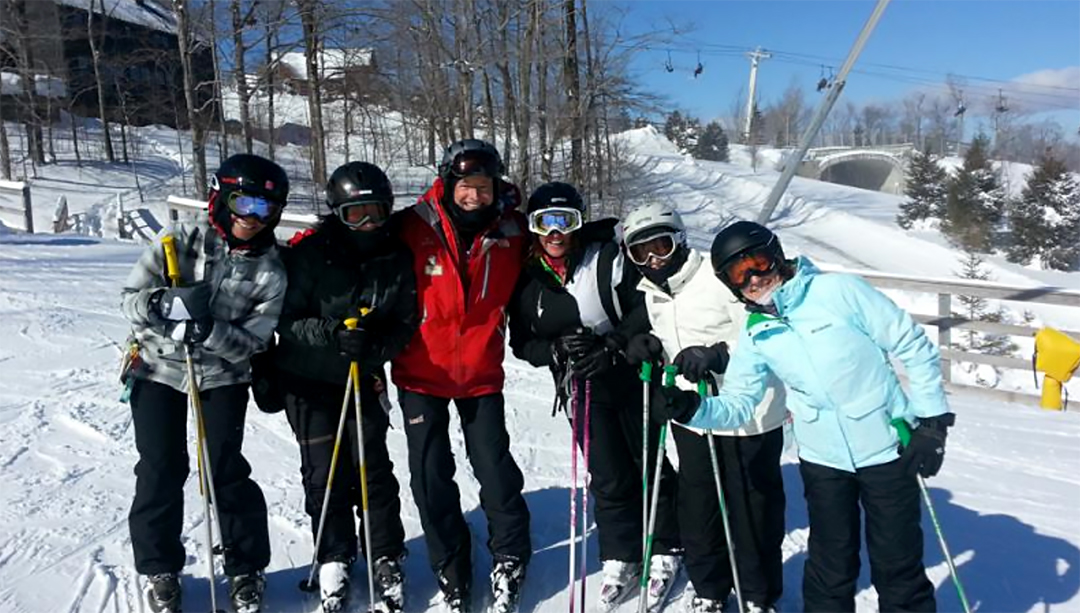
Ski buddies at the start of their journey. Source: Dave Chambers
On this journey, we were mostly constrained to groomed runs because of a lack of fresh snow. Whenever you go, I recommend driving. It’s the best way to indulge in the culture and to experience the human kindness displayed by the Canadian people.

Yellowstone’s Winter Magic

SOURCE: YELLOWSTONE EXPEDITIONS
In 1991, while guiding a small group in Yellowstone National Park, I tried to describe walking outside as the sun rose one February morning near Old Faithful:
“Morning light pours over the hills, reflecting off the frost in a blinding cloud of diamonds. Elk and bison shake snow off their backs, stirring after a long night’s chill. Duck and geese stretch and preen. Billows of geyser steam hover and settle, creating dense, lacy patterns on bowed pine branches. Yellowstone tastes of winter magic.”
Summer and Winter
To me, Yellowstone isn’t a great treat in summer. Yes, the combination of animal and geothermal activity is unique – but this year there were close to three million visitors, June to August. That’s too many vehicles and frowning faces jammed along narrow roads.
Winter is totally different. First, there’s almost no traffic (no bears either, although they may peep out of their dens in January). The only road that’s kept plowed runs east from Mammoth in the northwest to Cooke City, where it dead ends. All other roads are snow-covered and accessible by snowmobile, snowcoach (enclosed and heated tracked vehicles), or on skis or snowshoes.
Yellowstone’s winter is created for superlatives. No other place in the world has such an inspiring combination of wildlife and wild geology. It’s rich in history; has spectacular mountain scenery; and the park’s 2.2 million acres are yours without crowds or pollution.
Getting There
Yellowstone is located in the northwest corner of Wyoming, with little extensions north into Montana and west into Idaho.
To enter the park, you can travel north from Jackson Hole; west from Cody, Wyoming; or east from West Yellowstone, Montana. My favorite (fourth) route is east from Bozeman to Livingston; south through the Paradise Valley; pass through the sleepy town of Gardiner; and drive up to Mammoth Hot Springs, where you can overnight at the venerable Mammoth Hot Springs Hotel, with elk grazing outside the ground floor windows.
Using Mammoth as a base, you can drive toward Cooke City, with a lot of photos stops for wildlife in the Lamar Valley, and then backtrack.
Heading South
From Mammoth you can get to Old Faithful by snowcoach or snowmobile, sight-seeing, skiing, and snowshoeing along the way. Norris Geyser Basin and the jaw-dropping Canyon of the Yellowstone River, with ice-laden and thunderous falls, are natural stops.
The center of the park is a volcanic crater, 40 miles across, with the world’s greatest concentration of geothermal features: geysers and fumaroles, mud pots and hot pools. One of my favorite Yellowstone memories is a morning ski on a snow-covered wooden boardwalk, watching a bison standing above a steam vent, basking in the warm air billowing around his belly.
Snowpack around Mammoth can be thin, but Old Faithful has reliable conditions and all kinds of good trails. You’re guaranteed to see lots of elk and bison, maybe coyotes, possibly wolves.
SOURCE: YELLOWSTONE NATIONAL PARK LODGES
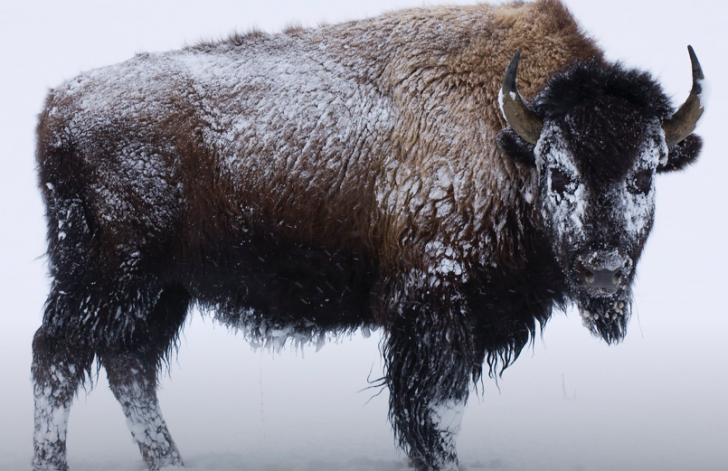
In winter, bison are relatively indifferent to humans, since they’re intent on scarce forage and surviving sometimes bitter cold, but it’s not something to count on. I’ve skied within feet of a bison, on a narrow trail with a cliff to one side and sheer drop on the other. We came around a corner and there they were. We carefully didn’t make eye contact with the cows and calves that plodded toward us, and I could hear muttered prayers from the other skiers (my teeth were chattering too hard to enunciate).
Of all the times I’ve visited Old Faithful, the most indelible and endearing memory isn’t a glorious streamside tour, two feet of light fresh snow, or being mock-charged by a bull elk. It’s the smiles on three kids’ faces as one cold morning they dropped tablets of food coloring in glasses of hot water, ran outside the Snow Lodge, and threw them in the air! It was a cold morning, and the droplets turned into rainbows of frozen mist – blue, red, green – that slowly drifted in the breeze and disappeared. So a half-dozen of us adults did the same thing.
Now, that’s magic.
Resources
The Mammoth Hotel and the Old Faithful Snow Lodge provide Yellowstone’s only winter accommodations and dining other than yurt village/guide service Yellowstone Expeditions (https://yellowstoneexpeditions.com/). They typically open for the season mid-December 20th through early March.
You can book accommodations by contacting Yellowstone National Park Lodges (https://www.yellowstonenationalparklodges.com/). For a snowcoach tour, I’d recommend Yellowstone Alpen Guides in West Yellowstone (https://seeyellowstone.com/), especially if you want skiing or snowshoeing.
Secrets for Your Best Ski Season Ever
Over 11 seasons I’ve probably taught 500-600 kids and adults as a part-time instructor at Stratton/VT & Butternut/MA. “Never-evers”, experts, 4-yr olds to 80-yr olds. Me: flipping through trail names like a deck of cards, choosing the best run for the task at hand and my eager, anxious learner.
Here’s the huge thing I’ve learned:
Anyone can become a better skier, if the skier has both a desire and determination to improve…simply by taking a few ski lessons at the outset of ski season.
Why at the beginning?
Because each season, starting out, we’re all squirming and thinking, trying to put our skiing back together again. So instead of once again reinforcing some of the “bad” habits carried over from last season, you can trade them for one or two new/better ideas that will help you ski with more skill.
But wait, there’s more: any improvement in your skiing proficiency ALWAYS leads to enjoying skiing more! (Shoot me your questions at the end and I’ll reply.)
As an instructor, I’m lucky. In early December we do OUR training. We take refresher lessons with the best instructor “trainers” at our resorts. We’re brushing up on our skills. It helps me a lot. But it took me a while to accept the fact I still needed to be in “learning” mode.
This season try this… either by yourself or with a friend who’s at a similar ability level. Sign up for a private lesson of 2-3 hours on your second day of the season. On the first day, ski around and get a feeling for what’s working and… what’s not. Think about what you’d like to change, what’s confusing or difficult, what you’d like to ask questions about, then write it down. Now you’re ready for that lesson on Day 2. Because now you’re engaged in being an “active learner”. Real progress as a skier doesn’t just “happen” to you. It comes as a result of efforts you make to change what’s not working, in favor of more useful approaches.
I witnessed this approach in action, in Utah, last March. One of my best friends, with whom I’ve skied for 40 years, took a short program of four group lessons at Alta. Called “Intermediate Breakthrough” it seeks skiers who truly desire improvement. My friend wanted to improve, and was ready to do what it took. He explained what he wanted from the lessons, and he worked hard to use the skill tips offered by his instructor.
And he not only improved…he made a quantum leap in his overall skiing proficiency, and in his ability to ski more challenging terrain while enjoying it. It was remarkable to see, and it was the result of only four lessons, but four lessons in which both student and instructor were invested in producing real results. Alta’s “Intermediate Breakthrough” is awesome.
Believe me, you can do it too… It’s totally worth it.
[authors_page role=contributor]