


Test Your Skiing Knowledge
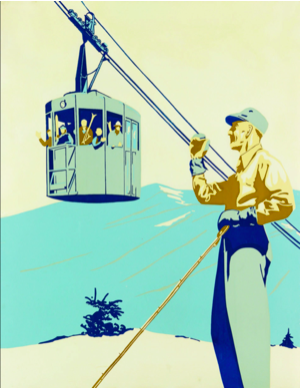
Each issue of SeniorsSkiing.com will have a picture to help you test your skiing knowledge. The pictures are from collections in a variety of participating ski museums, which we encourage you to visit and to support.
This image was submitted by The New England Ski Museum, a non-profit based in New Hampshire with locations at the base of the Cannon Mountain Tramway and in downtown North Conway. In addition to an extensive collection of objects, the museum issues a substantial publication with articles on ski history and content from museum exhibits. More about the museum and its most wonderful shop at www.newenglandskimuseum.org,
The man in the picture is known to each of us but not in the context of skiing. If you can identify him, send me a note (jon@seniorsskiing.com). For the person sending the first correct answer, we’ll purchase a membership in The New England Ski Museum. The correct answer and the name of the winner will appear in the next issue of SeniorsSkiing.com.

Tukino Skifield, Mt Ruapehu, Aotearoa/New Zealand
Tukino Skifield (www.tukino.org) is a Club-operated field (“skifield” is the down-under term for ski slope) on the eastern slopes of Mt Ruapehu (9175 ft/2797 m), a live volcano and the highest mountain on the North Island of New Zealand. It is located within Tongariro National Park, a World Heritage Area, encompassing two other large volcanic cones (Ngauruhoe and Tongariro) plus numerous smaller ones.
The first known and documented skiing on Mt Ruapehu was in July 1913, soon after which the Ruapehu Ski Club was formed, making it one of the oldest outside Europe.
The field is on scoria ash with many boulders, so skiing is rarely possible before the end of June. The core season is usually August-September and the annual snowfall averages about 70”. Tukino, like other nearby skifields, has a mix of green, blue and black terrain.
Tukino’s fixed lift served vertical is 1115’. A portable tow and cat can extend it to almost 2000’, conditions permitting. Neighboring Whakapapa, New Zealand’s largest ski area, has a 2300’ vertical.
Skiing at Tukino is open to the public, but Club members (annual adult membership: $70) enjoy substantial discounts for accommodations and lift-passes. Most maintenance and skifield work is done by volunteers, with a small core of alpine-qualified staff. There are three fully-equipped lodges, each taking up to 32 guests; these are operated by their respective Club owners.
Tukino and the access road are operated and maintained by a coalition of local ski clubs. The upper part of the road requires 4WD.
The Tukino field has two fixed “nutcracker” rope-tows (so-called because the device attached to your tow-belt, used for clamping onto the tow-rope, resembles the traditional implement for opening walnuts etc!) plus a portable rope-tow. Conditions permitting, cat skiing also is available.
Skiing Tukino is a bit old-fashioned and takes some effort (and 4WD) to get there. Staying over requires a sleeping bag and pitching in with meals, cleaning, etc. Accommodation prices at each of the three clubs are reasonable and include meals. The entire area is off-grid, so getting online is possible but challenging. But who needs Internet when conversation and games with other club members and guests make the experience memorable.
Visit club websites for more information on each of the three options: Aorangi Ski Club (www.aorangi.org); Desert Alpine Club (www.desertalpine.club), Tukino Alpine Sports Club (http://tukinoalpinesportsclub.org.nz ).
Photo courtesy of tukino.org
Summarizing Skiing History Magazine’s Sept-Oct 2021 Issue
Skiing History magazine, a project of the International Skiing History Association (ISHA), is published six times a year. Its collection of articles is always interesting. Click on ISHA’s “Take A Run With Us!” advertisement and register for a free digital issue. Better yet, support skiing history and ISHA by becoming a member! Membership is a terrific gift for any older skier.
Skiing History magazine: Sept-Oct 2021
The first fall issue of Skiing History magazine (September-October 2021) kicks off with a spectacular three-part history of skiing music and song by long-time contributor Charlie Sanders. Most of us remember when skiers gathered around the fireplace with guitars and gluhwein in hand, singing along to “Super Skier,” “90 Pounds of Rucksack” and “Two Boards Upon Cold Powder Snow.” Charlie has reconstructed ski-related songs back to the 19th century – and the full-length series, posted on the website skiinghistory.org, contains 200 links to actual musical performances on YouTube.
This issue’s featured athlete is the amazing Olympic freestyle gold medalist Kari Traa. With three medals in four Olympiads, four world championships and four overall World Cup titles, Traa remains the most-decorated mogul skier in history. Today she’s raising kids and running a $70 million athletic-wear company – but has time to compete in formation skydiving events. Our new contributor, widely published sportswriter Aimee Berg, interviewed Traa at length.
For several generations, until aluminum replaced hickory as the choice material for jumping and downhill racing skis, Northland was the world’s premier ski brand. Owner Christian Lund promoted the idea that he founded the company. But the truth is far more complicated. As authors Greg Fangel and Paul Hooge explain, Lund shrewdly took advantage of several factory fires to acquire control of the company, and the market.
Remember when ski instructors yelled at us to “down-UP!” to start each turn? Ron LeMaster reviews the use of up-unweighting in the old Arlberg technique and its de-emphasis in modern skiing. We still use it sometimes in heavy powder.
The Bonne Bell Ski Team didn’t race – they sold cosmetics. Jeff Blumenfeld recounts the story of Jess Bell’s wholesome, athletic skiing glamor girls.
Andreas Wyller was Norway’s first Alpine racing champion. Einar Sunde reviews a new biography, in Norwegian, recounting Wyller’s career in skiing and heroic death as a Royal Air Force pilot.
Plus: The Laurentian Ski Museum finds a new home; the mayhem of the 1964 Bash for Cash race at Aspen Highlands; a Warren Miller classic on shaping up for skiing; and much more!
Want more? Take advantage of the introductory discount on a subscription to Skiing History magazine – see the ad on this page.
[authors_page role=contributor]