


Look Back: Sunday River
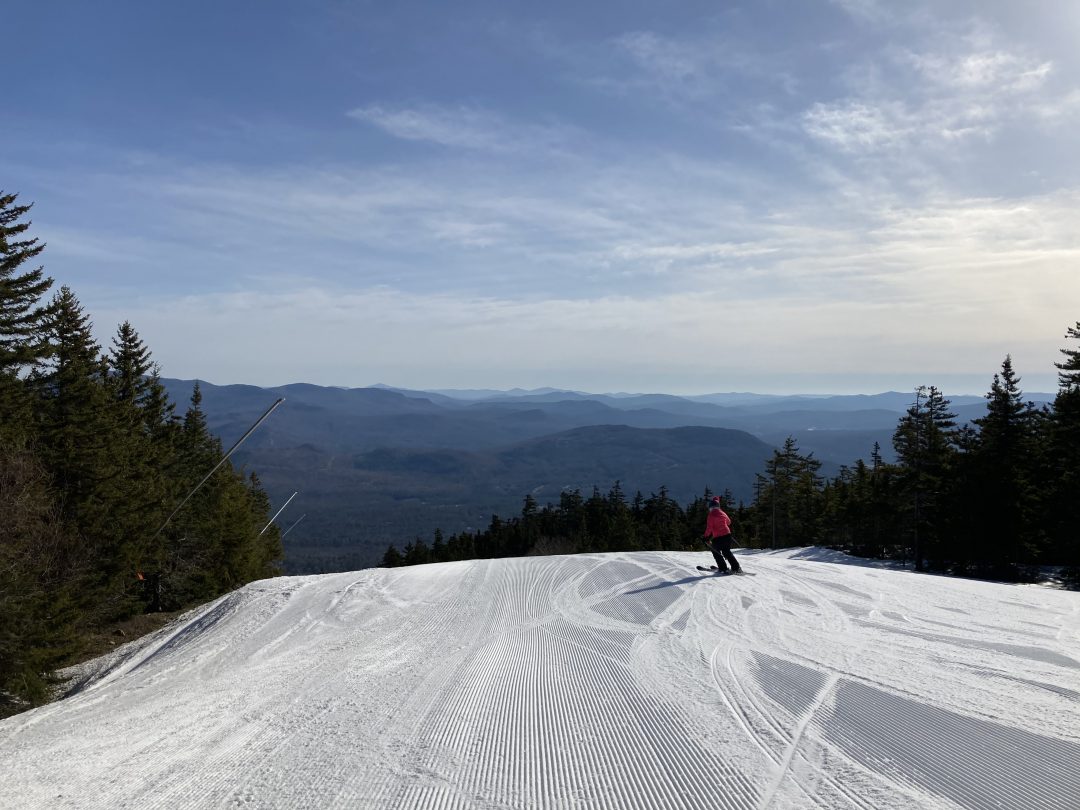
Smooth sailing on Risky Business. Photo by Tamsin Venn.
For the record, early morning skiing was just the best at Sunday River, Maine.
We skied this reliable, late-season spot over Easter weekend with two gorgeous sunny days, happy the travel restrictions into Maine had eased for us at last. Better late than never.

Everyone wore masks. Photo by Tamsin Venn.
Count SR’s season-long commitment to snowmaking (90 percent coverage) as the insurance that makes the late season possible, especially with paltry late-season snowfall. Also, a three-mile-long ridge of eight peaks gives skiers and boarders varied snow conditions at different exposures. You can always find something holding up well. Big vert lets you stay on upper slopes in afternoon to avoid lower-elevation slush. Good grooming helps put things right the next day in New England’s freeze and thaw cycle: 8 a.m. crispy corduroy.
All good.
The crowds were the biggest challenge. At the popular Barker Chair, social distancing was a little ragged, but everyone was wearing masks. People in the lift line were polite, waiting their turn, and no grumbling heard for riding alone. Slopes were busy, but most people knew what they were doing, including the rug rats, probably mostly passholders. (Note to senior self – the later in the season, the safer you are.) The one exception was the young, helmetless dude on the snowboard straight-lining White Heat.
There were a few surprises. We agreed to meet for Easter lunch at the sunny deck at North Peak Lodge, but only the bar was open. So we drank instead and ate chocolate bunnies. One closed trail we wanted to ski suddenly opened. The top of White Heat is nothing but a granite ledge with snow on top of it (you don’t realize that mid-winter). The schlep across a dry parking lot is not so bad.
I checked in with the millennials with me on what they liked at Sunday River and what they hope will be carried over into next year.

On the way over to the next peak. Photo by Tamsin Venn
Increased RFID use and access? Already there. Food trucks? Already had them. Outdoor dining? Great, unless it’s a blizzard. They can’t wait to get back to booting up in the lodge and more places to eat. They plan to renew their Ikon passes.
As for changes going forward, Sunday River says while plans for next year aren’t finalized, it will likely continue to encourage online advanced ticket sales, offer online food ordering at certain eateries, and hopes to expand takeout options.
Kelly Pawlak, President of the National Ski Areas Assn., noted successes that will likely be carried over into next year at most ski areas. Those include advanced ticket sales (ski areas like to know how many skiers will show up); reconfigured indoor spaces that open up space within lodges; increased use of ticket kiosks; outdoor living fixtures like fire pits, chairs, food trucks, outside food windows; and for employees, daily wellness checks, staying home if sick, plus sick pay for seasonal workers.
Summary of the 20-21 ski season? Like many, with the skis now hung up, I was very grateful there was one to begin with, and Sunday River made for a very rewarding finale.
The Year in Review
El Nino, Stay South. La Nina, Go North.
If you haven’t already done so, it’s close to the time when the skis and snowboards get tucked away for summer hibernation. Between Covid-19 restrictions, National Forest leases, and Old Man Winter calling it quits prematurely in much of North America, forces have conspired to end the season for the majority of winter sports enthusiasts. This is my final posting of the season, so I thought I might take a look back at the season that was.
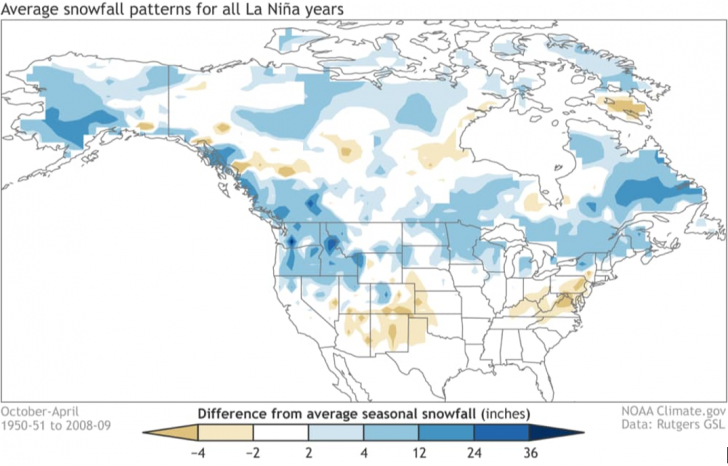
Just as is the case when putting together a winter forecast, a review of the season has to be framed by the state of the Pacific Ocean. That is, were we in the midst of an El Nino, a La Nina, or neutral conditions with respect to the water temperatures in the equatorial regions of the Pacific? The answer is La Nina, because those waters were colder than the long term normal throughout the season. In the summer and fall, I am often asked by friends where the best skiing will be in the coming season. When an El Nino is present, I always tell them to favor the central and southern resorts if they are headed west. Conversely, if it is going to be a La Nina winter, I advise that they stay north of I-70. Why? Well, here is a map of the average winter snowfall for all La Nina years.
It is clear to see that when La Nina conditions are present, the jackpot for snow is typically found in the northern Rockies and Pacific Northwest, including far western Canada. Although the correlation is weaker the farther east you go, due to the extra distance from the warm/cold pools in the Pacific, you can see that generally speaking the Upper Midwest and the northern resorts of New York and New England do pretty well. How did this season work out? Here’s the Top 10 resorts in terms of snowfall, through March 15th (the latest I could find).
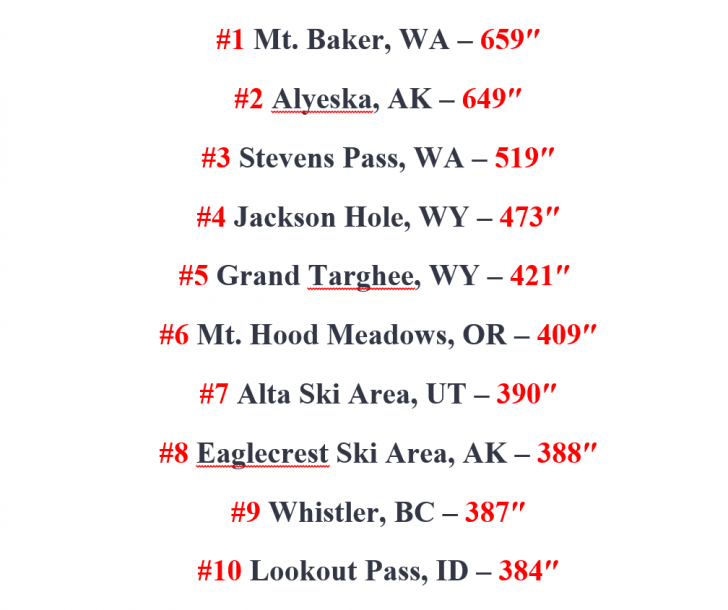
No surprise that all ten are in the West. Only occasionally does a Jay Peak or Sugarloaf push their way onto this list and after a paltry amount of snow in March, there will be no New England “contendahs” this year. Now, notice where 9 of the Top 10 are located…north of Interstate 70! Alta is the only exception, and they are only slightly south of that line of demarcation. Also, Alta’s normal snowfall is close to 550 inches, and I doubt that they will get that extra 200 inches to reach normal snowfall between mid-March and when the lifts stop turning at the top of Cottonwood Canyon. Moral of the story – if it’s a La Nina, stay north of I-70. If it’s El Nino, head to the central and southern resorts.
Elsewhere, the Upper Midwest bucked the La Nina trend with a below normal snowfall season at most resorts. In a more typical La Nina fashion when a southeastern upper ridge brings spells of warmth, the season was more of a struggle at times in the mid-Atlantic and Southeast but these regions had several runs of stellar conditions if your timing was right. The Northeast enjoyed a solid season, with a “Fabulous February,” and then the flakes stopped flying in March.
For those of you who might think on a broader scale, I leave you another way to measure how this season worked out with respect to snowfall. It’s a graph of seasonal snow extent (in square kilometers) from December 1st through February 28th, which constitutes “meteorological winter.”

This winter was better than 5 of the last 6 and 7 of the past 10 and the data trend over the past 50-plus years is positive, contrary to what some folks want you to believe. The models that focus on El Nino/La Nina are hinting that we may be in La Nina again next winter, something to consider as you start to put together your travel plans. Thank you very much for reading my column the past several months. Right now, though, “That’s a wrap!”

Make More Tracks: A Personal Note At The End Of The Season
XC Has Grown In Participation. Hopefully, Make More Tracks Played A Role.
Dawn, Appleton Farms, Ipswich, MA. Credit: NSNA
The Make More Tracks Resource Guide and series of articles in each issues since October was conceived to provide readers of SeniorsSkiing.com with information to expand their options in the winter of the pandemic. It was intended to provide info and perspectives about mostly XC skiing.
As someone who dreamed about skiing as a little suburban boy and has skied since high school, I’ve found that mixing my snow sports is a great idea for my body and mind. It appears on first look that XC skiing is “too much work” compared to riding the lift and pointing down to let gravity take the effort. The fact is that XC skiing can be done at any individual’s pace that is comfortable. You can avoid the uphill trails, you can ski for as long as you like, you can rent equipment at a XC ski area where the trails are groomed, tracked and maintained regularly, and you have many other options with XC skiing. The physical, psychological, and spiritual wellness association with XC skiing are simply undeniable.

Snowy day in the Lincoln Woods.
The folks who produce SeniorsSkiing.com felt that the pandemic would impact the alpine skiing experience. Even though the vast majority of readers of SeniorsSkiing are not into XC skiing, it was assumed that perhaps this would be the year that alpine skiers would consider trying it. The statistics at the national Cross Country Ski Areas Association tell us that all the XC ski areas saw many alpine skiers trying XC skiing this year. We hope that Make More Tracks played a part for SeniorsSkiing.com readers to decide to try XC and that they had a new and meaningful experience, one that will continue for years to come.
As the SeniorsSkiing.com Cross Country Ski and Snowshoe Editor, I want to thank Mike Maginn, Jon Weisberg, and Jonathan Wiesel for their wisdom and roles in producing the Make More Tracks Resource Guide and article series for the readers of SeniorsSkiing.com.
So, next winter on a sunny day in the high teens or low twenties, consider dressing lightly, visiting a XC ski area and go experience natural outdoors on XC skis. You’ll be glad that you did!
Editor Note: Visit Roger’s XCSkiResorts.com to learn where you can stay and XC ski in delightful inns and lodges across the US.
[authors_page role=contributor]