


Ski Japan: Happy Appi Kogen
Untracked Deep Powder For A Week.

Appi Kogen is a self-contained resort in northern Honshu.
Casting aside the duvet and, with a flourish, we spread the curtains wide to greet a new day, a new location, a place of considerable legend.
Here the tall Japanese Black Pines punctuate the landscape between the tall buildings of our hotel in this place almost three quarters of the way up the island of Honshu.

Appi Kogen is one of Japan’s best ski resorts. The resort’s tagline: “Be Happy in Appi”, of course.
We have arrived by road to Appi Kogen, almost taking a whole day to do so. This road trip was tedious, attributed to a slow traffic jam and, paradoxically, the most exciting bus trip we could ever conceive. Our bus driver, growing weary and ever more frustrated by the constant traffic jam, decided a different route was needed. The existence of a little used forest track was discovered—a forest track at times covered in deep virgin powder snow.
Our driver revealed quite a level of skill when required to navigate slippery and often poorly delineated tracks through the forest. Our driver and his co-driver were engaged in constant discussion as to how to proceed when fast acceleration was required. It was best alpine driving we are ever likely to witness. Although I well remember being in a taxi going up a hill from St. Anton to Lech in Austria where our driver exclaimed in strong language his scorn for the slippery steep slope and the driver of a Mercedes that halted his progress. Then, sliding backwards down a considerable slope completely at ease with his dilemma, he just reversed to a lower slope where he could gain some traction and move forward back up the steep narrow slope.
Back to Japan. Our trip, a long, long ten-hour drive by bus, one we hired at Lodge Scolé at Zao Onsen Ski Resort to take us to Appi Kogen. Zao was a place of big tree runs and Snow Monsters. Traveling plans were adjusted for what we thought would be just a four-hour trip up the main island of Honshu.
A huge snowstorm of cold air from across the Sea of Japan unloaded across the north. Our movement down the road now so slow at one point we left the bus to obey a nature call at a rest stop. We visited said rest stop and purchased takeaway lunch before returning to find the bus only 80 meters further down the road.
Appi Kogen is not far from the East Coast where those winter winds suck up the moisture from Sea of Japan and dump when they hit the land mass around Appi. Indeed this is often the case along the whole coastline particularly in the North where we are now.
It is another skiing day, a day not quite like we have experienced before above the snow line. Although I recall a day in Lech where we skied in snow so deep the only reveal of me deep in this fine dry powder is the top of my ski helmet.
Appi Kogen is very similar to this as is much of Japan in winter where it will often snow down to the beach and cover the sand.

Light fog at the top of the gondola leads to fields of deep powder.
After a couple of runs down medium steep slopes on the front side, we decide to venture as far out as we can to the most outer edge of the ski resort. We are at the topmost point on a black run now with powder so deep and almost un-skied, the day still early. We set an easy pace to get some rhythm in to our legs and balance in the fine powder. The visibility is ok but a little foggy. Japan is like this in winter because the cold is only -2 C (28 F) or at most -8 C (18 F), this knowledge gathered over many previous visits.
As we proceed down the slope, it is obvious the area has not been skied today or even possibly this last week. The slope is lined with trees mostly beech, so definition of the journey down is easy in the slight fog. As we near the end of this trail, the skiing gets flatter and, after 900 meters, we arrive at the gondola. It will surprise you to discover we skied all day down that one slope in fresh powder. Would you be further surprised to learn we skied that same slope for a whole week with no change to the perfect powder? Well, it amazed us to discover that many Japanese don’t like ungroomed snow. When you learn to ski in Australia. the quality of snow is mostly hard pack ice. There, the day temperature around -1C (30 F) to 1C (34 F) and then freezing overnight: result, ice. So we are very lucky in Oz if we ever experience powder. At Appi Kogen, we have never experienced such perfect conditions for skiing for one whole week .
Be adventurous if you dare. Take a trip soon you will find the country very rewarding in so many ways.

Appi K: 70 percent of runs are intermediate or “easy”.

Trailside Porcupine Becomes A Celebrity
That’s one sharp porcupine. Credit: Laurie O’Connor
Skiers nimbly dodged a porcupine as he wallowed through deep snow to cross Alta’s ski slope. Some stopped to watch the prickly fellow tumble into a tree well and then start to climb. That’s all there was to see. The show was over. He was as prickly as the evergreen so his camouflage was perfect. He virtually disappeared.
But porcupine puns spiked when someone asked: “Why did the porcupine cross the trail?”
“He was looking for love,” said one.
“There was no point to staying where he was,” said another.
And the jokes continued …
“Something was needling him.”
“Because he didn’t want anybody to get stuck waiting for him.”
“He pined for a different tree.”
“Needle-less to say, to get to the other side.”
“His friends kept calling him slow-poke.”
“Where there’s a quill there’s a way.”
Most rodents don’t get such laughable attention. Do you have a porcupine pun to add?
Looking down from a chairlift, porcupine tracks are easy to identify. Tracks look like they were made by a tiny snowboard. Porcupines can weigh 12–35 pounds, and their quills detach easily if touched. They’re the third largest rodent in the world after the beaver and South America’s capybara. Porcupines crave salt, and when we lived in New England they were known to eat outhouse toilet seats for traces of salt left by human bottoms. And to get road salt they’d chew the tires off hikers’ cars parked overnight at remote trailheads.

This Week In SeniorsSkiing.com (March 5)
Looking Ahead, First Timers Tips For Europe, Personal Risk Test, Midwest Nordic Centers, DV/PCR Visits, Brunvand’s Journey, L2A Top-Bottom, Tune Up Kit, Okemo Founders, Harriet’s First Time, Emily And March.

Outdoor author Patrick McManus said: “God invented March in case eternity proved to be too brief.”
March, the elongated month, stretching from the cold of February to the sunshine of April. March, do you know what you are doing to us? You are driving us crazy. First, snow, then, nothing, then warm rain, then snow. March is the transition month, the signal that the year is changing, moving from one state of being to the next.
Behind is the COVID year with all its unusualness. Ahead is the change. It appears the virus and all the aberrations it brings MAY be receding, and, like the month of March, may be transitioning, too. One can certainly hope.
And if the virus morphs to a more benign level of threat, be prepared for a really big change, an explosion of demand for all things forbidden in the last year. People are rabid to get back to whatever degree of normalcy makes sense.
Example: In Ipswich, the picturesque little town down the road, a new bakery shop announced it would be opening in an historic building near the town green. The “soft opening” would be on Friday last week, testing their equipment, procedures, recipes, etc. The local news carried the announcement. People were lined up for coffee, bread, pastries well before the doors would open for the first time, standing out in the chilly morning, lined up way up the hill for something different. Lots and lots of people who wanted a taste not only of pain au chocolat, but “normalcy”. Call it by the familiar cliche: Pent Up Demand.
We believe that if normalcy or a facsimile comes in the fall, then now is the time to think about your plans for next season. What have you always wanted to do that you feel you must do in the upcoming year? Time is marching on, dear readers. Think big and broadly about next season’s adventures.
Season pass, sure, but no big deal. Trip out West, yes, definitely. But, if you want to put a real exclamation point on your COVID year, consider a ski trip to Europe.

Kirchburg: €€ and just down the road from Kitzbuehel
If you’ve always wanted to ski in Europe, now is the time to think about where and how. You can go on a group trip with our advertisers—the 70+ Ski Club, AlpSkiTour, or Inspired Italy—or or you can venture forth yourself. If you’ve never been, you are presented with a dizzying array of questions: How do all those interconnected areas work? Will I need a guide? What’s crowded and when? What resorts are expensive? Touristy? Weather?
You can start your research with Bob Trueman’s article this week. A long time ski coach, Bob is UK-based and knows the resorts in Continental Europe quite well. He offers some tips for first timers as well as sharing some of his favorite spots.
Time to spin some plans. Or fantasies. Regardless, March is the time to shift out of our status quo. Let’s hope.
________________________________________
Thank you, dear readers, for your generous support of SeniorsSkiing.com. We are humbled and gratified by your response. We plan to start mailing out premiums at the end of March or beginning of April. Please be patient.
________________________________________
This Week

Jan, Judy, Erk, 1962.
Our Question For You asks what side of the risk spectrum you would place yourself? Are you a fast-and-furious hucker? A sedate blue carver? It will be interesting to see where are readers are along the continuum between those poles. Click here.
Finally, we focus on the Midwest. Reader have rightly criticized us for not promoting Midwestern skiing. Here’s an attempt to correct that: a compilation of the top Nordic resorts in the Midwest, part of our ongoing Make More Tracks series. Click here.
Contributor Pat McCloskey reports on a recent trip to Deer Valley and Park City. He tells us the true skinny of what it’s like to ski at big destination resorts this crazy winter. Click here.
Jan Brunvand continues his narrative of his ski life, this time, describing what happened when he returned from his Fulbright in Norway in the mid-50s. Click here.
How are your quads? Do you think you can make a non-stop run from the top of Les Deux Alpes down to the village (about one mile vertical)? Here is a video of someone who did. Click here.
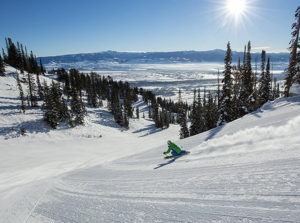
Or is this you?
Correspondent Karen Lorentz offers another profile of entrepreneurial ski resort founders, this time, the Mueller family, who bought Okemo in the early 80s and built it up, expanded, and attracted many new visitors. Click here.
The ever practical Marc Liebman shows us what is in his ski tune up kit. He takes ski tuning very seriously. Do you? Should you? Click here.
Long time correspondent Harriet Wallis offers a memory of how she learned skiing. Trust us, she’s just as fiesty now. Click here.
Skiing Weatherman Herb Stevens sees a storm coming to the Northeast soon. March madness, indeed. Find out when. Click here.
Finally, our Snow In Literature series brings you a poem from Emily Dickinson about her visiting friend, you guessed it, the month of March. Click here.
Tell your friends about SeniorsSkiing.com. Remember, there are more of us every day, and we aren’t going away.

Sunburst Six as it approaches the summit. Credit: Okemo Resort
[authors_page role=contributor]